Showing posts with label superfund. Show all posts

Friday, May 2, 2025

U.S. Sues Vermont, Other States Over Climate Laws

Donald Trump had her minion, AG Pam Bondi sue 
four states, including Vermont, to try and strike
down their climate laws. 
 As widely expected, the U.S. Justice Department, if you can call it that now, has sued Vermont over its climate "superfund" law.  

Vermont was one of four states targeted in this lawsuit. New York's climate "superfund" law, which is similar to Vermont's is also under the gun. 

The DOJ also filed lawsuits against Hawaii and Michigan over their plans for legal action against fossil fuel companies for harms created by climate change, as the Associated Press reported. 

These DOJ actions were widely expected

Back in April. Donald Trump issued an executive order targeting, among other things, Vermont's climate superfund law, saying the law "extorts" energy producers. The order directed U.S. Attorney General Pamela Bondi to investigate going after Vermont and other states with similar laws.

Bondi has clearly followed orders. 

"These burdensome and ideologically motivated laws and lawsuits threaten American energy independence and our country's economic and national security," Bondi bleated in a written statement. Bondi said she's trying to stop "these illegitimate impediments to the product of affordable, reliable energy that Americans deserve."

Vermont officials haven't officially reacted much to the DOJ lawsuit, at least not yet. The AP reports  Vermont Attorney General Charity Clark is looking forward to representing Vermont in this case. Gove Phil Scott had not immediately responded to a request for comment at the time of the AP inquired. 

Other Vermonters were more combative. 

"The fact that it has gotten the attention of the White House in my mind tells me we're doing something right right now, because just from what were seeing from the Trump administration, it tells me this is an important law that other states should follow suit on," Vermont State Sen. Anne Watson D/P -Washington County told WCAX.

As has so often happened with Trump executive orders, and his efforts to dictatorially bend people to his will, Bondi's announcement will just add to the huge and growing pile of expensive lawsuits Trump has inspired against him.

The fossil fuel industry was already in litigation against Vermont's law, so this just duplicates efforts. Sure, having the added weight of Trump (literally and figuratively) behind them might help the fossil fuel industry. 

But I do want to hope against hope that this plays out fairly in the courts. 

If, under the Constitution or existing federal law that Vermont's climate superfund is genuinely illegal, then fine, we'll know.

Vermonters tend to be fine with the rule of law, but they're not OK with bullies. Vermont on its own of course can't defeat Trump's efforts.  But he's pretty unwise to mess with this Brave Little State


Monday, April 21, 2025

Trump Executive Order Targets Vermont "Climate Superfund" Law

One of Donald Trump's zillions of executive orders 
specifically targets "climate superfund" laws in
Vermont and New York, but whether the order has
any legal teeth is entirely another question. 
To nobody's surprise and to lots of eye rolling in Vermont, Donald Trump released an executive order targeting the state's climate superfund law.  

Trump says the law "extorts" energy producers. 

The law would work much like the federal Superfund law that's been around for decades. 

Under the Vermont climate superfund law, a company that produces large amounts of carbon dioxide would have to pay a share of what climate change has cost Vermont, based on how much the company contributed to global emissions during the same period

Not long after Vermont adopted its climate superfund law, New York followed suit with a similar law. Trump's executive order takes aim at both states.

Trump's characteristically whiny order states:

"New York, for example, a 'climate change' extortion law that seeks to retroactively impose billions in fines (erroneously labelled 'compensatory payments') on traditional energy producers for their purported past contributions to greenhouse gas emissions not only in New York but also anywhere in the United States and the world.

Vermont similarly extorts energy producers for alleged past contributions to greenhouse gas emissions anywhere in the United States or the globe."

That's not quite right because the laws do take into account the targeted companies' overall emissions, the laws only seek to receive compensation for the expense of climate change in those states. 

The executive  order is not just about New York and Vermont and their climate superfund laws. 

Per Vermont Public: 

"The document broadly seeks to restrict states' abilities to set local energy policy, particularly policies that support climate action or renewables like solar and wind, or that impeded the development of new domestic energy sources."

With his executive order, Trump is sticking his nose into something that is already being litigated through the courts. 

The fossil fuel industry is already suing Vermont and New York regarding this law. In a normal world, without Trump, this would be litigated through the courts to determine whether these climate superfund laws are constitutional or not. 

But that's not the world we live in now. King Trump, or so he thinks can just wave his magic orange wand and everybody will just bend to his will.

Until they don't. 

Vermont Attorney General Charity Clark, of one, is unimpressed. 

She told Vermont Public that Trump's order has no legal teeth and as no bearing on Vermont's enforcement of its own laws.

"The president has a lot of power; he does not have the extent of the power  he wishes he had, which is why we see all these executive order that say a lot of words but don't actually do anything.....And this is another one of those examples."

Clark felt compelled to offer this basic elementary school civics lesson to Trump:

"Congress passes the laws. The executive branch, the president, carries out the instructions of Congress, and it's the courts that get to interpret the laws."

There are legitimate legal questions about the Climate Superfund laws, such as whether it interferes with interstate commerce.  The fossil fuel industry also questions whether companies should be held responsible for the actions of society at large. 

Under the executive order, U.S. Attorney General Pam Bondi has about two months to simple a report and recommend actions to prevent states from engaging in climate policy she deems illegal.

Again, that's really up to the courts and not Bondi or Trump to decide. We hope. But there will be court appeals, no matter what happens. 

The fossil fuel industry is not just relying on the courts.  It appears that Trump's executive order has to do with a meeting oil executive had with Trump earlier this year. In that meeting, they asked Trump for help in fighting the Vermont and New York climate superfund laws, as the Washington Post reported in March. 

Apparently, the oil executives got what they wanted.    

Friday, January 3, 2025

New York Takes Vermont's Lead, Establishes Climate "Superfund" Law

Following Vermont's lead from last year, New York
Gov. Kathy Hochul signed legislation creating a
"climate superfund" to force fossil fuel polluters
 to help pay for climate related damages in the state.
 Vermont lawmakers made waves last spring when the state adopted a law that requires fossil fuel companies and other big polluters to pay for climate related damage all those emissions have and will cause the state. 

The law faces an uncertain future because, as you might imagine the fossil fuel companies are not happy with this idea and will sue. 

But other states have taken a keen interest in Vermont's law, and it's starting to snowball. New York Gov. Kathy Hochul signed into law a bill similar to Vermont's earlier this month. 

Per the Washington Post: 

"The bill...... would allow the state to fine the biggest greenhouse gas emitters a total of $75 billion, to be paid over 25 years into a fund based on their contributions to overall emissions between 2000 and 2018.

That money would be used to pay for the damage already done to homes, roads and bridges - and help cover the cost of preparing for increasingly extreme weather in the years come."

Fossil fuel lobbyists reacted to the New York legislation pretty much the same way they did when Vermont passed their own climate superfund law.  WaPo again:

"New York's law is almost certain to face legal challenges. The American Petroleum Institute, the oil and gas industry's powerful lobbying group, sent state lawmakers a memo in 2023 saying the proposed bill was unconstitutional. A could would probably strike it down, the group did, because it was preempted by federal law and sought to hold companies responsible for the actions of society at large."

Plus, there's the ever-present problem of the incoming Trump administration. Sigh. 

I think this type of law has merit, but buckle up for a long, long legal fight over this. 


California, Maryland and Massachusetts have been considering similar laws, but so far no climate superfund bill has made it to the governors desk in any of those states. 


Sunday, June 2, 2024

History Made: Vermont Now First State To Hold Fossil Fuel Companies Liable For Climate Change

Vermont just enacted a first in the nation climate superfund
law, which bills fossil fuel companies for climate
related disasters and costs, like last July's severe
flooding across the Green Mountain State. 
 The "Climate Superfund" idea in Vermont we've been watching is now a done deal, making us the first state to hold fossil fuel giants accountable for effects of climate change. 

Basically, what Vermont has now enacted is a make fossil fuel and other industries pay up for climate related disasters that have cost us big money. 

Republican Gov. Phil Scott had threatened to veto the measure, but instead last week, he just didn't sign it, meaning it went into law.

In Vermont, if a governor doesn't sign a bill instead of signing or vetoing it, that just signals the governor's relative displeasure or ambivalence about a proposal. 

As the Associated Press reports:

".....he is very concerned about the costs and outcome of the small state taking on 'Big Oil' alone in what will likely be a grueling legal fight. But he acknowledged that he understands something has to be done to address the toll of climate change.

'I understand the desire to seek funding to mitigate the effects of climate change that has hurt our state in so many ways,' Scott, a moderate Republican in the largely blue state of Vermont, wrote in a letter to lawmakers."

Still, give Scott credit.  He's probably one of the few Republicans anywhere who isn't have a screaming fit about annoying those poor little fossil fuel companies, most of whom have been making record profits later. 

That's one of the reasons the Vermont legislature went this route. They smelled blood. Of course the much bigger reason Montpelier took this step is because that city - and much of the rest of Vermont - was inundated last summer by some of the worst flooding in the state's history.   

Floods and other climate extremes have been becoming more common in Vermont with climate change. That, of course follows global trends as the world's climate continues to go off the rails.  

One piece of the legislation that appeased Scott a little was a provision in the law that the Vermont Agency of Natural Resources just report back to the Legislature on the feasibility of the effort, the AP reports. 

I'll be really interested to see how the state calculates the financial effects of climate change in Vermont and who is to blame. Here's a rundown of how that will work, as the AP describes it:

"Under the legislation, the Vermont state treasurer, in consultation with the Agency of Natural Resources, would provide a report by Jan, 15, 2026 ton the total coset to Vermonters and the state from the emission of greenhouse gases from Jan. 1, 1995 to Dec. 31, 2024 

The assessment would look at the effects on public health, natural resources, agriculture, economic development, housing and other areas. The state would use federal data to determine the amount of covered greenhouse gas emissions attributed to a fossil fuel company."

Sounds really complicated, but Vermont State Treasurer Mike Pieciak said he is up to the task.  A state treasurer ought to be good at math, but Pieciak better be a genius at it. 

I don't know all the mechanisms of this plan.  Like, how do you pick out which part of a disaster was "caused" by climate change and what part might have happened anyway?  After all, in general, climate change often is not causing weather extremes. It's just making them even more extreme than they otherwise would be. 

Litigation over this is inevitable.  Predictably, the fossil fuel industry is not amused by all this stuff going on with those crazy Vermonters. 

The American Petroleum Institute sniffed that the Vermont law "retroactively imposes costs and liability on prior activities that were legal, violates equal protection and due process rights by holding companies responsible for the actions of society at large, and is preempted by federal law."

Before you say the American Petroleum Institute has a slam dunk case, remember, selling cigarettes is and always was legal in the U.S. Yet, laws went after tobacco companies for the harm their products caused. 

I get it they're not exactly the same thing, but the model might just work. 

Anyway, the American Petroleum Institute also informs us that the Vermonters behind this proposal and law are un-American heathens bent on destroying the United States. "This punitive new fee represents yet another step in a coordinated campaign to undermine America's energy advantage and the economic and national security benefits it provides," said an API spokesman. 

Huh.

You can definitely accuse the Vermont Legislature of being liberal, and it's fair to disagree with some or even all that they do. But I haven't seen in the news any of our fine lawmakers saying the want to destroy America and our way of life.

Maybe I missed the fine print or something. 

There's going to be a lot of fighting and twists and turns over this, and some lawyers are probably going to make a lot of money either supporting or fighting this climate superfund idea.

They main thing to watch is whether Vermont started a whole movement much bigger than the taming of the cigarette companies over the decades. Or will this be a flash in the pan. I'm betting against the flash in the pan scenario, since other states are considering following Vermont's lead.

This is not just entertainment, folks.  This is a big deal, if only because climate change is the ultimate big deal. 


Wednesday, May 8, 2024

Vermont House Passes Superfund" Law, Could Become First In Nation

Vermont is now close to becoming the first state in the
nation to establish a climate "Superfund" law that would
demand money from oil giants to pay for climate-
related disasters, like last summer's flooding.
 Back on January 31, I told you about legislation in Vermont that would create a "Superfund" to pay for recovering from climate-related disasters in the Green Mountain State.  

The money would come from large firms like oil producers and others who emit or at least cause to emit huge amounts of greenhouse gases.

This week, the Vermont House was approved in Montpelier by a veto-proof majority.   It now goes to the Vermont Senate for a final review before landing on Gov Phil Scott's desk.

As Vermont Public reports, Scott has vowed to veto the bill, saying he's worried about the cost to taking Big Oil to court and how long it would take to pry money out of these corporations to pay for this Superfund thing.  

A few Republican legislators are also opposed to the proposal, saying we are all complicit, really. Did you drive to work this morning? Unless you have an EV, you emitted greenhouse gases purchased from Big Oil. 

A two-thirds vote in both the Senate and House would be needed to override the veto. The House vote this week is veto-proof if pretty much everybody there votes the same as they did this week after the potential veto. We'll have to see what the Senate does. The Senate did pass the preliminary version of the bill in March by a 26-3 vote. That's veto-proof if history repeats, which seems likely. 

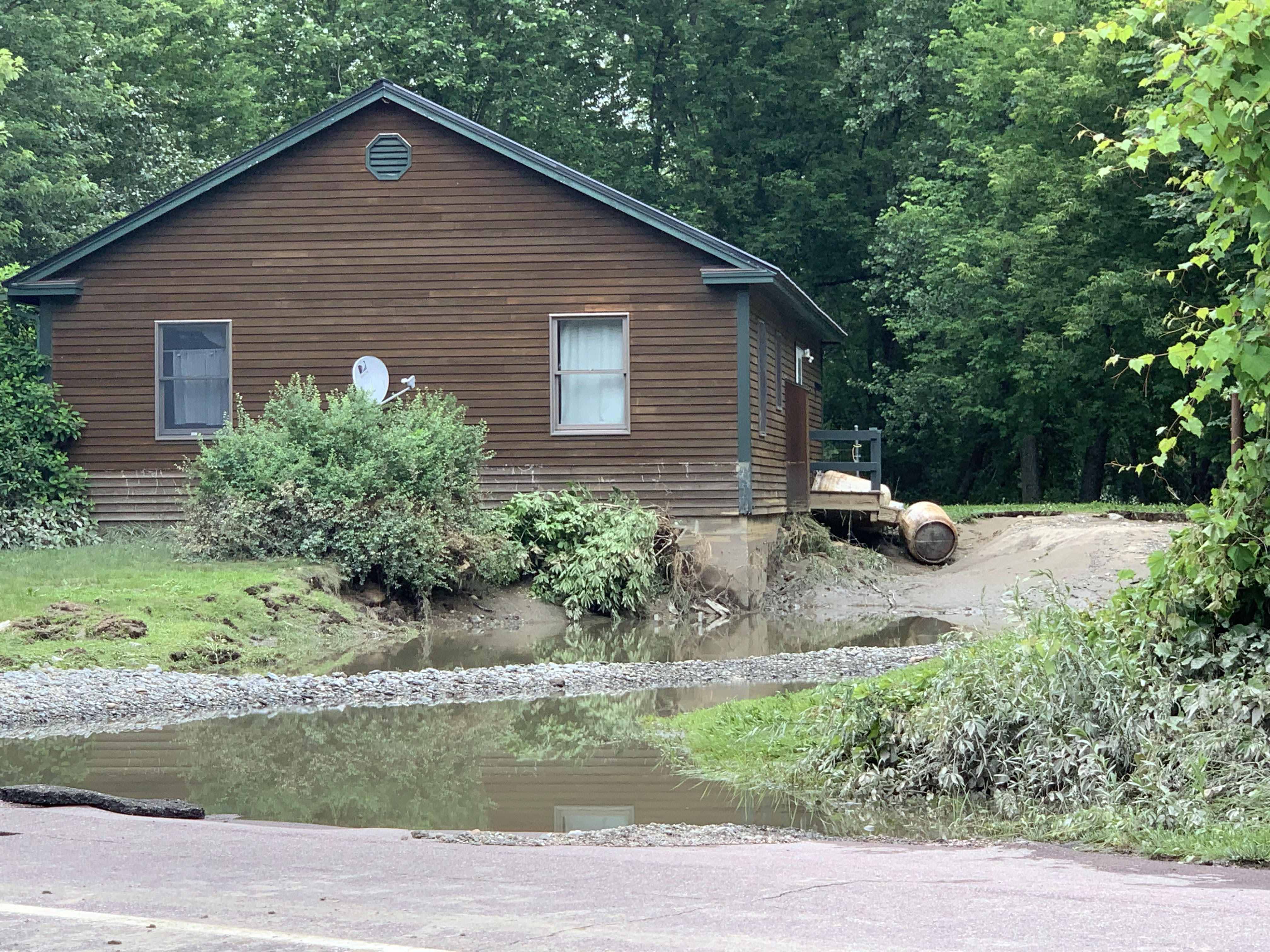
There's no question that disasters made worse by climate change are costing Vermonters big bucks. Last summer's flooding is thought to have caused more than $1 billion in damage. Some people are still displaced from their homes because of that event. 

Other events in the past year, like another big flood in December and twin, powerful wind storms in January, added to the toll on Vermont. 

Meanwhile, most of the largest oil companies in the world raked in record profits over the past few years. 

Proponents of the climate Superfund want a piece of that pie to pay for bolstering ourselves against future climate disasters and paying for ones we've already had. 

If enacted, Vermont would become the first state to enact this type of law. Because we are first, climate activists are watching this whole thing closely.  They hope it opens the floodgates for more such laws elsewhere. Already, other states like California, Maryland, Massachusetts and New York are considering similar bills.   

We're getting close to the end of the Vermont legislative session for this year, so the final denouement is coming on this soon. 

So, watch this space for an update on whether this gets enacted or not.  

Wednesday, January 31, 2024

A Vermont "Superfund" For Climate Disasters?

A Cambridge, Vermont home damaged by flooding last
July.  Vermont lawmakers have introduced legislation
to create a "climate superfund" to help with climate
related disasters. The money would come from 
fossil fuel businesses, who would surely sue
if this law is enacted. Lawmakers say they
are confident the bill will withstand court scrutiny.
If Vermont is a supposed refuge of sorts from climate change, why are disasters caused by this phenomenon costing us so much?"  

More importantly what are we going to do about that cost?   

The Vermont Legislature is among those asking those questions. And they have another question: Who should pay? 

Here's what VTDigger reports:

"A slew of state lawmakers - 20 out of 30 senators and 87 out of 150 representatives - are invoking a precept from kindergarten. The person who made the mess should clean it up."

The Vermont legislature is looking at you, fossil fuel industry. 

SUPERFUND

The legislations really isn't that much different from the federal pollution Superfund idea that's been running for decades. Big businesses that create hazardous waste pay for pollution cleanup. 

The climate superfund idea means we now have two companion bills, one in the Vermont House the other in the Senate, that would establish a climate change "superfund." 

Vermont Public explains how this would work:

"Companies that produced more than 1 billion metric tons of carbon dioxide equivalent between 2000 and 2019 would have to pay a share of what climate change has cost Vermont, based on how much the company contributed to global emissions during the same period." 

Environmental groups in the state have been lobbying for this sort of thing and are happy the bills have been introduced. 

There's no doubt climate change is already costing a lot of money. The big flood in July - very likely supercharged by a warming world - will end up costing Vermonters more than $1 billion, notes Vermont Public. 

Vermont Public also reminds us that a 2021 University of Vermont study estimated climate change fuels flooding in just the Lake Champlain basin could end up costing $5 billion by the end of this century.

Never mind flooding elsewhere in the state, larger storms, more wind damage, searing heat and other hazards brought on by a changing climate. 

But how much money should Vermont collect and how do we do the accounting?

The answer in the legislation is somebody will have to do some detailed and accurate accounting of the damage in Vermont due to climate change. The legislation says that somebody is Vermont State Treasurer Mike Pieciak, and the would  have to get that accounting done by 2025. 

Pieciak told Vermont Public he's excited about the task and he thinks he and his staff can gather an accounting of damages in the Green Mountain State due to climate change.  Pieciak says he expects the accounting to be airtight and able to withstand litigation.

It'll have to. 

The legislation might be a great idea, but good luck collecting the money. 

 More from VTDigger: 

"The idea is to target companies that produced fossil fuels between the start of 2000 and the end of 2019 resulting in the emission of at least one billion metric tons of greenhouse gasses. Each of those companies would be held liable for its proportion of the cost of those emissions to the state. The 'cost recovery' payments would go into the 'climate superfund' earmarked for infrastructure projects that help Vermont adapt to climate change."

Awesome! 

But it's not like the fossil fuel industry is going to start enthusiastically writing checks to the State of Vermont.

First of all, VTDigger says Vermont's governor, Phil Scott, isn't sure he's on board with this. The Republican is rather pro-business, so this idea might give him pause.

On the other hand, Scott isn't exactly enthusiastic about relying on taxpayers to fund recovery from climate disasters. He says (reasonably enough) that Vermonter are taxed enough. 

No doubt Scott is aware of this little tidbit from VTDigger: 

 "According to the ominously-named Vermont Atlas of Disaster report, the Green Mountain State ranks fifth in the nation for per-capita spending on climate disasters. And conversations among lawmakers this year make clear that Vermont taxpayers don't have much more to give."

Let's say Scott decides to sign the bill, or he vetoes it but the legislature overrides the veto. Then what?

I guarantee the businesses Vermont targets for payments would sue.  However, at least some Vermont Legislators are cautiously optimistic.

VTDigger again: 

"Rep. Martin LaLonde, D-South Burlington, who is a lawyer himself, said lawmakers 'can't judge, in the end, whether this is going to make it all the way through the court cases." Still, he said lawmakers have worked with the Vermont Attorney General's Office and legislative counsel, 'and we're all confident that we have a very good case to make.'"

Well, maybe in the lower courts. 

But I see this sort of thing making it all the way to the U.S. Supreme Court. The current makeup of that court is probably the most right wing in memory, so they won't go for it.  

Still, I have to give lawmakers credit for trying.  It's time, anyway, to keep pushing for solutions rather than just giving up. Even if the U.S. Supreme Court does prove unsympathetic. 

Meanwhile, U.S. Sen. Bernie Sanders introduced a climate superfund bill at the federal level which would act much like the Vermont idea.   Other states like Maryland, New York and Massachusetts have also introduced climate superfund bills, says Vermont Public. 

Court cases and litigation will surely postpone Vermont's climate superfund and similar plans in other states and on the national level. 

However, I doubt the push to make the fossil fuel industry pay for climate change will go away. It'll be a long slog, like the battle to make the tobacco industry pay for the harm it caused. 

Climate change is obviously an even bigger deal than the health havoc created by cigarettes.