Matt's Weather Rapport

Vermont weather geek's hodgepodge of weather and climate news and opinion. Often Vermont focused, but taking a national and global approach, with sometimes an appropriate dash of fun, outrage, cynicism and compassion.

About Me

My photo
mjsvta@gmail.com
View my complete profile
Showing posts with label volcano. Show all posts

Thursday, January 29, 2026

It Rained Rocks In Hawaii

Tephra or light weight volcanic rock and ash,
covers this car in Hawaii after a Kilauea 
eruption sent debris into populated areas.
 OK, this isn't really a weather or climate story, but close enough. It involves rain, but not the type of rain made up of water, frozen or otherwise. 

This rain, in Hawaii, was rocks. 

The uber-active Kilauea erupted again last Saturday, pushing fountains of lava 1,000 feet into the air. 

But what goes up must come down. And people around the park ended up enduring a tephra storm. 

Tephra is rocks and ash ejected from a volcano. Kilauea regularly discharges both lava and tephra, but the material usually lands on areas that are too dangerous for people. Saturday, unusually light winds made the tephra fall in populated areas near the volcano.

The debris fell on summit overlooks, trails, roads and even some residential areas. A section of Route 11 was closed. 

According to Hawaii News Now

'Some debris close to the size of a grapefruit was reported in Hawaii Volcanoes National Park, including at Uekahuna, the Steam Vents, Volcano House and Keanakako'i, where the rocks were reported to be still hot when they fell.

'I haven't seen this one yet. This is uncharted territory for the Volcano Village,' said Eli Schonbrod, general manager for the Lanikai Brewing Company. 

Colleen Gifford, a cashier at the Kilauea General Store, has lived on Hawaii Island for 40 years, and she she has 'never, ever seen it like this.'"

Some very small tephra - basically bits of ash - was spotted as far away as Hilo, more than 25 miles away. 

Video showed what looked like a black hailstorm, thunking down on car roofs, and littering roadways, parking lots, lawn and roofs with what looked like millions of pieces of crumbled black paper.

Tephra is more light weight than rocks, so it wasn't smashing cars and roofs. It was kind of remotely a storm of falling Brillo pads. But tepha can be sharp, pointy enough to scratch paint. A few people who were out in the tephra storm were scratched enough to bleed slightly. 

Of course, the tephra made a big mess. The day after the eruption, people were seen sweeping and shoveling piles of it away. Plows had to clear one section of a road as if there were a tropical snowstorm. Many roofs remained littered with the stuff. It'll probably come down from the roofs the next time it gets windy or it rains. 

Although more Kilauea eruptions are inevitable, the tephra is unlikely to be a problem again. Almost always, trade winds veer this stuff away from people, as mentioned. This was basically just a one-off. 

Videos

News report of what it all looked and sounded like. Click on this link to view, or if you see the image below, click on that.


Cleanup from the eruption looked like it was quite a chore. Again, click on this link or if you see the image below, click on that. 


Posted by mjsvta@gmail.com at 2:52 PM No comments:
Email ThisBlogThis!Share to XShare to FacebookShare to Pinterest
Labels: evacuations, Hawaii, Kilauea, precautions, tephra, volcano, weird news

Tuesday, December 9, 2025

Hawaii Volcano Destroys One Of The Cameras Monitoring It; Camera's Last Moments Are Fascinating

The live cameras trained on Hawaii's Kilauea volcano are often a must-watch. 

Screen grab from a camera on Kilauea just before it was
destroyed by an eruption Saturday. This shows lava
splattering down right in front of the camera. 
Moments later, the camera went off line, destroyed. 
Kilauea is one of the most active volcanoes in the world, so we often in these web cams we are treated to views of fountains of lava gushing high into the air.  Powerful. Beautiful. Scary. 

On Saturday, Kilauea killed one of those web cams, and viewers got to watch its spectacular death. 

Now, this isn't really a weather or climate story, but the images are too good to pass up. 

The United States Geological Survey have set up the cameras around Kilauea for all of us to enjoy. All except the Hawaiian Volcano Observatory's V3 streaming camera is still operating. The camera named V3 was killed by the volcano on Saturday. RIP V3.  

Kilauea erupted Saturday, and it was one of the biggest of the year. Vents sent lava as high as 1,000 feet in the air. The lava burst out at angles, not straight up. That was especially the case from a southernmost vent, which is why the camera got nailed. 

Per The Watchers.

"Hot pumice and molten spatter from this south vent reached the V3 streaming camera site on the south rim of Halema'uma'u crater just before 10 HST (10 a.m. Hawaiian time). Video released by the U.S. Geological Survey shows the final seconds of the camera feed as the lens was obscured by tephra and the transmission abruptly ended. The device was later confirmed destroyed by direct impact and burial."

The video is something to see. At first you see huge amounts of lava rocketing skyward, then falling in an oddly graceful fashion. The eruption keeps getting closer, until you see hot pumice stones and chunks of lava landing right in front of the camera. 

Finally, the view is buried and smoke and steam. Right before it cuts out, a big chunk of red lava appears to land on the camera. 

Click on this link to view, or if you see the image below, click on that.  


Posted by mjsvta@gmail.com at 9:24 AM No comments:
Email ThisBlogThis!Share to XShare to FacebookShare to Pinterest
Labels: camera, Hawaii, Kilauea, news, viral video, volcano

Monday, December 5, 2022

Mauna Loa Eruption Shuts Down Key Climate Monitoring Site

The Mauna Loa Observatory, the world's premier site for
measuring carbon in the atmosphere, has been shut
down by the volcano's eruption. 
 You might have heard that the big Mauna Loa volcano in Hawaii is erupting for the first time in 38 years.  

One big problem this eruption has caused is it has temporarily shut down the worlds premier atmospheric carbon monitoring site. 

As Yahoo News reports:

"The Hawaiian station goes back to 1958 and is the main site for the famous Keeling Curve that shows rising carbon dioxide levels from the burning of coal, oil and natural gas that tracks with rising temperatures. Levels of carbon dioxide at Mauna Loa have increased 33 percent since 1958."

The monitoring station is at an elevation of 11,300 feet and has a 131-foot tower that collects air to measure levels of carbon dioxide, radiation and other substances, reports Yahoo News. 

The lava flows are not threatening the actual monitoring station, but the eruption cut power lines further down the mountain. Also, lava crossed the road leading to the observatory. 

The world has something like 300 carbon monitoring stations, so measurements will continue. But Mauna Loa is regarded as the most accurate and cleanest. That's because there's no big population centers nearby. There's not much vegetation around, either. 

And the elevation is so high that it really helps grab a good sample of the atmosphere. It's too high up to contaminate measurements with day to day pollution from cars, houses, factories and such. 

 I'm seeing conflicting reports about whether this is the first time the volcano has screwed up carbon measuring on Mauna Loa. Another Mauna Loa eruption in 1984 halted measurements for 36 days, but that time away was short enough so that it didn't really mess up records, says Yahoo News. But Hawaii News Now says this is the first time in 60 years or more that measurements were interrupted.

The Keeling Curve is named after Charles David Keeling, who in 1958 started taking carbon dioxide measurements atop Mauna Loa.  The Keeling Curve demonstrates the carbon dioxide levels in Earth's atmosphere are currently higher than they've been in 3 million years. 

His son, Ralph Keeling, told Axios that scientists are scrambling to find a similar location to Mauna Loa to take CO2 readings, at least on a temporary basis. 

"In the long run, but I don't know how long, the station will be up again. So the record will continue as before, and we'll have some kind of gap where the data is slightly different or missing," Keeling said. 

Incidentally, some very large volcanic eruptions can temporarily change the climate. Tambora, in 1815, caused a world-wide chill down, leading to New England's "Year Without A Summer" in 1816.

To a lesser extent, Pinatubo in 1991  cooled the world by 1 degree Fahrenheit for a year or two after its eruption.  That almost, briefly wiped out all the heating from climate change at that point in history. 

Most volcanoes, when they do affect the Earth's climate, cool it. But last January's massive Tonga eruption might have the opposite effect. It injected lots of water into the dry stratosphere, which might temporarily accelerate global warming for the next couple of years or so. 

Mauna Loa's eruption is producing lots of lava, but smoke and ash are not rising particularly high in the atmosphere, so this event won't affect the world's climate in any measurable way. 


Posted by mjsvta@gmail.com at 3:24 AM No comments:
Email ThisBlogThis!Share to XShare to FacebookShare to Pinterest
Labels: carbon, Climate change, eruption, Mauna Loa, measurements, news, science, volcano

Tuesday, January 18, 2022

So Far, It Looks Like Tonga Volcano Won't Cool Earth, But Atmospheric, Ocean Effects World Wide Entire World's Atmosphere

The volcano exploding in Tonga last weekend. Its effects were
felt around the world, but the eruption is unlikely to
cause any noticeable global cooling. 
 We have a bit more data and some incredible stats from that volcano that blew up in Tonga Saturday.

When I first posted about this volcano, I wondered if the ash and sulfur and stuff that billowed all the way up into the stratosphere would have an effect on global climate.  Large quantities of sulfur injected into the stratosphere would tend to temporarily cool the Earth's climate.  

The huge eruption of the Pinatubo volcano in the Philippines back in 1991 pushed enough sulfur into the stratosphere to cool the world by about a degree Fahrenheit for a year or two. An even bigger volcanic eruption in 1815 cooled the world even more dramatically, with cold and disastrous results. 

According to the Washington Post, satellite data analyzed over the weekend suggest the Tonga eruption had only about 1/50th of the impact of Pinatubo, which means Saturday's blast would only cool the world, or counteract continued global warming, but 0.02 degrees Fahrenheit. In other words, basically too small to notice.

That said, if the Tonga volcano keeps erupting, it could belch more and more sulfur into the stratosphere to the point where it could have a noticeable, though temporary effect on climate.

ATMOSPHERIC/OCEANIC REVERBERATIONS

Even so, that Tonga blast was mighty. One estimate is the blast had 14,000 times the yield of the atomic bomb that destroyed Hiroshima.  So of course the Tonga last was felt  one way or another around the world. First, let's go to the source, right at the blast site. Volcanic eruptions often produce lightning, but Tonga was off the charts. Lighting detection equipment detected 60,000 strikes or 70 lighting strikes per second in the first 15 minutes following the blast, says the Washington Post. 

I was stunned yesterday to read the volcanic blast was heard 1,500 miles away in New Zealand. It turns out, the shock wave generated a booming noise in Alaska, 5,000 miles away from the volcano. Hawaii is closer to the volcano and nobody reported noise there, so there must have been some sort of weather situation in Alaska that made it audible. 

Climatologist Brian McNoldy (@BMcNoldy)
posted this graph showing five atmospheric pressure
jiggles from Tonga volcano shock waves passing
over Miami. The lowest one on the bottom,
labeled in yellow, was not a volcano shock wave
but rather a strong cold front passing through. Click
on the image to make it bigger and easier to see.

Tsunamis from the volcano were detected pretty much all over the world. Some of them were surprisingly large. In Peru, the tsunami killed two people and caused a lot of flood damage along the coastline. 

The tsunami created a four-foot spike in water levels at Port San Luis, California, 3.5 feet at Arena Cove, California, 2.7 feet at Crescent City in northern California and 2.8 feet in King Cove, Alaska, reports the Washington Post. 

There are actually two types of tsunamis.  The most familiar -  and dangerous  - ones are caused by earthquakes and volcanoes. Another type, meteo-tsunamis are triggered by abrupt changes in weather, such as a sudden air pressure rise or fall or very quick changes in wind speed or direction. 

The Tongo volcano produced both types of tsunamis all the way over in the Caribbean Sea, though anyone standing on a beach there probably wouldn't have noticed. But instruments did detect the tsunamis. 

About 24 hours after the volcanic explosion, the tsunami directly caused by the event had rounded the base of South America, and spread out in a subtle fashion across the Atlantic Ocean into the Caribbean. 

In Martinique, the tsunami amounted to about a 0.2 meter, or nearly eight inch shift in water levels. But half a day before that the water levels at Martinique beaches wiggled much more modestly.  That was caused by air pressure changes created by the shock wave in the air created by the volcano.

The atmospheric shock wave circled the globe more than once. It went all directions of course. The eastbound one crossed the United States and was measurable across the nation, reaching us here in Vermont at around 11 a.m. Saturday. 

The westbound edge of the shockwave crossed Asia, Europe and the Atlantic Ocean, reaching us here in New England late Saturday night.  Then it continued westward across the nation again.

For some reason, the air pressure changes with that second one were a little bigger than the earlier one in Vermont/New England, despite having traveled a much larger distance.  I'm not sure why, and I haven't found any credible source that would explain why.

One guess is that the shock wave had traveled all the way across the Atlantic and was not disrupted by mountains and other terrain.  Or, the air over us late Saturday was especially cold and dense, which could have left the atmosphere more prone the disturbance caused by the shock wave.   

In Miami, sensitive barometers have recorded air pressure jiggles five times as the remains of those shock waves orbit the Earth. 

In one instance, in Seattle, the atmospheric perturbations probably briefly changed the weather. A thin temperature inversion had the Sea-Tac airport fogged in.  When the shock wave arrived, the fog cleared briefly, apparently because the pressure change disrupted the temperature inversion.  Once the shock wave passed and the barometric pressure stabilized, the fog came back. 

TONGA ITSELF
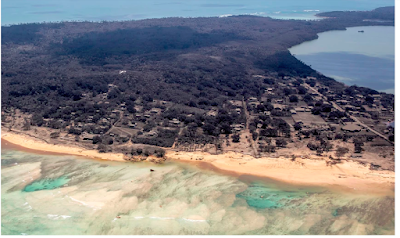
An island in Tongo covered in ash from the massive volcanic
eruption last week. Photo by Vanessa Parker/AP
The volcanic blast obliterated the island it was on. Worse, reports are finally trickling in about the effects elsewhere on this multi-island nation and the news is quite bad. 

As NBC News reports, international phone lines and the internet are still down in the region, so it's hard to get a grasp of what's going on along Tonga's chain of islands.

We do know at least three people died in the large tsunamis that swept Tonga, in addition to the two who died in the smaller tsunami in Peru. Thick ash turned the normally verdant landscape brown. Scores of buildings along the coasts have been swept away.  A reconnaissance flight over one island showed a collection of about 50 houses had been entirely swept away. 



Posted by mjsvta@gmail.com at 1:37 PM No comments:
Email ThisBlogThis!Share to XShare to FacebookShare to Pinterest
Labels: air pressure, Climate change, news, science, shock waves, Tonga, tsunami, volcano, world

Saturday, January 15, 2022

Massive Tonga Volcanic Eruption Also Has Meteorological, And Possibly Global Climate Effects

Satellite view of massive volcanic eruption in 
Tonga today. Depending on how much ash and
other material the eruption put in the stratosphere,
this could have some slight, temporary cooling 
effect on the global climate 
 If you hadn't heard, there's a lot of breaking news this morning about an incredible volcanic eruption in Tonga. 

Tonga is a chain of island in the southwestern Pacific Ocean. There, an underwater volcano has been erupting. There was a large eruption Friday, then Saturday, an immense one.  This is surely the most powerful explosion the world has seen in decades, possibly centuries. 

It immediately produced an immense cloud of ash, a shock wave that traveled thousands of miles and tsunamis that are in one form or another affecting the the entire Pacific Ocean basin, all the way to the United States and Canadian west coasts. 

That's impressive, given that Tonga is about 8,600 miles from Los Angeles. Any tsunami activity on the West Coast will be relatively minor. No big waves smashing into buildings, but it is too dangerous this morning to be hanging out on the water or right on the beach. Tsunami waves as high as 2.7 feet have already been reported in Hawaii. 

Relatively small tsunamis then hit the United States west coast, causing some damage in California mostly to boats and cars parked at marinas. 

More destructive tsunamis have hit islands in and near Tonga.

So far, I've discussed geology and oceanography, not meteorology and climate, which is the point of this blog. But the eruption has had or might have effect on both those sciences.

The explosion was so huge it sent shock waves through the atmosphere far and wide. People in New Zealand, about 1,500 miles from the eruption, heard booms and rumbles from atmospheric shock waves generated by the explosive volcano. Barometric pressure in New Zealand wiggled up and down. This morning, barometers registered tiny, but abrupt changes in air pressure that moved west to east across the nation.

Those barometric wiggles were noticed here in Vermont shortly before 11 a.m. today. 

To give you an idea of the scale of this, had the Tonga explosion occurred in Miami, we would have heard the boom and rumbles from it here in Vermont. 

There's a chance this eruption could cause a bit of global cooling.  We probably won't know for weeks what effect the eruption will have on the global climate, if any. 

We do know the explosion was big enough to loft ash, sulfur and other stuff into the stratosphere, which is the layer of the atmosphere above where most weather occurs.

From there, the gunk from Tonga would be swept across nearly the entirety of the stratosphere above Earth.  If there's enough stuff up there, it could cause temporary global cooling.  

A tsunami washes over a Tonga island after a massive
volcanic eruption in the southwestern Pacific Ocean today

A huge eruption of the volcano Pinatubo in the Philippines back in 1991 cooled the world by about 1 degree Fahrenheit for a year or two, and temporarily putting the brakes on global warming.

An even worse volcanic explosion in 1815 spewed so much stuff into the atmosphere that the Earth cooled dramatically.  It caused the infamous Year Without A Summer in 1816 in North America and Europe. (There were hard freezes every summer month in Vermont that year, and snow drifted up to 20 inches deep in Danville during early June).

So far, there's no indication that things will get this dire worldwide from the Tonga eruption. One thing that might have helped is the eruption was partly under the sea, which might have contained some of the ash and sulfur.

How much this eruption cools the world, if at all, will also be the amount and combination of ash and sulfur there is.  If it's mostly ash up there, that will rain out of the atmosphere pretty quickly and not have much of an effect. If there's a lot of sulfur, that would have at least a one to two year cooling effect.

Another question is if this volcano has a series of similar explosions like today's a whole bunch more gunk will end up in the stratosphere, which would have a more pronounced effect on the global climate.

Regardless of what happens, this doesn't cancel climate change. It's possible it could slow or even stall climate change temporarily. Then climate change would come roaring back and quickly rise to levels the atmospheric warming would have had without the volcano 


Posted by mjsvta@gmail.com at 8:40 AM No comments:
Email ThisBlogThis!Share to XShare to FacebookShare to Pinterest
Labels: atmosphere, Climate change, effects, eruptions, news, science, shock wave, stratosphere, Tonga, tsunami, volcano
Older Posts Home
Subscribe to: Posts (Atom)

About Me

My photo
mjsvta@gmail.com
View my complete profile

Blog Archive

  • ▼  2026 (531)
    • ▼  November (3)
      • Vermont October Was Sunny - With Oddly Warm Days A...
      • Warm Start To November, Needed Rain (Hopefully!) L...
      • Vermont Weather Flipping To Milder As We Switch In...
    • ►  October (45)
    • ►  September (48)
    • ►  August (48)
    • ►  July (45)
    • ►  June (41)
    • ►  May (43)
    • ►  April (45)
    • ►  March (63)
    • ►  February (70)
    • ►  January (80)
  • ►  2025 (757)
    • ►  December (86)
    • ►  November (74)
    • ►  October (71)
    • ►  September (56)
    • ►  August (79)
    • ►  July (48)
    • ►  June (47)
    • ►  May (43)
    • ►  April (53)
    • ►  March (64)
    • ►  February (62)
    • ►  January (74)
  • ►  2024 (720)
    • ►  December (70)
    • ►  November (68)
    • ►  October (65)
    • ►  September (51)
    • ►  August (52)
    • ►  July (53)
    • ►  June (51)
    • ►  May (46)
    • ►  April (65)
    • ►  March (65)
    • ►  February (57)
    • ►  January (77)
  • ►  2023 (602)
    • ►  December (61)
    • ►  November (41)
    • ►  October (37)
    • ►  September (43)
    • ►  August (49)
    • ►  July (60)
    • ►  June (42)
    • ►  May (37)
    • ►  April (42)
    • ►  March (64)
    • ►  February (61)
    • ►  January (65)
  • ►  2022 (537)
    • ►  December (56)
    • ►  November (42)
    • ►  October (36)
    • ►  September (36)
    • ►  August (35)
    • ►  July (35)
    • ►  June (32)
    • ►  May (36)
    • ►  April (37)
    • ►  March (48)
    • ►  February (67)
    • ►  January (77)
  • ►  2021 (480)
    • ►  December (51)
    • ►  November (42)
    • ►  October (32)
    • ►  September (33)
    • ►  August (39)
    • ►  July (40)
    • ►  June (34)
    • ►  May (32)
    • ►  April (38)
    • ►  March (46)
    • ►  February (45)
    • ►  January (48)
  • ►  2020 (161)
    • ►  December (35)
    • ►  November (31)
    • ►  October (31)
    • ►  September (30)
    • ►  August (32)
    • ►  July (2)

My Twitter Feed

Tweets by mattalltradesb
Powered by Blogger.