Showing posts with label air pressure. Show all posts

Saturday, December 14, 2024

Under Pressure: Near Record High Barometric Pressure In Vermont Today

Clear skies started this Saturday morning as barometric
pressure in Vermont approached near record highs for
December. Very high pressure almost always leads
to clear skies. 
 As of early this morning, Burlington's air pressure, corrected for sea level was 1047.8 millibars or 30.92 inches. 

That is wicked high and it's still rising. Today, we'll come within a whisker of breaking the record for highest December air pressure in Vermont on record. It'll all just short of the records set around Christmas, 1949.

As I mentioned in passing yesterday, this won't screw up your life.  Which is a good thing. There's enough high pressure trying to get ready for the holiday, without the atmosphere making it worse. 

To oversimplify, when the air pressure is high, you basically have a big pile of air sitting on top of you. Air is sinking under areas of high pressure, which is how you get those elevated pressures to start with.

CLEAR, COLD

Sinking air also tends to destroy clouds, so it's usually pretty clear under strong high pressure systems. That this one is hitting in December is great for those of you affected by seasonal affective disorder. 

The days this time of year are short to begin with.  It's also almost always overcast in Vermont during December. So a spell of sunshine is always welcome this time of year, even if it is rather chilly. 

If you're going to have near record high pressure, chances are it will happen in the winter.  Weather systems - be they storms or areas of high pressure - tend to be stronger in the cold seasons than in the summer. 

It's usually cold when the air pressure is super high in the winter. Sometimes super cold, if the high pressure came down from the Arctic  Cold air is dense, which increases air pressure.  

This time, and during the December record high pressure in 1949, the cold isn't extreme. The air did not come from the Arctic, but instead has some influence from the Pacific Ocean.

Today will only be slightly cooler than average. But strong high pressure encourages calm, clear nights.

Where it cleared up overnight in southern Vermont, temperatures at dawn today were in the single digits in places like Bennington and Springfield. Lingering clouds kept northern areas somewhat warmer.

Tonight will be by far the chilliest of the winter so far. Blame that strong high pressure.  The Banana Belt Champlain Valley should end up in the single numbers above zero.  The coldest hollows of the Adirondacks will be in the low teens below zero.  Much of Vermont will be near zero.

That's not extreme for this time of year, but it is much colder than we're used to.

EXTREME WEATHER

I've noticed the weather can often get pretty extreme before and especially after bouts of near record high pressure, but that doesn't seem to be the case this time. 

Sure, next week will be unsettled, but nothing wild for December.

In the 1949 high pressure, it was chilly during the peak of it, but record high temperatures preceded and followed the event. 

Near record high pressure hit on February 12-13, 1981,  and that brought seasonable cold temperatures. But right after that, Vermont had an extreme week long February heat wave, in which daily high temperatures were in the 50s to low 60s.

The wildest case of dramatic weather happening around the time of record high pressure was in 1920.  this happening might have been 1920.

The all-time record high pressure in Burlington, Vermont for any time of year was 31.12 inches on January 31, 1920.  This one came down from the Arctic, and it was bitterly cold. The high temperature that day in Burlington was minus 9 with a low of 28 below, still a tie for the third coldest reading on record in the city. 

Then came an incredibly temperature surge. Enosburg Falls went from 39 below on the morning of February 1, 1920 to 47 above on February 2, a jump of 86 degrees!

The current high pressure will move on to the east and weaken starting tomorrow, opening the door to some fairly unremarkable storm systems to give us bits of rain and snow occasionally next week. 


Tuesday, January 18, 2022

So Far, It Looks Like Tonga Volcano Won't Cool Earth, But Atmospheric, Ocean Effects World Wide Entire World's Atmosphere

The volcano exploding in Tonga last weekend. Its effects were
felt around the world, but the eruption is unlikely to
cause any noticeable global cooling. 
 We have a bit more data and some incredible stats from that volcano that blew up in Tonga Saturday.

When I first posted about this volcano, I wondered if the ash and sulfur and stuff that billowed all the way up into the stratosphere would have an effect on global climate.  Large quantities of sulfur injected into the stratosphere would tend to temporarily cool the Earth's climate.  

The huge eruption of the Pinatubo volcano in the Philippines back in 1991 pushed enough sulfur into the stratosphere to cool the world by about a degree Fahrenheit for a year or two. An even bigger volcanic eruption in 1815 cooled the world even more dramatically, with cold and disastrous results. 

According to the Washington Post, satellite data analyzed over the weekend suggest the Tonga eruption had only about 1/50th of the impact of Pinatubo, which means Saturday's blast would only cool the world, or counteract continued global warming, but 0.02 degrees Fahrenheit. In other words, basically too small to notice.

That said, if the Tonga volcano keeps erupting, it could belch more and more sulfur into the stratosphere to the point where it could have a noticeable, though temporary effect on climate.

ATMOSPHERIC/OCEANIC REVERBERATIONS

Even so, that Tonga blast was mighty. One estimate is the blast had 14,000 times the yield of the atomic bomb that destroyed Hiroshima.  So of course the Tonga last was felt  one way or another around the world. First, let's go to the source, right at the blast site. Volcanic eruptions often produce lightning, but Tonga was off the charts. Lighting detection equipment detected 60,000 strikes or 70 lighting strikes per second in the first 15 minutes following the blast, says the Washington Post. 

I was stunned yesterday to read the volcanic blast was heard 1,500 miles away in New Zealand. It turns out, the shock wave generated a booming noise in Alaska, 5,000 miles away from the volcano. Hawaii is closer to the volcano and nobody reported noise there, so there must have been some sort of weather situation in Alaska that made it audible. 

Climatologist Brian McNoldy (@BMcNoldy)
posted this graph showing five atmospheric pressure
jiggles from Tonga volcano shock waves passing
over Miami. The lowest one on the bottom,
labeled in yellow, was not a volcano shock wave
but rather a strong cold front passing through. Click
on the image to make it bigger and easier to see.

Tsunamis from the volcano were detected pretty much all over the world. Some of them were surprisingly large. In Peru, the tsunami killed two people and caused a lot of flood damage along the coastline. 

The tsunami created a four-foot spike in water levels at Port San Luis, California, 3.5 feet at Arena Cove, California, 2.7 feet at Crescent City in northern California and 2.8 feet in King Cove, Alaska, reports the Washington Post. 

There are actually two types of tsunamis.  The most familiar -  and dangerous  - ones are caused by earthquakes and volcanoes. Another type, meteo-tsunamis are triggered by abrupt changes in weather, such as a sudden air pressure rise or fall or very quick changes in wind speed or direction. 

The Tongo volcano produced both types of tsunamis all the way over in the Caribbean Sea, though anyone standing on a beach there probably wouldn't have noticed. But instruments did detect the tsunamis. 

About 24 hours after the volcanic explosion, the tsunami directly caused by the event had rounded the base of South America, and spread out in a subtle fashion across the Atlantic Ocean into the Caribbean. 

In Martinique, the tsunami amounted to about a 0.2 meter, or nearly eight inch shift in water levels. But half a day before that the water levels at Martinique beaches wiggled much more modestly.  That was caused by air pressure changes created by the shock wave in the air created by the volcano.

The atmospheric shock wave circled the globe more than once. It went all directions of course. The eastbound one crossed the United States and was measurable across the nation, reaching us here in Vermont at around 11 a.m. Saturday. 

The westbound edge of the shockwave crossed Asia, Europe and the Atlantic Ocean, reaching us here in New England late Saturday night.  Then it continued westward across the nation again.

For some reason, the air pressure changes with that second one were a little bigger than the earlier one in Vermont/New England, despite having traveled a much larger distance.  I'm not sure why, and I haven't found any credible source that would explain why.

One guess is that the shock wave had traveled all the way across the Atlantic and was not disrupted by mountains and other terrain.  Or, the air over us late Saturday was especially cold and dense, which could have left the atmosphere more prone the disturbance caused by the shock wave.   

In Miami, sensitive barometers have recorded air pressure jiggles five times as the remains of those shock waves orbit the Earth. 

In one instance, in Seattle, the atmospheric perturbations probably briefly changed the weather. A thin temperature inversion had the Sea-Tac airport fogged in.  When the shock wave arrived, the fog cleared briefly, apparently because the pressure change disrupted the temperature inversion.  Once the shock wave passed and the barometric pressure stabilized, the fog came back. 

TONGA ITSELF

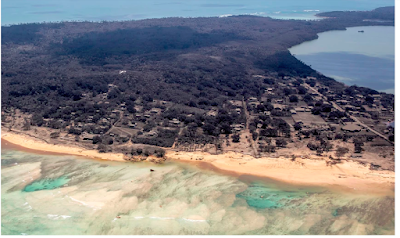
An island in Tongo covered in ash from the massive volcanic
eruption last week. Photo by Vanessa Parker/AP
The volcanic blast obliterated the island it was on. Worse, reports are finally trickling in about the effects elsewhere on this multi-island nation and the news is quite bad. 

As NBC News reports, international phone lines and the internet are still down in the region, so it's hard to get a grasp of what's going on along Tonga's chain of islands.

We do know at least three people died in the large tsunamis that swept Tonga, in addition to the two who died in the smaller tsunami in Peru. Thick ash turned the normally verdant landscape brown. Scores of buildings along the coasts have been swept away.  A reconnaissance flight over one island showed a collection of about 50 houses had been entirely swept away.