Showing posts with label Moore. Show all posts

Monday, June 9, 2025

Aspiring Meteorologist Seeks Good Trouble/Revenge As I Would Put It, Against 2013 Oklahoma Tornado Calamity

An injured Aria Vargyas, then age 8, right side of photo,
being carried out of the tornado-destroyed Briarwood
Elementary School in Moore, Oklahoma on May 20,
2013. The tragedy killed her two sisters, and 
powered her fascination with meteorology so she
can work to prevent deaths in similar storms.
She's now 20 years old and a meteorology student 
at Texas A&M. Photo by AP 
 On May 20, 2013, a powerful EF-5 tornado swept across Moore, Oklahoma. It was one of the worst tornado disasters in recent American history, 

It killed 24 people, injured 212, destroyed 1,150 homes and caused $2 billion in damage. 

Among those injured was Aria Vargyas, then eight, when Briarwood Elementary School, where she was a student, was hit by the twister and collapsed around her.  

Her sisters, Karrina, 4, and Sydnee, 7 months died in their house near the school as the tornado blew the home apart and scattered it to the winds. 

There's even an iconic photo out there of a rescue worker carrying an injured Vargyras out of collapsed remains of the school 

As Texas A&M University of Arts and Sciences and CBS reports, Aria Vargyras, now 20, is in a way seeking revenge against the tornado. 

She is now a meteorology major at Texas A&M, wishing to build a career studying tornadoes and how to predict, understand and ultimately find ways to dissipate storms that produce these deadly tornadoes.

If you insist on a Hollywood connection, her story echoes the plot of the two famous "Twister" movies.

In the first one, the protagonist is a woman who as a child lost her father in a tornado. The character is now a researcher and tornado chaser who is trying to figure out the mechanisms of tornadoes to better understand them and mitigate them.

In the second Twister movie, the protagonist is a woman who, earlier in life lost friends in a tornado chase that went awry and is now studying ways to dissipate and stop tornadoes in their tracks. 

Hollywood isn't reality, of course, but Vargyas has an incredibly compelling story.

A locket around Aria's neck holds a photo of the three sisters. She still has the letters she wrote to them after the storm as she tried to cope with the pain. '"I hate that you're never coming back....And I hate that I have to realize that," she wrote, 

 As Texas A&M explains.

"In dealing with the loss of her sisters as she grew up Vargyas found herself increasingly obsessed with meteorology and the mechanisms behind storm formation. She eventually made it her goal to pursue an education that would enable her to become a meteorologist and work toward preventing weather disaster and their devastating impact on other families and communities.

'My passion for meteorology fully stems from my sisters,' Vargyas said. 'I am doing this for them. I want to do research to help find a way to dissipate storms, but it was because of my sisters that I wanted to do that. I wanted to make sure no one went through what I went through at such a young age.'"

Vargyas just completed her freshman year at Texas A&M. "It's fascinating to delve deeper into the dynamics of weather systems....Understanding the intricacies of atmospheric processes is crucial to my quest to improve prediction and response. Ultimately, I do want to storm chase, looking at the radar, taking pictures and mapping."

Her passion for meteorology and writing, has helped with the grief of losing her two sisters, Texas A&M reports. 

"I started writing, journaling and trying to write my feelings down, and that's what gets me through the rough patches.... Somewhere along the road, it got easier. I didn't cry as much when I talked about them...When I would think of them, it would be a good memory instead of a sad one." 

Right now, we live in a time when a significant portion of the population denigrates science and scientists. We have people in positions of power who do that. The discoveries and truths scientists learn about and tell us don't always match the world view that some politicians want. Or more accurate, a world view that would make them more money than the truth. 

Most scientists don't have as dramatic a story like Vargyas has. But they also don't go into their respective fields to somehow screw over would-be billionaires. Or foist a "climate change hoax" on the population to control them.  Or something. 

Sure, there are bad apple scientists out there, just like there is in every profession. A small minority of scientists cheat, or find ways to make lots of money instead of, you know, actual science.

But honestly, those fools are few and far between. 

As I wrote some of this past Friday afternoon, meteorologists were watching storms in southern Vermont like hawks. The storms risked bringing  life-threatening flash floods, and those scientists were ready to warn the public and save lives  as soon as the first sign of trouble loomed.

It's just what they do.  

We clearly need scientists like Vargyas and so many of the others out there. Too bad not enough people recognize this. Until it's too late.  

Tuesday, March 25, 2025

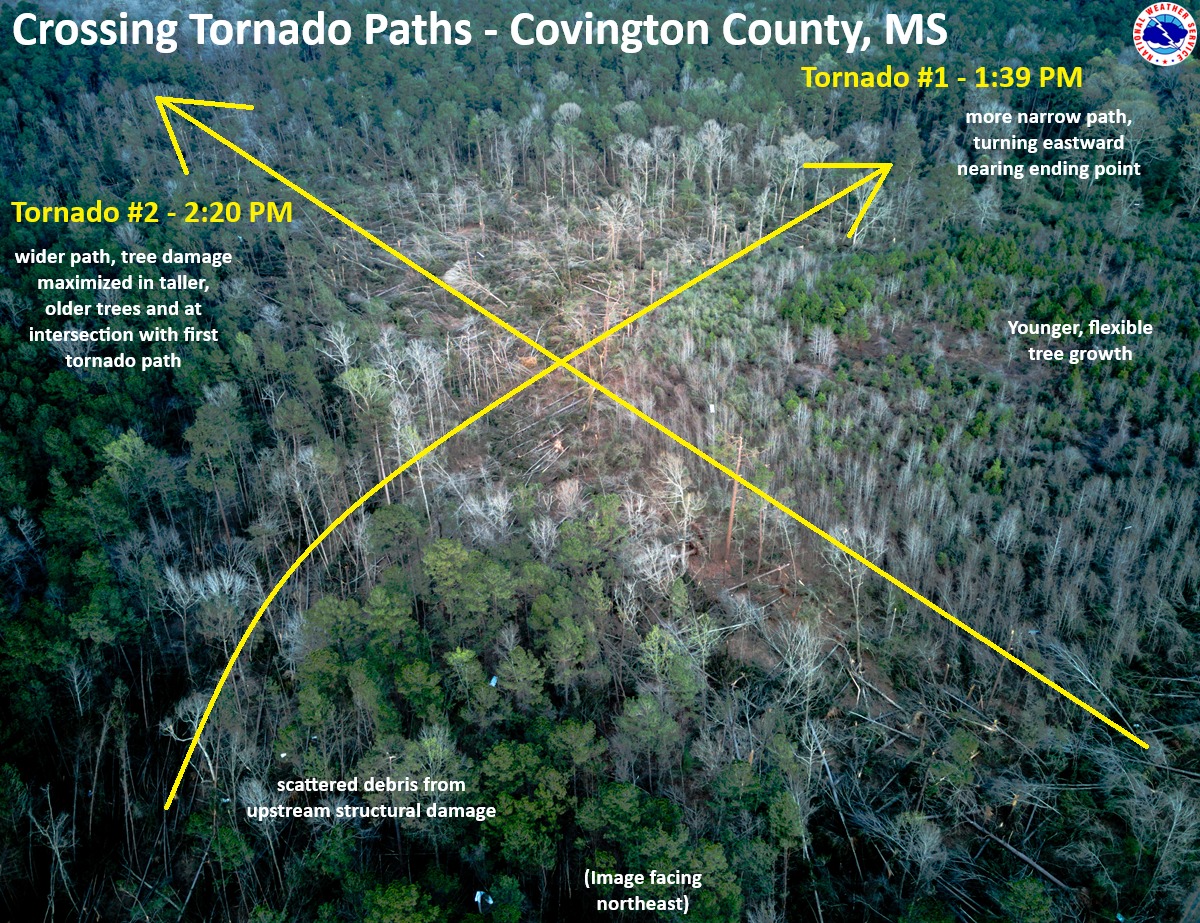
Two Weird Tornados Hit The Same Spot In Mississippi Within 41 Minutes. One Of Many Odd Tornado Stories

Aerial photo and schematic from the Jackson, Mississippi
National Weather Service office showing how two
tornadoes crossed paths within 41 minutes of
each other earlier this month. 
When there's a large tornado outbreak in the United States, you're almost guaranteed to hear odd stories about the behavior of at least some of those twisters. 

So it was with the swarm of tornadoes that hit on March 14-15.  So far, there have been at least 114 confirmed tornadoes with this outbreak, easily the biggest so far this year. 

Of course, we have at least one weird story about this outbreak. As the Washington Post reports:

"In western Covington County, home too 18,059 people, a pair of tornadoes left a crosscrossing path of damage southwest of the town of Collins, the county seat, in an area just north of Spring Hill School Road.

"......the first one, a dying EF4 that had begun in northern Louisiana, hit the zone around 1:39 p.m. central time. By that point, it had covered more than 67 miles and been on the ground for 1 hour and 22 minutes. 

Then, at 2:30 p.m, and EF2 tornado hit the same spot."

That had to be a pretty terrifying afternoon in Covington County. 

 The explanation, according to WaPo:

"Sometimes the most favorable conditions for tornado formation and maintenance exist in a small zone. When the storms pass through that sweet spot, they can spawn significant long-track tornadoes in rapid succession."

It is weird for two tornadoes to go in two different directions within the same hour, but it can happen.

My guess - and it really is just a guess - is the first one, ahead of a cold front, was associated with a supercell, which typical run southwest to northeast ahead of such a weather system.

The second one hit when the cold front was closer, and the inflow from the front might have helped the second twister to move southeast to northwest, toward the front. 

Luckily, the two tornadoes intersected in a forested area. Though both caused damage, at least nobody's house got hit twice.

OTHER TORNADO ODDITIES 

There have been other examples of large tornadoes crossing paths on the same day, or coming close to it.  This is most common in very large or super outbreaks of tornadoes.

During the famous April 3, 1974 super outbreak of tornadoes, two intense tornadoes passed in close succession  southeast of Flintville, a town in southern Tennessee.

On April 12, 2020, a deadly EF-4 passed just south of Bassfield, Mississippi, followed by an EF-3 that afternoon just north of town. 

There are certain unlucky communities that have been repeated hit by horrible tornadoes. Tanner Crossroads, Alabama was hit by two EF-5 tornadoes on the same day  in that big 1974 tornado outbreak. 

Then in the next big tornado on April 27, 2011, another EF-5 tornado crashed through Tanner Crossroads. It's the only U.S. town known to have been hit by three EF-5 tornadoes. 

EF5's are the worst possible tornado, with winds of over 200 mph.  This type of tornado sweeps houses away completely and pulverizes them. Unless you are in a tornado shelter or a very protected basement, you would not survive such a twister. 

There's also the unlucky city of Moore, Oklahoma, which has been hit by more than 20 tornadoes since 1961. Two of them were EF-5s and two others were EF-4s, the second strongest category of twister.

We have plenty of other examples of supremely unlucky towns in Tornado Alley

UNLUCKY PEOPLE

In Paragould, Arkansas, two tornadoes within less than a year of each other had crisscrossing paths that wrecked the same small group of houses in the Club View Estates neighborhood

One of the homes, belonging to the Drope family, was damaged last May 26 in a tornado.  They weren't able to move back in until a few months later. Then, on March 15, yet another tornado struck the same house, pretty much destroying it. .

This was actually the third time this family endured a tornado. A decade ago, they lived about ten miles up the road from where the remains of their current house is now.  That former home when they lived there was also damaged by a tornado. 

Just this past weekend, Rolling Fork, Mississippi was hit by a tornado. This one could have been worse. It caused some damage, but didn't hit the middle of town, and its winds were "only" about 100 mph.  Bad, but not as bad as it could have been

But Rolling Fork residents are spooked by tornadoes, especially if they hit on March 23, like this one did. It was the second anniversary of and EF-4 that struck the town, killing 17 people and leveling most of the community. 

By the way, the 2023 tornado might have been an EF-5, the worst kind, depending on how you measured it. I had a post on March 24 explaining some quirks in measuring these monster twisters. 

Single tornadoes, or groups of tornadoes in one town can be particularly terrifying. In May, 2007, an EF-5 tornado destroyed Greensburg, Kansas. Then its path performed a loop, crossing its own path and repeating the damage just north of where it had just demolished Greensburg. 

UNLUCKY YEARS

Then there are unlucky years, in which strong tornadoes hit big population centers repeatedly instead of mostly staying in rural areas. The year 1953 comes to mind. It was the only year known to have seen five F5 tornadoes until 1974, when seven such tornadoes hit in just the one Super Outbreak.

Not the Midwest, but a Midwest-
style EF-4 tornado pictured here
struck Worcester, Massachusetts
of all places in 1953, killing 94
and injuring 1,300
The year 1953 featured massive tornadoes hitting larger cities. On May 11, 1953, a huge twister hit downtown Waco, Texas, killing 114 people and injuring 597.

Barely a month later, on June 8, 1953, a F5 tornado hit the Flint, Michigan and surrounding towns killing 116 people and injuring 897. 

The next day, the same weather system move into New England, spawning an F4 tornado in Worcester, Massachusetts and nearby towns, ending the lives of 94 people and injuring 1,300,

More recently, we had the year 2011, which brought the super outbreak of tornadoes on April 26-28 that spun off 360 tornadoes from Texas to New York. The outbreak focused the worst of its wrath on Mississippi and Alabama, which were raked by numerous intense tornadoes. This outbreak killed 321 people. 

Then, less than a month later, an EF-5 tornado struck Joplin, Missouri on May 22. That massive storm killed 161 and destroyed much of the city. 

In total, between those two tornado outbreaks and others, 553 people lost their lives in twister during 2011.     

LATEST ODDITY

Tomorrow, a severe storm outbreak with large hail and even potential tornadoes is forecast in (check notes) an area of the Pacific Northwest encompassing Portland, Oregon and Seattle, Washington, among other cities.

Such an outbreak of severe weather is extremely rare in the part of the nation, but there you go. 

The same storm system threatens to cause a new tornado outbreak in the Midwest, Gulf Coast and Southeast Sunday and Monday. 

Friday, June 11, 2021

One Type Of Drought To Love: A Lack Of Intense U.S. Tornadoes Lately

Tornado damage, minor, relatively speaking, in Tupelo,
Mississippi on May 3. There were no recorded violent 
tornadoes in May, 2021 AP photo by Thomas Graning
 It's been a busy year for weather disasters in the United States so far.

We've had crippling winter storms in February, frequent, extensive bouts of flooding in the South since March, big hail storms in Texas and elsewhere, and widespread drought in the West.  

One type of disaster that's been thankfully lacking this year, though, is violent tornadoes. 

May is usually the worst month for tornadoes in the United States.  This year, for the first time since accurate records on these things started in 1950, there were no tornadoes of EF-3 strength or worse.  EF-3 tornadoes have winds of 136 to 165 mph. 

Tornadoes are rated on six-point scale from EF0- to EF-5, with the fives being the worst. The great majority of tornadoes in the U.S. are weaker EF-2 or less. These weaker ones have winds of 65 to 135 mph. 

The ones that tend to grab headlines are the EF-3s to EF-5s, which, if they hit a populated area, cause terrible destruction.

Most years, there's at least a few scattered EF-3s, 4s, or even 5s somewhere in the United States. Unless re-analysis proves otherwise, this will be the first May on record without anything so destructive 

There was actually about an average number of tornadoes across the United States in May.  We have 289 reports of tornadoes, says NOAA's Storm Prediction Center.  The average is around 272, so close

Even the relatively strong EF-2 tornados were lacking in May. So far, there were only eight such twisters confirmed during the month. That's the fifth fewest on record for May, says the SPC.  That means almost all U.S. tornadoes in May were pretty weak, and didn't cause all that much damage.

Here's an even better piece of good tornado news: For the first time since 2014, there were no tornado deaths in the United States for the month of May. 

We also broke another, very welcome tornado record. As of yesterday, it's been eight years and 21 days since the last time an EF-5 tornado hit the United States.  That's the longest we've gone without the strongest tornadoes we can get.

EF-5s are the real monsters of the tornado world, being the strongest they can get. They produce winds of over 200 mph. In these strongest tornadoes, entire homes are swept off their foundations and swept away.  Cars and car-sized debris are blown 100 yards or more through the air. Bark is removed from trees and pavement can be sucked off roadways and parking lots. 

You wouldn't want to be caught in one of these. 

Luckily, with this new record means that nobody has been caught in an EF-5 tornado since May 20, 2013, when an EF-5 swept through Moore, Oklahoma. That tornado killed 24 people and caused at least $2 billion in damage.

There's not a clear reason why the United States has not endured an EF-5 tornado since Moore.  One good theory, writes Bob Henson in Yale Climate Connections,  is that there actually been one or more EF-5 tornadoes since 2013. We just don't know it. 

The strength of tornadoes are determined in post-storm analyses. Meteorologists look at damage to buildings, trees, and other items, and figure out from the damage how strong the tornado was.

But if an EF-5 tornado lumbers through the wide open Great Plains without hitting anybody's house or property, it won't be designated as such because there's no damage assessment to be done.

It could be just dumb luck that EF-5 tornadoes in recent years detoured around towns and farms and patches of woods in the otherwise grassy prairies. 

Tornadoes attract zillions of storm chasers, and some of these chasers bring radar equipment. Their radar has detected likely winds of 200 mph or more in some twisters in remote areas since 2013, so the idea that there are uncounted EF-5s is pretty valid. 

There's no telling when the drought of strong tornadoes will end, but it could end on a dime. 

We've had a similar experience with hurricanes, notes Henson in Yale Climate Connections. No strong hurricanes hit the U.S. from October, 2005 until August, 2017, the longest period we've had without such big storms.

Then Category 4 Hurricane Harvey hit Texas in August 17, and since then the U.S. has been hit by five major hurricanes. 

With that in mind, it's probably just a matter of time before the United States deals with another tornado tragedy like that in 2013 Moore, Oklahoma.