Showing posts with label lilac. Show all posts

Thursday, October 16, 2025

Completely Backwards: Vermont Lilacs Blooming In October!

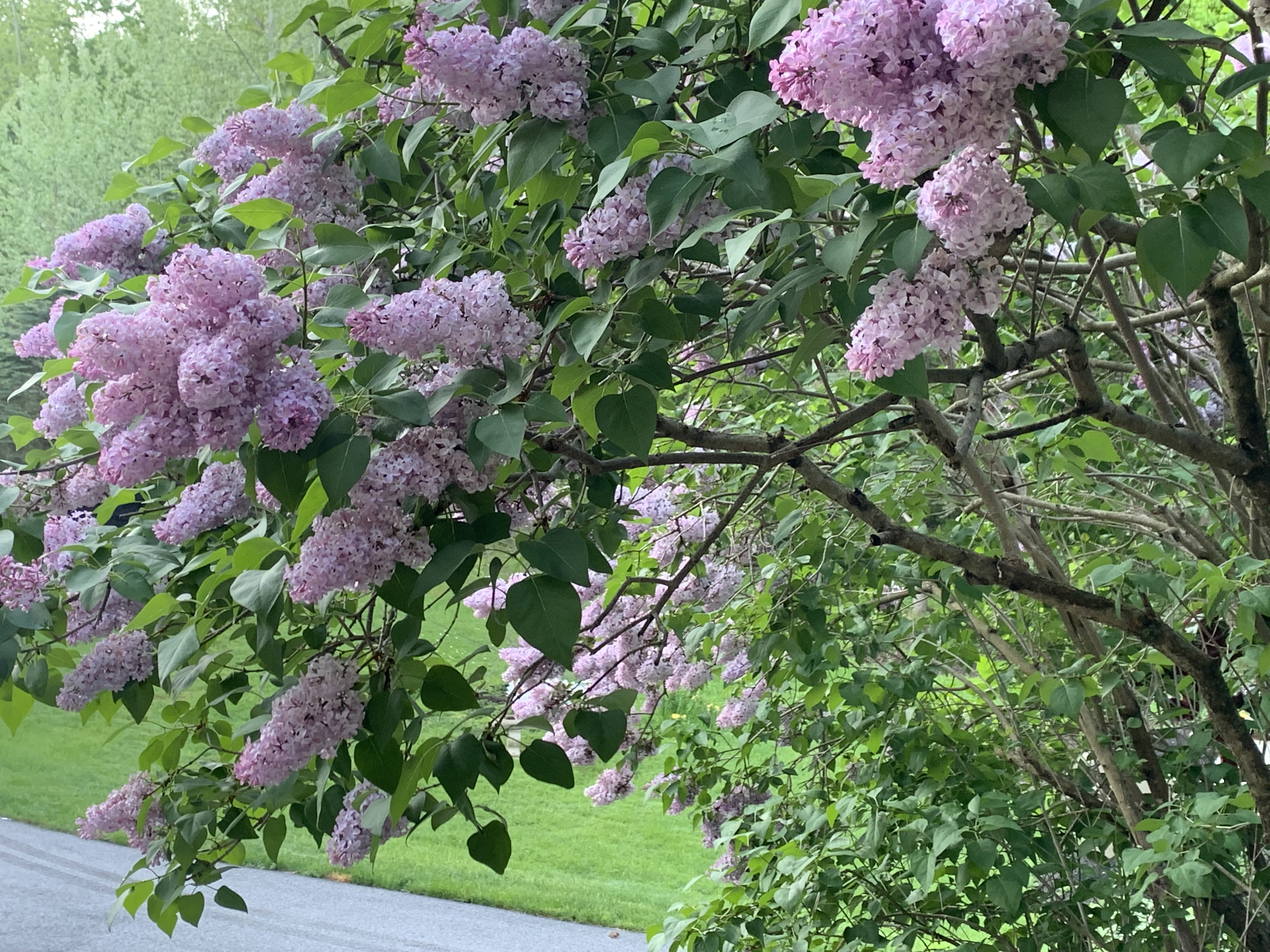
Lilacs bloom on the tree outside my house in 
St. Albans, Vermont this week. Stress from a
wet spring, a blight and drought have caused
this out of season display. 

You might have seen the following in your travels lately and said, what the hell?!?!?

Lilacs are blooming in Vermont. In October. 

Lilacs are of course a highly welcomed sight in May. What's not to love about them? When they bloom, they signal that you're in the heart of spring.

 They smell absolutely divine. And they're gorgeous. And traditional. I don't think I've ever seen an old farm house in Vermont without a lilac bush that's almost as old as the house. 

These lilac bushes usually cede beauty to the sugar maples in the autumn. While our hillsides glow orange and red and yellow, lilac bushes normally just drop their green leaves late in the autumn, and you're done until spring. Ho-hum.

This year, our lilac bushes were stressed by topsy turvy weather much more so than usual. Yes, we can blame climate change for another round of weather extremes in 2025.  

This year, we had an unusually wet, sopping spring. That encouraged a leaf blight to take hold in lilac leaves. That's a huge part of the reason why you saw so many lilac bushes with curled up, browning leaves that fell off prematurely. The blight - as you can imagine - stressed the lilac bushes. 

Then, the rain shut off in July, and we sank into our big flash drought. That stressed the lilac trees even more. 

"Stressful conditions put the plant in a dormant-like state and when the cooler temperatures and shorter days of fall arrive, some of the flower buds are triggered to bloom," Iowa State University Extension explains. 

We also finally got some rain in late September, which also might have helped trigger the odd new blooms.  

The good news is the blight, the drought and the weird October blooming won't kill or really harm your lilac bushes. These are really, really tough plants. Ever try to kill a lilac? It's almost impossible. Besides, why would anyone want to kill a lilac?

Next May, your suffering lilac will bloom beautifully, and on schedule. It might have fewer blooms than usual, because the tree put on some of its blooming effort this month. 

The strange doings with lilacs are a sign that weather extremes brought on by climate change are having an effect on everything.  In the springs of 2021 and 2023, for the first time in my life, I noticed freeze damage to lilac blooms.

In both those years, oddly warm early spring weather got trees leafing out and blooming way too early. Then snow and frost and deep freezes hit, turning some of those gorgeous lavender lilac blooms a disappointing brown. Or they didn't bloom at all in some cases.

Hopefully, normal amounts of precipitation will return soon. The drought here in Vermont and the rest of northern New England is still in full force. The latest weekly U.S. Drought reports comes out later this morning. I'll put up a post about that update here in this blog thingy later today. 

Maybe we'll get lucky and the weather during the spring and summer of 2026 will be pretty moderate to give all our garden plants a break. 

But give the climate change that everyone is experiencing, I'm sure something bizarro will happen next growing season, too.  

Wednesday, April 16, 2025

Spring Leaf Out Just Reaching Vermont, Another Early Arrival Among Many Recent, But Not As Early As Last Year

The National Phenology Network tracks the progress
of first leaf out of early plants like honeysuckle and lilac
as it moves northward in the spring. Blue shows where
leaf out was later than usual this year, red is where it
is earlier than normal.  Leaf out has just begun
to creep into far southwest Vermont, a good 10 days
or so earlier than normal. Click on the map to
make it bigger and easier to see. 
At least by one measure, spring has gotten into at least far southwestern Vermont. 

Every year, the National Phenology Network tracks the first time spring leaves begin to appear on certain species of plants as the season advances northward. 

The earliest spring plant leaves had by yesterday begun to enter the low elevations of southwestern Vermont.  

So by this measure anyway, it's officially springtime in Vermont.   

DEFINING SPRING

I think I owe you some definitions first.  Phenology is the study of the timing and cyclical patterns of events in the natural world. 

The National Phenology Network is basically a clearing house that collect, organizes and shares phenological data to other scientists and the general public. It's a pretty interesting website. 

This network defines first leaf of spring this way:  "The First Leaf Index is based on the leaf out of lilacs and honeysuckles, which are among the the first plants to show their leaves in the spring."

In and near Bennington, that has just happened.  And it looks first leaf will spread up into the Champlain Valley soon, thanks to a mild Monday and Tuesday that juiced the spring season.  I notice honeysuckle is just on the cusp of leafing out, and my lilacs are starting to get pretty close to the edge too.

There will probably be a stall in this process today and to an extent tomorrow as chilly air will prevent much in the way of spring growth. 

However, milder air in the forecast Friday and Saturday will get things moving again. Saturday in particular looks promising as a mild, likely rainy Friday night will lead to a balmy Saturday.

It usually takes a while longer to the leaf out to spread into central and northeastern Vermont, but it will get there.

As you might have seen in posts in recent years, I track these phenology leaf out maps fairly closely every spring. What can I say? I'm a big fan of the season.

EARLY SPRINGS

More often than not, in this age of climate change, leaf out has come earlier than normal in recent years due to warm springs.

The leaf out creeping into southwest Vermont is roughly two weeks early, and that's not even the earlier we've ever seen in recent years. In 2023 it was even earlier, thanks in part to an insane, record heat wave on April 13-16 that year that brought temperatures into the 80s across most of Vermont and 90s in parts of southern New England. 

Leaf out in Vermont was also exceptionally early in 2021.  And it was earlier than average last year and in 2022.

Last year was even earlier than we're seeing now. By April 16, 2024 leaf out had covered all of western Vermont all the way to the Canadian border. 

Tracking leaf out has been interesting this year,  It usually starts in South Florida in late January then begins to spread north. It was later than normal along the Gulf Coast, then a little earlier than average in the northern Gulf States.

A cool spell delayed things and made spring greening a little late in the mid-Mississippi Valley in early March. But once the leaf out reached the Mason Dixon line, it's been earlier than normal all the way up to its current northward extent from  New England to South Dakota. 

The Pacific Northwest is running one to two weeks late with their leaf out. 

The National Phenology Network also tracks bloom times, which uses in large part the time honeysuckle and lilacs bloom. 

The bloom index as of yesterday had only gotten as far as roughly a Washington DC to St. Louis line, so it will be awhile before it gets to Vermont  

Saturday, May 28, 2022

The Hero Lilac

The big lilac in front of my house put on a huge, aromatic
show this spring, infusing me with a bit more confidence
in the rest of the garden season. 
When I bought my house back in November, 2007, the place was a wreck.  

Before me, it had been owned by - no lie - a schizophrenic pot dealer with a penchant for guns and a huge overestimation of his plumbing and electrical skills.  

But I needed a bargain fixer upper and this was my ticket. 

The house had good bones, though it was a wreck. The plumbing leaked, the electrical system was about as far from code as you could get. The property comprises an acre, all overgrown with weeds, dead shrubs and tangles of wild grapevine. 

However, I envisioned a place that would eventually become a paradise, a comfortable home with beautiful gardens where a weather geek like me can watch and measure the change of seasons, the pluses and minuses of Vermont weather, and for better or worse, changes in the climate.

Thanks to my husband Jeff and his exquisite design vision, the house is now gorgeous. (Bonus: Also safe and up to building code standards).And because of my love of playing in the dirt, the gardens aren't too shabby. 

This process from beast to beauty has to start from a place of potential. The house was just a simple rectangle, a blank slate on which Jeff could work his magic. 

The property had pieces that promised beauty, too. The back yard has three enormous poplar trees, The Triplets as I call them, that anchor the back yard gardens.

When I bought the house, there was a large but battered lilac bush out front just begging for some TLC.

I'm a Vermonter, and I know it's sacrilegious to destroy a lilac. And this old lilac had potential, like the rest of the property. Lilac and I were fast friends.

I quickly tore out all the dead limbs and stems. In December of 2007,  pruned the tangles. Contained the tendrils running out toward the drive. Lilac rewarded me in May, 2008 with gorgeous blooms and hasn't let me down since.

Except for one incident that wasn't Lilac's fault. I'll get to that in a bit. 

Blooms on my lilac were so profuse the branches sagged,
leaving me with this gorgeous view at my front door

Lilacs are tough old birds. They'll survive just fine for decades after the house they were near has long since disappeared. So I learned never to worry about Lilac. This guy fights back. 

In April, 2010, we had an early spring. By the last week of the month, Lilac had leafed out and had plenty of flower buds. Then on April 27-28, thirteen inches of snow flattened twelve-foot-tall Lilac to the ground. 

Then it thawed and Lilac sprung back almost as if nothing had happened. I had to remove one relatively minor branch that had cracked. 

Lilac became my measure of how late or early spring was. Lilac bloomed spectacularly by the first of May, 2012, the earliest I'd seen that happen. It was a remarkably warm spring. It ran a little late in May, 2014 after a cool spring. 

But Lilac was always reliable.

Maybe it's a sign of how off the rails the climate has gotten, but last year was the first time I've seen Lilac's spring glory diminished by goofy weather. 

Spring, 2021 was very early, almost as early as 2012. The florets were budding and growing by April 20. Then, on April 21-22, it snowed.  No problem, Lilac has proven it can handle that. Then, with temperatures in the 20s, roaring northwest winds and snow squalls ripped through during the morning and early afternoon of April 22.

That managed to kill many of the florets on Lilac.  It subsequently bloomed a little bit, but the show was very much diminished last spring. It made me wonder a little bit if gardening is even worth it. If climate change can diminish tough Lilac, what will it do to everything else, eventually. 

Apparently, Lilac wants me to buck up.  This year, another early spring, but not as early as last year arrived. There was one scare of sorts with another super heavy, wet snowstorm on April 19 that weighed down the branches, but that ended quickly with no problem.

The blooms this year were more than I've ever seen. Everyone in Vermont appears to have had a great lilac year, but Lilac by my house outdid itself. You can scarcely see any leaves, the blooms were so profuse. The branches were so heavy with blooms they sagged almost to the ground. 

Talk about encouragement! The breeze blowing the aroma of the lilacs through the house was enough to snap me out of my negative mood.'

A too-early bout with heat and humidity (yay, climate change again) made the lilac show come and go faster than usual. The blooms have faded now, but they did their job. 

Yes, I'm way behind on gardening this year.  But I can go forward with confidence, with Lilac's spring blessing. I don't know what kind of setbacks I might suffer this summer, - drought, floods, severe windstorms, spongy moth caterpillars - who knows? 

In the age of climate change, you need any type of confidence I can collect.