Showing posts with label blooms. Show all posts

Thursday, October 16, 2025

Completely Backwards: Vermont Lilacs Blooming In October!

Lilacs bloom on the tree outside my house in 
St. Albans, Vermont this week. Stress from a
wet spring, a blight and drought have caused
this out of season display. 

You might have seen the following in your travels lately and said, what the hell?!?!?

Lilacs are blooming in Vermont. In October. 

Lilacs are of course a highly welcomed sight in May. What's not to love about them? When they bloom, they signal that you're in the heart of spring.

 They smell absolutely divine. And they're gorgeous. And traditional. I don't think I've ever seen an old farm house in Vermont without a lilac bush that's almost as old as the house. 

These lilac bushes usually cede beauty to the sugar maples in the autumn. While our hillsides glow orange and red and yellow, lilac bushes normally just drop their green leaves late in the autumn, and you're done until spring. Ho-hum.

This year, our lilac bushes were stressed by topsy turvy weather much more so than usual. Yes, we can blame climate change for another round of weather extremes in 2025.  

This year, we had an unusually wet, sopping spring. That encouraged a leaf blight to take hold in lilac leaves. That's a huge part of the reason why you saw so many lilac bushes with curled up, browning leaves that fell off prematurely. The blight - as you can imagine - stressed the lilac bushes. 

Then, the rain shut off in July, and we sank into our big flash drought. That stressed the lilac trees even more. 

"Stressful conditions put the plant in a dormant-like state and when the cooler temperatures and shorter days of fall arrive, some of the flower buds are triggered to bloom," Iowa State University Extension explains. 

We also finally got some rain in late September, which also might have helped trigger the odd new blooms.  

The good news is the blight, the drought and the weird October blooming won't kill or really harm your lilac bushes. These are really, really tough plants. Ever try to kill a lilac? It's almost impossible. Besides, why would anyone want to kill a lilac?

Next May, your suffering lilac will bloom beautifully, and on schedule. It might have fewer blooms than usual, because the tree put on some of its blooming effort this month. 

The strange doings with lilacs are a sign that weather extremes brought on by climate change are having an effect on everything.  In the springs of 2021 and 2023, for the first time in my life, I noticed freeze damage to lilac blooms.

In both those years, oddly warm early spring weather got trees leafing out and blooming way too early. Then snow and frost and deep freezes hit, turning some of those gorgeous lavender lilac blooms a disappointing brown. Or they didn't bloom at all in some cases.

Hopefully, normal amounts of precipitation will return soon. The drought here in Vermont and the rest of northern New England is still in full force. The latest weekly U.S. Drought reports comes out later this morning. I'll put up a post about that update here in this blog thingy later today. 

Maybe we'll get lucky and the weather during the spring and summer of 2026 will be pretty moderate to give all our garden plants a break. 

But give the climate change that everyone is experiencing, I'm sure something bizarro will happen next growing season, too.  

Thursday, March 21, 2024

Near Record Early Cherry Blossom Bloom In Washington DC, But 150 Of The Trees To Be Chopped Down Soon

Stumpy, a beloved cherry tree along the Tidal Basin
in Washington DC is to be chopped down along with
150 other trees because of rising tides. Note the water
surrounding Stumpy in the photo. The tree was
damaged by the high water, giving Stumpy a 
Charlie Brown Christmas tree vibe. That's
why people love Stumpy so much and will miss it. 
 The famous cherry trees in Washington DC reached peak bloom on Sunday, one of the earliest such blooms on record.   

People also better enjoy this year's bloom, as about 150 of the trees are about to be cut down.  (Don't worry, there will be plenty of cherry trees left behind to bloom in future years).

THE BLOOM

First, the early bloom. As the Washington Post notes, people have been keeping track of bloom times among the cherry trees since 1921. This year's was tied with 2000 as the second earliest flowering on record. March 15,1990 takes the cake as the earliest bloom. 

The blossoming came earlier than forecasted and before the start of the Capitol's annual National Cherry Blossom Festival, which started Wednesday and ends April 14.

Climate change (of course!) seems to be playing a role in the earlier blooms as well: Per Washington Post: 

"As March temperatures have climbed over the past century, the average peak bloom date has advanced about six days, from April 4 to March 30. Including this year, each of the past five has seen a peak before March 298. Last year it was on March 23 - more than a week early."

Peak bloom has hit before April 4 in 16 of the past 20 years. Looking at it another way, in the 57 years ending in 1978, the trees bloomed on or after April 12 on thirteen occasions. Since 1978, blooms that late never happened again. 

CUTTING SOME DOWN

Washington DC has about 3,800 cherry trees in and around the Tidal Basin and Washington Monument. After the blooms fade this spring, there's going to be about 150 fewer of them.

They are victims of sinking ground and climate change, which is causing the tidal basin to flood the area more and more frequently, especially near the Jefferson Memorial. 

Back in the late 19th and early 20th century, a seawall was construction in the area to keep tides at bay. But the sea wall has sunk as much as five feet. That's mostly because the area was built on mud dredged from the Potomac River, and that mud has settled.

 Meanwhile, water levels have risen by about a foot due to climate change. 

NPR describes the scene now:

"Every day, twice a day, at high tide, portions of the walkway around the Tidal Basin flood with several inches of water. Some of the roughly 2,500 cherry trees around the basin have water lapping at exposed roots; others are completely inundated. Numerous park benches are partially submerged."

The National Park Service this spring will embark on a $113 million project to raise portions of the walkway.  A new seawall will be built, supposedly high enough to withstand about a century of future sea level rise.  They'll be able to build the seawall higher, if it becomes necessary.

To complete this project to keep the Tidal Basin at bay, they'll have to cut down about 150 trees. Once they're done, the National Park Service promises to plant 274 new cherry trees.

STUMPY

One of the victims of this project is the beloved Stumpy.  

Stumpy is the Charlie Brown Christmas Tree of the Tidal Basin. Repeated flooding from Tidal Basin salt water has turned into Stumpy into a gnarled, lopsided mess.  Still, Stumpy persists, putting out fresh blooms each year. 

People love Stumpy's pluck in the face of such adversity, and they are celebrating it and truly mourning its impending demise. 

The Credit Union Cherry Blossom 10-mile and 5K will commemorate Stumpy with its image on race t-shirts and race metals. Stumpy also now has a full-sized mascot.

The Washington Post adds this:

"Clippings from Stumpy will be sent to the National Arboretum to create genetic matches. The hope is to plant little Stumpy clones on the National Mall or nearby parks. The rest of Stumpy and the other trees will be ground into mulch and spread around the remaining cherry tree bases to protect their roots and provide nutrients to the soil."

Sort of the circle of life, I guess. 

I understand the need to remove Stumpy, but I'm going to miss that brave little tree.  


Sunday, April 16, 2023

Extreme April Heat In Vermont/New England Might Lead to Crop/Garden/Forest Damage

Earlier than ever. Green leaves were starting to make an
appearance behind my St. Albans, Vermont house this
morning while a lilac bush in the foreground leafs
out and gets ready to bloom. Record heat this past
week as pushed spring into the too-soon category.
When I got up this Sunday morning, some of the early growing trees behind the house shimmered with tender new green leaves. The lilac bushes were brimming with tiny floret buds, ready to put on a show. 

I've never seen that kind of thing happen so early in Vermont.  It's truly remarkable.

This spring had been proceeding at a fairly average, comfortable, pedestrian pace, until the unprecedented early season heat arrived this week. 

Western Vermont won the heat prize Saturday. In Burlington, the record high Saturday was 85 degrees, breaking the old record of 82 set in 2003,

Everything springtime related leapt ahead far ahead of schedule. Things are where they should be around the first of May.  This race through spring will continue today with temperatures that will be far, far above normal again today. 

The summer party ends tomorrow with sharply cooler air.  Long range forecasts are suggesting that the second half of April might actually be chillier than normal.

If this cooler air is just kind of chilly without hard nighttime freezes, that will be good. It will just slow down the progress of spring and start to bring us more in line with where we should be.

Light to moderate freezes, temperatures that stay at or above, say, 28 in the Champlain Valley and in the mid 20s or better in much of the rest of northern Vermont between now and early May probably wouldn't cause much damage. Unless these readings are accompanied a lot of wind. 

 But it can get as low as the teens this time of year in most of the Green Mountain State that would be a disaster.

This coming week won't be a disaster, despite a particular chill in the air Tuesday and Wednesday. At least we'll get a little rain out of this shift to colder weather.  We need it. 

There's a good chance we'll have  widespread frosts and freezes Wednesday night, but I really doubt it will get cold enough to cause any real harm. 

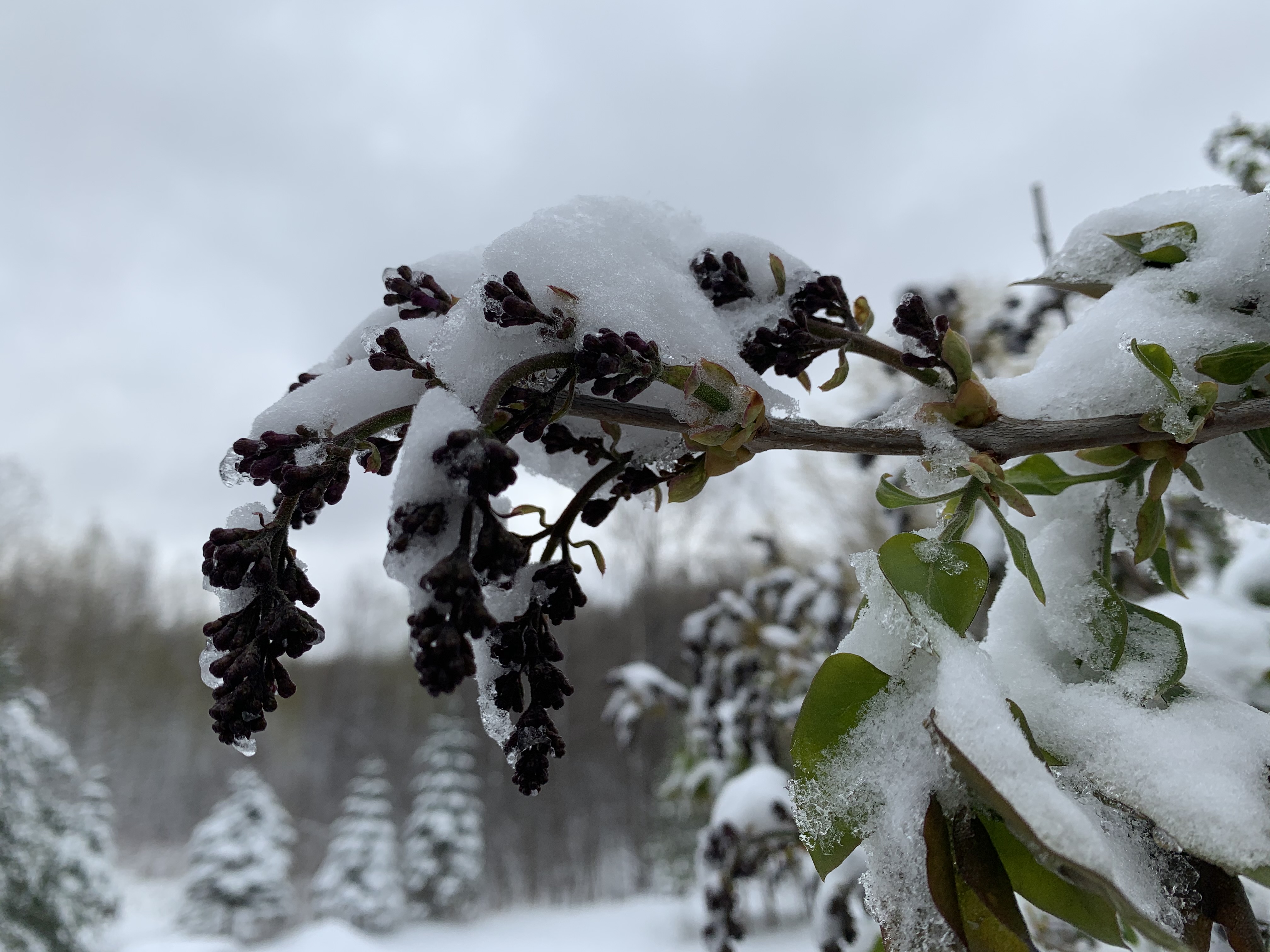
This budding lilac floret, pictured here on April 22, 2021,
froze to death and never bloomed after a late season
snow and freeze that year. This highlights the danger of
what could happen if spring growth comes too soon.

However, if you brought your tender planters outside to enjoy the warmth, you'll need to bring them back indoors this week. 

My hibiscus has enjoyed the warm sun this week, for instance, but I'm locking it in the house and turning up the heat a bit when it gets cold starting this week. 

In the short term, we're safe, but I don't know how cold it might get in late April. 

These strange spring heat waves have already led to sometimes disheartening, or even costly damage.

A record early heat wave in Vermont back in 2002 brought the earliest 90 degree reading on record to Vermont on April 17 the year. Leaves on trees started coming out almost as soon as they are this year. 

Late in the month, hard freeze destroyed garden plants, and blackened swaths of forest by killing the early leaves. The visible damage lasted well into June before new leaves grew.  Trees being forced to re-leaf stresses them, in much the same way that spongy caterpillars did in Vermont last year and the year before,

Trees can usually withstand on year of defoliation, but if it happens year after year, it takes a toll. 

Other times, the damage from weird early heat is not so costly, but just a little depressing. 

Early spring, 2021 was warm and things were blooming early.  On April 21 that year, lilac trees were already displaying budding florets, and crabapple trees were just starting to bloom. 

Then a snowstorm and harsh freeze hit northwestern Vermont.  Some of the crabapple trees never really bloomed that year as a result. Many of the lilacs ended up stunted, only partially blooming.  Living without the annual spring display of full-blown lilacs was surprisingly depressing. 

Climate change has brought too-early heat waves that encourage too-early spring growth frequently in recent years. Sometimes, in the eastern United States, this has brought widespread agricultural damage, as the Southeastern U.S. saw in 2012 and 2017 and to a lesser extent earlier this year. 

That's not to say freezes are guaranteed to ruin our Vermont spring this year. The fact that it has come too early, though, leaves us prone to trouble. The best bet is just to hope for normal late April weather once this heat wave finally dies after today.