Showing posts with label factory. Show all posts

Monday, May 4, 2026

For A Change, A Company Does It Right By Employees As A Tornado Loomed

Extreme tornado damage in an industrial area of 
Mineral Wells, Texas that was hit by a tornado
late last month. One employer, Ventamatic, 
took watches and warnings seriously, so they
sent employees home ahead of the storm,
which very likely saved lives. 
 I've written in the past cases in which companies seemed indifferent to their employees as tornadoes bore down on their workplaces. 

For a change of pace, we have a case in which a company protected its employees from a tornado. 

That nobody died is a testament to great warnings from the National Weather Service, a company that enacted its emergency plan and kept a close eye on the weather.

The company in question is Ventamatic which has, or at least had, a manufacturing plant in Mineral Wells, Texas. 

 Company officials on the afternoon of April 28 first noticed a dangerous supercell storm when it was near Wichita Falls, about 80 miles northwest of Mineral Wells. 

An area of Texas, including Mineral Wells, went under a tornado watch, since the supercell was heading in the general direction of tha city. So Ventamatic officials sent all the 120 workers home, because the homes had better protection from tornadoes than the plant. 

Plus, removing the workers meant there wasn't concentration of people at risk. Sending the workers home dispersed them into a wide area.  Many workers went home to houses that were ultimately not in the path of the tornado ,and not damaged.  

Supervisors at the plant also contacted the next shift telling them to hold off on coming in until the bad weather passed. 

The tornado struck the complex as an EF-3 with winds of up to 145 mph. A total of 132 homes and businesses suffered damage.  Nine houses were a total loss and 12 others had major damage. The Ventamatic plant was decimated. 

Aerial video of the industrial complex housing Ventamatic showed leveled buildings and sheet metal strewn everywhere.  The sheet metal must have been swirling wildly in the tornado, enough to cut a person in half if they're hit. 

But there was nobody at Ventamatic to hit.  

Mineral Wells Mayor Reagan Johnson called management a "true, true lifesaver for the community. Incredible that he did that.......Just knowing even what that employer did, the forethought to do that, the awareness, what a hero,!" according to KDFW Fox 4

 It appears not all businesses in the manufacturing complex were sent home.  Unconfirmed reports on Facebook indicated employees at a factory called Parker Hannifin were taken by surprise by the tornado and didn't even have time to reach the safest part of the building, which was the bathrooms. 

They instead huddled in a break room, and managed to escape serious injury.

Bottom line, Ventamatic officials were weather aware, had an emergency plan that included what to do when a tornado threatens, and they followed that plan. Perfect!

That contrasts with past incidents involving workplaces and tornadoes. In December, 2021, a huge tornado rampaged through western Kentucky, approaching the town of Mayfield. Workers at Mayfield Consumer Products, a candle factory claim in a lawsuit that supervisors repeated turned down employees requests to go home and hunker down with families, which they believed to be safer than the factory building. 

Some workers left anyway. 

In the end, the powerful tornado leveled the factory, killing nine people and injuring several  more. At last report, the lawsuit had not been resolved

On the same night as the Mayfield tornado, another twister struck an Amazon warehouse in Edwardsville, killing six workers.

As I wrote in December, 2021, a few days after the tornadoes: 

"Tornado warnings for Edwardsville were issued at least 20 minutes before the tornado hit. However, Amazon managers either didn't take the warning seriously, didn't know what to do with them, or more depressingly if true, prioritized production over worker safety. "

In that same tornado outbreak an Amazon driver heard tornado warnings and sirens and wanted to head back to the warehouse or a safer place. A vehicle is pretty much the least safe place to be in a tornado. 

The driver's dispatcher radioed back, "If you decide to come back that choice is yours. But I can tell you it won't be viewed as for your own safety. The safest practice is to stay exactly where you are. If you decide to return with your packages it will be viewed as you refusing your route, which will ultimately end with you not having a job tomorrow. The sirens are just a warning."

Yes! The sirens are a warning! Meaning get to a safe place immediately. But it's all about profits to keep Amazon's multibillionaire owner happy, isn't it?

The issue isn't just tornadoes. 

During Hurricane Helene, supervisors allegedly didn't allow workers to leave the Impact Plastics factory in Erwin, Tennessee as flood waters rose outside. They weren't allowed to leave until it was too late. 

Twelve people were swept away in the floodwaters and all but five of them died.  

Meanwhile, back in Mineral Wells, there were other success stories that prevented tornado deaths. 

Johnson, the Mineral Wells  mayor, said a teenager was home alone but had the presence of mind to hide in a closet as the tornado bore down on their house.  Probably because tornado safety is drilled into Midwestern kids' heads. 

In another case, a husband got into a closet 10 seconds before the tornado hit because his wife was relentlessly nagging him to do so. 

"She's getting a good anniversary present this year, I hope," Johnson said.  

Saturday, November 30, 2024

A Factory-Effect Snowstorm? Yeah, It Really Happened.

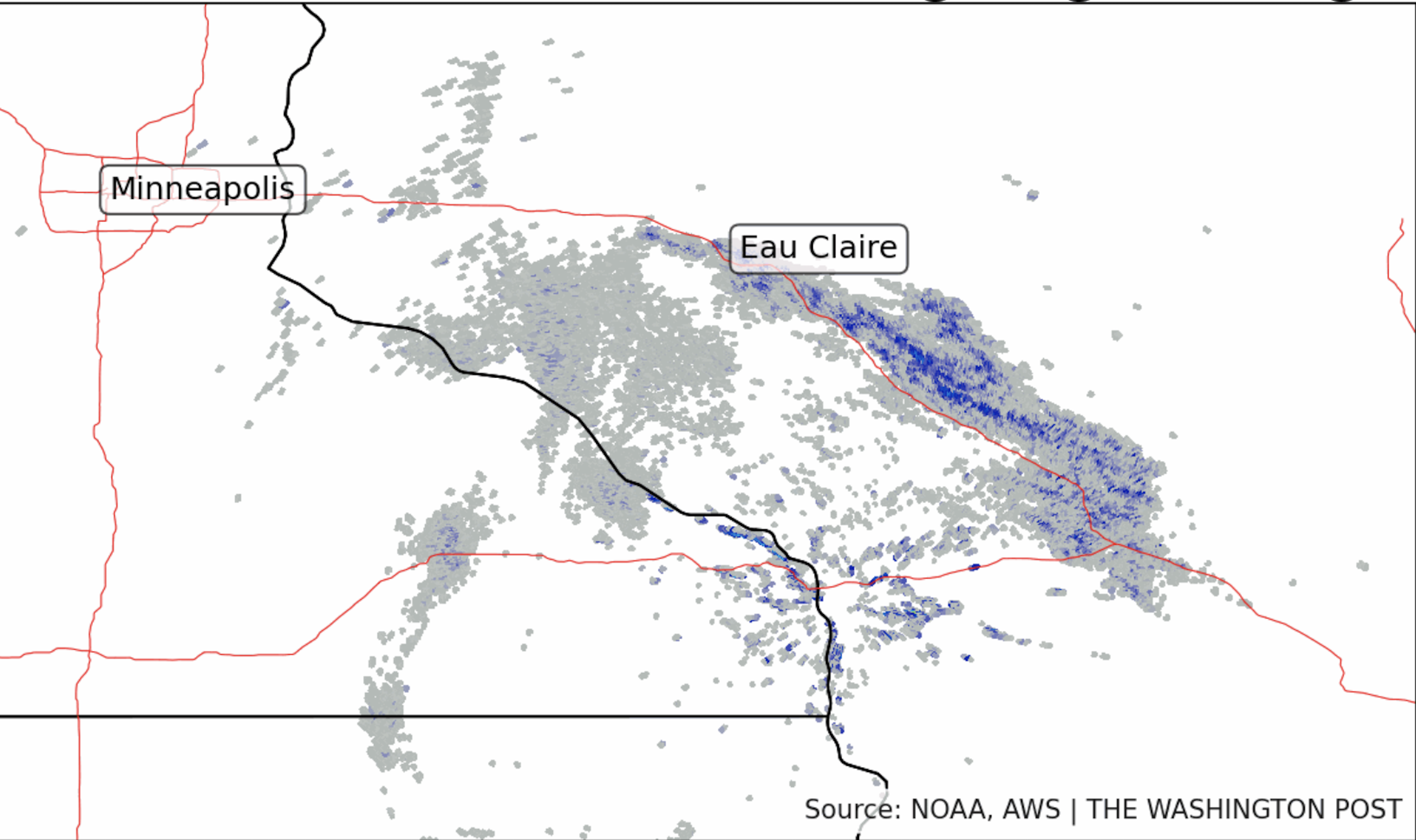
Radar imagery from Thanksgiving shows a 100-mile
long band of snow along Interstate 94 in Wisconsin
caused by, of all things,  factory.
Lake effect snowstorms are in the news this weekend. 

But here's an odd one: 

A factory-effect snowstorm shut down part of an Interstate highway in Wisconsin. That's right, a factory caused a snowstorm.

As the Washington Post describes it, a glass factory near Menomonie Wisconsin spewed steam and a few particles into the air on Thanksgiving, like it pretty much always does.

It was a dull Wisconsin morning, cold, damp, with a low overcast. Temperatures were in the 20s, and it was much colder than that a few thousand feet up.

The low stratus deck consisted of zillions of supercooled water droplets. 

Supercooled water droplets are at a temperature below freezing, but are still liquid. Those supercooled droplets will freeze if something hits them, like particles in the air or ice crystals.

The steam belching from the glass factory did the trick. As soon as the emissions hit that supercooled low overcast, the droplets froze and changed into snowflakes. Which fell out of the sky. In droves.

It was obviously only a very narrow band, as just one set of factory smokestacks can do so much. But the snow band pretty much paralleled Interstate 94 win Wisconsin for up to 100 miles. 

Hard to see due to thick snow falling, but traffic tie
ups on Interstate 94 in Wisconsin Thursday caused
by a weird factory-effect snowstorm. 

The variable visibility and slick pavement created by the snow caused some crashes which temporarily closed part of the Interstate.  There were reports of 16 crashes within five hours, including a six-car pileup. 

Snowfall amounts were fairly modest, as again, a factory isn't a lake and doesn't have the power to produce feet of snow like Lakes Erie and Ontario can in western New York. 

Still a good three inches of snow fell along some of the path of this factory-effect snow, so that's pretty impressive. 

This isn't the first time something like this happened but it's one of the more impressive. Emissions from power plants and even steam from relatively small rivers can create snow. Sometimes, it doesn't take much to make it snow. 


Monday, December 20, 2021

Tornadoes Highlight Workplace Safety, Or Lack Thereof, In Weather Emergencies

Remains of the candle factory in Mayfield, Kentucky 
after this month's tornado.  Was worker safety compromised
by managers not allowing employees to leave to 
find safer shelter?
Deaths at a candle factory in Mayfield Kentucky and at an Amazon warehouse in Edwardsville, Illinois during the big tornado outbreak earlier this month has put a spotlight on how workplaces deal with weather crises like tornadoes.  

Or not deal with them.  Worker safety during severe weather events seems not to be a priority. 

There' is admittedly s a lot of conflicting information and questions about how managers at the two devastated workplaces dealt with the oncoming disaster they faced on December 10.  It does seem like more could have been done to protect workers.  

At least eight people, possibly more, died during the tornado in the Mayfield Consumer Products factory. Six died when a tornado ripped apart the Amazon warehouse in Edwardsville.  There's also disturbing news of an Amazon delivery driver being ordered to continue her route despite tornado sirens going off around her, or she'd lose her job.

It became apparent at least a couple hours beforehand that Mayfield might be on trouble, given the path of a dangerous supercell and tornado originating in Arkansas. 

According to NBC News, workers were told they'd be fired if they left.

'"For hours, as word of the coming storm spread, as many as 15 workers beseeched managers to let them take shelter at their own homes, only to have their requests rebuffed, the worker said. Fearing for their safety, some left during their shifts regardless of the repercussions."

Around 5:30 p.m. that day, tornado warnings went off around Mayfield. That warning turned out to be a false alarm. But it prompted employees to request going home because of the growing threat of a large, new tornado later that night that would devastate the town and level the factory. 

You don't want to be out driving when a large tornado is nearby, of course. But had people left the factory an hour, two or even three hours before the tornado, they would have had time to access tornado shelters or basements, which are safer than large buildings with free standing roofs, like the candle factory. 

A spokesman for Mayfield Consumer Products has denied the employees' accusations, calling them "absolutely untrue."   Workers there are suing, so I'm sure more information will come out on this. 

In Edwardsville, the Amazon worker in a warehouse near the one that was hit by the tornado said a colleague in the hit warehouse had her phone with her.  That enabled the worker to receive the tornado warning. She said that allowed her to run for shelter. She would not have known the tornado was coming if not for the cell phone warning. 

Amazon, however, takes a dim view of employees having their cell phones with them. 

As NBC News reports: 

"Workers at two neighboring Amazon facilities in Edwardsville, just outside St. Louis, who were also in the path of the tornadoes overnight Friday, said they had little training in preparing for tornadoes and bristled at a company policy that multiple sources have said the company is trying to bring back Jan. 1, which would ban workers from having cellphones at work."

Many if not most people nowadays receive weather warnings via their smart phones. Banning cell phones would leave Amazon workers at the mercy of managers who might or might not hear tornado warnings, or not care enough if a tornado materializes.

NBC also said Amazon workers told them they are expected to work while there are tornado warnings, which is a big no-no. Especially in a building like a huge Amazon warehouse. 

These warehouses are huge and flimsy, without a lot of support beams to support the structures in the extreme winds associated with a tornado. The entire south half of the Edwardsville Amazon warehouse was shredded.

Tornado warnings for Edwardsville were issued at least 20 minutes before the tornado hit. However, Amazon managers either didn't take the warnings seriously, didn't know what to do with them, or more depressingly if true, prioritized production over worker safety.  

As The Intercept reports:

"....messages revealed a communication breakdown in which corporate failed to notify employees about the tornado even as it happened.  The Intercept quoted one employee who said, 'Corporate and IT were troubleshooting network outages and found out the building was hit by a tornado from the media.'"

In other words, if this report is true, the mucky mucks were much more concerned about production problems than dealing with the real danger - the tornado. 

The same day Mayfield was hit, this Edwardsville, Illinois
Amazon distribution center was hit by a tornado, 
killing six workers. Critics are saying that Amazon's
tornado and weather safety protocols are
severely lacking. 

This reading of Amazon managements' dismissive attitude toward employees in danger is also reflected in the tale of an Amazon delivery driver caught out in her truck in worsening weather as tornado sirens blared around her.

Bloomberg offered screen shots of text messages between the driver and managers. I know this is going to help make this post long, but you really need to read the exchanges to see how cavalier Amazon can be with worker safety.

Driver: "Tornado alarms are going off over here."

Dispatch: "Just keep delivering for now. We have to wait for word from Amazon. If we need to bring people back, the decision will ultimately be up to them. I will let you know if the situation changes at all. I'm talking with them now about it."

Driver: "How about for my own personal safety? I'm going to head back. Having alarms going off next to me and nothing but locked buildings around me isn't sheltering in place. That's wanting to turn this van into a casket. Hour left of delivery time. And if you look at the radar, the worst of the storm is going to be right on top of me in 30 minutes."

Dispatch: "If you decided to come back, that choice is yours. But I can tell you it won't be viewed as for your own safety.The safest practice is to stay exactly where you are. If you decide to return with your packages, it will be viewed as you refusing your route, which will ultimately end with you not having a job tomorrow. The sirens are just a warning."

The things the dispatcher said are absolutely astounding. "Sheltering" in a delivery van on a street during a tornado is pretty much the most dangerous thing a person could do.  Flying debris would be a mortal danger to anyone in a van. 

"The sirens are just a warning." ' Well, duh!!!! The sirens are a warning that a tornado is approaching. So they should be disregarded?  And saying that taking basic tornado safety will cost the driver her jo is absolutely beyond the pale. 

What should have happened is the managers should have directed the driver to at least return to the warehouse to go into hopefully a safe room. Even better, the driver should have been instructed to stop, seek a business or home in a well constructed building, and go into a tornado shelter, a basement, or a windowless, interior ground floor room.  I know the driver said there were a lot of locked buildings, but she could have found a safe refuge if she started looking at the moment the tornado sirens went off.

You can see this "profits before people" ethos in other weather safety incidents involving Amazon. Says The Intercept:

In one case earlier this year, an Amazon contractor in southern Illinois sent a letter to Amazon requesting several hours off his shift in preparation for Hurricane Ida. An Amazon seller support manager replied that the contractor's performance would suffer.

'It's important to confirm the shipment of orders by the expected date so that customers can see the status of their shipped orders online,' the manager told the contractor. 'Orders that are ship confirmed late may lead to increased negative claims, negative feedback and/or customer contacts and negatively impact customer."

Amazon's bungling or worse of tornado safety is just more evidence that the behemoth company's culture is to dismiss worker safety.  There's been scandals on high rates of worker injury, inadequate bathroom breaks and lame Covid protocols. 

And heat stroke, to get back to weather hazards. Like during the unprecedented heat wave last June in the Pacific Northwest. 

Gizmodo, quoting the Seattle Times, said "workers at the company's Kent, Washington facility endured near 90 degree heat while some stations pushed employees to work at maximum speed in the unprecedented weather for so-called 'power hours.'

There have been several other complaints of heat, causing worker illness and even deaths at Amazon facilities in Chicago, New York, New Jersey, Connecticut and Pennsylvania. 

For all the above reasons, I don't do business with Amazon.  I buy my goods directly from retailers and suppliers.

Of course, just one person - me - doesn't make a huge difference and Amazon remains hugely popular with consumers. 

Amazon and other online retailers have "trained" consumers to expect their shipments to arrive at the drop of a hat. I work in customer service for an online retailer, and there is a thankfully small subset of "Karens" who don't give a whit if there's an excellent reason why their order is late, even if that reason is because of a collapsed warehouse or worker deaths. 

Most of us are quite willing to have our packages slightly delayed if it means the driver remains safe from harm. Unfortunately, a minority of consumers think it's worth it for people to die to ensure the tchotchkes they ordered arrive instantaneously.  (These are the same people who protest loudly when a TV station interrupts some dumb show like "The Bachelorette to broadcast tornado warnings).

Social media sites like Twitter and Reddit are rife with stories of bosses and corporations demanding employees show up to work in dangerous weather conditions. 

That has to change. I can see a boss being miffed if an employee won't drive to work in a light snowfall in a northern climate. But it's time to rain hell on employers who insist workers risk their lives in hurricanes, tornadoes, floods, ice storms and other hazardous weather just to raise the bottom line by a few pennies.

This shouldn't be a new Gilded Age. This shouldn't be dystopia. Any employer who risks workers' lives for any reason, including dangerous storms, need to suffer some gawd-awful consequences.