Showing posts with label firings. Show all posts

Tuesday, August 19, 2025

Sharpiegate Comes Back, Like The Monster That Won't Die

"Sharpiegate" started six years ago over Donald
Trump's failed attempt at forecasting Hurricane
Dorian. It's still going on today with the firing
of two NOAA officials, in part because
 Trump. Just. Can't. Let. It. Go.
 Sharpiegate is back in the news, in a typically depressing way. 

Back in late July, two NOAA scientists who defied Trump in the name of accuracy and science in his first administration are being sacked.  It looks like because Trump has a long memory, at least in terms of loyalty.  

"Two top National Oceanic and Atmospheric Administration officials who played a role in the high profile "Sharpiegate" investigation at the agency were placed on administration leave this week. 

Stephen Volz, the assistant administrator at NOAA's Satellite and Information Service, and Jeff Dillon, a deputy general counsel at NOAA, were placed on leave..."   Volz told NBC News."

You might remember Sharpiegate. Back in 2019 Trump incorrectly said Hurricane Dorian was threatening Alabama, but National Weather Service meteorologists in Alabama contradicted him, accurately saying the storm was no threat to Alabama. 

A normal president who might have been misinformed like that would say, "Oops, we have updated info that says Alabama doesn't have to worry, so we'll move on."

But this is Trump of course, who can never be wrong about the slightest thing. He  later produced a forecast map that had been amateurishly altered by a Sharpie to suggest Alabama had been threatened by the storm.   To make everything worse, top NOAA officials, appointed by Trump in his first administration, rebuked those professional and accurate Alabama meteorologists.  

Which of course looks like political pressure and not science to me and pretty much everybody else 

 Here's why we think Volz and Dillon are in trouble now.  Neil Jacobs was nominated by Trump as his pick to head NOAA. Jacobs got in trouble with Sharpiegate. Per NBC: 

"NOAA hired the National Academy of Public Administration to perform an independent assessment into allegations of scientific misconduct during the incident. The investigation found that Jacobs violated NOAA's ethics policies. 

Volz wrote the final decision about the report for NOAA, which agreed with NAPA's findings. He said Dillen worked on that document also. Volz said he did not know whether notices that they'd both been put on leave on the same day and their connection to the 'Sharpiegate' report were a coincidence."

CNN talked to former NOAA officials who smell a rat. One said: "It's an interesting coincidence that less than a week before Neil Jacobs sent committee vote, the two dedicated career civil servants who investigated him for scientific integrity violations around Sharpiegate were dismissed from service."

 NOAA confirmed the pair had been placed on leave, but are tightlipped on why. Dillen is out due to unspecified "performance issues." Volz is out for an "unrelated matter."

 They're not even telling Volz why he's out. 

 It's all for plausible deniability. It looks bad to admit they're getting rid of Volz and Dillon to soothe Trump's narcissistic ego. So they're denying it has anything to do with Sharpiegate. 

NOAA's communications director, Kim Foster, had this to say: "Neither action is related in any way to each other or the Sharpiegate investigation."

Sure, Jan. 

As for Jacobs, the Senate Commerce, Science and Transportation Committee on July 30 advanced his nomination, but we don't know yet when the full Senate will vote on the nomination. 


Tuesday, March 4, 2025

More Trump Moves On Top Of NOAA Firings Will Threaten Forecasting And Peoples' Lives Even More

Now, the Trump team might shut down leases on
critical NOAA/National Weather Service 
forecasting buildings, further degrading 
the quality of U.S. weather forecasting on top
of the harm the administration's firing of hundreds
of NOAA workers did last week. 
 The Trump administration looks like it wants to end the leases on two buildings that house critical NOAA and National Weather Service nerve centers. 

First reported in The Verge, it appears the NOAA Center for Weather And Climate Prediction is on the list for a lease cancelation. 

Reports Axios: 

"The building houses the National Weather Service's National Centers for Environmental Prediction, or NCEP, which includes the Environmental Modeling Center. It opened in 2012 and has about 268,000 square feet of space. 

The modeling center runs the computer models used in day-to-day weather forecasting and ensures the weather data correctly goes into these models and that they are operating correctly."

This center provides information to the National Weather Service, Air Force, Navy and Federal Aviation Administration, as The Verge reports. 

So it''s not just a matter of you ending up with a little rain on a day that forecasters said was going to be partly sunny. These operations are crucial for public safety in severe weather, national defense, and airline safety. 

Additionally NOAA has canceled a lead for a radar development lab in Oklahoma. 

So far, luckily, the lease cancelations are not a done deal, if you can believe Trump administration officials. 

Per Axios:

"A senior White House officials told Axios on Tuesday that for NOAA, the administration is "simply re-evaluating the lease terms, not closing any building, which any good steward of money would do.  The official stressed that no formal lease-cancellation letter has been sent to NOAA. The official acknowledged that DOGE is canceling leases at other government agencies, but said NOAA is an exception."

Predictably, and accurately. many experienced meteorologists decried the idea of ending the building leases - and likely the operations they run - as a dangerous move that will cost American lives. 

"This is horrible news for numerical weather prediction in this country. The data that comes from these key parts of our weather enterprise saves lives," Jim Cantore the famed meteorologist on The Weather Channel posted on X.

Meteorologist Brad Panovich, Chief Meteorologist at WCNC in Charlotte, North Carolina raised this excellent point on X:

"This will literally bankrupt the U.S. If you ever wondered why NOAA/NWS is in the department of commerce, I have some news for you. Every single $ of our economy is impacted by the weather. Agriculture, Energy, Travel, Logistics, Defense, logistics of every major company etc. I could go on but you get the idea."

Panovich said he thinks, or at least hopes, the lease cancelation idea will be reversed.  

Meanwhile, the Washington Post recently dove a little deeper into how all those firings at NOAA would affect weather forecasting. 

Here's only a few examples. 

For one thing, around the clock weather monitoring could suffer. After all, dangerous storms can happen anytime of day or night. What if radar went down in the wee hours of the morning just as a swarm of tornado-producing thunderstorms approached a particular region?

After tornadoes, the National Weather Service sends meteorologists out to survey damage. That's not just to be looky loos.  The damage assessments help them determine how strong the tornado was. Then they can analyze radar and other data from during the storm to help them better forecast the path and strength of future tornadoes that might form. 

As much as 25 percent of the staff at NOAA's Environmental Modeling Center was cut.  This is the office that builds, maintains and improves the computer models widely used in weather forecasting. 

If these models are not maintained and built, the data gets worse, and so does the forecast accuracy. That's important when a large storm like a hurricane or intense nor'easter seems likely to form.  Emergency managers want the best model so they can accurately pre-position resources to quickly step in to help.

By the way, cuts to NOAA and the National Weather Service will not only cost lives, but also likely cost money, not save it.

The average United States taxpayer spends $3 for all the services and products the National Weather Service provides.   A 2019 study indicated that every $1 invested in the National Weather Service produces $73 in value for Americans. 

Today, an exceptionally large and powerful storm is sweeping the middle of the nation. It's spinning off tornadoes, blizzards, wildfires, floods, snowstorms and an incredible huge area of dangerous high winds stretching from New Mexico to New York. 

I hope that's investigated. 

This storm would have been incredibly challenging for National Weather Service meteorologists before the job cuts and the uncertainty and the morale issues this whole mess has brought on. 

Some tornadoes touched down in Texas.  A few of them had no warnings from the National Weather Service. It's still unclear if that was because the weather system was so complicated it was hard to tease out the developing tornadoes (possible), or whether this was related to last week's NOAA job cuts. 

As the spring severe storm season comes into focus, I fear we will have more "surprise" tornadoes because the Trump administration got rid of too many of the eyes that should be looking into these storms. 


Friday, February 28, 2025

Trump To People Threatened By Dangerous Weather: Drop Dead

Friday's firing of hundreds of staffers at NOAA,
including the National Weather Service, put
American lives in danger, but the Trump
administration is unconcerned about that. 
As expected and dreaded, the Trump administration, led by the Elon Musk putting public safety during extreme weather events in jeopardy. 

The firings include positions at the already-understaffed National Weather Service, which is the nation's front line warning system for when storms turn dangerous. 

Exact numbers are hard to come by, but it looks like about 10 percent of NOAA's work force would lose their jobs. 

The first test of how these cutbacks will affect public safety could come as early as Tuesday and Wednesday, as a potentially significant tornado outbreak seems possible across the Deep South. 

Such outbreaks of severe weather require a high level of attention from meteorologists because such conditions evolve quickly. A harmless thunderstorm can become tornadic in minutes, and the National Weather Service needs to be ready to issue warnings. 

A lack of staff could mean key hints that a tornado is forming could be missed.

Per the Washington Post:

"Daniel Swain, a climate scientist at the University of California at Los Angeles, said the move to fire NOAA staff 'including mission-critical and life-saving roles at the National Weather Service is profoundly alarming'

'I want to be clear: If there were to be large staffing reductions at NOAA and NWS...there will be people who die in extreme weather events and weather-related disasters who would not have otherwise.'"

The firings include about 375 probationary employees at the National Weather Service. The pre-existing short staffing there is due in large part to a previous hiring freeze imposed by the Trump administration. 

Also on Friday, news broke that a federal judge ruled the mass firings of probationary government works across several agencies are probably illegal. The judge ordered the Office of Personnel Management to rescind directions ordering the mass firings.

It's unknown how this ruling will ultimately affect the firings at NOAA and other agencies. 

Already the cutbacks are being felt. The National Weather Service routinely launches balloons into the air so minute details of atmospheric conditions can be assessed. This data is fed into forecasting computer models. 

Balloon launches are already being canceled due to new staff shortages, so the quality of these forecasting models might well diminish.  That's especially bad when emergency managers are trying to get an idea in advance of where a severe storm might go and how bad it will get.  This helps them pre-position supplies in the path of the storm to get an early jump on recovery. 

Worse climate models will mean worse, more inaccurate forecasts. 

Besides, a lot of FEMA workers have been canned by Trump and Musk, too. The combination FEMA and National Weather Service firings will certainly mean emergency responses to U.S. weather disasters will become much worse. Again, unnecessarily threatening lives. 

Your local TV meteorologist will be affected by the cutbacks as well. They rely on data from the NOAA and the National Weather Service to formulated their forecasts. If the data degrades because the NWS firings, so will the TV meteorologists' forecasting accuracy, no matter how talented that meteorologist is. 

Well known, professional meteorologists around the nation condemned the firings. "Mass firings have started at the National Weather Service, including people in critical roles. Cutting waste is great. Mindlessly taking a sledgehammer to a valuable organization is stupid. All the know-it-alls who said we were fabricating this threat can shut up now, thanks," said Josh Morgerman on X.  Morgerman is a well -known hurricane and typhoon chaser and documentarian. 

When the decision to fire NOAA staffers seemed imminent but hadn't quite happened yet, veteran meteorologist (and one of the nation's top tornado experts) had this to say on X:

"The post is not about politics, but about support for my friends that work for the National Weather Service, part of NOAA, a federal agency.

NWS meteorologists work long, hard hours serving the people of this country, not only during times of severe weather, but on routine days as well,

Their surface and upper air observation networks along with computer models radars and satellites are critical for all meteorologists, including those of us in the private sector."

There is already some political pushback to the NOAA firings. We'll see what happens with those. Colorado Sens. John Hickenlooper (D) and Michael Bennet (D) and Rep. Joe Negus (D) have called for an independent investigation into the mass firings, according to The Hill. 

I know this seems awfully conspiratorial, but I think a goal of the Trump administration is to have people live in fear. They're easier to control that way. So they fear having Medicaid, and Social Security taken away. 

The NOAA firings are another form of fear: Will we still receive adequate warnings when severe weather threatens?

This is all also likely to be a part of Project 2025, the wide ranging 922-page plan developed by the conservative Heritage Foundation to remake the federal government under Trump. 

Trump seems to be playing by the Project 2025 playbook. That plan called for privatizing weather forecasting in the U.S.  That, would, of course, make weather forecasting less reliable, and perhaps put critical weather warnings behind paywalls that some people might not be able to afford. 

I still worry we're heading in that direction, which would be even worse that the stupid, ill-advised NOAA firings we saw on Friday. 

This also all could further enrich Trump. Musk and other U.S. oligarchs. Hey, if the billionaires are able to collect a few extra billion beyond what they already have, it's worth the price of lost lives. At least in their rotten minds. 


Friday, January 31, 2025

Local Meteorologists Fired In Ill-Advised Cost Cutting Move, Public Outcry Ends Up Saving Those Jobs, Offers Lessons For Trump Admin

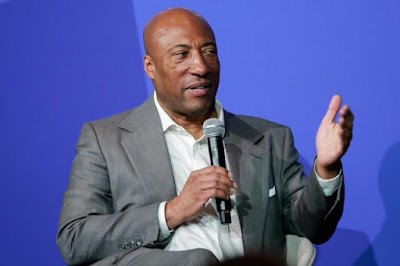
Allen Media Group, owed by billionaire Byron Allen,
pictured here, tried to get rid of dozens of 
meteorologists at their local television stations and
replace them with a consolidated group
of Weather Channel meteorologists in Atlanta.
This did not go over well and was rescinded,
but it's a reminder of how corporate consolidation
hurts locals, including their important weather info,
Local television meteorologists very often quickly get a big fan base, for very good reasons. 

They tend to be personable, and also quickly learn the lay of the land, meaning they're on top of local conditions that make storms worse or less severe depending on which neighborhood they hit.  These meteorologists really become the public's eyes and ears on the ground when the weather crap hits the fan.

Which leads us to the Allen Media Group's really stupid, now rescinded move to fire meteorologists at local stations it owns.  Their weather forecasts would come from Weather Channel meteorologists in Atlanta, who might be excellent at their jobs, but have little idea of the nuances that really make local weather forecasters indispensable. 

This whole kerfuffle gives us lessons on the evils of corporate consolidation, which ensures big money for the CEO but messes with the quality that the public should expect.  

The hijinks of these private corporations also gives us a warning regarding the fate of the National Weather Service. The NWS is  a critical resource in which their meteorologists in regional offices,  like their local TV counterparts, know the areas they cover like the back of their hands, making their storm warnings all the more accurate and effective.

I bring this up because there are fears that the Trump administration could actually disband the National Weather Service and rely on corporate meteorological corporations without that local expertise, and the sense of duty you'd expect from local experts. 

More on that in a moment. 

ALLEN MEDIA AND THE RESCINDED PURGE

Local meteorologists tend to be underpaid, but their dedication to their craft is legend. 

They come to us every day with useful information, and sometimes, with timely, life-saving alerts and warnings. They'll tell you the precise neighborhood the tornado is heading towards, which streets are about to go under water in a flash flood, and why the roads in, say, Waterbury are about to get snow covered and slippery while the roads up in Burlington will stay just fine. 

As one person LeeWatson_357 posted on X:  "Laying off Weather People in tornado prone areas is very dangerous. People based in Atlanta don't know the local areas in markets like Tupelo, Mississippi."

All this made the supposed  cost-cutting move by Allen Media Group, owned by billionaire Byron Allen, this month really stupid.. They axed local meteorologists for television stations and would just send forecasts from its Weather Channel headquarter in Atlanta to its stations across the county. 

As Variety reports:

"Handing out pink slips to dozens of beloved small-market local TV news weathercasters would be ill-advised even in the best of times. But to do it right as unpredictable and dangerous weather disasters tear across the country this month - from wildfires in California to a historic freeze in the south - was particularly tone deaf."

Apparently, local viewers understand this. A huge public outcry led Allen Media Group to rescind the firings. At least for now.

It looks like all the affected television stations were given the same statement from Allen Media Group to read: "After receiving significant feedback across various markets, Allen Media has decided to pause and reconsider the strategy of providing local water from the Weather Channel in Atlanta and (local television station) will continue to provide market-leading coverage from your Storm Tracker Meteorologists."

As tvtechnology.com reports, local stations affected by the layoff cancelations were grateful to their audiences. "Your calls, emails texts... every word spoken in support of our team was heard, and without your outpouring of messages that rang so loud, this change may not have been possible," said Craig Ford, the news anchor for ABC affiliate WTVA in Tupelo, Mississippi. 

LESSONS LEARNED

This bad move by Allen Media was averted, but these consolidation efforts are happening throughout the media. It's not just meteorologists: 

Variety reports:

"Sinclair, CBS, Gray Media and others have done variations of the same in recent years. These cost-cutting moves are a disappointing financial reality given a soft advertising marketplace and audiences turning their attention away from TV.  It's also happening in newspapers of course. But what's lost in these moves to centralize coverage is the local expertise and nuance that goes from having your boots on the ground, knowing the intricacies of your community and having a personal relationship with viewers. 

Ironically, removing all of that will only hasten the demise of local media as we know it. What is more local that the daily weather forecast? Stripping away the very selling point that still makes broadcast valuable - it's live, local nature - may help save a few coins in the short run, but it's a recipe for obsolescence in the long term."

I witnessed that here in Vermont when I worked at the Burlington Free Press. It was founded in 1827 and became a daily in 1848.  It had a storied past of ground breaking Vermont journalism. When I joined the paper in the late 1980s, it was still the to-go source for news and information. 

The paper's corporate overlord kept doing its cost cutting, laying off workers in waves (I was finally led go in 2013). Now the Burlington Free Press is pretty irrelevant, online only, and no longer a source of local news brought to you by journalists who really knew the community. 

NATIONAL WEATHER SERVICE

During his campaign, Donald Trump professed to know little about Project 2025 and he said he had even less involvement in it.

Project 2025 is a detailed plan developed in recent years by the conservative Heritage Foundation explaining how they wanted to radically change the federal government. This plan would only happen, the conservatives thought, if Trump was elected. 

And here we are. 

As I wrote last August, one of the ideas in Project 2025 would privatize the National Weather Service. Some private corporation would issue forecasts from somewhere, probably with less expertise, never mind any expertise on local conditions.  Perhaps the forecasts and life saving weather warnings would be behind a paywall, making only people with means to be able to hear, say, a tornado warning.

So far, nothing like this has been proposed, but the Trump administration is still very young. It could definitely still happen.

Which brings us back to public outcry. 

Loud opposition to Trump's steamroller of dubious decisions won't overturn all of them.  But public opposition is already slowing down and in some cases at least temporarily stopping some bad idea. As seen in the Allen Media Group blunder, the public can change things it doesn't like. 

Especially when it involves crucial resources and safety that are held near and dear to hearts of the public.