
Showing posts with label melting. Show all posts

Saturday, April 11, 2026

Why Are There Still Southern Snowbanks? Latent Heat Takes Time

Old snow piles take forever to melt. 
Every spring, we in Vermont see dirty, sad monuments to the past winter. 

They're in the form of those dirty, ugly slowly fading piles of snow at the edges of supermarket parking lots and back behind strip malls. The piles are a remaining bit of late winter grossness while trees bud and flowers bounce happily in the spring breezes nearby. 

This spring, people in the the southern United States had the rare opportunity to experience these fading remembrances of winter and they were freaking out. 

Usually when it snows in the south, it's usually a wet, heavy slop that's so close to water anyway that it melts quickly. Or it's a quick shot of fluffy, usually a couple inches at most.

This winter, a huge swath of the South, Midwest and Mid-Atlantic States got basically snowy cement in January. It was a dense mess of snow, lots of sleet, all frozen together by a round of freezing rain. 

In February, southerners freaked out this mess wasn't melting, despite temperatures occasionally poking well above freezing. The conspiracy theories swirled. It wasn't melting, so it wasn't "real" snow. The government, the corporations, the oligarchs were doing.....something.

But there's reasons why that snow and ice didn't melt fast. We'll get to that in a minute. 

Then, the dirty icy "monuments" in the parking lots in the South remained well into March. That's normal for us in Vermont, but it's completely bizarre for people in Tennessee, or Virginia or even Maryland and New Jersey.   

The conspiracy theories started again. Snow always melts way before now! Something is wrong! say the worried conspiracists.  Even if people didn't believe the conspiracy theories, they still remarked about black piles of debris in Philadelphia in late March that were in fact leftover snow piles. 

Montclair, New Jersey residents are annoyed by lingering snow dumps in parks.  The snow was removed from streets in the winter, and left in the parks. As of earlier this week, much of the snow was still there, covered in grime and flecked liberally with trash. Big piles of "snowcrete" remained at the airport in Baltimore as April arrived. 

Now all these residents get to enjoy what we Vermonters do: On top of our mud season, the rotting piles of dirty snow  in parking lots and the grimy puddles surrounding them are as much a scene of spring as crocuses and budding trees.

Big old snow piles need a lot of what is known as latent heat of fusion to completely melt.  Latent heat of fusion is just the energy needed to turn ice from a solid into a water a liquid. That's not the same as temperature. It's not a matter of just heating up the ice. Energy has to go into the process of converting ice to water. 

According to the Boston Globe via Mental Floss: 

The piles are dense and heavy, especially since they formed in large part from sleet in addition to some snow. The piles were plopped there, become even more dense and heavy. The snow closer to the surface  starts acting as an insulator for the snow buried further down. The compact snow requires more energy to dissipate.

If you really want to get rid of an old ugly snow pile, you can spread it out with a shovel or backhoe. If more surface is exposed to the air, it will melt faster. If you don't have the energy to do that, pray for rain.

A well soaked snow pile melts faster than one that sits out there day after dry, sunny day .

And it could be worse. In the winter of 2015, Boston had epic amounts of snow, we're talking several feet in a few weeks. The city piled snow in back lots in a desperate attempt to get it off the streets. Not all of that 2015 snow melted until July.

Thursday, December 26, 2024

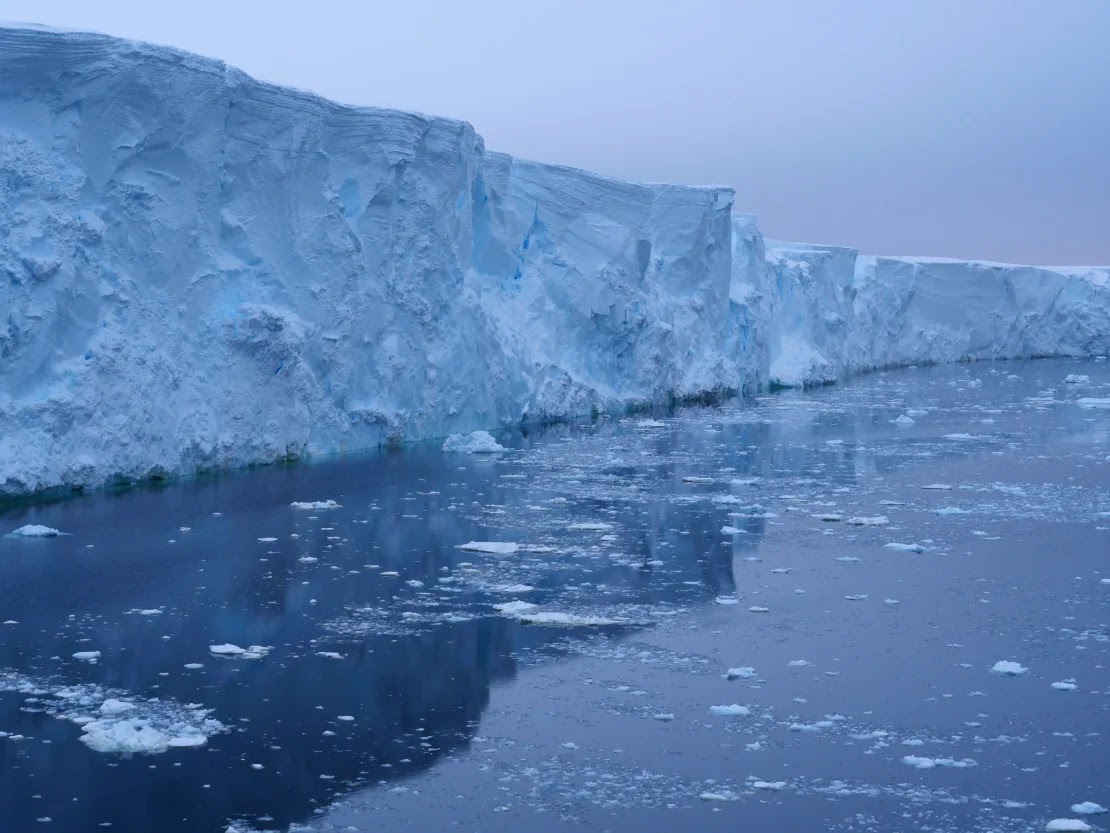
"Doomsday Glacier" Might Postpone Its Troublemaking. Maybe.

A part of Thwaites Glacier in Antarctica, which has been
the focus of a lot of study, with worry about climate-
induced sea level rise. Photo from 
British Antarctic Survey
For years, a certain giant glacier in Antarctica has been known as the "Doomsday Glacier", with scientists saying it could collapse at almost any time, causing some abrupt and damaging worldwide sea level rises.  

Luckily, the Thwaites Glacier, as it's known, might not be so scary after all. At least not yet. And it is still at least a little frightening to climate scientists.  

Says Newsweek:

"The research suggested that a catastrophic collapse of the glacier, which could lead to rapid and drastic sea-level rise, is less likely to occur this century than previously thought. 

The Thwaites Glacier in West Antarctica - about the size of Florida - has been a major focus for climate scientists due to its unstable nature and significant contribution to sea level rise.

Currently, it accounts for about 4 percent of the annual increase in sea levels and holds enough ice to raise them by over two feet if it fully melts, according to the International Thwaites Glacier Collaboration."

Marine ice cliff instability or MICI is when ice shelves collapse, they expose big ice cliffs that often collapse from their own weight, causing a chain reaction of rapid glacier retreat, says Newsweek. 

Scientists have studied MICI in theoretical settings and climate models but never in real world situations. Until now. Newsweek continues:

"Using updated computer simulations, the Dartmouth team found that MICI is unlikely to occur this century at Thwaites. Even if the glacier's entire ice shelf were to collapse today, the resulting ice cliffs would likely not be tall enough to crumble and trigger the catastrophic chain reaction previously feared."

This study contradicts what scientists were saying even just several months ago, that the Thwaites was headed toward imminent collapse. 

That's not to say this thing is perfectly safe.  First of all if it were to collapse, the two foot sea level rise wouldn't be the end of it.  The glacier acts as sort of a giant dam, holding back huge sections of the Antarctic ice sheet. If Thwaites went away, much of that ice sheet would flow into the ocean, eventually raising sea levels by ten feet.

Which wouldn't be good if you live in a low lying coastal city. Like Miami, for instance. 

As recently as September, scientists said comparatively warm sea water was infiltrating beneath the base of the glacier, accelerating melting on its bottom.  That would help accelerate its rate of melting, so that's not good. 

Even if Thwaites were no big deal, we're not safe from sea level rise. 

 It's still going up due to climate change. Sea levels are going up by about 0.13 inches per year. That doesn't sound like much, but it makes a big difference after a few decades, especially in highly developed, flat and sinking coastal regions. 

Plus, the pace of sea level rise is starting to increase. 

Saturday, March 30, 2024

Is Climate Change Making Days Longer, Slowing Earth's Rotation?

 Apparently, Earth is spinning more slowly than it used to because of climate change.

Earth's rotation has slowed down ever so slightly, due
to, believe it or not, climate change.
It's definitely not slow enough for you to notice it, though. 

It does turn out that melting ice from glaciers and ice caps and such are messing up the Earth's rotation just a little bit.  

According to Nature.com:

"An analysis published in Nature ......has predicted that melting ice caps are slowing Earth's rotation to such an extent that the next leap second - the mechanism used since 1972 to reconcile official time from atomic clocks with that based on Earth's unstable speed of rotation - will be delayed by three years.

'Enough ice has melted to move sea level enough that we can actually see the rate of the Earth's rotation has been affected,' says Duncan Agnew, a geophysicist at the Scripps Institution of Oceanography in La Jolla, California and author of the study."

This is all being looked into by metrologists, who are scientists who study measurements, not to be confused with meteorologists, who study weather. 

Precision timing via atomic clocks means every once in awhile adjustments need to be made to match the Earth's rotation. 

Probably due to changes in the Earth's core, the planet's rate of rotation had been increasing a little since the 1970s or so. That has made those occasional leap seconds necessary.

The world-wide bodies that keep track of this sort of thing had scheduled a "leap second" in 2026.  But since the Earth's rotation is now that itty bitty bit slower than it used to be, the leap second has been postponed to 2029.

You wouldn't think Earth's rotation slowing by such a minuscule amount would matter to you and me, but it turns out it does.

Nature.com explains: 

"A delayed leap second would be welcome by metrologists. Leap seconds are a 'big problem' already, because in a society that is increasingly based on precise timing, they lead to major failures in computing systems, says Elizabeth Dooley, who heads the time and frequency division at the National Institute of Standards and Technology in Boulder, Colorado. "

So, in this case, climate change is doing people a favor, for a change. Obviously the bad greatly outweighs the good, but I suppose there's a bright side to everything.

For now anyway. 

If the Earth's rotation slows enough to require a negative skipped second rather than one being added, it would create a nightmare. There's no accounting for it in all the existing computer codes, so nobody is sure how to make a negative second work.

We should also probably explain why melting glaciers and such are making the Earth's rotation slow down. To understand, it try to think of Earth as a figure skater. 

Nature.com gets into it:

"Data from satellites mapping Earth's gravity show that since the early 1990s, the planet has become less spherical and more flattened, as ice from Greenland and Antarctica has melted and moved mass away from the poles toward the Equator.

Just as a spinning ice skater slows down by extending their arms away from their body (and speeds up by pulling them in), this flow of water away from Earth's axis of rotation slows the planet's spin."

Climate change is why metrologists are worries about "negative leap seconds."  As more and more ice melts from Greenland and Antarctica, the Earth's slowdown will probably continue. 

Scientists plan to eliminate leap seconds in 2035 in favor of much less frequent leap minutes. Leap seconds are just not worth the trouble. 


Wednesday, August 23, 2023

Even Highest Altitude European Glaciers Can't Escape This Summer's Heat

A Swiss glacier with blankets over it in a last ditch effort
to slow melting during heat waves. A new heat wave is
breaking records for the highest elevation of above
freezing air over Europe. 
 Swiss meteorologists said that Monday night, you had to reach an elevation of 17,381 feet before you encountered subfreezing air. below 32 degrees, or 0 degrees Celsius. 

That's the highest elevation on record in which above freezing air reached. 

That sounds esoteric, until you consider that Switzerland's vaunted glaciers are all below that elevation, subjecting even the highest glaciers to melting. 

According to the Associated Press:

"MeteoSwiss meteorologist Michael Schwander said it marked only the third time such readings had been tallied above 5,000 meters (16,404 feet) - and that the level was generally around 3,500 (11,483 feet) to 4,000 meters (13,123 feet) in a typical summer. 

'With a zero degree far above 5,000 meters, all glaciers in the Alps are exposed to melt - up to the highest altitudes,' said Daniel Farinotti, a glaciologist at the federal technical university in Zurich, ETHZ in an email. 'Such events are rare and detrimental to the glaciers' health, as they live from snow being accumulated at high altitudes.'

'If such conditions persist in the longer term, glaciers are set to be lost irreversibly,' he said."

Switzerland has about 1,400 glaciers, the most in Europe. They've lost at least half of their total volume since the early 1930s. They've lost 12 percent of their volume in just the past six years, the Associated Press reports.

The high elevations hot spell in Switzerland is part of an intense heat wave now hitting much of Europe. It's being caused by a "heat dome," which is intense area of oddly warm high pressure sitting over parts of the continent. A similar heat dome is afflicting the central United States with record heat. 

In France, people are being told to avoid high elevations in the Alps, because melting ice is opening new crevices in glaciers and causing rock falls. 

Four regions in France are under a rare red alert, which allows local officials to cancel outdoor events and take other measures to protect people from the dangerous heat.

The most tragic news from the European heat wave so far comes from Greece, where 18 charred bodies were found after a wildfire made possible by the record heat swept through. The dead were believed to be migrants. 

For once, we in Vermont are lucking out with the weather.  The heat in the Midwest and Plains is not forecast to spread east. Our temperatures should remain near or a little cooler than normal for at least the next week. 

Climate change, acting in concert with El Nino, has caused numerous record heat waves acros s the world since June. The month of July was the hottest on record for the world as a whole. Many climatologists expect August to be the world's hottest on record, too.


Monday, March 20, 2023

Antarctic "Doomsday Glacier" Label Is An Exaggeration, But Still A Big Problem For World.

They call it the "Doomsday Glacier" but how much is
this disintegrating ice shelf in Antarctica going to raise
sea levels. Could be a lot - eventually 
 Scientists are beginning to get a better handle on trouble with a so-called "Doomsday Glacier" In Antarctica that is falling apart a lot faster than climate experts would like. 

As the Associated Press tells us, polar scientist Britney Schmidt of Cornell University created a robot to poke around this glacier, whose real name is the Thwaites ice shelf. 

 Reports the Associated Press: 

"Before, scientists had no observations from this critical but hard to reach point on Thwaites. But with the robot named Icefin lowered down a slender 1,925 hole, they saw how important crevasses are in the fracturing of the ice, which takes the heaviest toll on the glacier even more than melting. 'That's how the glacier is falling apart. It's not thinning and going away. It shatters, said Schmidt, lead author of one of two studies in Nature."

That shattering accelerates the overall erosion of the ice shelf, scientist said.  

The glacier is about the size of Florida. People call it the Doomsday Glacier because if it all melts, global sea levels would rise by two feet, not including sea level rise from other sources. 

The good news is that it will take a few centuries for all of the Thwaites ice shelf to melt.  

On a geological scale, however, the changes with Thwaites are super rapid. Warmer water is eating away at the ice shelf from below. 

More from the AP:

"'Thwaites is a rapidly changing system, much more rapidly changing than we started this work five years ago, and even since we were in the field there years ago,' said Oregon State University ice researcher Erin Pettit."

Petitt wasn't part of the study mentioned above. But she continued:  "I am definitely expecting the rapid change to continue and accelerate over the next few years." 

Friday, January 27, 2023

More Bad Climate News: Frigid Top Of Greenland Isn't So Frigid Anymore

There's still an incredible amount of
ice in Greenland, but unfortunately.
recent studies suggest it is 
melting faster than first thought. 
 The top of Greenland's massive ice sheet is something like two miles above sea level. Given how high that is, and how far north it is, it's a frigid place. Thaws are rare, even in the summer. 

But even there, the climate change news is bad, as it seems to be everywhere. It's hotter up at the tippy top of Greenland than it's been in at least 1,000 years.  

Yes, yes, I know nobody was around to take the temperature of the Greenland ice cap 1,000 years ago, but scientists can still figure out how cold it was centuries ago.

As the Washington Post reports, that warmest in at least 1,000 years conclusion was reached by scientists  who looked at oxygen bubbles in ice taken from deep inside the ice sheet. '

The Washington Post tells us: 

"The samples allowed the researchers to construct a new temperature record based on the oxygen bubbler stored inside them, which reflect the temperature at a the time when the ice was originally laid down. '

'We find the 2001-2011 decade the warmest of the whole period o 1,000 years,' said Maria Horhold, the study's lead author and scientists at the Alfred Wegener Institute in Germany."

Warming has continued to ramp up since 2011, so the study's findings are probably underestimating how much the climate in Greenland has changed, the Washington Post reports. 

As I've said several times in this blog thingy, what goes on in Greenland doesn't stay in Greenland. Obviously, when any ice up there melts, it eventually flows into the Atlantic Ocean. This contributes to global sea level rises. 

If all of Greenland's ice melts, worldwide sea levels would rise by 20 feet. Obviously, the entire Greenland ice cap won't completely melt anytime soon. But any sea level rise, is bad, considering that melting glaciers around the world, and never mind all that ice thawing in Antarctica is feeding into the oceans, too. 

The warming at that high altitude top of the Greenland ice cap will eventually introduce a nasty feedback loop. 

Part of the reason why the ice cap over millennia has maintained itself is it's so high up. The higher you go, the colder the atmosphere is. That's why you have snow capped mountains in the summer if said mountains are high enough. 

But as the top of Greenland's ice cap melts, its surface will inevitably be at lower and lower elevations. So you end up combining increased temperatures from global warming with higher temperature for simply being at a lower altitude. The rate of melting would then increase for two reasons, not just one.

Climate denialists will note that at some point this winter, it was 65 degrees below zero at a station in Greenland. Yes, that's damn cold. But something called "winter" is going on. Greenland is a frigid place, and climate change has not altered that. 

All the warming we're talking about occurs in the summer. It's chilly in Greenland at the height of July, too, as we already explained. But those thaws are getting more and more disconcerting.