Showing posts with label sea level. Show all posts

Monday, March 9, 2026

Sea Level Rise Is Worse Than Thought, New Research Shows

Sea levels are actually higher than thought because of a 
mismatch in research assumptions. Predictions for the
effects of sea levels due to climate change 
will need to be adjusted. 
Sea level rise, one of the most expensive symptoms of climate change might well be worse than feared, new research shows. 

The problem is that sea levels are already higher than we thought because of mistaken research assumptions. 

According to USA Today:

"The new research, published March 4, in the peer-reviewed British journal Nature, found that more than 90% of the existing sea-level studies use a reference sea level that is lower than the actual sea level along the coast. That means already dire projections about sea level rise might be underestimating the risk.

Those studies underestimated baseline coastal water heights by an average of about a foot. Researchers studied hundreds of scientific studies and hazard assessments to arrive at this conclusion. The cause, according to the Associated Press, is a mismatch between the way sea and land altitudes are measured. 

Study co-author Philip Minderhoud, a hydrogeology professor at Wageningen University in the Netherlands, said a "methodological blind spot" between the different ways those two things are measured. 

Many studies assume sea levels without waves or currents, when the reality at the water's edge is of oceans constantly roiled bye wind, tides, currents, changing temperatures and things like El Nino, Minderhoud said, as the AP reported

 The AP continues:

"Adjusting to a more accurate coastal height baseline means that if seas rise by a little more than 3 feet - as some studies suggest will happen by the end of the century - waters could inundate up to 37%k more land and threaten 77 million to 132 million more people, the study said."

As you can see, this means mitigation plans for future sea level increases are obsolete before they're even needed. 

Some scientists say the study might be exaggerating the problem, but even so, this is just yet another complication as worsening effects of climate change loom. 

Also, more recent sea level studies are taking into account the discrepancy, so chances are future warnings about sea level rise will be more accurate.  

Sunday, November 23, 2025

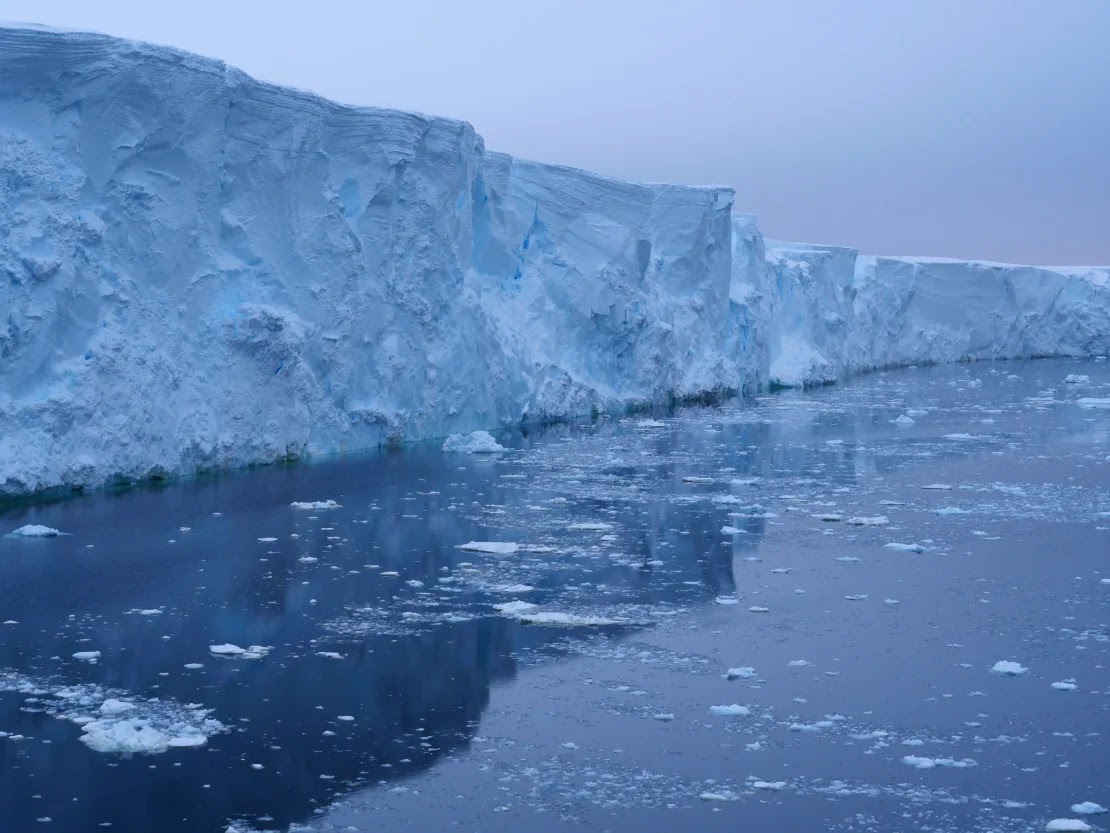
Could A Small But Rapidly Disintegrating Antarctic Glacier Climate Change Danger Signal?

Hektoria glacier in Antarctica was largely reduced
to debris ice after it abruptly retreated at a record pace.
Photo by Naomi Ochwat
When you think of glaciers, and how they melt, you probably picture a slow, drip, drip, and maybe a little stream or river running out of the edge of it. 

You'd think it would take years, even decades for most of a glacier to wilt or disappear under pressure from climate change. 

But one glacier in Antarctica, the Hektoria Glacier, is breaking speed records for eroding, says a team of researchers led by Naomi Ochwat, a University of Colorado glaciologist.

Per the Washington Post;

"More than five miles of glacial ice in Antarctica vanished in only two months, retreating 10 times as fast as the previous record, with possible implications for the stability of other glaciers and the pace of sea-level rise on a warming planet."

 Hektoria Glacier is on the eastern side of the Antarctic Peninsula, and is pretty small compared to most glaciers in Antarctica. It'sabout the size of Philadelphia.  The peninsula is that finger of land that comes off Antarctica and points toward South America, like a frigid finger seeking out warmth away from the Antarctic ice cap. 

But the fact that it retreated so fast makes scientists wonder about other, much bigger glaciers. Can they, too, disintegrate as fast as Hektoria? Was Hektoria a canary in a coal mine, or since this is Antarctica, a penguin in a coal mine?

That would be a problem, as glaciers that are on land add to global sea level rise as they melt. A rapid melt might accelerate those rising sea levels beyond what many scientists already expect.

 It's already bad enough, as storms are increasingly bringing sometimes serious storm surges to coastlines. We also already have "sunny day floods" when tides are particularly high when the pull of the moon is just right. 

If all of Antarctica's ice melted, sea levels would rise by about 190 feet. Of course, much of Antarctica's ice is here to stay, but even if a small percentage its glaciers go bye-bye, sea coasts worldwide would be in big, big trouble. 

Here's how the Hektoria Glacier disintegrated, as WaPo tells us

"Heckoria is a tidewater glacier, meaning it flows across land before ending in the sea. After rising temperatures reduced the amount of sea ice in the bay abutting the glacier, waves broke down ice fastened to the coastline that had protected Hektoria. 

And, without that buffer, the floating end of the glacier began cracking and shedding icebergs into the ocean."

Once the glacier lost its floating portion, the rest of it thinned, and a gently sloping plain underneath the glacier let ocean water to seep in. The ice bobbed up with the water getting beneath it, so it broke up quickly. 

As usual with these things, there's disagreement over whether this is a one-off or if many other glaciers are on the brink of collapsing. 

There's something called the grounding zone. It's the spot beneath the glacier's ice where the ground ends and it starts to float on ocean water. 

The scientists looking into this don't exactly know where the Hektoria Glacier grounding zone is. If the grounding zone is further inland than the researchers figure, the glacier ice was already on water, making it more prone to breaking up. 

Ochwat said seismic sensors detected a bunch of little earthquakes when Hektoria was in retreat and falling apart. That probably means the ice was resting on bedrock. "Because that ice is touching the Earth, we get earthquakes," she said. 

The Washington Post said Ochwat is going to look at other Antarctic glaciers to see if they're also on slick, shallow beds that are vulnerable to fast retreats. 

The reason that people are worried about other glaciers is, of course, climate change. 

As CNN tells us:

"Hektoria's retreat was heavily influenced by climate change (Ockwat) said. The loss of sea ice in the ocean next to Hektoria, believed to have been driven by ocean warmth, allowed wave swells to reach the fast ice and break it up, leaving the glacier exposed to ocean forces."

As sea ice continues to decline due to climate change, more glaciers might be poised to fall apart like Hektoria did. 

Hektoria is "a smaller cousin to some truly gigantic - I mean the size of the island of Britain - glaciers in Antarctica that could conceivably go through the same process, as this whole evolution of the ice sheets on Earth evolves with global warming," Bethan Davies, a glacial geologist at Newcastle University told CNN. 

 There's another glacier in Antarctica, the Thwaites Glacier, which some overwroughtly call the "Doomsday Glacier" contributes 4% of overall sea level rise. Another one the Pine Island Glacier is Antarctica's fastest melting glacier. 

The bottom line: Antarctica makes climatologists nervous, and this new knowledge isn't exactly Zoloft  for scientist's climate change anxiety. 

We need to make sure scientists keep studying the hell out of Antarctica and its ice and its melt rate. What goes on in Antarctica doesn't stay in Antarctica.   

Saturday, October 11, 2025

East Coast Braces For Big Storm, Major Coastal Damage; Effects On Vermont Still Questionable

The developing storm, seen on this morning's satellite
imagery, was centered off the coast of Georgia
and had an expanding shield of clouds. Pretty
much the entire Eastern Seaboard will be hit
with storm surges and damaging waves. 
The East Coast is, as we mentioned yesterday, bracing itself for a humdinger of a storm, and I'm sure you'll see a lot of news and social media videos of giant waves crashing into comparatively tiny beaches, vacation homes and tourist businesses. 

The worst of it will come in starting with this evening's tides, and ramping up to its worst rampage Sunday and Monday. Sand dunes that protect property and roads will get flattened by the waves in spots, and beaches will erode away. 

Out on Cape Hatteras, the tide will be two to four above normal later today and tonight, according to forecast. Large waves of eight to 12 feet are likely, so I imagine more houses will fall into the ocean. 

In places like Delaware, the Virginia Tidewater and the Jersey Shore, residents are also bracing for huge waves, and tidal flooding. There might be some evacuations, and shoreline homes and businesses could easily be damaged.

Tide level at Cape May, New Jersey might be as high or higher than in the 2012 Superstorm Sandy.  The tide at Atlantic City could be among the top ten on record.

New Jersey had declared a state of emergency in anticipation of the storm.

 Long Island is bracing for similar bad weather, with flooding of shoreline homes and businesses expected there, too. A lot of roads will also be closed. Businesses and homeowners were moving possessions to higher ground or upper floors as the storm approached. The Riverhead Country Fair on Long Island, an extremely popular event out there, has been canceled this weekend. 

 This storm is going to be a lot like a hurricane sweeping up the East Coast, only it's not a hurricane. Just a regular old storm joining forces with a strong high pressure system to its north to shove water inland where it doesn't belong. 

The pressure difference between the storm and the high to the north will create coastal winds gusting to 60 mph or more. That long fetch of east winds over the Atlantic will shove a lot of water onto the Eastern Seaboard, which is why everybody is expecting such destructive storm surges this weekend. 

It's going to be one memorable storm for many along the coast. It won't rise to the level of the famous "Perfect Storm" of 1991, but it will be something. 

We also can't ignore the fact that sea levels are gradually creeping up, year after year, thanks to climate change. A storm of this magnitude would have caused a lot of damage a half century ago, but not quite as much as this storm, as the water is starting from a slightly higher level than it would have back then.

The damage will also be much worse than it would have been back in 1970s or 1980s because a lot more houses, businesses, condos, resorts, gift shops, honky tonks and gawd knows what else has been built along the shore since then. If you've got more stuff in the way, more stuff is going to get knocked over. Or at least soaked with sea water. 

Expect more and more of this kind of mess as we go through the coming years and decades.

VERMONT EFFECTS

Rainfall prediction map for this upcoming nor'easter
in and around Vermont. Up to an inch could fall in 
far southern Vermont with very little up north.
This forecast is very much subject to change. 
The Green Mountain State has no shoreline to flood, of course. Unless you count Lake Champlain, which is so ridiculously low due to drought that a 200 mph wind wouldn't stir up enough waves to cause any damage. (Although, as you might imagine, a 200 mph wind would cause a lot of other problems)!

Don't worry, the wind from this storm will be far less than that. Things could get a little gusty on the western slopes of the southern Green Mountains Sunday night and Monday.  Maybe even enough to knock over a tree or two or snap a power line. 

But Vermont is mostly going to sit out this storm. 

The storm does look like it will come close enough to give some rain to parched southern Vermont. But we don't know how far north that rain will get. 

The strong high pressure over Quebec that will help create the intense east winds and storm tides along the eastern seaboard will block the storm - and its moisture - from coming too far north. Plus the high pressure will feed in some dry air, likely evaporating a lot of the rain that tries to come down from the clouds. 

As of Saturday morning, computer models were still arguing with each other as to how much rain will fall where in Vermont. It's a difficult forecast because somewhere in northern New England, including here in the Green Mountain State, there will probably be a sharp line from decent rains to the south and not much of anything north. 

We don't know exactly where that line will be. Honestly, we probably won't know until the storm makes its closest pass at us Sunday night and Monday. 

So expect adjustments to the forecast. As of this morning, predicted rainfall totals range from near an inch close to the Massachusetts border to just a few raindrops up near the Canadian border.  

Any rain will help, of course. And after the storm goes by, we'll settle into a cooler and cloudier weather pattern than we've had all of this autumn so far. That means the drought won't be able to keep intensifying so fast, and might even level off, if we get showers here and there. 

But as far as any drought-ending downpours and drenching goes, we're still out of luck for now.  

Monday, September 15, 2025

Surprising Cause Of Sea Level Rise: We're Pumping Out All The Groundwater

Giant aquifers, like those depicted in this map, are
rapidly being depleted by man, and that 
phenomenon has greatly influenced the
pace of sea level rise. 
When we think of the reasons behind sea level rise and climate change, the images that pop up in our heads are melting glaciers, torrents of water pouring off the Greenland ice sheet in the summer, that kind of thing. 

But one of the biggest drivers of sea level rise is coming from a surprising source: Pumping groundwater to the surface for drinking water, irrigation and industry. 

According to ProPublica:

"So much groundwater is now being pumped that it is filling the oceans as it drains off land, becoming one of the largest drivers of global sea level rise."

The result is vast parts of Earth's land masses are drying out, according to an ambitious new study.  

ProPublica goes on:

"More than anything, Earth is being slowly dehydrated by the unmitigated mining of groundwater, which underlies vast proportions of every continent. Nearly 6 billion people, or three quarters of humanity, live in the 101 countries that the study identified as confronting a net decline in water supply.  - portending enormous challenges for food production and a heightened risk of conflict and instability." 

This comes from a study led by Hrishikesh Chandanpurkar, an earth systems scientist working with Arizona State University. The research was published recently in the journal Science Advances. The study looks at most of the Earth, but excludes the fresh water ice sheets of Antarctica and Greenland 

There's even more bad news in the research: The loss of water through groundwater pumping is happening as many areas are growing drier due to climate change. 

The study notes that with climate change, some areas of Earth are getting drier while others are getting wetter. However, drying regions are expanding quickly while places that have been getting wetter are shrinking. 

Deep, high quality aquifers are actually widespread, lying beneath one third of the planet. The aquifers are under about half of Africa, Europe and South Africa. They took millions of years to form and would take thousands of years to refill. 

But with us humans, a significant amount of that water is taken from underground, given over to irrigation or industry, then runs off, eventually finding its way to oceans. 

This loss of water from aquifers has gotten so great, that it is one of the largest causes of sea level rise. "Moisture lost to evaporation and drought, plus runoff from pumped groundwater, now outpaces the melting of glaciers and the ice sheets of either Antarctica or Greenland as the largest contributor of water to the oceans," ProPublica reports

The study was done using 22 years of data from NASA's Gravity Recovery and Climate Experiment, or GRACE satellites. Images from the satellites measure changes in th mass of the Earth and can be used to estimate its water content. 

As ProPublica reports, study co-author Jay Famiglietti has for two decades used GRACE data to determine where aquifers were declining. 

Chandanpurkar and Famiglietti began to wonder what all this meant regarding all the water available on the continents. So the study, really an inventory of all land-based water contained in glaciers, rivers and aquifers, set out to see how things were changing. 

Spoiler: It's changing fast.

For instance, scientists and water managers were well aware that aquifers in the U.S. Southwest were receding.  Their research also showed a "creeping disaster" of accelerating drying in aquifers spreading out from the Southwest into Texas, and down into Mexico. The same pattern was noted in Europe, the Middle East, North Africa and parts of Asia.  

So, draining the aquifers looms as a crisis for crops and industry, which would die out with the drying out of aquifers. Even if crops can still grow, shipping them out will be problematic, since the water from the aquifers is raising sea levels. Which floods ports and such. Not to mention important crop-growing regions like the Nile and Mekong deltas.

One the groundwater is lost to the seas, the only ways to get it back are through expensive and inefficient coastal desalination plants. Or waiting hundreds or thousands of years for rain to replenish desiccated aquifers.  

Other research that the climate change is not only warming up the air and the oceans. It's actually starting to extend its tentacles deep underground. The research says ground water is warming up as much as 40 to 50 meters (about 130 to 165 feet) underground. 

That underground warming could increase microbial production and allow chemicals such as arsenic, locked away in cold underground rocks, to get released as warming takes hold far below our feet. The warmer groundwater could also bubble up into lakes, ponds and rivers, allowing more damaging algae blooms and killing some aquatic life, as Grist reports. 

 As climate scientist Peter Gleick notes, drying out aquifers threatens global food production. And food is the foundation for stability. So don't get too smug, America. If you think we have immigration problems, brutal, often unfair and possibly illegal deportations and the political turmoil that comes with all that now, just wait until the groundwater dries up.  

Like or not food and climate refugees might well be stampeding toward our borders in the United States. No matter how many walls we throw up, or how many Executive Orders presidents declare. 

Water and the lack thereof is already contributing to war and violence, ProPublica notes. The Syrian civl war that began in 2011 started as rural unrest stemming from drought and groundwater depletion. Ukrainian wheat support much o the world, so Russia is targeting that nation's water infrastructure. 

There are things we can do to slow or even stop the groundwater depletion, the researchers said. Drip irrigation can cut water use by as much as 50 percent. Arid Israel has used that technique effectively. 

When California farmers reduced their use of Colorado River water in 2023 and 2024, Lake Mead rose by 16 feet. People in arid areas can remove lawns in favor of native plants. Cities can recycle a lot of their water.  

This is a solvable crises. But work has to start now to get this going. 

Thursday, December 26, 2024

"Doomsday Glacier" Might Postpone Its Troublemaking. Maybe.

A part of Thwaites Glacier in Antarctica, which has been
the focus of a lot of study, with worry about climate-
induced sea level rise. Photo from 
British Antarctic Survey
For years, a certain giant glacier in Antarctica has been known as the "Doomsday Glacier", with scientists saying it could collapse at almost any time, causing some abrupt and damaging worldwide sea level rises.  

Luckily, the Thwaites Glacier, as it's known, might not be so scary after all. At least not yet. And it is still at least a little frightening to climate scientists.  

Says Newsweek:

"The research suggested that a catastrophic collapse of the glacier, which could lead to rapid and drastic sea-level rise, is less likely to occur this century than previously thought. 

The Thwaites Glacier in West Antarctica - about the size of Florida - has been a major focus for climate scientists due to its unstable nature and significant contribution to sea level rise.

Currently, it accounts for about 4 percent of the annual increase in sea levels and holds enough ice to raise them by over two feet if it fully melts, according to the International Thwaites Glacier Collaboration."

Marine ice cliff instability or MICI is when ice shelves collapse, they expose big ice cliffs that often collapse from their own weight, causing a chain reaction of rapid glacier retreat, says Newsweek. 

Scientists have studied MICI in theoretical settings and climate models but never in real world situations. Until now. Newsweek continues:

"Using updated computer simulations, the Dartmouth team found that MICI is unlikely to occur this century at Thwaites. Even if the glacier's entire ice shelf were to collapse today, the resulting ice cliffs would likely not be tall enough to crumble and trigger the catastrophic chain reaction previously feared."

This study contradicts what scientists were saying even just several months ago, that the Thwaites was headed toward imminent collapse. 

That's not to say this thing is perfectly safe.  First of all if it were to collapse, the two foot sea level rise wouldn't be the end of it.  The glacier acts as sort of a giant dam, holding back huge sections of the Antarctic ice sheet. If Thwaites went away, much of that ice sheet would flow into the ocean, eventually raising sea levels by ten feet.

Which wouldn't be good if you live in a low lying coastal city. Like Miami, for instance. 

As recently as September, scientists said comparatively warm sea water was infiltrating beneath the base of the glacier, accelerating melting on its bottom.  That would help accelerate its rate of melting, so that's not good. 

Even if Thwaites were no big deal, we're not safe from sea level rise. 

 It's still going up due to climate change. Sea levels are going up by about 0.13 inches per year. That doesn't sound like much, but it makes a big difference after a few decades, especially in highly developed, flat and sinking coastal regions. 

Plus, the pace of sea level rise is starting to increase. 

Wednesday, October 23, 2024

North Carolina Coastal Town Braces For Nor'easter Season: How Many More Homes Will Fall Into The Ocean?

House on the left in process of collapsing into the
ocean on September 24 in Rodanthe, North Carolina
It bumped into the house on the right, damaging it
and that house is doomed to collapse, too.
Seemingly centuries ago, really just weeks ago,  back in mid-September before we had to deal with Hurricanes Helene and Milton, the coastal town of Rodanthe, on North Carolina's Outer Banks, had been facing the kind of damage you sometimes see in hurricanes.   

Just a slower motion version of it. Without the actual hurricane. 

Neither hurricanes Helene and Milton really affected Rodanthe. But before those two storms, all it took was a routine easterly fetch of wind and waves off the Atlantic Ocean to cause more problems there. 

Houses are falling into the water, as you can see in the video in this link, for instance.  Also, theres's a couple good news videos of this situation that adds more good context to this post.

According to a September 24 Washington Post piece:

"The latest came early Tuesday afternoon when the ocean claimed an unoccupied house at 23039 G.A. Kohler Ct. It marked the third such home collapse since Friday on this erosion-plagued stretch of the Outer Bans - and the 10th home to fall since 2020.

Rodanthe, home to some the most rapid rates of erosion on the East Coast, has become a poster child in recent years for the perils of living along a vulnerable coastline, particularly in an age of more intense storms and rising seas. 

Multiple homeowners in this small community have raced to relocate their homes farther from the shoreline, often at a cost of thousands of dollars. Others have tried to move their homes further from th encroaching tides, only to run out of time."

Three homes fell into the ocean in less than a week. Days before the house described above fell in, yet another one did. That failure caused added damage to a precariously situated house next door to fall into the waves. 

The one the Washington Post described in that September 24 article appears to have damaged the one next to it, so that one should go soon if it hasn't already. A nearby red colored house also looks doomed. 

Earlier this month, the Board of Commissioners in Dare County, where Rodanthe is located, voted to apply for a FEMA Flood Mitigation Assistance grant. A state project director is reaching out to eligible homeowners to see if they're interested in the voluntary program.

The program targets 20 potential properties in Rodanthe that are in or close to the ocean and within 300 feet of stable vegetation. The whole process takes three or four years, so we're probably going to see more homes fall into the ocean.  

Aerial view in Rondanthe, North Carolina taken a couple
months ago. Four houses in the foreground
have since collapsed into the ocean, 

Which of course is a problem since each collapse causes a huge mess. Debris spreads miles up and down the beach with each collapse, and it all has to be picked up. I'm sure sharp objects like glass shards and nails are left behind, too. 

Inches matter with sea level rise. According to a Washington Post article from March, sea levels have risen seven inches in recent decades at Oregon Inlet, near Rodanthe. A stretch along Seagull Street in Rodanthe loses about a dozen feet or more per year to erosion. 

I'm also sure there was more erosion on the Outer Banks and elsewhere along the Atlantic Seaboard last week.  We just had a full super moon - named because the moon is a little closer to Earth than usual and looks bigger than it normally does,

This super moon contributed to King Tides that caused "sunny weather flooding" along coastlines from New England to  Florida. This never used to be a real problem decades ago, but sea level rise has made even just a full moon in calm weather cause coastal flooding. 

A nor'easter far off shore probably also contributed to swells that probably added to the erosion late this past week. Video of Buxton, North Carolina, a little south of Rodanthe, showed King Tide waves smashing ashore, causing plenty of flooding and erosion under crystal clear blue skies. 

Speaking of nor'easters, even though hurricane season is about to wane, nor'easter season is just ramping up.  This will no doubt increase the pressure on homes on North Carolina's Outer Banks, and up and down the East Coast for that matter. 

It'll be interesting to see how many more houses and buildings fall into the ocean this winter, especially if it's really stormy out there. 

VIDEOS

CBS News video, first aired Wednesday, on the challenges that face North Carolina's Outer Banks, focusing on Rodanthe. Click on this link to view, or if you see the image below, click on that: 


Television station WRAL has more on this. Again, click on this link to view, or if you see the image below, click on that. 


Friday, May 24, 2024

Florida's DeSantis signs "Don't Say Climate Change" Bill. We'll See How That Works Out. Meteorologists Rebel

We can always rely on Florida for easy but stupid answers.

s
Florida Gov. Ron DeSantis signed "don't say climate
change" legislation that scrubs reference to it from
state statutes. I guess if you pretend it doesn't
exist, then it doesn't exist?
Gov. Ron DeSantis signed a "Don't Say Climate Change" bill into law that eliminates that supposedly awful phrase from state documents and regulations.  

As the Associated Press reports:

"Opponents of the bill DeSantis signed say it removes the word 'climate' in nine different places, moves the state's energy goals away from efficiency and the reduction of greenhouse gases blamed for a warming planet."

References to climate change will disappear from state statutes. I guess DeSantis doesn't want Floridians to say much.  After all, under DeSantis, Florida is the home to "don't say gay" laws. 

By the logic of DeSantis and his Republican-led legislature, if you pretend climate change doesn't exist, it goes away, I guess. Never mind the record spring heat wave that's been hitting parts of Florida. Or the increasing rate of sea level rise that keeps causing nuisance flooding in Miami. Or the enhanced hurricane risk later this summer and autumn. 

The bill DeSantis signed into law earlier this month also bans wind turbines offshore or near the state's huge coastline. 

Additionally, as NPR reports:

"(The law) would also boost expansion of natural gas, reduce regulation on gas pipelines in the state and increase protections against bans on gas appliances such as stoves, according to a news release from the governor's office."

DeSantis claims that the law is "restoring sanity" on energy issues and "rejecting the agenda of the radical green zealots."

This comes at a time when Florida is really under assault from climate change and its side effects. A record heat wave this month sent heat indexes up to the 110-115 range, much higher than ever observed in May. 

Due to sea level rise, Miami has seen so far in 2024 water above mean high tide more often than in 1996, 1997 and 1998, said Brian McNoldy, a meteorologist specializing in sea level, climatology and hurricanes. 

Speaking of hurricanes, we know Florida is prone to hurricanes. Climate change tends to make those storms bigger and more powerful.  Due to unprecedented warmth in the parts of the Atlantic Ocean that brew hurricanes, forecasters say this could be a record season.  Florida could be in the crosshairs again. 

Insurance rates are going up because of this threat. Want to retire to Florida? If you do, remember that these higher insurance rates are forcing many Florida senior living centers to close.

Meteorologists are among those starting to rebel against DeSantis and his climate nonsense. 

Steve MacLaughlin, a meteorologist at a NBC affiliate in Miami, tore into DeSantis on social media and a video posted on his stations web site. "As Florida is on fire, underwater and unaffordable, our state government is rolling back climate change legislation and language, " he said on X, formerly Twitter.

On the video, MacLaughlin says, "The world is looking to Florida to lead in climate change, and our government is saying that climate change is no longer the priority it once was."

Other Florida meteorologists are starting to follow MacLaughlin's lead. John Morales, a longtime South Florida meteorologist, urged colleagues in broadcast media to do the same as MacLaughlin.

On X, formerly Twitter, Morales linked to MacLaughlin's video and said, "this is the time like no other to be courageous. Here's how."

MacLaughlin emphasized he was not telling people how to vote or who to vote for, but rather was emphasizing the science and the risks. 

Pointing out the obvious dangers of climate change can affect a television meteorologist's career. Last year, Chris Gloninger, a meteorologist at KCCI in Des Moines, resigned from his position after he got tons of hate mail and threats from MAGA types because he dared to note how climate change was endangering Iowa. 

Gloninger is now a Senior Scientist at Woods Hole Group.  

I'm not sure why so many far right politicians think that not mentioning things they don't want to deal with makes them go away. For better or worse, Americans tend not to want to shut up.  

I have a feeling that DeSantis and his minions will find this "Don't Say Climate Change" nonsense will eventually backfire on them. 

Climate change is powerful enough to eventually overrule any type of right-wing legislation.  Talk about backfiring! 

Monday, January 22, 2024

Greenland Ice Loss Worse Than Thought, Says New Study

A new report says ice loss from Greenland - already 
known to be bad - is even worse than thought.
 Climate scientists and others interested in climate change really monitor Greenland as one measure of how bad things are getting as the world warms. 

That's why you disproportionately read about Greenland in the news, and in this here blog thingy. 

Well, here's another one, 

It turns out Greenland has lost more ice than people thought. Even if  the original lower estimate was pretty huge. 

Per the Washington Post: 

"Researchers had previously estimated that the Greenland ice sheet lost about 5,000 gigaton of ice in recent decades, enough to cover Texas in a sheet 26 feet high. The new estimate adds 1,000 gigaton to that period, the equivalent of piling about five more feet of ice on top of that fictitious Texas-sized sheet."

According to The Guardian, if you include the ice loss found in this study, the Greenland ice cap is losing an average of 30 metric tons of ice per hour due to climate change. 

The additional ice loss researchers found came from the glacier's edge, where it meets the water. That portion of the glaciers float on the water. Any floating ice that melts won't raise sea levels like ice loss form inland portions of Greenland ice. Inland ice melt runs downhill into the ocean, raising its level. 

 The ice floating on the waters around Greenland is like the ice cubes in your gin and tonic. If the ice melts in your drink, the water level won't rise, but you won't get as much punch from the gin, as it will get diluted.

The ice loss on the edges of the glacier - on the water - has some similarities to your now ice free, diluted gin and tonic. 

The melting ice dilutes the amount of salt in the North Atlantic. That can mess up the ocean currents that bring relatively warm water - and air - to western Europe in the winter.   

The big Atlantic Ocean circulation is known as the Atlantic Meridonal Overturning Circulation, or AMOC.  Worst case scenario would be this circulation collapsing completely due to too much fresh water gumming up the system. 

A collapse of these large scale currents could really disrupt the climate of western Europe and parts of North America at the very least.  It would probably have worldwide effects, such as frigid weather in western Europe, some parts of North America turning much colder even as the world warms, while other parts of the same continent become hot and arid.

The good news is that most scientists don't see the AMOC collapsing anytime soon. But it is slowing down, so even that could cause lesser but still important weather and  climate headaches around the globe. 

Even if nothing at all happens to AMOC, all that ice melting off Greenland is of course bad news. The melt water raises ocean levels around the world. 

 Ominously, it's not just glaciers melting along the Greenland shores in just parts of that vast island. It's everywhere. "There's basically no part of Greenland that's safe from climate change," said Chad Greene, the study's lead author and a scientist at NASA's Jet Propulsion Laboratory.

Zeke Hausfther, noted on X, formerly Twitter, that the Greenland ice sheet has lost over 6 trillion metric tons of ice since 1970, or more than 700 tons of ice lost per person for every person on the planet today.    

Greenland is actually having a very cold winter. That doesn't matter very much because ice doesn't melt up there even in super warm winters. It's the summers we have to worry about. 

Last year, Greenland lost 196 billion tons of ice.  That's better than some previous years. There was a LOT of melting in 2023, but that was partly offset by lots of snow earlier in the year, which added some mass to Greenland before melt season started. Still the ice loss in 2023 was the most in four years. 

Still, the last year  Greenland actually to its ice mass was in 1996. It's been on a losing streak since. Which also means the rest of the world has been on a losing streak, too.

Thursday, December 14, 2023

Hot Times In The Arctic: Annual Report Card Shows Big Changes Affecting Entire World

The Arctic got at best a D- in NOAA's annual Arctic report
card that takes a look at how climate change is affecting
the top of the world. Remember, what goes on in the
Arctic does not stay in the Arctic .
 Most of the world has had a really hot year in this age of climate change. 

Relatively speaking, the Arctic was arguably the most out of whack, according to the National Oceanic and Atmospheric Administration's annual Arctic Report Card, which was released Tuesday. 

The main takeaway from this year's edition: The Arctic is warming almost four times faster than the world as a whole, and had their hottest summer since at least 1900,

According to NPR:

"'The Arctic is now more relevant to us that it has ever been before,' said NOAA administrator Rick Spinrad. 'In many cases, what we're seeing is - by a few years - the kinds of impacts that we're going to see elsewhere in the country.'

Climate change in the Arctic doesn't just offer a view of the future. It also directly influences worldwide changes across ecosystems, from sea-level rise, to new weather patterns to altered wildlife migrations. 

As Spinrad put it,' what happens in the Arctic does not stay in the Arctic."

The report has plenty of examples of how warming in the Arctic is screwing with people who live near the upper reaches of the Earth, and everybody elsewhere. 

The Arctic had its hottest summer on record and its sixth warmest year on record. Despite the summer heat, the Arctic "only" had its sixth lowest sea ice extent on record.  That was because some pockets of the Arctic were relatively cool, like the East Siberian Sea and areas of ice near Alaska. That slowed the ice melt in the summer a little. 

Greenland lost 150 billion tons of ice. That's bad because Greenland is the second biggest source of global sea level rise. One mitigating factor became apparent this year. A warmer Arctic means a wetter Arctic. At least most of the time. That means it snowed more than usual in Greenland this year. The extra snow ensured that the loss of Greenland ice was less than the recent average. 

It's worth noting that the peak high point of Greenland's ice sheet, 10,000 feet above sea level, got above freezing this summer for only the fifth time on record. 

Worldwide commerce is being affected by a warming Arctic, or better or worse. As the Washington Post tells us:

"The Northwest Passage, which allows ships to pass between the Atlantic and Pacific archipelago, was relatively ice free by late August....The Northwest Passage has long been an object of fascination as a means to dramatically reduce shipping distances and costs, and especially since 2007, when dramatic melting first opened it up."

Shipping companies are really taking notice of this. Early in my lifetime, it was quite a laughable idea that the Northwest Passage would be a viable shipping route. How times change with climate change. 

Wildfires, of all things, are becoming increasingly common in the Arctic.  As I've already reported, most of Canada was seemingly on fire during 2023. That includes the far north of that nation.

Sure, as noted, the Arctic is by and large getting wetter, but the droughts in between the rains are also getting worse. 

Per the Washington Post: 

"More than 90 percent of the 11 million acres that burned across Canada through the end of October was in the Northwest Territories, according to the report. Data from the European Union's Copernicus Climate Change Service released Tuesday showed that Canada accounted for 23 percent of global wildfire carbon emissions this year."

Climate change is making Arctic salmon populations weird. That's important because that's the livelihood of many people in the Arctic. 

Says NPR: 

It'll be interesting, and probably alarming to see what happens in the next 12 months up in the Arctic. El Nino is helping to supercharge climate change, at least temporarily. 

Though I'm sure there will be record warmth up there this winter, it won't matter too much quite yet because it will still be too cold for appreciable warming.

But a warm winter would make less ice for than normal, setting the stage for even lower sea ice extent next summer. Greenland remains a wildcard. I wonder if huge heat waves - at least by their standards - will cause even greater ice loss than in recent years. 

Remember the quote cited above: What goes on the Arctic doesn't stay in the Arctic. It's part of the reason we in Vermont choked on wildfire smoke last summer. Gawd knows what a hot Arctic will bring us next year. 


Tuesday, September 27, 2022

Climate "Tipping Points" Loom To Make World Dangerous, Depress You. Sorry.

A study released this month suggests irreversible climate
change "tipping points' are looming even if the world
warms just a little bit more. 
 The news most of this year, especially over the summer, would naturally make us even more nervous about the ongoing climate crisis. 

Heat wave after heat wave were punctuated by repeated unprecedented floods from Kentucky to Italy to Pakistan. 

 Earlier this month, scientists piled on with a new study on climate tipping points. 

A tipping point is when a threshold is reached in which something big will happen. Once you get to the tipping point, a substantial change is inevitable. Carbonbrief.org, I think, explains tipping points with this little relatable example:

"Imagine a child pushing themselves from the top of a playground slide. There is a point beyond which it is too late for the child to stop themselves from sliding down. Pass the threshold and the child continues inevitably towards a different state - at the bottom of the slide rather than the top."

So, the scientists in the new study tell us we're very close to five tipping points that would make the march of climate change much worse. 

Climate tipping points create changes that do happen much slower than the kid on the playground slide. But they're fast enough go have big implications for us, or your children or grandchildren. 

As Science.org explains, in the dry language that scientists use that still scare the bejeezus out of us.:

"Climate tipping points are conditions beyond which changes in part of the climate system become self-perpetuating. These changes may lead to abrupt, irreversible and dangerous impacts with serious implications for humanity."

According to the Paris climate agreement, we need to limit the world to a 1.5 degree Celsius or less of global warming. We're already close, as temperatures since the Industrial Age began have gone up by 1.1 degrees. 

As this new scientific report suggests, going past that 1.5 degrees would bring us to those nasty tipping points. 

Looking at this report, let's start with the Greenland and West Antarctic ice sheets. Climate change is already causing a lot of melt from those ice sheets. The melt water flows into the oceans, which makes sea levels rise and increasing coastal flooding across the globe. 

You'd think if we rein in global warming, we can reduce the amount of melt from these ice sheets and things would be relatively copacetic.

But, as the study suggests, if we go past a certain point. around 1.5  to 2 degrees Celsius of warming, we'd reach a point where nothing can stop the ice sheet from melting, even if we entirely shut off global carbon emissions. 

That could lead to the Greenland and West Antarctic ice sheets entirely melting. The bad news is that would raise sea levels worldwide by 30 feet. The relatively good news is it would take 500 years or so for that to fully happen. But even a foot of sea level rise in a more short term interim is a big issue.

Many of the world's most populated areas are within a foot of sea level. Or just a few feet above sea level, meaning they're prone to flooding during storms if sea level rises.  

There's other weird things that can happen if we reach tipping points. A key ocean current in the North Atlantic would stop.  The currents have pretty much always kept Europe fairly warm in the winter, given that much of the region is so far north. 

For instance, Paris is just below 49 latitude north. For comparison's sake, the Vermont/Quebec border is at 45 degrees latitude. So Paris is north of Vermont. 

But those ocean currents keep Paris' normal January high temperatures in the mid-40s, compared to the upper 20s in Vermont.  If those warming ocean currents or slow down significantly, Europe could become much colder in the winter despite the overall global warming trend. I think summers would continue to warm in Europe, so the end result would be a much more extreme climate.

Which would put Europe's climate somewhat closer to that of Siberia, where it can be in the 40s and 50s below zero or even colder in the winter, but in the 90s or even near 100 in the summer.  

You can imagine the kinds of disruptions this type of European climate change would cause.

By the way, if we go beyond these tipping points by increasing global temperatures further, we get into even more tipping points. Above two degrees Celsius, we could lose the Amazon rain forest, which helps regulate the global temperature.

Worse, permafrost in the Arctic would really, really melt, releasing more carbon and methane into the atmosphere, which would help accelerate climate change despite humans' attempts to cut back on emissions.

It's not like it's now too late, that we shouldn't even try to reduce emissions. It's not too late, but we ought to act fast. The quicker carbon emissions decline, the better the world will be for many generations to come.