 |
| Map of Antarctica. The Thwaites glacier is seen to the left. If it melts global sea levels could rise dramatically. |
Before you get too panicked, the glacier won't end the world. But at some point, it might cause enormous trouble that would be felt around the globe.
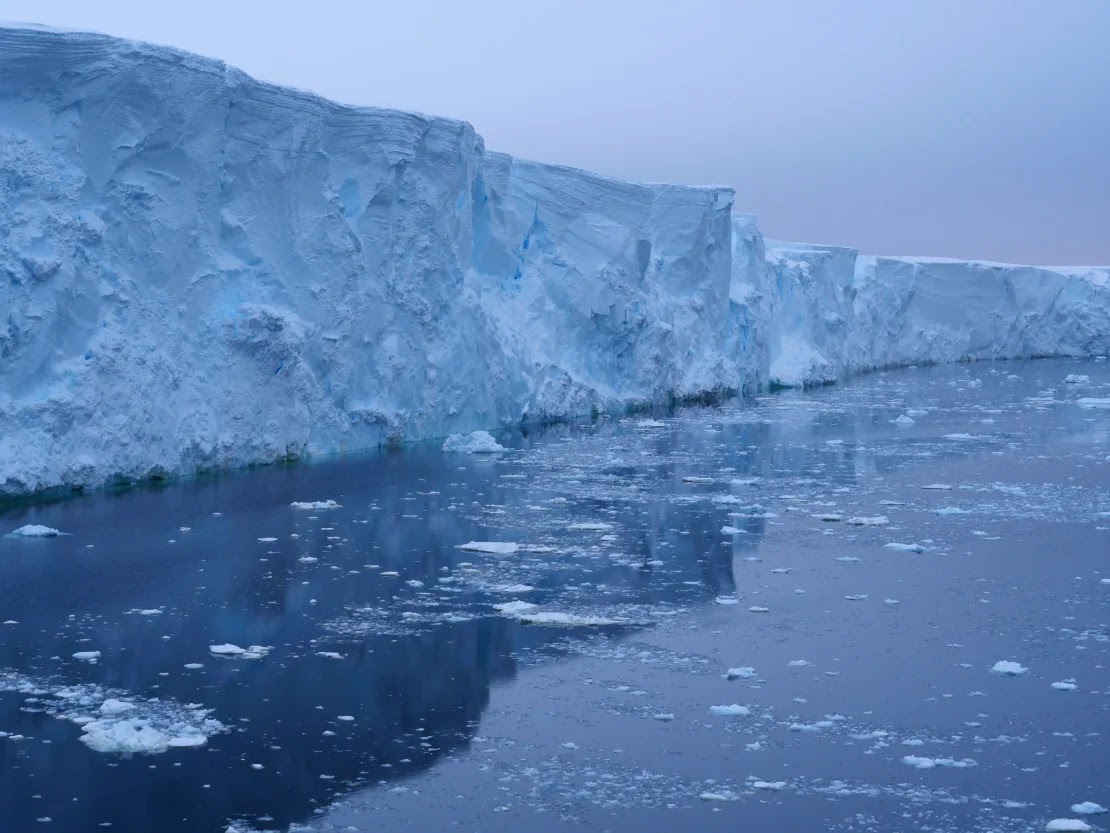
The official name of this thing is Thwaites Glacier in Antarctica. It's about the size of Great Britain, and it is melting.
The "Doomsday" label is because the glacier is so huge and is melting so fast, that its effects are already being noticed. The thawing glacier already accounts for four percent of the world's annual sea level rise.
Were the glacier to entirely collapse, it would raise global sea levels by about 65 centimeters or roughly two feet. Hence the "Doomsday" label as that much of a sea level rise would be truly catastrophic for coastal cities and communities worldwide.
Each centimeter of sea level rise would expose an estimated six million people worldwide to coastal flooding, so imagine what 65 centimeters would do.
Oh, and if the Thwaites Glacier collapses, it could destabilize the much bigger ice sheet behind it. If that big ice sheet goes, that could add another 10 to 15 feet of sea level rise. This wouldn't happen tomorrow, but it's a big enough threat to start thinking about, even if the catastrophe is decades or even a century into the future.
At this point, there's no way to stop Thwaites Glacier from continuing to melt. But maybe people can slow the melt down. And maybe slowing the melt rate would buy time while us humans struggle to stop the flow of fossil fuel emissions into the atmosphere. If fossil fuel emissions stop, so too, would climate, eventually at least.
ut we are nowhere near that moment yet.
One off the wall, expensive but still perhaps viable idea is to put a huge barrier around Thwaites glacier to stop warm water from getting at it.
According to Interesting Engineering:
"The proposed structure would be just under 0.1 miles (152 meters) tall and stretch roughy 50 miles across key parts of the seabed in front of Thwaites Glacier. Anchored to the ocean floor, the curtain would act as a physical barrier, limiting the flow of warm seawater that melts the ice shelf from below,"
"The plan faces major technical challenges. The structure would need to survive extreme Antarctic conditions, deep water pressure, moving ice and long-term ocean exposure. Even supporters acknowledge it could take years before any full-scale deployment is possible."
It would also be incredibly expensive, to the tune of several billion dollars. It's unclear from where that money might come. The logic behind spending that kind of money on a Thwaites Glacier barricade is that it would still be way less expensive than dealing with an eventual 10-foot sea level rise.
At the very least, this whole thing is a potential research opportunity.
Probably with this giant, expensive curtain in the back of their minds, scientists are drilling way down through the glacier and deploying instruments to see how warm water is interacting with the base of the glacier.
Data will be transmitted daily via satellite for at least a year. It'll be a way to figure out how deep ocean water in a warming climate affects glaciers it comes in contact with.
"This is one of the most important and unstable glaciers on the planet and we are finally able to see what is happening where it matters most,'" said Pete Davis of the British Antarctic Survey.
I have no idea whether this barricade will ever get built or whether the collapse of this "Doomsday Glacier is imminent. But it's just one trouble spot in a world of potential crisis points brought on by climate change.