Showing posts with label government. Show all posts

Friday, January 2, 2026

Trump Administration Screws Hurricane Helene Victims Again

FEMA is dragging its feet in approving buyouts
for North Carolina homeowners whose property was
wrecked by Hurricane Helene 15 months ago. 
A popular Federal Emergency Management Agency feature is the Hazard Mitigation Grant Program. People whose homes were wrecked in disasters and are at risk of being hit again after repairs can apply for a buyout. 

Qualfied applicants under the voluntary program can get the pre-storm value of their home. Then they can take the money and move somewhere that's less disaster prone. 

The damaged home is torn down, and the site would never be developed again. The community benefits because they won't have to deal with that property in the next disaster, since there would be no house there.  

More than 800 Hurricane Helene victims in western North Carolina applied for buyouts, some of them as long ago as this past February. North Carolina officials, having vetted the applications, sent nearly 600 of those to Washington for processing. More will likely get approved in North Carolina.

But so far, the only thing FEMA has heard in response is crickets. FEMA has not so much as approved one of the buyout applications.  

Reports the Washington Post:

"So far...not a single approval has come through. North Carolina Gov. Josh Stein has called the paralysis 'absolutely unacceptable,' and has pushed for answers. Earlier this month, he wrote to FEMA's acting administrator, detailing the startling number of applications that 'remain without a final decision.'"

By the time the Washington Post published the story more than a week ago, nobody from FEMA responded to requests for comment. 

However, once the story was published, the agency sent a short statement, saying it "remains committed" to North Carolina Helene recovery. The FEMA statement said many applicants had not been approved yet "because they do not comply with federal regulations." 

That's news to William Ray, the director of North Carolina Emergency Management, as NPR reports. "we do not have anything in hand that says that officially things are ineligible. We are not able to get a good answers from FEMA as to why they are not moving forward."

Join the club, William.  

Maybe the problem is Homeland Security Director Kristi "Ice Barbie" Noem, whose department has authority over FEMA.  She has a rule in which she personally approve every expenditure over $100,000.

My accusation is all conjecture and sarcasm on my part, but it wouldn't surprise me if Ice Barbie is gumming up the works with FEMA assistance because she's so busy kicking non-whites out of the country and cosplaying some sort of weird ICE assassin or something.  

 In the best circumstances, these buyouts take awhile to arrange. A 2019 study found that it takes a median of roughly five years to complete a buyout from start to finish. However, FEMA says it usually takes two years to complete. 

However, the Trump administration has deeply cut staffing at FEMA this year, so who's left to manage the buyout process. Plus, the very existence of FEMA is in question, as its future is being debated both Trump Powers That Be. 

Which leads us to another broken Trump promise. He had said that he would "slash through every bureaucratic barrier" and said "every single inch of every property will be fully rebuilt, greater and more beautiful that it was before."

So far. Trump's administration hasn't even been able to tear down damaged properties, never mind build everything back. North Carolina is still a mess, 15 months after the hurricane. 

I'll let WaPol handle this:

"The reality is that local governments continue to wait for large sums in federal reimbursements for debris cleanup and other projects. Roads still need repairs. Renters and homeowners remain displaced."

Click on this link to read the entire, very worthwhile WaPo article. 


Saturday, December 20, 2025

Trump Administration Breaking Up Renowned Climate Center; Retribution Against Colorado Governor Suspected

The National Center for Atmospheric Research in
Boulder, Colorado. The Trump administration
wants to break it up saying the scientists there
are "climate alarmists" with no evidence to back
that up. It appears the announcement might
be related to Colorado refusing to release
from jail a 2020 election conspiracy theorist.
One of the world's leading climate research centers, in Boulder, Colorado, is targeted for closing because Donald Trump has his head in the sand. 

And also probably because he's still butthurt that Colorado won't release a 2020 election conspiracy theorist from jail.

At issue is the National Center For Atmospheric Research, or NCAR. It was founded in 1960 and has resources like supercomputers, data sets and high-tech research planes that conduct meteorological and climate research. It's also an educational center for future scientists. 

As you'd expect, scientists are almost uniformly outraged by the plan to dismantle NCAR. 

Katharine Hayhoe, a Texas Tech University professor and chief scientist at the Nature Conservancy, called the center "quite literally our global mothership," and said "Dismantling NCAR is like taking a sledgehammer to the keystone holding up our scientific understanding of the planet."

Hayhoe also said on her post on the social media platform X: 

"(NCAR) supports the scientists who fly into hurricanes, the meteorologists who developed new radar technology, the physicists who envision and code new weather models and yes, the largest community climate model in the world

Casper Amman, a former research scientist at NCAR, told the Washington Post the center plays a unique role by bringing together soiled specialists to collaborate on some of the biggest climate and weather questions of our time. 

"Without NCAR, a lot could not happen....A lot of research at U.S. Universities would immediately get hampered, industry would lose access to reliable base data."

Weather and climate services around the world use NCAR modeling and forecasting tools. It also supplies real time data to people dealing with events like big wildfires and floods. 

Of course, the Trump camp has a completely different view about their plans to dismantle NCAR.

 Here's a Trump minion on X:

"The National Science Foundation will be breaking up the National Center for Atmospheric Research (NCAR) in Boulder, Colorado......This facility is one of the largest sources of climate alarmism in the country."

One of Trump's favorite whines is climate change. Every chance he gets, he says climate change is a hoax and a con job, his words. He apparently thinks that he's smarter than the vast majority of scientists who tell us climate change is real. Those scientists are growing increasingly alarmed about that warming. 

 USA Today, which first reported this development, reported:

"The administration plans to identify and eliminate what it calls 'green new scam research activities' during an upcoming review of the center, according to the White House while 'vital functions' such as weather modeling and supercomputing will be moved to another entity or location. 

Efforts to dissolve the National Center for Atmospheric Research will begin immediately, the official said, with the plan being to fully close the center's Mesa Laboratory in Boulder."

NCAR's staff consists of 830 employees who are part of the University Corporation for Atmospheric Research, a nonprofit consortium of more than 130 colleges and universities. Those universities focus on earth system sciences. We don't yet know how many jobs or programs this dismantling would affect.

THE REAL REASON

There's almost certainly more to all this than just Trump's aversion to any true information about climate change. Trump's focus seems to be suddenly all about Colorado 

 As USA Today reports:

"The move to break up the National Center for Atmospheric Research comes after the Trump administration earlier in the day announced the cancellation of $109 million environmentally focused transportation grants in Colorado that sought to boost electric vehicles, rail improvement and research into hydrogen and natural gas-powered trains."

Amid these announcements, and on the same day the NCAR breakup was announced, Trump called Polis "weak and pathetic" and "incompetent" because he refused to release former Colorado County Clerk Tina Peters from prison.

And there it is: Revenge. 

Peters was once the top election official in Mesa County. She's part of the election 2020 conspiracy gang, convinced the election that year was "stolen" by the Joe Biden campaign. There's no evidence that ever happened. 

Eventually, in 2024,  a Colorado jury convicted Peters of giving Trump supporters unauthorized access to a voting machine after the 2020 election. She's serving a nine-year sentence on those state charges. 

Recently, Trump said he is pardoning Peters. There's one teeny, tiny problem with that. The president can only pardon people who were convicted on federal charges and are in federal prisons.

Peters was convicted on charges brought by the State of Colorado and is in a state prison. 

"Tina Peters was convicted guy a jury of her peers, prosecuted by a Republican District Attorney and found guilty of violating Colorado state laws, including criminal impersonation. No President has jurisdiction over state law more the power to parse a person for state convictions," said Colorado Gov. Jared Polis

How dare Polis stand up to Glorious Leader Trump!  So the Trump people brought out their usual mob boss schtick. "Nice state ya got there. Would be a shame to see anything happen to it."

Here's the quote to prove it:

"'Maybe if Colorado had a governor who actually wanted to work with President Trump his constituent would be better served,' a senior White House official told NOTUS in an email on Wednesday."

NOTUS.org is a nonprofit, nonpartisan digital news outlet.

The Washington Post said an unnamed White House official declined to say how Polis is not cooperating with the administration, but denied the move was in response to Polis and his team not releasing Peters from prison.

Sure, Jan. 

Colorado is already fighting back 

According to Politico,  the U.S. Senate adjourned for the holidays this past week without passing a government funding package that would prevent a partial government shutdown starting January 30. 

One big part of the holdup are Democratic Colorado Senators Michael Bennet and John Hickenlooper, who said they would hold up the spending package because of the plan to dismantle NCAR.  

Trump appears to be in a weaker position politically than he was earlier this year. Stay tuned at this bat channel to see whether the plan to end NCAR really happens.

We should all hope not. 

Friday, October 24, 2025

Climate Central Takes Over Billion Dollar Disaster Database That Trump Administration Abandoned.

Climate Central has taken over a data base of
billion dollar disasters in the United States.
The federal government had maintained the
data, but the Trump administration ended
it because they don't want to 
acknowledge climate change. 
Weather and climate science runs on data.

The more data you have, the better information you have, the better judgement you'll have, the better prepared you'll be.  

As I've noted numerous times, the Trump administration has been cutting back on the tools scientists need to keep track of the weather and climate.

One of the things gone is a data base of disasters that cost a billion dollars or more. 

The Trumpsters hate anything that shows climate change is causing trouble, since they insist climate change doesn't exist.

So they decided if climate driven disasters aren't reported, they don't exist. 

Or something like that. 

AsABC News Explains: 

"But in May, the Trump administration announced it was shutting down the website that hosted the dataset. That made it difficult for the public and experts to track the impact of major disasters, as the program used a combination of private and public data, some of which was not available to organizations outside the government."

Obviously, anyone who cares was bummed about the loss of that information. 

However, the data is coming back. Climate Central, a non-profit organization that communicates climate change science, affects and solutions to the public and policy makers. 

A guy named Adam Smith is running and managing the billion dollar disaster data set. He managed the billion dollar list at NOAA, but he was let go by the Trump cutbacks. He is now Climate Central's Senior Climate Impact Scientist. 

ABC continues:

"'The billion dollar disaster analysis is vital in demonstrating the economic impact of extreme weather and climate events, which helps communities understand the real-world consequences of climate change and the increasing impact of these different events," said Smith. 

'I would also say this dataset was simply too important to stop being updated,' Smith added. 'We've seen a widespread demand for its revival from many aspects of society and industry, including the private sector, academia, local community decision makers, even Congress,'"

Climate Central replicated all the data sources for the disaster report, so the information going into it is equivalent to what we used to see on the federal NOAA website.  They'll also use the same peer reviewed methods as the NOAA version did. 

The billion dollar data base isn't the only set of information being rescued from the follies of the Trump administration. 

The Trump administration pretty much got rid of the web site climate.gov, which was the go to place for comprehensive, accurate climate information. The site now directs you to noaa.gov, which has some climate information, but nothing nearly as comprehensive as what was once on the site. 

A non-profit developed an alternative site called climate.us that has much of the information that was removed from climate.gov. 

THIS YEAR'S DISASTERS, COMPARED

According to the revived data compiled by Climate Central, so far this year, the United States has had 14 disasters costing $1 billion or more. (This is all inflation-adjusted).

Mostly because of the incredible wildfires around Los Angeles in January, the cost of this year's disasters are so far is running well above average. The fires alone cost more than $60 billion in damage.

Through June big U.S. disasters have cost $101.4 billion. Most of them involved, tornadoes, severe thunderstorms and flooding. 

This means even if no other big disasters hit this year, 2025 will end well above the average of $67.3 billion. 

However, 2025 won't necessarily be the most costly year on record, despite the strong start. Years with large hurricanes in the U.S. tend to be the most expensive, The year 2017 was the most costly, in large part because of Hurricanes Harvey and Irma, with $405.2 in damage.

 Next was 2005, which included hurricanes Katrina and Rita, with $275.5 billion in overall damage. 

It looks like no big hurricanes will hit the U.S. this year. (Forecasters worry Tropical Storm Melissa will turn into a giant hurricane, but most predictions expect that storm to have relatively little effect on the U.S. 

If no other billion dollar disasters happen this year, it looks like 2025 would be the eighth most expensive since 1980, which is the beginning of the data base record.

The disaster total will probably go up for this year. Four other disasters are still being assessed to determine whether they cost at least $1 billion. These include the horrible, deadly July 4 weekend floods in Texas, and three severe weather outbreaks between May and August.  

And gawd knows what the final two months or so of 2025 might bring. 


Monday, September 29, 2025

National Weather Service Still Struggling With Staff Shortages

Despite promises of rehiring, the National Weather
Service remains dangerously low on staff.
Burnout looms large and that could
hurt public safety in the U.S. 
As tropical storms and hurricanes whirl, and wildfires threaten, and winter storms loom sooner than you think, the National Weather Service is still struggling with deep staff shortages, as the Washington Post reported this weekend. 

The stupid staff firings led by the odious Elon Musk last winter and spring, along with resignations and retirements means 600 workers, or about one in every seven, left the National Weather Service. 

Adequate staffing at the National Weather Service is at about 4,500 employees. Right now, they're well south of 4,000. 

According to the Washington Post: 

"Some National Weather Service staffers are working double shifts to keep forecasting offices open. Others are operating under a 'buddy system,' in which adjacent offices help monitor severe weather in understaffed regions. Still others are jettisoning services deemed not absolutely necessary, such as making presentations to schoolchildren."

Somehow, National Weather Service storm monitoring and weather forecasting have gone almost without any interruptions.  

However, just think if two big weather emergencies happened at once.  I don't know whether the NWS would have been able to handle it. Take this week for example,

Hurricane Humberto and soon to be hurricane Imelda have been very close together in the Atlantic Ocean, making forecasting difficult. .But neither storm is a direct threat to the United States, so forecasting for the two tropical systems is being managed OK.

But what if everything was further west. Imagine a scenario in which Hurricane Humberto was about to make landfall in the Carolinas while at the same time Imelda was threatening Houston or New Orleans.

Would the National Weather Service have the bandwidth to manage both crises? Once upon a time, they would. Right now, I'm not so sure. 

CURRENT NWS SITUATION

The Trump administration did a reversal earlier this year and granted the National Weather Service an exemption to a government-wide hiring freeze. But the fresh hiring largely hasn't happened yet. 

The incoming new NOAA director, Neil Jacobs, has pledged to address the staff shortages, but a U.S. Senate Committee just barely advanced his nomination on September 17. 

NOAA staffers, including most everyone at the National Weather Service are working overtime. Their work/life balance is shot to hell. WaPo says managers are picking up forecasting shifts. Some offices are sharing their employees remotely with locations that don't have enough staff. That requires overtime and working weekends. 

Even worse, if the government shuts down this week, NWS meteorologists considered essential employees. So they would be working without pay on top of everything else. At least until Congress and Donald Trump finally decide to get their act together. 

Good luck with that. 

There was a lot of concern this spring and summer that overstretched NWS meteorologists would miss things like rapidly developing tornadoes and flash floods. If that has happened, it's been rare. I haven't come across data showing whether or not forecasts for dangerous weather have degraded under the Trump regime. 

Stay tuned for eventual studies and research on that topic. 

Here's an example of the potential danger. The National Weather Service office in central Texas was able to issue timely flash flood warnings ahead of and during the epic and deadly July 4 weekend Texas Hill Country flash floods. Those floods still claimed more than 130 lives, despite the warnings.   

At the time of the flood, the Austin/San Antonio NWS office which covers the area hit by the flood, was  understaffed by six employees. One of the vacant positions at that NWS office was warning coordinator. 

The warning coordinator is the one who alerts local officials to danger. In the Texas flood, local officials appear not to have responded adequately to the warnings. Early indications are that was not primarily the fault of the National Weather Service. However,  communication between the NWS and local emergency officials is still under investigation, the Texas Standard reports. 

Three months after the flood, the Austin/San Antonio NWS office is now seven employees short of fully staffed. The warning coordinator position is still unfilled.

EXHAUSTED STAFF

Meanwhile, the longer the meteorologists are overworked, the more likely the will start to miss things. 

That could cost lives. 

"They're going to run out of gas," John Sokich, a retired National Weather Service employee told the Washington Post. "They're going to start missing things. You can't sustain that level of effort for much longer."

A NOAA spokesperson blandly said that the NWS "remains equipped to meet its mission of protecting American lives and property through timely forecasts and critical decision support services."

Yeah, only because NWS meteorologists are now practically killing themselves accomplishing that mission.  

Saturday, May 10, 2025

RFK Jr Puts On The Tin Hat To Combat "Chemtrails"

RFK Jr. seems to have embraced the tin hat crowd's
obsession with "chemtrails" which are really jet
contrails made of ice crystals, but let's not let
a good conspiracy theory get
in the way of, you know, reality.
 Our esteemed Secretary of Health and Human Services Robert F. Kennedy Jr. seems to be trying on more tin hats for size.  

This time it's the chemtrail model of lunacy. 

This all came out last week, when another snake oil salesman, I mean, highly regarded doctor, Phil McGraw - you know him as Dr. Phil - hosted a town  hall interview with RFK Jr.  

Audience members had questions, as you can imagine. One of those audience members brought up chemtrails.

For the uninitiated, chemtrails are fictitious. But they're a fun conspiracy! 

"Chemtrails" are just contrails from passing high flying aircraft.  Water vapor and fine suit from burning jet fuel comes out of the plane's exhaust, and freeze into ice crystals in the frigid air of the upper atmosphere. If the humidity up there is high enough, you get a long trail of those ice crystals in the sky. 

They're basically just long, skinny cirrus clouds. 

However, the conspiracy theorists among us have all kinds of other ideas as to what's going on.  The conspiracies are all over the place, so it's hard to pick out exactly what these supposed chemtrails are doing.

 Is it a mind-control substance some government is spraying to control the minds of the world's populace somehow?  Or maybe they're spraying unwanted COVID vaccines on an unsuspecting population? Or they're trying to kill off a large percentage of the world's population for gawd knows what reason?

They're all ridiculous. But these weird stories have a lot of adherents. 

The fact that I am calling chemtrails fictitious will inevitably bring out all the conspiracy theorists and others who will whack me as part of the conspiracy that's hiding a secret government plot to spray the populace with various and sundry chemicals,  or something like that. 

Now, let's leave it to Dr. Phil and especially RFK Jr. to make this whole thing worse. 

Here's how it all played out, as Gizmodo reports:

"Toward the end of Dr. Phil's town hall, an audience member named Emily stated she was concerned about the existence of 'aerosol injections' of aluminum, strontium, and other purported toxins being sprayed into the skies - a statement that RFK Jr. completely took at face value when asked how he was going to address the issue.

'That's not happening in my agency. We don't do that. It's done, we think, by DARPA. And a lot of it now is coming out of jet fuel - so those materials are put in jet fuel," Kennedy responded."

Apparently, Kennedy is among the many in the tin hat crowd that blame DARPA for all the terrible things the "chemtrails" are supposedly doing. DARPA is the Defense Advanced Research Projects Agency, which is part of the U.S. Defense Department. 

Being the Defense Department, I'm not convinced that everything DARPA does is pure as the driven snow, but they certainly are not doing chemtrails. Or whatever that is. 

Our hero, RFK Jr, is going to end all this, though, don't you worry! At Dr. Phil's event, he added, "I'm going to do everything in my power to stop it. We're bringing on somebody who's going to think only about that, find out who's doing it and holding them accountable."

Oh, great. RFK Jr is going to go out and find some schmuck they can blame for........water vapor. 

I said RFK is making everything worse because in this case, anyway, he's going to sign on legions of people who will join the chemtrail train. Anything Trump - and by extension his minions - say, will just delight turn his MAGA fans into rabid followers of whatever their flavor of the day is. 

One day its trans people. The next it's Canada. After that, Trump wants to be the Pope. Or he'll somehow reopen Alcatraz as a prison. Then we move onto the chemtrails here.  It's hard to keep up.  

The thing you won't hear from MAGA and the chemtrail crowd is that jet airplanes do actually have a negative effect on us earthlings. Jets and other aircraft are big contributors to climate change. Global air travel and transport is estimated to be responsible for 3.5 percent of climate change

Sure, that's not a huge share, but every contribution hurts.  But since the Trump people say climate change is a "hoax" I'm sure his followers would much rather go down the chemtrail rabbit hole than pay attention to you know, actual science.  

Thursday, January 23, 2025

St. Louis Demonstrates How To Royally Screw Up A Winter Storm Aftermath: Streets Still Icy Weeks After Ice, Snow Hit

Streets of St. Louis, Missouri still look
like this three weeks after a snow
and ice storm,  Probably the worst
job I've seen of any municipality
cleaning up after a storm. 
Here's the story of the kind of winter storm that gets politicians thrown out of office.

A big winter storms swept across large swaths of the nation back on January 5. St. Louis was hit hard with lots of freezing rain and snow.  

It was no surprise that in the first few days after the storm, city streets were atrocious to drive on.

But as the days turned into weeks, many side streets were not cleared.  Residents said they've seen no trucks, no plows, no road salt.  

It's dangerous. On Saturday, an elderly man fell on the ice and hit his head. The street he was on was too icy for the ambulance to get through.  Paramedics had to gingerly walk down the icy street to reach the man and treat him. 

The temperature briefly got as high as 56 degrees last Friday before crashing again.  News video shot after the thaw showed more ice on some side streets than on adjacent sidewalks and lawns.

The city said it hired a private company to help with the side streets as the ice clearing lagged. But as of this past weekend, they still hadn't gotten to everyone yet.  The company they hired has six trucks with plows and salt, and two other trucks with salt only. 

Trash pickups have not happened either. Per a union contract, trash haulers in St. Louis do not drive if there's an accumulation of six inches or more of snow or temperatures are below 10 degrees. 

Trash bins have been overflowing in many neighborhoods as a result.

Alarmingly, local news media reported that many side streets remained untouched due to misinformation from employees to their public works bosses. I'm not sure on the details, but if employees are lying like that, there's a real problem going on in St. Louis. 

St. Louis Mayor Tishaura Jones rebuffed calls to declare a state of emergency in the city, but did call in those outside companies to help.

As of Wednesday, many St. Louis streets were still basically skating rinks. Television station KSDK said the mayor's office told them the streets aren't clear due to a lack of resources and it's cold out. 

The city did cut $600,000 from the snow removal budget, which likely isn't helping. They did add three small trucks that can clear the many narrow alleys in St. Louis, but they won't arrive there until the end of the year because of supply chain issues.

So much for that idea, then. 

Other cities manage to clear streets better than this. St. Louis is having a colder than average January, but it's not record-breaking. And they've only had an additional 2.1 inches of snow since that big storm that started this mess back on  January 5.   

I'm not sure what will happen to local leaders amid public anger, but if people are forced out of office, it won't be the first time a winter storm has created a political shakeup. 

One famous example was the aftermath of a large blizzard that struck Chicago in January, 1979. Mayor Michael Bilandic botched the storm recovery, leading to fellow Jane Byrne challenging him in the Democratic primary for mayor. 

Byrne ended up defeating Bilandic, to become Chicago's first female mayor. 

Way back in February, 1969, an unexpectedly heavy snowstorm dumped 15 inches of snow on New York City. The storm hit on a Sunday, and it took until Wednesday just to get major roads cleared, subway and rail lines recovered and schools reopened. 

The storm ultimately killed 28 people.  He's been a shoo-in for re-election, but barely eeked out a victory and his political fortunes never recovered. 

Sometimes a winter storm won't end a politician's career but can at least partly define them. Texas Sen. Ted Cruz fled to Cancun as a deadly, highly destructive winter storm and freeze hit Texas in 2021. To this day, people call him Cancun Cruz.

St. Louis, after a sharp cold snap this week that kept the icy streets treacherous, is in for a break. Several days of mild weather are expected, especially toward the weekend. The weather looks poised to do what the city couldn't manage: Clear the streets of snow and ice.   

Tuesday, December 5, 2023

Climate Change Footprint Is Everywhere, As I'm Learning In Scotland

A stormy late afternoon Monday in Edinburgh, Scotland.
Just like in many parts of the world, including back home
in Vermont, storms are getting more extreme in
Scotland due to climate change. 
EDINBURGH, SCOTLAND - As any good tourist would do, I'm trying to learn as much as I can about the city.  

Given my interest in weather and climate, that includes information on how climate change is affecting Scotland. 

Turns out climate change is affecting this area in similar ways to Vermont. Just as in the Green Mountain State, climate change is making Edinburgh warmer and wetter.  

Edinburgh is not a warm place.  It's almost as far north as Anchorage, Alaska. It's as far north as north-central Quebec.  

But it's not frigid here. The waters of the Gulf Stream in the Atlantic Ocean keep things moderate and tolerable in Scotland, though. 

Daytime highs in the winter tend to be in the low 40s around Edinburgh and summertime highs are in the mid-60s . Extremes in Scotland are not as wild as they are in most of the United States, including Vermont. 

The coldest temperature on record here is 4 degrees (Fahrenheit). The hottest-ever reading hit pretty recently, 88 degrees on July 25, 2019. That being one sign of climate change right there.

By contrast, Burlington, Vermont has been as cold as 30 below and as hot as 101 degrees, so the range is much greater than in Scotland. 

Any sort of change in the climate anywhere is disconcerting and potentially destructive. That's of course true in Scotland. 

With climate change, summers in Scotland are expected to become drier overall, but with more intense storms thrown in.  That means a higher chance of drought, and also a higher chance of flash floods. That   scenario might sound familiar to us Vermonters, who in recent years dealt with summer droughts, and disastrous July and August flooding. 

Autumns are getting especially risky in Scotland, with flooding increasing at that time of year. Just this October, Storm Babet caused some of the worst flooding on record in much of Scotland. All seasons in Scotland are expected to be warmer than they are now. 

Climate change is on the minds of politicians and policy makers here in Scotland. 

The City of Edinburgh Council has a pretty detailed plan on their web site on dealing with the consequences of climate change.  They're most worried about flooding from storms and from sea level rise. 

Edinburgh is of course a coastal city, meaning it's prone to the effects of sea level rise. The estimates are sea levels at the Edinburgh harbor should rise by about six inches by 2050, That doesn't sound like much, but even a slight sea level change can add immensely to storm surge damage and waves.

Scotland as a whole has a goal of net zero carbon emissions by 2045. I have noticed a large number of EVs in Edinburgh. They make sense here. There's usually need to go any long distances. The streets are narrow and winding, so you don't want a large car here.  Since it's a compact city, it's easy to walk or bike to wherever you're going.

Also, Scotland has a robust public transit system, which is great if you want to reduce carbon emissions. Edinburgh is crawling with buses, and I always see plenty of passengers on them. The train network is extensive and very easy to use. 

We took a day trip from Edinburgh to New Berwick on the coast about 20 miles to the northeast Sunday. The train to and from there was efficient, clean and convenient.  Wish we had something like that in the states! 

Both Vermont and Scotland, along with local and regional governments around the world do seem to be  taking action against climate change, and girding themselves against the effects from it.  It seems like the top leaders of the world, and especially the wealthy billionaire class who made their money on fossil fuels and associated industries that are holding us back from solving the climate crisis. 


Thursday, September 28, 2023

Biden Proposed Civilian Climate Corp To Create Jobs, Fight Climate Change. Is It Big Enough?

President Joe Biden is creating a Civilian Climate Corp,
modeled on the Civilian Conservation Corps in the 
1930s.  Will it be as successful as that 
Great Depression-era project?
 When my dad was alive, he told me stories about the Civilian Conservation Corps or CCC during the 1930s Great Depression, and how the work helped get people back on their feet and gave them a sense of purpose.  

Now, the world is facing another crisis in the form of climate change. President Joe Biden, as you might have heard on the news, is proposing an "American Climate Corp."

According to NPR: 

"The White House on Wednesday unveiled a new climate jobs training program that it says could put 20,000 people to work in its first year on projects like restoring land, improving communities' resilience to natural disasters and deploying clean energy"

The American Climate Corps is intentionally modeled after the Depression-era  CCC. Participants will be paid, and most jobs in the Climate Corps won't require previous experience. The Biden administration is trying to establish new regulations that would make it easier for participants to enter the federal public service after the program, NPR reports. 

So far, the American Climate Corp sounds more low-key than the Civilian Conservation Corps nine decades ago. As History.com describes it: 

"The Civilian Conservation Corps was a work relief program that gave millions of young men employment on environmental projects during the Great Depression. Considered by many to be one of the most successful of Roosevelt's New Deal programs, the CCC planted more than three billion trees and constructed trails and shelters in more than 800 parks nationwide during its nine years of existence.  The CCC helped to shape the modern national and state park systems we enjoy today,"

My dad (who everybody called Red) did not participate in the CCC. But judging from the conversations I had with Red, it helped inspired in him a love and fascination with nature and the environment. That embrace of the natural world was passed down to me and my two sisters. I bet the same thing happened to millions of families, because of the CCC.

It appears the Biden administration has similar lofty goals. NPR again:

"President Biden's climate policy advisor Ali Zaidi told reporters that the program has broader goals beyond addressing the climate crisis. 

'We're opening up pathways to good-paying careers, lifetimes of being involved in the work of making our communities more fair, more sustainable, more resilient,' Zaidi said."

Sure, but this is much smaller than the CCC, despite its obvious benefits.  As the Washington Post reports, the program will hire more than 20,000 young people in skills that fight climate change, such as installing solar panels, restoring coastal wetlands and retrofitting homes to become more energy-efficient. 

Critics are saying Biden's goals for the Climate Corps aren't lofty enough. Lawmakers like Rep. Alexandria Ocasio-Cortez, D-NY and Sen. Ed Markey, D-Mass wanted more funding for the climate corps, So already, we know this won't be as ambitious as the 1930s CCC.

Biden's Climate Corp seems to have several purposed. Yes, fighting climate change is a biggie. It also looks like he's trying to shore up support among younger voters, who tend to be much concerned about climate change than a lot of Boomer wandering around out there. 

It's also a jobs program, as the Biden administration is emphasizing well paying union jobs, which he hopes the Climate Corp will help create. 

When this thing is set up, people will be able to log onto a new web site where they can learn about the program and sign up for training or jobs. 


There is another key difference, too. While the Conservation Corps primarily employed young, white men, the White House says that the American Climate Corps is designed to attract participants from disadvantaged communities disproportionately impacted by the changing climate.


Saturday, February 18, 2023

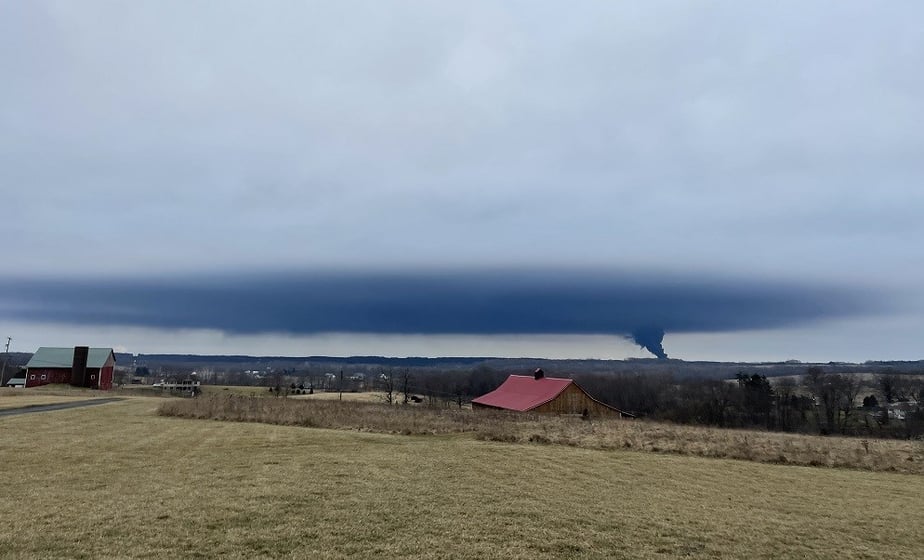
Ohio Toxic Derailment Worked With Weather To Worse Catastrophe

Photo is not a distant tornado in Ohio. It's the toxic plume
from the train derailment in East Palestine, Ohio mixing
with an overcast and then precipitating down in
a broad area during this environmental disaster. 
The huge environmental disaster from the train derailment in East Palestine, Ohio earlier this month was almost certainly created by human error. 

Weather conditions helped spread the mess. 

 We're lucky some of Ma Nature's extremes didn't make it even worse.  The weather during the disaster was pretty average, helping to contain the toxic mess to a relatively small area. 

Still, it's bad enough.  

The train derailed on February 3 in East Palestine, Ohio, very close to the Pennsylvania border.  The train cars were still burning on February 5 when emergency officials noticed a rapid temperature change in a derailed tanker car that contained vinyl chloride, a chemical used in the manufacture of PVC.

Vinyl chloride explodes violently when heated too much, so a catastrophic blast seemed imminent, according to Ohio officials. So they made a decision to do a controlled release of the chemical, which sent an immense black, toxic cloud of smoke and fumes skyward. 

What goes up must come down. We don't have good information on what kind of fallout came from that cloud.

We do know vinyl chloride is bad. Really bad.

 As the Washington Post reports: 

"'It is unclear how much of this volatile chemical escaped into the air or burned before entering surface waters and soil, but vinyl chloride is highly mobile in soils and water and can persist for years in groundwater,' said Cornell University soil and crop scientist Murray McBride, recommending that farmers test wells and surface soils in the months to come."

It seems pretty clear that there's a high risk to people right near the derailment site. What about people near the cloud released during the "controlled release?"

At the time of the "controlled release," around 3:30 p.m. February 5, winds in the area were from the west to southwest at 10 to 15 mph, according to weather data from nearby Youngstown, Ohio.

The day was overcast, and the release launched a plume of dense black smoke that rose up into the overcast, and spread out when it hit that cloud layer. Judging from photos, there might have been a temperature inversion that allowed the smoke and fumes to linger over the area, probably dropping fallout of some sort. 

I'm not sure how long this "controlled release" lasted, but in the following days, the winds kept changing directions. 

Breezes of 10 to 15 mph came from the northwest on February 6, for instance. On February 7, winds in the area were mostly from the south at 15 to 20 mph, but they shifted to the northwest later in the day.

This helped ensure whatever was in the air was dispersed in almost every conceivable direction.  

So far, the Environmental Protection Agency is saying that the area is relatively safe, though clearly more testing needs to be done. 

The air in and around East Palestine was reported to still have a chemical odor this week, but the EPA says you can smell the stuff and it would still be below unsafe levels. The following is my opinion, not from officials:

I'm not convinced its safe in and near East Palestine, or anyone who lives under or near that plume from the controlled release. 

People living in the area report dead fish in rivers. Chickens as far as 10 miles from the derailment site were found dead. 

 I have been asked by a couple people if there's any risk to us in Vermont from this Ohio environment disaster. The answer, thankfully is no. Even if the wind was blowing from the direction of the derailment, by the time the air got here, the plume would have been so completely dispersed that it would have no effect on us. 

This is the view above the cloud layer as a black plume
of smoke and toxins rise from the derailment disaster
site earlier this month in East Palestine, Ohio.

However, railroad tracks criss-cross Vermont and hazardous material is transported on these tracks. Unfortunately, there's every reason to believe another East Palestine could occur in Vermont. 

It doesn't help that train regulations are lax, and railroad employees are overworked, which can lead to errors. 

Much has been made of U.S. Transportation Secretary Pete Buttigieg's somewhat muted response to the East Palestine catastrophe. But - forgive me for injecting politics into this - more blame should go to the previous administration.

It's too soon to pin down the exact cause of the crash. However, the Obama administration in 2015 put new rules in places requiring  trains carrying flammable liquids to use electronically controlled pneumatic brakes. These would apply braking simultaneously across a train rather than railcar by railcar over a span of seconds. This rule would have taken effect this year.

But the Trump administration dropped those rules in 2017, saying they were too expensive for railroads.  

Since it feels like another train disaster is inevitable under current rules and practices, weather conditions will always be there to potential make these catastrophes worse. 

I don't think it's an "if" as to when we see another East Palestine. It's a "when."