Showing posts with label Helene. Show all posts

Friday, January 2, 2026

Trump Administration Screws Hurricane Helene Victims Again

FEMA is dragging its feet in approving buyouts
for North Carolina homeowners whose property was
wrecked by Hurricane Helene 15 months ago. 
A popular Federal Emergency Management Agency feature is the Hazard Mitigation Grant Program. People whose homes were wrecked in disasters and are at risk of being hit again after repairs can apply for a buyout. 

Qualfied applicants under the voluntary program can get the pre-storm value of their home. Then they can take the money and move somewhere that's less disaster prone. 

The damaged home is torn down, and the site would never be developed again. The community benefits because they won't have to deal with that property in the next disaster, since there would be no house there.  

More than 800 Hurricane Helene victims in western North Carolina applied for buyouts, some of them as long ago as this past February. North Carolina officials, having vetted the applications, sent nearly 600 of those to Washington for processing. More will likely get approved in North Carolina.

But so far, the only thing FEMA has heard in response is crickets. FEMA has not so much as approved one of the buyout applications.  

Reports the Washington Post:

"So far...not a single approval has come through. North Carolina Gov. Josh Stein has called the paralysis 'absolutely unacceptable,' and has pushed for answers. Earlier this month, he wrote to FEMA's acting administrator, detailing the startling number of applications that 'remain without a final decision.'"

By the time the Washington Post published the story more than a week ago, nobody from FEMA responded to requests for comment. 

However, once the story was published, the agency sent a short statement, saying it "remains committed" to North Carolina Helene recovery. The FEMA statement said many applicants had not been approved yet "because they do not comply with federal regulations." 

That's news to William Ray, the director of North Carolina Emergency Management, as NPR reports. "we do not have anything in hand that says that officially things are ineligible. We are not able to get a good answers from FEMA as to why they are not moving forward."

Join the club, William.  

Maybe the problem is Homeland Security Director Kristi "Ice Barbie" Noem, whose department has authority over FEMA.  She has a rule in which she personally approve every expenditure over $100,000.

My accusation is all conjecture and sarcasm on my part, but it wouldn't surprise me if Ice Barbie is gumming up the works with FEMA assistance because she's so busy kicking non-whites out of the country and cosplaying some sort of weird ICE assassin or something.  

 In the best circumstances, these buyouts take awhile to arrange. A 2019 study found that it takes a median of roughly five years to complete a buyout from start to finish. However, FEMA says it usually takes two years to complete. 

However, the Trump administration has deeply cut staffing at FEMA this year, so who's left to manage the buyout process. Plus, the very existence of FEMA is in question, as its future is being debated both Trump Powers That Be. 

Which leads us to another broken Trump promise. He had said that he would "slash through every bureaucratic barrier" and said "every single inch of every property will be fully rebuilt, greater and more beautiful that it was before."

So far. Trump's administration hasn't even been able to tear down damaged properties, never mind build everything back. North Carolina is still a mess, 15 months after the hurricane. 

I'll let WaPol handle this:

"The reality is that local governments continue to wait for large sums in federal reimbursements for debris cleanup and other projects. Roads still need repairs. Renters and homeowners remain displaced."

Click on this link to read the entire, very worthwhile WaPo article. 


Thursday, January 2, 2025

Helene-Ravaged North Carolina Endures New Flooding

Screen grab from WCNC shows a footbridge built
after Hurricane Helene being carried away downstream
by renewed flooding in western 
North Carolina last weekend. 
 The storm system that spread tornadoes across the South last weekend also caused renewed flooding and heartache in parts of North Carolina still reeling from the cataclysmic Hurricane Helene floods that struck in late September. 

The flooding wasn't anywhere remotely as bad as what happened in September, and wasn't even that extreme by North Carolina standards. 

But the post-Helene western North Carolina landscape is far from rebuilt.  A lot of ad hoc repairs that weren't meant to be permanent were washed away, creating a new, big setback. 

The storms dumped several inches of rain on some mountainous areas of North Carolina. 

As WCNC video showed, a temporary bridge that connected families to the outside world floated away amid high water in Avery County, northeast of Asheville. 

"We did do a lot of work early on to get footbridges build for folks so they at least had access to their homes, and those were all washed away," Robin Allis of the group Bridges for Avery told the television station. 

The group will need to raise more money to once again replace those bridges. It looks like they'll have to replace up to 100 temporary bridges wrecked by the weekend's heavy rain and high water.  I can only imagine the emotional toll the heavy rain and renewed flash flooding also had on people traumatized by Hurricane Helene. 

Officials in Avery County and elsewhere in western North Carolina said Helene has left rivers more unstable and debris-choked, so even relatively modest storms can cause renewed damage.  

In neighboring Tennessee, officials this weekend had to release water from behind the Walters Dam on the Pigeon River because of the heavy rain running off from the North Carolina mountains. The release caused a flood that swept away large pieces of equipment being used to repair a hydro station on the Tennessee/North Carolina border. 

A temporary ford giving access to residents across a river in Yancy County, North Carolina also washed away, but repairs to the makeshift path across the river was expected to finish by the New Year. 

This episode illustrates how important it is to rebuilt fully as quickly as possible after a big disaster, and to make that rebuilt environment as climate and disaster-resistant as possible.

Meanwhile, people still trying to recover from the Helene disaster are facing nighttime temperatures crashing down into the single numbers and teens and highs on some days remaining below 32 degrees. An ugly mix of rain, freezing rain, sleet and snow are in the forecast for the disaster zone Sunday and Monday.  

Wednesday, December 4, 2024

Hurricane Season 2024 Finally Comes To An End, Good Riddance!

Hurricane Helene approaching Florida in September. This
hurricane proved to be the United States' deadliest hurricane
since Katrina in 2005. The 2024 hurricane season, which
ended Saturday, was among the most destructive on record.
 Back on Saturday, we said our goodbyes to the Atlantic hurricane season of 2024.

And we also told it to don't let the door hit you on your ass on the way out.  It turned out to be a troublesome one, that's for sure. 

As NPR reports, it was the deadliest hurricane season in two decades and easily one of the costliest. Five hurricanes hit the continental United States in 2024, a near-record for the most hits in a single season. 

Hurricane Helene alone snuffed out 150 lives, the biggest death toll from a single hurricane in the United States since 2005's Hurricane Katrina.

Damage from this year's hurricanes amount to at least $190 billion, the second most costly hurricane year after 2017. That was the year that brought us Hurricanes Harvey, Irma and Maria.

As we head into the Christmas season, thousands of people are still experiencing heartache, loss, fear, homelessness and financial ruin because of this year's hurricanes 

For the record 2024 brought us 18 named storms with winds of at least 39 mph. Eleven of those storms became hurricanes (74 mph or greater) and five were major hurricanes (111 mph or greater)

The second half of the season was when most of the action happened. Twelve named storms formed after what is normally the season's peak in early September. Seven hurricanes formed after September 25, which is the most for that late in the season. 

We were warned back in the spring this would be a hyper hurricane season, as near record warm ocean temperatures and a favorable atmospheric setup would turbocharge the season, leading to a possibly record number of hurricanes.  Some estimates indicated we'd have more tropical storms and hurricanes than names in the 2024 queue for these storms.

But the last tropical storm of the season was Sara, leaving three unused names this year, Tony, Valerie and William.

Normally there would have been additional storms in August and the first week of September, which is near the peak of the season. All the ingredients seemed to be there for storms, but they just didn't materialize during that period. It was an odd mid-season lull

Meteorologists will probably spend years studying why the hurricanes mercifully shut down during those weeks in August. 

Some leading theories include the idea that disturbances moving off the west coast ofAfrica - which often eventually develop into hurricanes - were too far north this year, missing out on the very warm waters further south that would fuel these storms.

Also, to get a hurricane going, the upper atmosphere should be cooler than the air near the surface. That would create instability to few the thunderstorms that are the seeds of hurricanes.

This year, the atmosphere was warm through tens of thousands of feet in elevation. That prevented the needed instability to create nascent tropical storms. 

Those meteorologists will study if these really were the factors preventing hurricanes in August and whether climate change had anything to do with these atmospheric conditions. That research will help with predictions of future hurricane season, and individual hurricanes. 

Two of the season's hurricanes managed to cause damage here in Vermont. 

In July, the remnants of Hurricane Beryl (which was the earliest Category 5 Atlantic storm on record in the Caribbean) teamed up with a stalled weather front to unleash intense downpours, especially across much of central and northern Vermont. The result was the state's third catastrophic flood within a year.   

In early August, the remnants of Hurricane Debby blasted much of Vermont with high winds, especially the Champlain Valley. 

Both storms proved you don't have to be anywhere close to where a hurricane made landfall to have those storms cause real trouble.  

Monday, December 2, 2024

North Carolina Shows New Crises, Problems Keep Emerging Months After Disaster

Another byproduct of a climate disaster. Even people whose
homes were undamaged are facing homelessness. Closed
businesses mean unemployment and an inability to pay
rent in the aftermath of Hurricane Helene. 
We were all shocked by the drama of Hurricane Helene in western North Carolina back in September.

The water seemed more extreme than we've ever seen, wiping out entire neighborhoods, hillsides, towns, businesses. You see how high the floods got, and wonder how that was possible.  

No fewer than 103 people died just in North Carolina from Helene. Just unimaginable for a hurricane to do so much harm so far inland.

The headlines have faded some since the initial disaster.  We see glimpses of normality emerging. Water and other services in Asheville are up and running.  Many if not most of the hundreds of destroyed roads and highways are humming with traffic again. 

But new hurt keeps raining down on Helene victims. It's hitting those whose houses were destroyed, and those whose places never had a drop of water inside their living rooms during the storm. 

Some people are learning they can never go home again, and others are being kicked out of their homes into an uncertain future.

EVICTIONS

As the Washington Post reports, evictions are soaring in western North Carolina as people who lost their livelihoods in the storm can't pay their rent, and landlords are unable or unwilling to grant extensions to tenants who are in a real bind. 

Increased homelessness looms just as winter sets in. 

As WaPo reports: 

"From the time Buncombe County courts reopened in mid-October, at least 225 new eviction cases have been filed in the county, according to an analysis of court records by the North Carolina Tenants Union, which advocates for renters' rights. Filing s accelerated this month as people missed November rent deadlines, though some of the tenants represented in these numbers may have started missing payments before Helene."

Rents were high in the region before Helene.  Some housing stock washed away in the flooding, leaving even fewer potential rental units available.

Asheville and surrounding areas are a big tourist hub. The region missed its big fall foliage tourism season as the mountainous area was still in crisis mode and barring visitors as leaves burst into color in October and early November. 

Tourist-dependent businesses that weren't destroyed in the flood had to shut down, leaving many workers out of a job. Which meant they couldn't pay rent. 

Visitors are starting to trickle back into western North Carolina and a lot of businesses have reopened. But it will be months or years before that industry can be back to full throttle. The eviction crisis won't go away soon. 

This type of thing is happening elsewhere with greater frequency, as climate change makes storms wetter, windier and more intense. It might not always be on the scale of what western North Carolina is going through, but it still hurts the victims.

Even here in Vermont, there's a crisis brought on by flooding over the past two years or so.

As Grist reported back in October, our flooding exacerbated Vermont's housing crisis. It put hundreds if not thousands of housing units out of commission, at least temporarily.

And people who wanted to move out of homes in flood danger zones were priced out of the market by sky high housing prices.

Back in North Carolina, there are mounting calls for an eviction moratorium. The moratorium drive is coming from a broad based group of advocates, business leaders and political leaders. The disaster has caused a spike in job losses, since many businesses were destroyed, damaged or crippled by Helene. 

A number of people are in even more dire straights than eviction proceedings. Some people are still living in unheated campers and even tents as winter weather presses in.  This isn't going to go away anytime soon.

Volunteer groups continue to try. Church groups, builders and of course Habitat for Humanity are building lots of tiny homes to offer to people who lost their homes in Helene. Sure, tiny homes are by definition small, but at least they're solid roofs over people's heads, with heat and running water. 

I guess these tiny houses are one positive climate change adaptation method, given that we're going to keep having disasters like this. 

LITERAL SHIFTING LANDSCAPES 

Hurricane Helene produced at least 2,000 landslides in western North Carolina. Many of those swept away homes, killing and injuring dozens of residents. 

To add insult to injury, people who had homes where landslides hit can't rebuild. It's too dangerous. What's left of the land is also worthless. 

As CBS News reports,  geologists are mapping the landslides and assessing where it's unsafe to rebuild. About 13 percent of the mountainous region in western North Carolina is prone to landslides and debris flows, and those places should not have homes or businesses built on them.  Geologist Jennifer Bauer has these risky areas designated as purple zones in her mapping. 

"There are many homes below the purple zones that could be impacted by future landslides, Bauer said. 

As storms get wetter and more intense with climate change, the risk of landslides grows with it.

Not just in North Carolina. Any mountainous or hilly area is prone to landslides and mudslides. It's not just a winter California thing.

The risk includes areas here in Vermont, where I live. The state saw no fewer than 82 landslides during the July, 2023 floods, eleven of which prompted immediate evacuations. One of the landslides swept aside vehicles on a road in Barre, though no serious injuries came out of that incident. 

The increase in extreme weather will keep surprising us with after effects of each disaster that will surprise us and complicate recovery from each event. 

I'm not sure what else to say about it, other than to bluntly say, get used to it. It will be a rough ride. 


Friday, November 22, 2024

Post-Helene Asheville, North Carolina Reaches A Clean Milestone

Hurricane Helene devastated parts of Asheville, North
Carolina and cut off its water supply. As of this week
the water is on, and doesn't require boiling before use.
Although sections of the city remain devastated, the
majority of this tourist town is open and 
looking for visitors to return. 
On Monday, for the first time in 53 days, Asheville, North Carolina residents could put a glass under their kitchen tap, fill it, and gulp down a refreshing slug of water.  

Without boiling it first. 

That simple task had been impossible since Hurricane Helene devastated the region on September 27.

Among a million other things, the extreme hurricane and flood trashed water treatment plants in the region cutting off water supplies for most of the 94,000 or so residents of Asheville.

Water service returned to Asheville in the middle of October, but that water was still unsafe to drink.  The reservoir that provides most of the water for Asheville was a muddy, turbid mess. Treatment plants couldn't purify the water enough. 

But, things slowly got better. Last weekend, the city tested 120 water samples. They all came back good. So the boil water order is finally gone. 

Residents are being told to not use huge amounts of water, because that could still introduce dirt and muck into the system. So, no filling swimming pools, no watering the lawn for hours on end, no half hour long luxurious showers. 

I'm sure that's a good trade off. Better than always having to boil water. 

The return of potable water is a relief not just because it's a pain in the butt to boil water. Asheville is a big tourist town, so the lack of good water was one of many reasons tourists understandably stayed away.

After Helene the road network in the region was pretty much destroyed. Since then, many roads have reopened. 

Much of Asheville's River Arts District was obliterated by Helene's flooding. It'll take years for some of these areas to recover

But huge swaths of the city were not touched by actual floodwaters. Hotels, brew pubs, shops and attractions, including the famous Biltmore Estate.

Tourists were understandably discouraged from visiting Asheville and the rest of western North Carolina in the immediate, chaotic, tragic aftermath of Helene.  But now, parts of the region, including the city of Asheville, and much of Buncombe County, where Asheville is located, are open for business, and could use your tourist dollars.

Per the Asheville Citizen Times:

"Buncombe County could experience a 70 percent decline in tourism over the last there months of the year, the Buncombe County Tourism Development Authority told the Citizen Times in an email - translating to more than $584 in last revenue.

The travel and hospitality industries generate $3 billion in local spending, representing 20 percent of the local economy, the agency says."

I was in Asheville as a tourist years ago. It is a lovely city, and it's worth the trip. 

The city is moving ahead with its annual Christmas celebrations, which is an obvious move. People really need that distraction.  

Monday, November 11, 2024

Hurricane Helene Decimated North Carolina Forests, Too

The forest basically collapsed around this house
in mountainous western North Carolina during
the winds of Hurricane Helene in September.
As we well know, the extreme flooding from Hurricane Helene in western North Carolina is one of the worst and deadliest disasters the United States has seen in years. 

North Carolina Gov. Roy Cooper has recently said the total damage estimate in the state is so far up to $53 billion, very likely the most expensive disaster in the state's history. 

Almost all the damage was obviously due to floods and landslides. 

But I've been struck by the images I've seen of the destruction to forests in western North Carolina.  Heavy rain often extends far inland after a hurricane comes ashore, though this is an extreme example.  But wins from a hurricane usually diminish pretty quickly after a hurricane makes landfall.

The area of western North Carolina is very roughly 400 miles from where Helene made landfall near Perry, Florida.  Still, the wind damage up in the mountains near Asheville was incredible. 

As Fox Weather Reports: 

"The North Carolina Forest Service has completed an aerial damage assessment of forest lands across western North Carolina and the losses are staggering. 

The surveyors estimate 822,000 acres of timberland were damaged or destroyed across more than a dozen counties during Helene, with McDowell County hit particularly hard. All told, the NC Forest Service estimates damage to the state's timber at $214 million."

With all those trees down, there's new hazards that can afflict the mountains of western North Carolina. 

As television station WYFF in Greenville, South Carolina reports: 

"With the loss of such a large portion of the ecosystem in the area, officials said this can cause several negative effects including: The threat of wildfire due to increased fuel levels, loss of vital wildlife habitat, impacts on watershed health and the higher potential for invasive species to thrive."

Plus, you can't just play pick up sticks and remove all the fallen trees. There's too many. It's hard enough just clearing the mess from mountain back roads and remote driveways and hiking trails. 

WHY THE INLAND WIND

 The rapid forward movement of Helene probably helped preserve the storm's strong winds well inland. And the high elevations likely captured the strong winds better than valleys, as a dying hurricane often maintains its high winds aloft better than near the surface. 

The mountains were high enough to be exposed to those upper level winds. While valleys were comparatively calm, the mountains were being blasted by 80 to 100 mph winds. 

Former hurricanes can hang on to their wind energy well inland, especially as these interact with other weather systems. 

And yes, the chances are low, but here in Vermont we can lose much of our forests if the wrong hurricane takes the wrong path. 

It's happened before, in the Great New England hurricane of 1938. The Category 3 hurricane came ashore on Long Island and near New Haven, Connecticut and moved rapidly northwestward from about Brattleboro to Burlington. 

Its fast forward speed, and the fact that its winds were most intense over and east of the center decimated Vermont sugar bushes. Some estimates say half of Vermont's' maple trees blew over or were uprooted.

We even had a mini-instance this past summer of a former hurricane trekking inland and raising havoc with Vermont's trees.  

Hurricane Debby made landfall near Steinhatchee, Florida before dawn on August 5. Its remnants moved northeastward through central New York and clipped the northwest corner of Vermont on August 9. We were just in the correct spot for the Debby remains to transfer its remaining strong winds aloft down to the surface, especially in the  Champlain Valley.

Winds gusted past 60 mph, causing quite a lot of tree, power line and even structural damage. 

NORTH CAROLINA'S SETUP

The North Carolina Forest Service said most of the damage appears to be from what looked like downbursts or microbursts. That might be a symptom of intense upper level winds being "grabbed" by either topography or thunderstorms embedded in the overall wind field.

The topography of mountainous western North Carolina helped contribute to the areas of worst damage. 

Per the Washington Post:

"The same rugged topography that sent floodwaters racing through valleys compounded the wind's destructive power. Ridges acted like walls to a funnel, allowing winds to concentrate and strengthen. As they hit east-facing slopes, they were then pushed uphill, accelerating as they converged at the top of each peak."

Intense hurricane winds are almost unheard of as far inland as the Smoky Mountains of North Carolina. So trees there evolved in such a way that they don't tolerate such intense winds. They're not like pine forests near the hurricane-prone coasts, which are rooted in ways to brace their roots so they don't pull up. The pine branches and trunks are flexible so they often bend but not break in hurricane winds. 

The broad deciduous tree leaves in the mountains each act like little sails, pulling the tree in the winds until it topples. Those coastal pine trees have needles that don't catch the wind so much. 

The blasted forests of North Carolina might well be the longest lasting legacy of Helene.  It'll probably take a few years to patch up all the roads, rebuild homes and businesses that can be rebuilt, and for life to return to some semblance of normal.

But it will take decades to regrow the hardest hit forests. Many people living there will never again fully see the forests that had been part of their lives for decades.

 Videos:

First video is an interview of a woman whose family huddled in their high elevation house above Asheville, North Carolina as almost the entire forest around them blew down within an hour and a half. In the video, it's interesting to see that depending on which way the hillsides face, the forest destruction was either  complete or minor.

 In this video, it looks like wind got momentum going downhill,  kind of like the damaging downslope winds we sometimes see in Vermont on the western slopes of the Green Mountains. 

Very luckily, the trees fell in such a way that the house miraculously suffered only minor damage. Click on this link to watch and hear the wild story, or if you see the image below, click on that. 


Drone footage by Aaron Rigsby via AccuWeather shows areas of terrible forest destruction in North Carolina next to areas of beautiful autumn foliage. The video taken on October 22 shows the capriciousness of the timber damage in the western Carolina mountains. Again, click on this link to view, or if you see the image below, click on that. 


More excellent aerial shots by Aaron Rigsby. Click on this link or if you see the image below, click on that. 


Sunday, October 13, 2024

Campaign And Troll Falsehoods Sow More Fear, Confusion In Southeast Disaster Zone

One thing victims of the extreme Hurricanes Helene and Milton disasters  don't need are more fear and confusion that they already have. 

MAGA lies about FEMA's response to Hurricanes
Helene and Milton are dangerous for many reasons,
but apparently victimizing victims is fine if 
it somehow helps Trump get elected. 

Unlike water, electricity, shelter open roads and cell service, fear and confusion are in plentiful supply, as one would expect in such an extreme calamity. 

It is now the campaign strategy of Donald Trump and his supporters to promote wild stories about the federal response to the twin disasters.  

I guess firing up the "base" to win the White House is more important than the lives of the people coping with these calamities. 

People dealing with hurricanes Helene and Milton have the added misfortune of experiencing these catastrophes in the final weeks of a a nail biter presidential election. 

 FEMA DIVERTING FUNDS TO MIGRANTS?

The Washington Post a week ago delved into one of the the gems in North Carolina's disaster zone that seems to have gotten a lot of traction on social media;

"Former president Donald Trump doubled down on  misinformation about Hurricane Helene in an appearance in this storm-ravaged state Friday, repeating the falsehood that the White House used disaster funds for migrants."

Of course, that's not true. 

White House Spokesman Andrew Bates said flatly. "No disaster relief funding at all was used to support migrants housing and services. None. At. All."

 Republican governors of South Carolina, Georgia, Tennessee and Florida, along with the Democratic governor of North Carolina all say that they have been happy with FEMA's disaster response so far.

Of course, Trump and his followers are having none of that. They'll believe what they want to believe, as to them, the truth is besides the point. How dare those Republican governors contradict Dear Leader! 

ORIGINS OF LIES

Like every wild, false story, it all begins with a grain of truth. FEMA has enough money and personnel to swoop into disaster zones to provide immediate aid in the aftermath of these terrible disasters.  

However, the agency is in fact having trouble funding long term aid for disaster areas, such as reimbursing municipalities and states for road and infrastructure repairs they've done. 

Hurricane Helene destruction in North Carolina. Trump's
lies about the FEMA response could be making things
even worse for these disaster victims. 

Congress has to appropriate more money for that piece of the FEMA pie. A stopgap spending bill that prevented a partial government shutdown omitted additional funding for FEMA. Congress is in a recess now during the campaign season.

However, there have been calls for Congress to reconvene in the coming days to pass a supplemental FEMA money bill.  House Speaker Mike Johnson is against that idea. 

I am certain that there's been FEMA missteps already in North Carolina and in other Helene disaster zones. You get that in an emergency. FEMA aid was probably slow to reach some victims, given how many were stranded in inaccessible mountains and hollows. 

And there's probably bureaucracy frustrating people who intensely needed help last week, never mind right now. 

It's also no secret that FEMA can be an annoying bureaucracy. Vermont Sen. Peter Welch has called for a federal audit of FEMA,  citing administrative bloat and bureaucratic inefficiency.

But as far as FEMA ignoring desperate flood victims in North Carolina to coddle migrants, that's all stupid campaign lies. Most FEMA employees really want to help disaster victims, and are really good at their jobs. 

CONSEQUENCE OF LIES

FEMA is not capping aid to victims at $750.00.  They didn't block helicopters in North Carolina from searching for survivors. They're not diverting disaster aid to migrants. They didn't confiscate all the private aid that went to North Carolina. And the federal government is not withholding aid to areas where a majority of voters support Trump. 

There are also even crazier notions that a surprisingly large segment of the population believe. These include the idea that the government is somehow controlling the strength and path of hurricanes and other disasters. I'm planning an upcoming, separate post on that whackadoodle aspect of all this lies circulating around. 

 Meanwhile, these FEMA lies could have real life consequences. It's not just campaign chatter.   

The White House, its staff and Democratic presidential candidate Kamala Harris keep clapping back hard at the misinformation around the Helene response. They are all warning that they falsehoods could keep hurricane victims from seeking the assistance they critically need.

I also worry about FEMA workers. That kind of MAGA lies about FEMA can encourage the real wackos among them to consider violence and attacks against these workers. They're already reportedly receiving death threats. 

TikTok and X posts, along with other social media, is sadly rife with threats against federal workers just trying to provide some aid to disaster victims. 

Also, talk about wasting resources!  FEMA had to launch a web page to combat false rumors about its activities.  I agree that they had to do it to attempt to make sure accurate information gets out there. But it's a waste of time and resources, when if Trump and his minions hadn't resorted to all these lies, that FEMA rumor-quashing page would not have been necessary. 

Oh, by the way, there has been a case in which a president has diverted funds away from FEMA and steered the money toward his pet project. It wasn't the Biden administration. 

It was none other than Donald Trump, who's now falsely whining about FEMA money being diverted.

As Politico reported, Trump in 2018 initially wanted to refuse disaster aid to California after some destructive wildfires

And talk about a bald faced transactional, corrupt mindset, an aide to Trump talked him into providing the aid by pointing out fire-damaged Orange County, California had more Trump supporters than the entire state of Iowa. 

President Biden responded to this news by saying, "You can't only help those in need if they voted for you."

Which makes me glad Biden was president when deep blue Vermont suffered a series of flood disasters in 2023 and 2024.

WHY WE KNOW LIES AREN'T TRUE 

Anybody can go on social media and make up anything. The more provocative and outrageous, the more clicks and revenue some idiots can make. Truth is besides the point.

Say what you want about journalists - and there's a lot to say - but if FEMA was doing anything like what Trump and MAGA are accusing them of, it would be all over the news.

I was in journalism for decades. I know how they tend to think. Journalists love to get the scoop, of course, and they would shout from the rooftops if FEMA really was blocking aid. Or giving the aid to migrants instead of hurricane victims. 

There's two reasons for that.

One, like anybody else, journalists really want to advance their careers.  If a journalist broke a big story like that, there's potential for advancement, more income,  heck maybe even a Pulitzer Prize.

Also, many journalists have a "comfort the afflicted, afflicted the comfortable" ethos. Many - not all -journalists love to stand up for powerless victims of the powerful. So if FEMA really were victimizing hurricane victims who have lost everything, they would be all over it.

Come to think of it, I guess that's why  you've heard so often on the news Trump's accusations against FEMA described as lies, which they are. It's been all over the news. Because this is a case in many journalists are trying to comfort the hurricane victims being afflicted by Trump's falsehoods.   

Friday, October 4, 2024

The Tropics/Hurricanes Are Now Exciting In Atlantic Ocean, But Thankfully Staying Away

 I've always been impressed by the beauty of satellite photos of strong hurricanes.

Hurricane Kirk way out in the Atlantic Ocean this morning.
Satellite views of strong hurricanes are beautiful, as 
long as said hurricanes are not threatening lives and property.
Don't get me wrong. I hate hurricanes and the lives and property they destroy. We know all too well after Hurricane Helene last week. 

As of Thursday, the Helene death toll had climbed to 213, making it the second deadliest hurricane in the United States in 50 years. Only Katrina in 2005 extracted a higher death toll.  

The Helene death toll is climbing still, as people are still missing. And the suffering in western Florida, Georgia and especially North Carolina continues on.

Hurricane season post-Helene is continuing to be very active, but luckily, two very powerful storms will completely miss the United States.

HURRICANE KIRK

The beautiful satellite photo of the day is Hurricane Kirk. It's a really impressive and large hurricane. Powerful, too, with top sustained winds of 145 mph. .That's a strong Category 4 storm. 

Luckily for everyone, Hurricane Kirk is in the middle of nowhere. This morning, it was about halfway between Florida and the western coast of Africa. It wasn't near any islands to speak of. 

Even better, it's not headed toward land. Kirk is going north, and it will eventually weaken over the colder waters of the North Atlantic. Toward next week, it could become a nasty non-tropical storm in parts of Europe.

The only effects Kirk will have on the United States is large ocean swells that will cause dangerous surf and rip currents along the entire eastern seaboard. The Canadian coast, too. 

TROPICAL STORM LESLIE

There's another one out there, also apparently destined to be a strong hurricane. Which, thank goodness, also won't affect us in the United States.

At the moment, Tropical Storm Leslie is also in the middle of nowhere, well to the southeast of Kirk.  This morning it was kind of halfway between the northeast tip of South America and the westernmost coast of Africa. 

The National Hurricane Center says Leslie had top winds of 60 mph this morning. But it's expected to grow into another powerful hurricane over the weekend, but probably not as powerful as Kirk.

It's heading toward the northwest and that direction will continue through early next week. That should keep Leslie out to sea. Eventually, like Kirk, soon to be hurricane Leslie will move into the cold north Atlantic waters and die out. 

GULF OF MEXICO

If there's any threat coming to the United States in the coming days, it would come from the Gulf of Mexico. 

For a week now, the National Hurricane Center has been eyeing stormy weather in the southern Gulf of Mexico. 

This might or might not develop into a tropical storm next week. It depends on whether the developing system gets tangled up with a cold front coming in from the north or not.

In any event, this will not be another Helene. It'll never get especially powerful. But however it evolves, it does have the potential to produce flooding rains in Florida next week, so stay tuned!

Report: Helene Dumped The Equivalent Of The Entire Contents Of Lake Tahoe On Southeast U.S.

United States rainfall from September 24 to 29. Click
on the map to make it bigger and easier to see.
That bright purple splotch in western North
Carolina represents about two feet of rain. 
 Hurricane Helene combined with the "predecessor rain event" associated with that storm in the Southeast dumped 40 trillion gallons of water on the region.  

The Associated Press reports:

"That's enough to fill the Dallas Cowboys stadium 51,000 times, or Lake Tahoe just once. If it was concentrated just on the state of North Carolina, that much water would be 3.5 feet deep. It's enough to fill more than 60 million Olympic-size swimming pools."

It would also take 619 days for that amount of water to flow over Niagara Falls, on average.

The rainfall amount was calculated by meteorologist Ryan Maue, a former NOAA chief scientist. 

Other meteorologists checked Maue's work, and said his work looks pretty damn accurate. If anything, Maue might have underestimated the rainfall a little. 

The AP reports: 

"'That's an astronomical amount of precipitation,' said Ed Clark, head of the National Oceanic and Atmospheric Administration's National Water Center in Tuscaloosa, Alabama. 'I have not seen something in my 25 years of working at the weather service that is this geographically large of an extent and the sheer volume of water that fell from the sky."

The town of Busick in western North Carolina received 31.33 of rain. Other locations not far from Asheville received more than two feet of rain. 

Also, this was the second mega-rainstorm parts of North Carolina within just two weeks. On September 15-16, a stalled storm along the North Carolina coast that tried and failed to turn into a tropical storm still managed to dump 20.81 inches of rain on Carolina Beach and a foot to a foot and a half of rain in southeastern part of that state. 

Obviously with that much rain, extensive flooding was reported in that area. 

We should expect to see more and more of this in the coming decades as climate change continues to intensify. Warmer air can hold more moisture, and under the right conditions, can dump ever heavier amounts of rain. 

This is leading to more frequent and worse flooding in many areas. Us Vermonters know a thing or two about that given the events of the last two summers. 

Maue and others point out there were mega-floods well inland from coastal areas associated with both tropical and non-tropical systems well before climate change was a thing. 

That is true. Western North Carolina had a highly destructive flood like Helene back in 1916, though that one wasn't quite at the level of the one they just experience. 

In August, 1969, Hurricane Camille smashed ashore in Mississippi as a deadly Category 5 storm. It was one of the most powerful hurricanes ever to hit the United States. The remnants of Camille moved on to the mountains of western Virginia, where it dumped up to 27 inches of rain. That unleashed flooding that killed at least 150 people.   

Even here in Vermont, an offshore former tropical storm fed deep moisture into the state, creating the Great Flood of 1927.

So yes, big floods have always occurred. But it's happening more often and these things are getting wilder.

Associated Press again:

"Before 2017's Hurricane Harvey, 'I said to our colleagues, you know, I never thought in my career that we would measure rainfall in feet,' Clark said. 'And after Harvey, Florence, the more isolated events in eastern Kentucky, portions of South Dakota. We're seeing events year in and year out where we are measuring rainfall in feet."

For now, the nation is getting a brief break. Forecasts for the Lower 48 over the next two or three days show the least flood threat overall in months. However, southern and central Florida could see torrential rains and flooding starting early next week from a potential weak but slow-moving tropical system that's forecast to be in that area.  


Thursday, October 3, 2024

Did Factory Supervisors Cause Deaths Of Workers In Tennessee Helene Flood?

Managers at an Impact Plastics plant in Erwin, Tennessee
allegedly did not let employees leave as Hurricane Helene
floodwaters rose around them. This resulted in six deaths.
Another huge disaster, another case in which a major employer did not protect their workers from danger as they should have. 

At the Impact Plastics factory in Erwin, a small town in eastern Tennessee, employees kept working last Friday as waters in the nearby Nolichucky River rose.

Erwin is in the western foothills of the Appalachians, very close to the North Carolina border and right next to the tall mountains that collected two to three feet of rain from Hurricane Helene and a torrential rainstorm that immediately preceded the tropical system. 

They kept working into the power went out and water swirled into the factory's parking lot. Ultimately 11 factory workers and a contractor were swept away as they tried to escape and only five of them were rescued. The others are dead or presumed dead. Not all the bodies have been found. 

There's plenty of credible stories emerging there that plant managers wouldn't let people flee the rising flood waters until it was far too late. 

Here's part of a report in the Knoxville News Sentinel:

"Jacob Ingram has worked at Impact Plastics for near nearly eight months as a mold changer. It's a role, he said, that keeps him on his feet for the entire first shift.

As the waters rose outside, managers wouldn't let employees leave, he said. Instead, managers told people to move their cars away from the rising water. Ingram moved his two separate times because the water wouldn't stop rising. 

'They should've evacuated when we got the flash flood warnings, and when they saw the parking lot,' Ingram told Knox News. 'When we moved our card we should've evacuated then...we asked them if we should evacuate and they told us not yet, it wasn't bad enough. 

'And by the time it was bad enough, it was too late unless you had a four-wheel drive.'"

Ingram went on to tell the paper that he and 10 others fought their way through waist deep water when a semitruck driver called them over and helped them get on an open-bed truck, which was packed full of large flexible gas pipes.

A piece of debris smacked into the truck, knocking a woman off and sweeping her away. Then another piece of debris did exactly the same thing. Now two women were gone. 

Then the truck was hit by a much larger piece of debris, overturning the entire vehicle. Ingram thought to grab onto the plastic gas pipes, because he had seen some other pieces of the material floating downstream rather than sinking. 

Ingram and four other employees floated a half mile downstream until they hit a large pile of debris they could hang on to. An hour after that, a Tennessee National Guard helicopter plucked them from the pile to save them.  

We know one of the women who fell off the truck died. The body of Bertha Mendoza, 56, was found on September 29. Others from the truck are missing. 

Ingram managed to post some harrowing videos on Facebook that make it clear at least to me that employees of Impact Plastics should have been evacuated far sooner. 

Impact Plastics officials are circling the wagons on these damning accounts. As the Associated Press reports:

"Impact Plastics said in a statement Monday that it 'continued monitor weather conditions' Friday and that managers dismissed employees 'when water began to cover the parking lot and the adjacent service road, and the plant lost power.'"

But in a separate interview, Ingram told WVLT: "I actually asked one of the higher ups (if we should leave) and they told me, 'No, not yet.'. They had to ask someone before we was able to leave. Even though it was already above the doors of the cars."

 Ingram told WVLT that employees were made to stay on site for 15 to 20 minutes after the power went out. 

CBS News reported another employee, Robert Jarvis, gave exactly the same account as Ingram.  Jarvis also asked this question during an interview with television station WBIR: "Why would you make us stay there? Why would  you keep us there if you knew it was going to be bad, if you were monitoring it? Why were we still there?"

Well, my cynical but possibly accurate answer is some mucky muck with Impact Plastics somewhere was loathe to let their commodity, I mean human beings, get out of harms way. That is until the power failed, at which point the factory could no longer make revenue. By then, of course, it was too late for many of the employees to flee.  

Or, if I'm more charitable, the culture at Impact Plastics is that supervisors were tyrants, and there's not a lot of jobs in eastern Tennessee so employees were fearful of getting fired for, you know, trying to save their own lives. 

Notice how carefully Impact Plastics statements are worded. The statement said that while most employees left immediately, some remained on or near the premises. Yeah, because by then they were trapped by the raging floodwaters. 

The owner of a manufacturing plant near Impact Plastics had sent his employees home before they could become endangered and tried to drive a piece of heavy equipment to Impact Plastics in a rescue attempt. 

The Tennessee Bureau of Investigation is now looking into the allegations against Impact Plastics at the direction of a local prosecutor. 

EMPLOYEE DISASTER SAFETY OFTEN IGNORED

I admit part of all this might be Monday morning quarterbacking. I'm sure nobody in Erwin could have imagined things would get that bad that fast.  This is why in the same town, close to 60 people ended up trapped on the roof of a small local hospital as rapids raced around and through the building. 

Still, it fits a pattern in which too often, keeping employees safe during dangerous weather is just a drag on profits, sure to make shareholders unhappy. What's a few dead employees it allows you to buy a second yacht, right?

I've covered other examples like what allegedly happened at Impact Plastics. 

After a deadly tornado outbreak in December, 2021, employees of a Mayfield, Kentucky candle factory hit by a powerful tornado that night said managers would not let them leave to seek safer shelter ahead of the approaching twister. Nine people who were in the factory died in the storm. 

During that same, December, 2021 tornado outbreak, six people died in an Amazon distribution center in Illinois when a tornado hit. Employees there said they were not given the opportunity to seek safer shelter when tornado warnings blared.

In that same tornado, an Amazon driver said she was told by supervisors to keep driving instead of taking shelter despite the fact a tornado warning was in effect.

Also, legislators in Texas and Florida prevented municipalities from enacting ordinances that would have mandated water and rest breaks for outdoor workers toiling in those states' excessive summer heat. 

Which proves that lawmakers and Florida and Texas, and too many corporations, regard especially low wage workers that to them, it's no big deal if a worker dies because of dangerous weather. To them, these workers are not human beings. Just machines to replace when they are "defective" and break down in rough weather conditions. 

I really hope those responsible for the deaths at Impact Plastics are held accountable. 

Saturday, September 28, 2024

Helene Aftermath Remains Scary As Death Toll Rises, Crisis In Appalachians, Tens Of Billions In Damage

Flood destruction from Helene in North Carolina. 
 The death toll keeps rising from wide-ranging Hurricane Helene, with the latest figure being around 52 people. 

Unfortunately, this toll will rise, as searches are continuing. This is especially true up in North Carolina and parts of Tennessee, where flood waters haven't yet subsided enough to do any thorough searches. 

Electronic road signs on the edge of the worst disaster zone read "DO NOT TRAVEL IN WESTERN NC" 

Areas of western North Carolina and eastern Tennessee are the scariest as of Saturday morning and early afternoon. Pretty much all the roads in the region are closed and in many cases destroyed. That makes it hard to rescue people, and sadly, find bodies.

There are plenty of unconfirmed reports of people who climbed onto roofs, only to be swept away when the structures collapsed beneath them. There are so many back roads and hollows that nobody can get to, so we don't know what's going on.

In Asheville, most of the city had no electricity, internet service, cell service or running water. The news out of the southern Appalachians is going to keep getting more and more grim in the coming days, I fear. 

Emergency responders were overwhelmed, too. Buncombe County 911 fielded 3,300 calls within eight hours on Friday.

Meanwhile, damage assessments are only beginning to be thought of.  Moody's Analytics said it expects anywhere from $15 billion to $26 billion in damages from Helene, reports the Associated Press. I've seen other estimates that are even higher. 

Rainfall totals were extreme, to say the least. Busick, North Carolina reported 39.58 inches. Mount Mitchell State Park has 24.5 inches, Sumatra, Florida 15.5 inches and Dillard, Georgia 14 inches. 

Atlanta had 11.12 inches with 48 hours, the biggest two day total since record keeping began there in 1878.  Asheville, North Carolina collected over 12 inches of rain. 

Some radar estimates indicate 30 to 40 inches of rain fell on some of the Smokey Mountains. 

At one point, 4.3 million homes and businesses were without power due to Helene. 

Helene made landfall late Thursday night in the Big Bend area of Florida, an area that has become pretty luckless in terms of hurricanes lately. It was the third hurricane to strike there in the past 13 months, with Helene being the strongest of the bunch.

Three of the last five hurricanes to strike the United States hit the Big Bend, according to The Weather Channel.  

 The rain and wind have tapered off. Aside from possible dam failures, the risk of new flooding has largely ended, as the remains of Helene have finally faded to something tame. 

There's no threat of a new hurricane strike on the United States for at least a week. But it's still hurricane season, so the threat of another one of these monsters isn't over yet for the year. 

Videos:

This video shows a house floating downstream and collapsing in Asheville, North Carolina. Click on this link to view, or click on image below if you see it. 


Next video shows all the challenges of even trying to get around Boone and Blowing Rock, in the mountains of North Carolina, during Friday's Helene calamity. Again, click on this link to view or if you see image below click on that.


Drone video captured a bridge collapsing Friday in Greene County, Tennessee on Friday. As always, click on this link to view or if you see image below, click on that. 


Friday, September 27, 2024

Helene Death Toll Soars As Appalachians Awash In Catastrophic Flood, Extreme Florida Storm Surge Damage

Homes near Asheville, North Carolina flooded almost
to the roofs. If you look closely you see a person stranded
on one of the roofs. 
 As of late this afternoon the death toll from Hurricane Helene has soared to 25 amid the storm surges, wind, tornadoes and catastrophic flooding wrought by the wide ranging storm. 

Helene is no longer even a tropical storm, but was still producing intense flooding, some tornadoes, and gusty winds in the southern Appalachians and parts of the Midwest.  Meanwhile, the cleanup is only just beginning in Florida and Georgia. 

In Florida at least seven people died and  Gov. Ron DeSantis warned that number could rise as searchers sift through the debris of coastal communities destroyed by storm surges that in some cases reached 15 feet. 

The storm surge at Cedar Key, Florida topped ten feet, easily a record. Drone video shows numerous destroyed and washed out buildings in the town, with debris covering everything. 

The storm surge was expected to be more than 15 feet north of Cedar Key. However, there were no tidal gauges in that area to record how high the water got. There are reports of a 16-foot storm surge in Steinhatchee, Florida.  

Storm surges reached record levels of over seven feet in Tampa and Clearwater Beach. 

The action first shifted out of Florida late last night and moved into Georgia, where strong winds and intense flooding raked much of the state. Widespread flooding was reported in Atlanta. At one point, an on air meteorologist had to interrupt his report to dive into water to rescue a woman in a car flooded up to its window. 

 In Tennessee, about 50 staff and patients were stranded on the roof of a hospital as the building was "engulfed by extremely dangerous and rapidly moving water," according to Ballard Health.  High winds at first made helicopter rescues impossible, but later in the afternoon, helicopter crews had managed to retrieve everyone on the roof.

 Large sections on Interstate 40 in the Great Smokey Mountains in North Carolina and Tennessee were closed by mudslides. 

Photos on social media showed water reaching the roofs of some homes in and near Asheville. Rainfall totals neared 20 inches over the past few days in some spots.  

At least nine tornadoes spun out of Helene, mostly in North Carolina and Virginia. A particularly strong one destroyed buildings and injured at least 15 people in Rocky Mount, North Carolina. Tornado warnings from Helene were issued for places as far north as southern Ohio. 

Screen grab from WxChasing video shows extreme
storm surge destruction in Cedar Key, Florida. 

There's really too many instances of destruction to describe. In addition to the rising death toll, Helene has surely caused many billions of dollars in damage. It will probably be the most expensive United State disaster this year. 

What was Helene has merged with an upper level low and is still producing flooding rains and gusty winds through a wide area from Missouri to Indiana to North Carolina. The wind and rain should subside gradually over the next couple days.  

The tropics have gotten quite active. In what had been a quieter hurricane season than some experts anticipated, Helene introduce at least a mini-barrage of storms. 

Luckily, two that have formed do not appear to pose much danger. Hurricane Isaac, way out in the Atlantic Ocean about half way between Virginia and Portugal, has winds of 85 mph. It will soon move northeastward into colder waters in the middle of nowhere and slowly die.

Tropical Storm Joyce with top winds of 50 mph growing more organized far northeast of the Windward Islands. This storm is expected to run into a buzzsaw of dry air and hostile upper level winds and will weaken as it curves northward away from any land threats.

Another disturbance having recently moved off the African coast, is moving westward over the eastern Atlantic and could develop, maybe. 

The ominous threat is a possible new tropical storm that could form in the Caribbean or southern Gulf of Mexico next week. Gawd knows what that will do.

 Videos:

Asheville, Nor....   Click on this link to view or if you see the image below, click on that. 


A daring rescue of a man and his dog from a sinking sailboat in the Gulf of Mexico as Hurricane Helene raged. Again, click on this link to view or click on image below if you see it. 


Jumpy video, but scary. Video taken by one of the more than 50 people stranded on a Tennessee hospital roof by swift water from a flooding river. Click on this link or click on image below if you see it. 


Wednesday, September 25, 2024

No Hurricane Helene In Vermont, But Surprisingly Drenching Rain Beginning

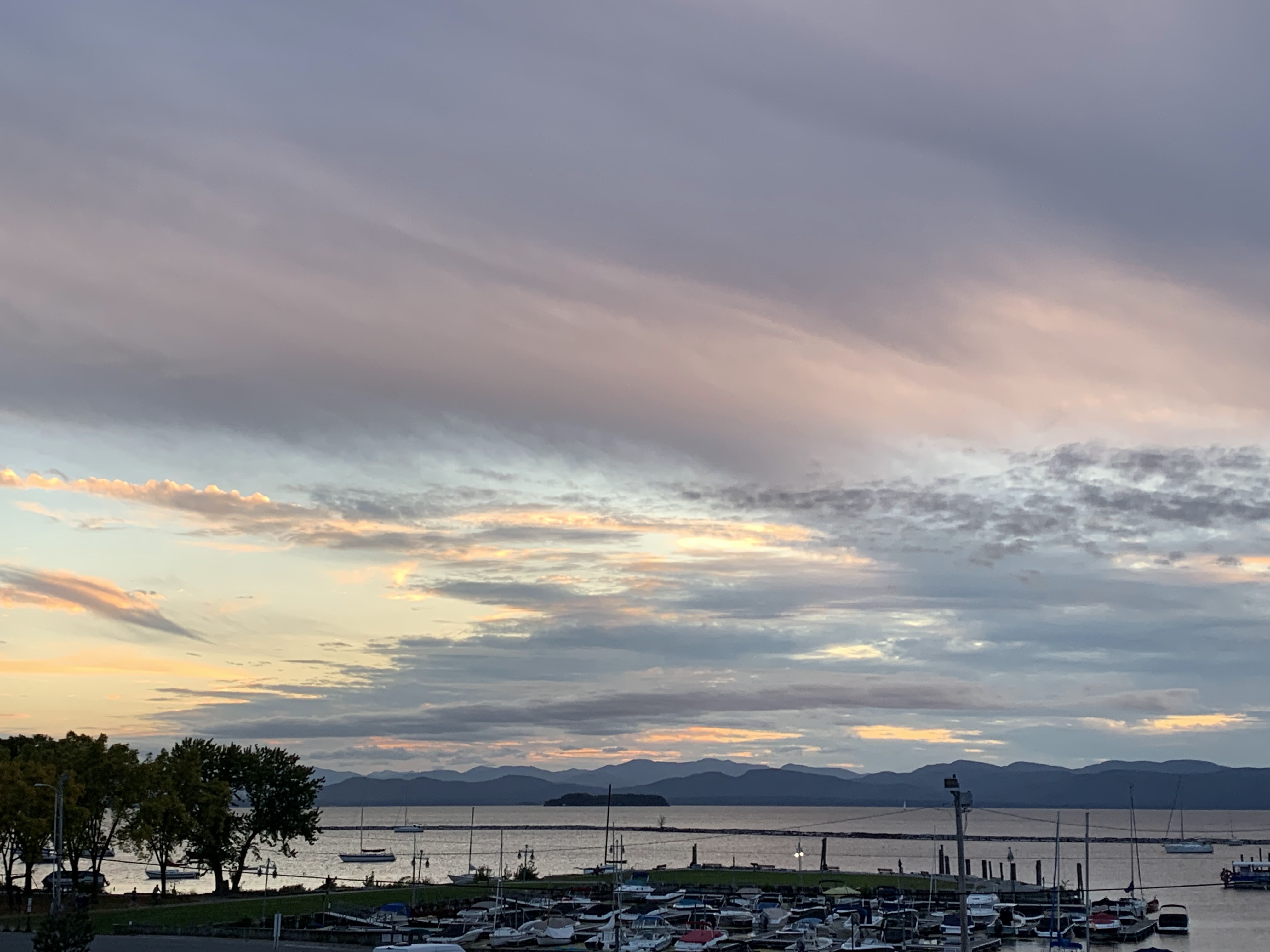
Clouds streaming into the skies over Lake Champlain
near Burlington, Vermont Tuesday evening heralded
our current brief but needed spell of wet weather.
It almost seemed odd this morning. 

I awoke to a dark and rainy and dreary start to the day here in Vermont, something we haven't seen in a long, long time. 

At least as recorded in Burlington, a 16 day streak with no measurable precipitation has come to end. 

The National Weather Service office in South Burlington ranks this as the 20th longest dry streak in records dating back to the 1880s.

The longest dry streak, for those of you keeping track, is 52 days from April 9 to June 6, 1903. 

Now, we're in a wet spell, and forecasters have greatly increased the amount of rain we'll get out of this. A few days ago, I thought this week's rain would only amount to maybe half inch or less. Now, we're expected a total of one to two inches through tomorrow, with locally higher amounts.

This, without any moisture assistance from soon-to-be Hurricane Helene, which still looks like it won't have much of an effect on us here in the Green Mountain State.

PROGRAM NOTE: I'll have a separate post on Helene later this morning. There's a LOT to talk about with Helene, and unfortunately it's pretty much all really bad news. 

For now, on to Vermont's blissfully wet situation. Unlike in the Helene zone of the southeastern United States, the rain coming to the Green Mountain State will do far more good than harm. 

TODAY

An initial cluster of rain and shower has been moving Vermont this morning, with central and northern Vermont seeing the most.  I am a little surprised by amounts of around a third of an inch so far. I anticipated some lighter stuff today.

The rain was beginning to move on, so we'll have a drier break later this morning and much of this afternoon. By "drier" I mean little or no rain during that period. But it still will be cloudy, kind of raw and breezy, with the most wind in the Champlain Valley. 

This will belated be the first truly chilly autumn day, with highs only within a few degrees of 60, all made to feel cooler by the clouds and winds. It's not at all unusual to have this kind of weather in late September. The lowest high temperature on record on this date in Burlington is 48 back in 1925, so we're not anywhere near the realm of true autumn cold.

Plus, we have more pretty warm weather on the way

Before we get there, the rain will move back in tonight. 

TONIGHT/THURSDAY MORNING

That high pressure system in southeast Canada that's been helping to keep us dry for so long is helping to play a part in making this new storm wetter than perhaps some of us originally thought. 

This forecast map from the National Weather Service office
in South Burlington shows the vast majority of us seeing 
a nice one to two inch rain soaker today, tomorrow.
The air flow between that and an approaching front from the Great Lakes is bringing quite a bit of atmospheric moisture our way from the warm Atlantic waters off the Mid-Atlantic and southeast coast.

The front and all that moisture will unleash drenching rains, with a few embedded downpours and maybe even a rumble of thunder overnight and the first half of Thursday. 

That's when most of the one to two inches of rain will fall.  Some places that really get bullseyed by the heaviest showers could manage a good 2.5 inches of rain. 

Aside from some ponding of water on a few roads, this rain will not cause any flooding. It's been so dry that the rain will soak into the ground nicely.  You might see river levels rise slightly tomorrow, but they will stay well within the range of normal stream flow for autumn. 

LATER THURSDAY AND BEYOND

The real rains will shut off as the front passes through by afternoon, but there could be some lingering showers around. Maybe even a couple weak, isolated thunderstorms. It will be seasonably mild - well into the 60s by afternoon. 

That high pressure that's been so persistent over southeastern Canada this month will re-assert itself, giving us yet another stretch of generally sunny, mild weather Friday through probably next Tuesday.  Highs each day will reach or get a little over 70 most places, with lows staying far, far above any frost dangers.

HELENE

As mentioned, so far, it looks like the only effects Vermont. These things often throw off a huge expanse of high, thin clouds far and wide, and we might see some of that toward Friday and the weekend, but it won't diminish how pleasant the weather will be.

Lingering moisture from Helene might make an expected cold front next Wednesday a bit wetter than it otherwise would be, but we won't have any huge amounts of rain from that.