Showing posts with label Florida. Show all posts

Friday, March 13, 2026

Florida Drought Has Water Supplies Drying Up ,Crops Wilting, Fires Burning

All of Florida is in a drought. The red shading represents
extreme drought. The dry weather is intensifying
We often think of Florida as humid and wet. But the Sunshine State has dry seasons, and this one is dangerously parched. 

Water restrictions are being put in place, farmers are fretting about crops and wildfires are harassing the state.

According to U.S. Drought Monitor, all of Florida is in drought. Northern and southern parts of the sate are in extreme drought while central Florida is in moderate to severe drought. 

The drought trend is worsening. Less than half of Florida was in extreme drought back in mid-February. Now, about three quarters of the state is in extreme drought. The drought is said to be the worst in a quarter century. 

Water conservation measures are ramping up. 

WGCU in southwest Florida reported:  

"The Southwest Florida Water Management District, which covers an eclectic area surrounding Tampa Bay, declared a "Modified Phase II 'Severe' Waters Shortage in January. '

That means lawn watering is down to one day a week in the district and only between midnight to 8 am or 6 p.m. to midnight.  

Then it got worse as rainfall kept falling short. 

Per Newsweek: 

"Critically low waters are "prompting Tampa Bay Water to issue an urgent call for conservation to help stretch supplies through the region's driest months. The utility says water from rivers typically provides more than 40 percent of the area's drinking water but ongoing drought had rendered those sources unusable. 

With temperatures rising and spring vegetation demands increasing, officials warm that without aggressive conservation, including limiting showers to find minutes, deeper restrictions could soon follow."

'We're heading into the driest months of the year when it only will get hotter and drier, so now is the time to save and get to those Florida summer rains, ' Tampa Bay Water public communications manager Brandon Moore told Newsweek."

March through May are usually the driest months of the year in Florida. The storm track moves north of Florida in the spring, so rains from passing fronts are less likely to affect the Sunshine State much. Once we get past Memorial Day or so, almost daily summer thunderstorms can help replenish low water. 

Farmers are struggling with the drought as the spring planting season gets under way. In addition to the drought, winter crops were decimated by repeated freezes. 

Wildfires have been harassing Florida, too. Extremely dry conditions are of course fueling them. But dead vegetation from the winter freezes isn't exactly helping. 

Some rain is headed toward Florida over the next week, but it won't be nearly enough to erase the drought. 

Monday, February 23, 2026

Other States Having Bad Weather Too: Florida Fire And Ice, Hawaii Flood, California Whiplash

Aerial view of one of the brush fires burning
in Florida. Drought, freeze damage, dry air
and gusty winds are causing several
wildfires around Florida. 
While all eyes are on the Blizzard of '26 ripping through the Northeast today, a few other areas of the United States are having their share of troubles, too. Florida is burning, and freezing again. Hawaii is flooding. Some of that deep snow California just got is about to wash away. 

Let's take a look, 

FLORIDA

After some record heat as relief from the freezes earlier this month, that New England nor'easter is pushing another shot of cold, dry air down into Florida. 

Freeze warnings once again cover most of Florida, extending as far down as southwest Florida below Naples. The freezes will hit areas already devastated by record cold in the opening week of February. 

Crops had just been replanted and had been growing in consistently warmer weather over the past two weeks. This will add to the destruction. One example is a tree farm in Indiantown consists mostly of just brown trees gutted and wilted by freezes earlier this month.

Worse, Florida is in a severe drought and the nor'easter is bringing gusty, very dry winds into the state today. Florida has had numerous wild lands fires this month already. The fire danger is almost off the charts today. 

One large fire blasted through 500 acres in Osceola County, Florida over the weekend.  Another brush fire earlier this month spread to a company that makes plastic pots and other equipment for plant nurseries. That fire sent thick clouds of black smoke billowing into the air.

It will turn warmer again in Florida later this week and it appears the frost danger will be over after Tuesday morning. However, not enough rain is expected to ease the drought, so the fire danger will probably last well into the spring. 

HAWAII

Torrential rains struck the island of Oahu in Hawaii over the weekend, causing some serious flash flooding. One town had 1.3 inches of rain in just a few minutes as the downpours passed through. 

Drone footage showed several homes flooded in Wailalua, as residents were evacuated by local officials.  Several roads were closed as water swept over them. The city and county on Honolulu have set up an online for for Oahu resident to report flood damage. 

Other video showed a stormwater easement that has never caused trouble gushing upward and pushing water into at least two homes. 

Moanalua Stream reached a record flood stage at 10.76 feet. KHON news showed video of many streets underwater, and torrents of muddy water pouring down steep hillsides. W driveways. ater lapped at doorsteps and flooded

The Honolulu Zoo also closed due to the heavy rain.

You can't directly blame a storm like this on climate change, but the Hawaiian storm is consistent with climate change's ability to make rain events more intense. 

Flood watches remained in effect until later today for large parts of the Hawaiian islands

The flooding was the second destructive storm in Hawaii this month. High winds on February 7 and 8 caused widespread damage in Hawaii on February 7-8.

CALIFORNIA

Last week, the higher elevations had a TON of snow last week. Snow fell at elevations as low as 2,000 feet. Higher elevations above 7,000 or 8,000 feet had 7 to 11 feet of snow 

Rain will fall tomorrow at elevations of up to 9.500 feet in California as the weather system is coming from the tropics. There is a flood risk, but on the bright side, the rainfall won't be super heavy. The flooding might occur on lower elevations that got some unusual snow last week. The melting snow and rain could raise river levels.

Higher up, the rain will just soak into the 7 to 10 feet of snow from last week. In a way, this is good, because it will increase the water content in the snow.

The rain will probably ruin what many in California said was some of the best powder days of their lives at resorts like Kirkwood. If you want to vicariously live through such a day in the California Sierras, click here for a Tahoe Mountain Life video showing the joy of eight feet of new powder on a bluebird winter day.

Saturday, February 7, 2026

Florida Freezes To Mess Up Your Grocery Bill

Farmers at Southern Hill Farm in Clermont,
Florida tried encasing crops in ice which
counterintuitively protects crops from harsh
freezes. Many farmers do this. But the 
cold was so intense in Florida the icing
did not work in many cases. Photo
from Southern Hill Farm via Facebook
This winter's cold is turning out to be expensive. And I'm not just talking about your heating bill. 

If you like fruits and vegetables, the price is probably going to spike soon, if it hasn't started to do so already thanks to those big Florida freezes. If you're tired of rising grocery prices, this isn't the news you want to hear. 

Some towns and cities hit all-time record lows for the month of February last weekend to kill off whatever didn't die in previous freezes this winter. 

The state was hit by a freeze back on December 30, with more freezes in mid-January before a series of frigid nights began around in the final week of January and intensified in February. 

It takes awhile for freeze damage to crops to become fully apparent. Farmers and agricultural organizations in Florida are just starting to assess the damage. So far, it's not looking good. 

CENTRAL FLORIDA

In central Florida, WFTV reports total losses at central Florida blueberry farms: 

"At H&A Farms, owner Michael Hill says his blueberry crop was wiped out because of the cold snap over the weekend. 'This whole farm is a complete loss,' They have a thousand acres of blueberry plants around the state. He cut into a blueberry to us the inside. "That's all brown. It's supposed to be green. 

Hill says they pack 40 percent of Florida's blueberries, which go to stores like Publix, Aldi and Costco. And because these berries died, Michael says he will no longer need the 2,000 workers to pick them in the fields or the hundreds needed to pack them."

The crop losses will have a ripple effect. Forklift operators, quality control specialists, shipping coordinators, boxers, stackers, packers, all those occupations in Florida blueberry industry vanished in a single night of cold weather. 

At one citrus farm in Plant City, in central Florida east of Tampa, temperatures remained below 28 degrees for more than six hours on both last Friday and Saturday nights. Even with covering trees with ice to protect the crops, damage starts when temperatures fall to 28 degrees or lower for four consecutive hours. 

At least eight to 10 percent of the current citrus crop was destroyed, making this the worst citrus freeze since at least 2010. Future citrus crops might be affected, too. 

"There will be heavy leaf loss from the frost damage and some of the young trees we've planted over the past ew months probably won't make it,' Trevor Murphy, the citrus grower in Plant City told AccuWeather. "The bloom and new flush on the trees will not make it either - we should have our main bloom toward the end of February into the first part of March. It'll be a few days until we start seeing leave and fruit drop. Coldest and longest duration of cold I've had since I've been growing oranges."

Also in Plant City, a farmer named Jonathan Allen, said his 120-acre field of sweet corn was wiped out. When farmers get desperate, they get creative. He tried building a berm and flooding the field to create a warmer microclimate, but the wind was so strong the subzero cold blasted right through the fields.  

"This freeze is the worst that I can remember, probably worse than 1989....Across the board it's devastation, complete devastation."

SOUTH FLORIDA

The more recent cold wave, on the weekend of January 31-February 1 blew all the way through South Florida and beyond. A town in Cuba reached 32 degrees, the first time on record that anyplace in Cuba reached the freezing point. 

Unlike previous cold waves, then, South Florida agriculture was trashed.  

As Axios Miami reports: 

Markon Cooperative, a North American produce supplier, wrote in market update on Wednesday that "recent freezing temperatures across Florida will  have a major impact on current crop production."

So yeah, that's really bad, since so much of our stuff comes from Florida. And I"m unsure how Trump's tariffs affect the price of food coming in from different nations, like Mexico. 

 Axios Miami says Markon Cooperatives affiliated squash growers report more than 50 percent of that crop has been lost. Bell pepper loses are at nearly 50 percent. Tomato growers say their fields have definitely suffered damage, but how much was still being assessed at the end of this week.

 One tomato grower told CBS Miami that a good 20 percent of his crop was probably lost. 

LANDSCAPES AND FIRES

Across most of Florida, plants, palms and some trees are now brown, wilted and battered. Some people, assuming climate change made them safe, planted tropical trees and plants in central Florida that don't tolerate freezes. 

These plants had managed to grow for years in warmer winters, only to be wrecked by this month's freeze. Proving the climate change is uneven. The general warming trend is punctuated by extremes, like the Arctic cold Florida has experienced lately.  

Floridians are being advised to leave their trashed landscaping alone for now. Then, when spring buds and shoots begin to appear, property owner will know what is destroyed and has to be removed or trimmed and which plants will survive.

Lastly, Florida now faces an increased fire risk. The state is often prone to wildfires in late winter and early spring, as the usual warm season thunderstorms are usually absent. And right now, almost all of Florida is experiencing a drought

This year, because of the freeze, the landscape isn't as green as it usually is. There's now a lot of dead vegetation that can easily make fires spread quickly.  Several fires were already burning before last weekend's freeze, and this will just make things worse.

No rain is forecast in central and southern Florida for at least the next seven days. Northern Florida is expecting only light rain at best.

At least it's starting to warm up in Florida. Another frost is expected tonight in far northern parts of the Sunshine State. But after that, for the foreseeable future, anyway, further frosts are unlikely for at least a week or two, if not more. 


Friday, January 30, 2026

Winter Weather: The South Is Doing It Again With Near-Blizzard, Intense Cold

This house in Rodanthe, North Carolina was one
of at least 15 Outer Banks houses that fell into
the ocean in 2025. A fierce nor'easter packing
winds of up to 75 mph, battering waves and
blizzard conditions is threatening more houses.
For the second time in a week, a wild blast of winter weather is brewing in the South, this time setting its sights on the Carolinas, and part of Georgia and Virginia. 

It might even snow a little in Florida again as that state, and much of the Southeast is once again facing bitter cold temperatures. 

This one, much like the Gulf Coast snowstorm a year ago, will be one for the history books. 

The main story is the nor'easter about to develop near North Carolina. It's the same one we were wondering a few days ago whether would see anything from it here in Vermont. We won't.

Eastern North Carolina and southeast Virginia could get eight to 12 inches of snow. The heaviest weather would come through Saturday night and early Sunday with strong winds and whiteout conditions - basically a blizzard.

The real scary spot will be out on the Outer Banks of North Carolina, which will be close to the center of the fast-intensifying and powerful nor'easter. This barrier island chain should see four to eight inches of snow with winds gusting to as high as 75 mph. So again, a blizzard.

In fact, it's possible the National Weather Service will ultimately issue a blizzard warning for the Outer Banks.  If that happens it will be the first time such a warning was issued for the area.

If a foot of snow falls near the coast, it'll be the first time since 1980 or 1989, depending on where you are near the North Carolina shore.   

Coastal flooding is a given, since forecasters predict a two to four foot storm surge and large, breaking waves of up to 12 feet.

At least 15 shoreline homes have fallen into the sea in 2025 in the Outer Banks, especially in and near the town of Rodanthe and Buxton. Those collapses occurred during only moderate-sized storms or due to hurricanes far offshore. 

It's a little frightening to think what might happen with an intense nor'easter scoring a direct hit on this area.  

Officials have declared a shelter-in-place emergency in the Outer Banks, meaning anyone who is safe from coastal flooding needs to stay indoors during the storm. 

Much of central and western North and South Carolina is expecting at least three to seven inches of snow out of this. What's known as a "deformation band" might set up somewhere in the region, giving some places in the central parts of the Carolinas up to a foot of snow. Exactly where that happens is still open to debate.

For the second time in a week due to a winter storm, North Carolina Gov. Josh Stein has declared a state of emergency for his state. 

Further south, Wilmington, North Carolina and Myrtle Beach, South Carolina are expecting about six or seven inches of snow, mostly Saturday night and early Sunday.  The area around Charleston, South Carolina can expect three to six inches of new snow .

The storm will extend into eastern Georgia, where places like Athens will see three to five inches of snow with winds or 35 mph. There could even be a little snow in northeast Florida. 

This snow will also be more unusual than most. In the rare times it does snow along the Southeast coast, it's wet and heavy. This snow will mostly be powdery. That means it'll blow around a lot, reducing visibility. On the bright side, there won't be many power outages. Especially since little if any freezing rain will hit anywhere with this storm. 

The nor'easter will largely avoid the rest of the East Coast. It will probably clip far southeastern New England with strong winds, a few inches of snow and the risk of coastal flooding on Sunday. It could give a nasty blow to Nova Scotia and Newfoundland in Canada early next week.

EXTREME SOUTHERN COLD

As the storm begins to depart from North Carolina Sunday, it will pull extremely cold air into the Southeast from more northern parts of the U.S.

Meteorologist expect many record lows to be set with this cold wave. That, in addition to the dozens of record lows this week in the wake of last weekend's winter storm. 

Extreme cold warnings are in effect throughout the Southeast. Places in northern Mississippi that still do not have electricity after last weekend's ice storm can expect temperatures near 10 degrees this weekend.  

The cold wave in Florida is going to be odd. Usually, frost and freezes in Florida have relatively little wind. 

This time, the frigid temperatures Saturday night will be accompanied by winds of up to 40 mph or even more in a few spots. That'll bring wind chills well into the single digits and teens to a state that's not prepared for that kind of weather. Officials are worried about the homeless population around the state. 

On Saturday night, strong northwest winds coming off the Gulf of Mexico into the deep cold in Florida could produce snow flurries as far south as Tampa. There's a very slight chance Tampa could receive measurable snow, even if it's a quarter inch or less. If that happens, it'll be only the third time history the city has gotten measurable snow. The other times were in 1899 and 1977.

The Tampa area saw flurries that did not accumulate in December, 1989 and January, 2010.

Many areas of Florida will have their hardest freeze in years. 

A freeze watch is in effect as far south as Miami-Dade and Broward counties away from the coast. Temperatures in Miami are forecast to fall into the mid-30s Saturday night with wind chills in the 20s. 

The weather is generating weird headlines like this one in the Miami Herald: "Will Insurance Cover Frozen Iguana Damage In Miami?"

Iguanas get stunned by the cold and fall from trees. They can be heavy enough to damage cars and lightweight buildings.  The answer to the Miami Heralds question is yes, depending on whether you have comprehensive coverage or not. 

Temperatures across the Southeast are forecast to warm up somewhat by early next week. But temperatures will remain well below at least through the week. 

Saturday, January 17, 2026

Florida Cold Worst In A Few Years. A Little Snow Thrown In, Too?

In this photo from Facebook, somebody Friday morning
wrote their state's name on window frost somewhere
in southwest Florida. 
Beach weather is on hold in sunny Florida as sharp cold fronts have dropped temperatures into the 20s in many locations, and are threatening a little snow near the Georgia border. 

Temperatures fell to as low as 18 degrees in Cross City, in northern Florida. Jacksonville had a record low of 22 degrees. Other record lows were reported in some cities in southern Georgia. 

Other cities that did not set record lows but still shivered included 24 degrees in Ocala, 30 degrees in Melbourne and Daytona Beach and 32 degrees in Orlando. 

Maybe they should have temporarily turned resort water parks to ski slopes?

A new cold front is expected to bring another bout of chill to Florida starting tomorrow. This one could deposit a little snow in extreme northern parts of the state.

Forecasters have been backing off on the amount of snow that might fall. If it does, it'll only be a dusting across parts of the panhandle near the Georgia border.

This won't be anything like last January, when a snowstorm shattered records along the Gulf Coast and northern Florida. As much as nine inches of snow fell in the Florida Panhandle. 

Still, two consecutive Januaries with snow in Florida would be something. 

The cold front that brought the incredible snow last year to northern Florida last year did not push significantly into South Florida.

This year, chilly temperatures covered the entire state. 

The temperature Friday morning in Miami was 44 degrees. It was not a record low, but it was the chilliest the city has been in three years. Fort Lauderdale reached 43, also the coldest in three years. 

This was enough for iguanas to rain down from the trees, temporarily paralyzed by the cold. Manatees huddled in big herds in bays and estuaries fed by warm springs to keep warm. 

The next cold front, the one that might bring snow to the northern tip of the Florida will give only a glancing blow to the southern parts of the state. It should be in the low 50s in Miami by Monday morning.  

Tuesday, January 6, 2026

The Year In Lightning, 2025: Florida Unseated As Nation's Lightning Capital

A lightning bolt in Ferrisburgh, Vermont in August, 2023.
AEM, an environmental consulting company, has some
interesting lightning data from 2025. 
The lightning capital of the nation is usually Florida. All summer, thunderstorms bubble up in the humid Florida air, so it seems like lighting is always zapping across the skies in the Sunshine State. Storms during other times of the year add to Florida's total. 

But in 2025, Florida lost its status - at least temporary - as the king of lightning storms.  

According to AEM, an environmental consulting firm, Oklahoma beat out Florida as the state with the highest concentration of lightning. The Sooner State had 73 flashes per square mile in 2025. The most lightning-dense county in America was Kay County, Oklahoma, with 123.4 lighting strikes per square mile.

Kay County is on the border with Kansas, about midway between Oklahoma City and Wichita, Kansas. About 43,700 people live in the county and go to enjoy 2025's lightning displays. 

Oklahoma's next door neighbor to the south, Texas, also had quite a lightning year. The state had 1.3 million more lightning flashes than normal. 

Across the United States in 2025 there were 88.4 million lightning flashes, which is 9.8 percent more  than in 2024. 

Most of those flashes had multiple pulses, in other words, flickers of charge. You'll often see a lightning bolt dim and brighten in split second intervals. Those are pulses. If you count all the pulses of lightning in the U.S. in 2025, you end up with 429.9 million pulses. 

The day with the most lightning strikes was June 15, with 929,016 of them across the nation. 

Lightning peaked on days that featured disasters costing a billion dollars or more. 

June 15 is a good example. That date as the start of a four-day outbreak of severe weather in the north-central and Northeast part of the U.S. The storm consisting of more than 60 tornado report sand 1,400 confirmed damage reports, caused seven deaths and $28 billion in damage, according to Climate Central.

The United States has a TON of thunderstorms each year. But the nearly 430 million flashes is a small percentage of the worldwide total, which is about 1.4 billion annually, according to NASA.

The lightning information AEM released this week was a teaser. Their full report is due on January 12 The report will have state by state information, so I might do a followup on Vermont and New England when the information becomes available.

The full report will have information in which states and counties had the least amount of lightning, which counties besides Kay County had the most lightning, and how lightning affected airports and tourist attractions around the nation  

Tuesday, November 11, 2025

Not Just Vermont: Arctic Blast Spreads Snow, Deep Chill Across Eastern Half of Nation

A heavy blanket of snow this morning in St. Albans,
Vermont. It was part of a huge cold and snowy
spell over the eastern U.S. Northern areas had zones
of heavy snow, while the Southeastern U.S.
reported record lows. 
I'm looking out the window today at nearly nine inches of snow outside, which is really something for November 11 in Vermont's Champlain Valley. 

And it's still snowing a little. 

I guess I can take comfort in the fact I have company. A remarkable blast of Arctic air - with snow in many places - has overtaken most of the eastern United States. 

Lake effect snows were the big story in the Midwest Monday. Chicago managed to avoid the worst of the lake effect snow bands that threatened the Windy City with up to a foot of snow. 

The worst of the lake effect snows hit north, south and east of Chicago. The city itself managed only about two or three inches of snow, while 3.5 inches of snow. Some places, like Momence and Cedar Lake, Illinois, got a foot of snow. 

Where it did snow it seemed to come all at once.  Video by Live Storms Media showed whiteout conditions in and around Gary, Indiana. 

Thing were so wild on Lake Michigan that there were waterspouts, or maybe more accurately, snowspouts spinning away out there in the turbulent, cold air over the water. 

The lake effect snows spread eastward during the day Monday. 

Meanwhile, a lake effect snow warning was issued for areas south of Buffalo through tomorrow morning. Some areas could get nearly a foot of snow. Parts of northwest Pennsylvania and northeast Ohio were also getting lake effect snows. 

Snow fell pretty far south, too. Stone Mountain, Georgia and Nashville, Tennessee were among the many southern locations that saw snow flurries. 

SOUTHERN FREEZE

Freeze warnings this week encompassed a huge swath from eastern Texas to southeast Virginia.  

The freeze warnings extended as far south as Brooksville, Florida, which is about 50 miles north of Tampa. 

It was a record 28 degrees in Jacksonville, Florida this morning, the earliest in the season its' been this cold since at least 1976. Charleston, South Carolina was also the coldest since 1976 with a low of 29 degrees. Savannah, Georgia reached 28 degrees. 

Other record lows in Florida this morning included 31 in Pensacola, 36 in Orlando, 35 in St. Augustine, 38 in Melbourne, 45 in Naples, 42 in Fort Myers and 40 in Sarasota.  

Overall, more than 80 record lows were tied or broken this morning, mostly in the southeastern United States. 

Freeze warnings are up again tonight in Florida and southern Georgia.

Ironically, the cold spell may in some weird way be related to climate change. In large swaths of the Arctic, temperatures in recent days have been as much as 30 degrees above normal. It's being cause by something called a Greenland Block. 

The Greenland Block is a large are of high pressure that sometimes sets up over the Arctic. It's a warm air mass, by their standards, anyway. The Block forces the cold air that's usually way up in Canada southward, into the United States. 

The block itself isn't related to climate change, but they're probably boosted by a warmer Earth. We also don't know if climate change makes the Greenland Block happen more frequently than it once did, or is this just some natural thing that happens from time to time with or without climate change. 

In any event, the Greenland Block is re-orienting itself by pressing a little more westward into Canada; This will help shut off a lot of the cold air coming from central Canada, though New England will stay on the cool side for quite awhile yet. 

But for the rest of the East and Southeast, this was just a foretaste of winter. Not the actual start of the season. 


Sunday, August 10, 2025

Lightning Doesn't Play! Some Examples

A lightning strike in Ferrisburgh, Vermont in 
August, 2023. Photo was taken through a windshield
while I was inside a truck with windows rolled up
Much safer inside a vehicle than standing
outside during lightning storms. 
 I'm always amazed at how destructive in strange ways lightning can be. 

We've all seen videos of lightning blowing up trees, or starting forest fires, or setting homes ablaze.

But it's still always fascinating to hear survival stories. They're better than hearing about lightning deaths, right?  

This post might end up making you paranoid the next time you hear thunder. 

Nap Interrupted

A couple weeks ago, a man was taking an afternoon nap in his Ormond Beach, Florida home when the building was struck by lightning. By some miracle, the house didn't catch fire, but the bolt was so strong it caused the ceiling and part of the roof to collapse on him 

Judging from the video, it almost looks like a tornado hit the house, not lightning. It wasn't even storming over the house. The lightning appears to have come out laterally from a nearby thunderstorms and the down on the house.

In addition to the damage to the roof and bedroom, all the electronics in the house were fried, and pieces of roofing tile were scattered all over the pool deck. 

Which proves the adage that if you can hear thunder,  even if it seems like it's in the distance, you're close enough to get struck by lightning. 

Alligator Zap

Now, staying in Florida (Of course!) an alligator farm of all things was struck by lightning this past week. The strike collapsed the largest oak tree in the St. Augustine alligator farm lagoon.  It appears the alligators survived the strike just fine. More importantly, the fencing surrounding the alligator enclosure held, which is nice. 

Somebody commenting on Facebook said whoever has to go in with a chainsaw to clean up the collapsed tree will have an interesting day.  Yeah, glad that's not my problem. 

Streamer Shocked

In another case, a streamer was hit by lightning while viewers watched. 

Luckily, it wasn't that bad, for the streamer and gamer, Chris Howard of North Carolina.  I kid you not, his handle on Twitch is Chrispymate. He's OK.

The electricity went into both the streamer's earbuds while he sat inside his house and caused an audible crackle and flash. The streamer looked stunned, obviously, and he then briefly staggered away. 

He came back on to explain what happened, though his microphone glitched a little, apparently due to lightning damage. The streamer is OK though. 

Electric Avenue

Also recently, a motorist was driving along a highway and filming the storm he was plowing through when lightning hit the vehicle. The video shows that the SUV he was in kept going after the strike, which is remarkable. 

The motorist said the lightning strike also blew chunks of pavement out of the road. 

All these incidents ended with no serious injuries, but remember - to be Captain Obvious here - lightning is exceptionally dangerous. So far this year, 13 people have died in lightning strikes. 

Being in or near water seemed to be the common denominator. Seven of the deaths involved people who were fishing, on boats or at the beach. 

Monday, July 28, 2025

Weather Conspiracy Theories Weirdly Gain Traction Over Reality

The tin foil hat crowd is working overtime, with so many
weather conspiracies that GOP politicians to pass
unnecessary law, and put people in unnecessary danger. 
 The weather wackos are out there. And gaining in numbers and power.

They're actually passing ridiculous laws, distracting from the big issues of the day that really need to be addressed.  

These are the people who look at all the storms, floods, wind and other weirdness out there we've had this year, and conclude some nefarious groups are controlling the weather. 

Even perfectly normal weather becomes fodder for these wackadoodle theories.  

Marjorie Taylor Greene in her usual full conspiracy mode said and has been "researching weather modification" (oh boy) and, "We must end the dangerous and deadly practice of weather modification and geoengineering."

Never mind that the limited attempts at things like cloud seeding and such and haven't produced any deaths or damage. Mostly because there's no weather modification going on, aside from local, small cloud seeding operations that produce sprinkles of rain.  

Still, Marjorie is  pressing on, introducing a bill that "prohibits the injection, release, or dispersion of chemicals or substances into the atmosphere for the express purpose of altering weather, temperature climate or sunlight intensity. It will be a felony offense."

She's got buddies in this endeavor. "Weather manipulation is real, but in the hands of our enemies or or some overlord, I think it can be a very detrimental thing. I'm big on God and just letting him work his magic and not people trying to play God," said GOP Tim Burchett, who cosponsored Greene's House bill that would ban supposed weather control.

Our friends Marjorie and Tim are  getting mocked for all this, as she always. does. Florida Democrat Care Moskowitz said on social media, "I'm introducing a bill that prohibits the injection, release or dispersion of stupidity into Congress."

Yeah, good luck with that.  

CLOUD SEEDING AND TEXAS

Meanwhile retired general Mike Flynn, a former national security advisor in the first Trump administration - and also a right wing batshit conspiracy dude - n reposted another nutcase, who, in all caps of course, screamed "I NEED SOMEONE TO LOOK INTO WHO WAS RESPONSIBLE FOR THIS. WHEN WAS THE LAST CLOUD SEEDING?"

The answer is a few days before the storm. 

Like almost all conspiracy theories, a microscopic nugget of truth begins the story for instance, in the days  before the big Texas flood, there was some cloud seeding aircraft up there, trying to produce a little rain for some places that were actually drought stricken before the flood. 

That produced isolated, small amounts of rain, as cloud seeding never creates much precipitation. Cloud seeding is arguably useful to provide some parched crops a little moisture, but it sure as hell doesn't make it pour, 

As meteorologist Matthew Cappucci explained on X, cloud seeding doesn't "create" moisture to land as rain drops. 

It just helps droplets in clouds bump into each other to form bigger drops that fall. You can't get much moisture from just a collection of clouds. 

In the Texas floods, a gigantic surge of moisture pumped very wet air and dense clouds into central Texas. That air and those clouds needed no help in producing those tragic downpours. 

Cappucci, in full snark mode, also said, "Claiming that enormous regional floods are tied to cloud seeding is like claiming an overweight individual jumping into the Pacific Ocean could cause a tsunami. Such crazy conspiracies exhibit a fundamental lack of any semblance of understanding of scale."

MORE LAWS, CONSPIRACIES

But, despite that dose of reality, it's full speed ahead with the conspiracies. 

Florida just passed through a new law that says public use airports starting in October must submit monthly reports on geoengineering and weather modification activities or lose funding. 

I'm not sure how that's going to work, because nobody at the airports or on planes who use those airports is modifying the weather, at least intentionally, but not matter. 

Florida Attorney General James Uthmeier  is really into this, though, because - sigh - he appears to be one of those sad people who think contrails from jets flying overhead is trying to poison the populace for some nefarious reason. Reasons that they really have a hard time explaining, never mind providing any evidence.

Here's Uthmeier's breathless, melodramatic statement on the issue: "From farmlands to our waterways, to the very air we breath - Floridians' health is under attack from toxic particulates being sprayed into our atmosphere, polluting our water, contaminating agriculture, and destroying human health."

Uthmeier included photos of cloud streaks in his post, which were those  jet contrails. Which is water vapor caused by condensation from the exhaust from aircraft.  

Uthmeier of course also invoked Texas and cloud seeding which we've already gone over, and there's no evidence (of course!) there's no toxins from our imaginary weather modification projects in Florida. 

First of all, nobody in Florida has applied for or received a weather modification license since it became a requirement back in 1957, according to PoliFact/Poynter. In 1957 citrus growers in three Florida counties tried cloud seeding for their orchards. But apparently, it didn't work great so they gave up. 

Poynter reached out to Florida environmental officials and Uthmeier to find out whether there were any reports of unlicensed weather modification efforts but didn't hear back. 

It's not just Florida. Missouri lawmakers are considering a proposal to ban all weather modification, including cloud seeding, saying in part that humans should not "play God" with the weather. 

Then there's the fringe group that is threatening to attack and destroy Doppler weather installations around the United States. 

The group, Veterans on Patrol, somehow think that Doppler radar is some sort of "weather weapon" but don't explain how a device that just measures precipitation intensity and direction is some sort of weapon. 

Earlier this month, a man was arrested for destroying the power supply to the weather radar at television  station KWTV in Oklahoma city. 

The dude who was arrested, Anthony Tyler Mitchell, 39, is not known to be a member of Veterans on Patrol, but the crime was inspired by them, officials said. 

But, according to NBC News, the head of that group. Michael Lewis Arthur Meyer (can we add a few more names?) welcomed the Oklahoma attack. 

"When we destroy and eliminate over 15 in a state of Oklahoma, your radar maps are going to change big time, and the weather in just going to be completely different over Oklahoma and the surrounding area," he told NBC. 

Or, in reality, the weather in Oklahoma won't change, except if he succeeds, residents of the state won't know if one of the area's many tornadoes, flash floods and other weather hazards are heading their way. I guess this dude figures Oklahomans love surprises, even if they are supremely unpleasant and deadly. 

He claimed the Texas flood was an effort by the military to murder children (by catching them in a flash flood, I guess), but he offered no motive for this alleged murderous scheme. 

I'm sure Mitchell, our radar vandal, is enjoying the charges of felony malicious injury to property, burglary and damage to critical infrastructure. 

We're all laughing at the stupidity of these whack jobs, except for one thing: It's dangerous. Wired reported the head of the Texas cloud seeding company Rainmaker has received 100 death threats since the Texas flood. 

And the fact that right wind influencers, MAGA politicians and other so-called leaders keep pushing the conspiracy theories means we'll keep seeing ill-considered, waste of time laws,.

MY "CONSPIRACY THEORY"

To appease their followers, the current administration will cater to these influences as yet another convenient distraction from what really matters, and what they are really doing. EPA administrator Lee Zeldin, always the good Trump minion, said he would investigate the so-called weather control that "caused" the Texas floods. 

"Americans have questions about geoengineering and contrails, They expect honesty and transparency from the government when seeking answers, For years, people who asked questions in good faith were dismissed, even vilified by the media and and their own government. That ends today," Zeldin sanctimonious declared recently. 

So, they'll find some innocent scapegoat to prosecute, like that cloud seeding company that might have caused a few sprinkles of rain a few days before  and 120 miles away from the Texas flood scene.

There always were and always will be gullible people who get taken in by the wildest stories. And there will be always grifter who take advantage of these gullible people, 

Which is what's going on,

Humans are modifying the weather in one big way: Climate change. As everyone in the real world knows, all that fossil fuel we've been burning for the past century or two has modified the climate and thus the weather. 

Heat waves are hotter, rainstorms are wetter and powerful storms are more powerful. 

As the Washington Post puts it, "....extreme weather events are becoming more intense and frequent because of human-caused climate change. Some long-term deniers of that well-established process have been more likely to blame chemtrails or cloud seeding than to reconsider the climate-altering effects of fossil fuel emissions."

My conspiracy theory - and I actually thing it makes a bit of sense - is that the fossil fuel industry will do anything to protect their business. 

Distract the public with bogus "theories" and they can keep pumping those greenhouse gases into the atmosphere. Which worsens the climate, and creates more extreme weather. Rinse and repeat. 

There's more than enough gullible people to keep this scam going.  

Friday, June 27, 2025

Florida Tornado Lifts Home Sideways For 20 Seconds With Woman Inside. Dramatic Video

As the Largo, Florida enters the neighborhood Wednesday,
roofing begins to fly off neighboring buildings. Then......
 A rare for June struck Largo, Florida Wednesday, damaging a mobile home park and yielding a dramatic video of what the twister did to one mobile home.  

You can watch the video at the bottom of this post. 

An older woman was inside, but miraculously, she got out with minor injuries.

The Ring security camera clip, from Fox 13 Tampa   which you can view at the bottom of this post, shows the tornado lifting here home so the bottom of it was vertical. The twister held the home in that position for nearly 20 seconds. Then the home slammed back down onto the ground, about where it had been in the first place. 

The woman, Deborah Mettler, 76, told WFTS-TV in Tampa Bay, Florida that it was like a Wizard of Oz experience.

You don't say.

The home next to the Ring camera is lifted off its 
foundation, and hangs perpendicular in the air for
nearly 20 seconds before crashing back to the ground. 
"I didn't realize I was actually up in the air......I was too busy doing somersaults and getting thrashed from one side of the room, through the wall, to the other side.

"I ended up back here in the bedroom. I had been in what was the family room and stepped out, which was good, because it's no longer there at all.  So if I had stayed in that room, I don't know what would have happened to me."  

The tornado damaged about 65 homes, but few were completely destroyed like Mettler's was. The EF-1 tornado had top winds of 90 mph and traveled about 2.1 miles through the city of Largo. 

VIDEO:

To view, click on this link or if you see the image below, click on that. 


Tuesday, March 25, 2025

The Year Of The Wildfires Continues: Carolinas Ablaze Again

Photo from the South Carolina Forestry Commission
shows a large fire burning on a mountain in western
South Carolina over the weekend. 
So far, this has been a year of awful wildfires. 

And we haven't even come close to peak season for this type of thing yet. 

Of course, we know about the horrible wildfires in California this past January that claimed at least 29 lives and caused billions of dollars in damage around Los Angeles.

Wildfires in Oklahoma and surrounding states claimed perhaps 400 homes during the middle of March

The Carolinas saw big wildfires earlier this month. Meanwhile, smaller but still dangerous brush fires have hit several Eastern states.

The latest problem is that the Carolinas are burning again. 

Western North Carolina is in the midsts of its peak wildfire season, which hits just before the hills and mountains turn green in the spring. 

This year is much worse than usual. 

There have been new evacuations because of these fires.  At least one home and two other structures have been destroyed in the fires, along with some cars and other property.  

The area most affected by the latest North Carolina wildfires are hitting an area devastated by Hurricane Helene last fall. Since that apocalyptic flood from Hurricane Helene last September, it really hasn't rained much in the Carolinas. 

Wreckage from that fire might be making the blazes worse and more challenging. Countless fallen trees and branches from that storm are drying out, adding potential fuel to those fires. 

That storm debris is also making things more dangerous for people needing to evacuate from the western North Carolina fires and the people fighting those blazes.  

Per CBS:

"It's to just the high winds, the low humidity, the steep terrain, but they're also dealing with storm debris that's blocking UTV trails, regular roads and them just getting in on foot because we have so many trees down,' Kellie Cannon, a spokesperson for Polk County told CBS affiliate WSPA."

Most of the western North Carolina fires were nowhere near containment as of Monday evening. 

Large fires were burning in western South Carolina, too, prompting evacuations. Another large fire in South Florida burned through 26,000 acres, and closed roads between southwest Florida and the Keys. 

Yet another large wildfire over the weekend in southern New Jersey briefly threatened homes. That part of New Jersey is now experiencing the most intense part of a drought that extends through much of the eastern U.S 

The Southeast, including the fire zones in the Carolinas, are expected to have dry, occasionally windy weather all week, which will keep the existing fires going and contribute to the fast spread of any new fires that could start. 

There is a little good news. But not much. Some rain is in the forecast for North and South Carolina toward Sunday and Monday, but it looks like the heaviest rain will pass to the west of the Appalachians in that region instead of thoroughly soaking the Carolina wildfire zone. 

Also, some rain is expected later this week in parts of western Texas and Oklahoma hit by the worst of the wildfires this month. But once again, the heaviest rain is expected to miss New Mexico, the Texas and Oklahoma panhandles,  and western Kansas, which need it the most.  

The bigger wildfires will shift to the West this summer. Drought condition continue in the Southwest and sections of the Rockies, so we can probably expect more big blazes in the western U.S. this summer and autumn.

VERMONT EFFECTS

It's the spring fire season here in Vermont, too and that state of affairs will last probably through April on dry weather days.

We've already had two or three days with high fire danger. So far, though, through Monday, Vermont has only seen five brush fires which combine have only burned just under an acre of land. So far, no crisis here.  

Damp weather over the the next several days should mostly keep fire danger here in Vermont to a reasonable level. There's also the possibility of a soaking storm Sunday and Monday, which would be good. 

However, with the dead weeds and stuff still prominent from last year, it would only take a couple days of dry, sunny, windy weather to set off another period of higher fire risk. Thankfully, so far at least, it doesn't look like Vermont will have the kind of long dry spell which would create the conditions for larger fires like those in the Carolinas.  

Videos: 

A good NBC News overview of the fires. Click on this link to view, or if you see the video below, click on that. 


To give you an idea how dry it is in the Carolinas, here's a video of how a small spark led to a fire that instantaneously spread across a South Carolina lawn. Looks like the landscape crew was able to put it out before it spread to houses. Click on this link to view, or if you see the image below, click on that. 


Tuesday, March 11, 2025

Florida Tornado Hits TV Station While On-Air Meteorologist Reports It, Storm Went On To Cause Lots Of Damage

House collapsed in Florida after a tornado struck
near Orlando, Florida. 
The first major tornado in years hit central Florida Monday, damaging homes, blocking roads, but miraculously causing no fatalities or injuries. 

The storm was notable because the tornado hit an Orlando, Florida-area  television station as an on-air meteorologist was warning the public about the twister.

It was an EF2 tornado, which top winds of 115 mph, which is stronger than usual for central Florida.  A

At the Fox 35 studios, meteorologist Brooks Garner was doing a live report of a tornado warning in the area and was tracking radar images of the dangerous storm for viewers. 

Viewers also saw images from the Fox 35 outdoor tower cam of the approaching storm. There was too much rain to see any kind of traditional tornado funnel, but a wall of wind and rain was seen approaching the studio. 

Soon the view turned into a maelstrom of water and flying debris as the television station was hit. You could hear the alarm in Garner's voice as he said, "Everybody in them Fox 35 building, get to your safe space under your desk, if you're not in a designated area." He ordered the news anchors to crouch under their desks, too. 

People watching all this could also hear debris hitting the Fox 35 building during all this. Security footage taken outside the studio shows visibility dropping to near zero in the tornado as piece of trees blow around and power lines snap along a nearby street. 

After the tornado passed, it turned out the television station building had not sustained serious damage; Garner was able to stay on the air to warn adjacent neighborhoods of the approaching tornado. 

The tornado did cause a lot of damage. One home with two occupants inside collapsed almost completely, but they pair escaped uninjured. In fact, no injuries were reported despite the fact numerous homes were damaged and the tornado roared through part of a major freeway with heavy traffic. 

The Florida tornado might be a precursor to what could be a large severe storm and tornado outbreak in the forecast Friday, Saturday and Sunday in the Midwest, Gulf Coast and southeastern United States. An intense Plains storm is forecast to create favorable conditions for such dangerous weather later in the week and weekend. 

Here's the on-camera episode as the tornado struck Fox 35 studios near Orlando.  It looks like the tornado wasn't super strong at the moment it hit the television station, but was still scary. Click on this link to view, or if you see the image below, click on that. 


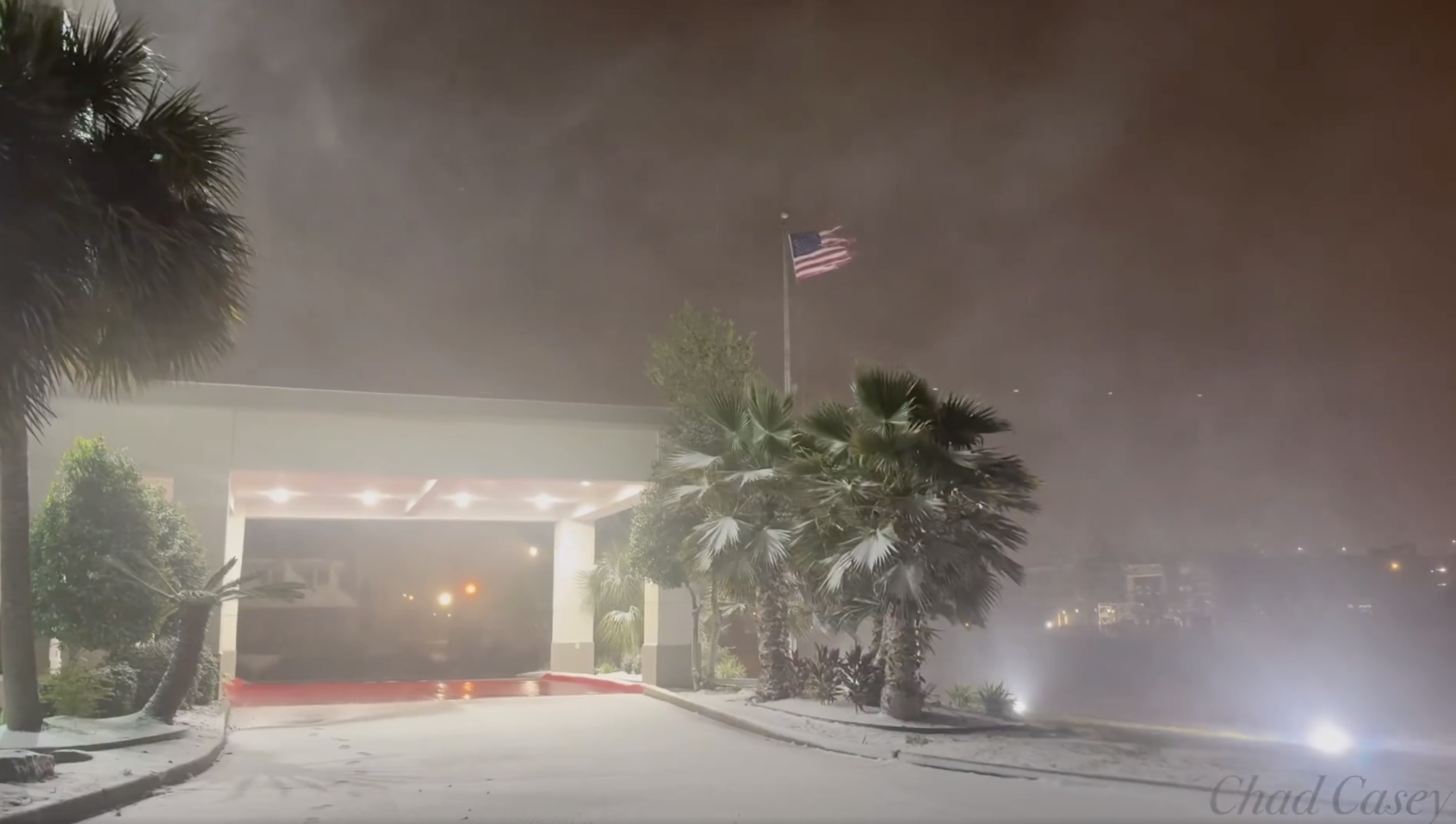
Wednesday, January 22, 2025

Gobsmacked By Incredible Gulf Coast Snow; Dangerous, All-Time Record Cold This Morning, Travel Paralyzed In Region.

Screen grab of web cam showing snowball fights and
dogs playing on snowy Bourbon Street, New Orleans.
The incredible snowstorm that hit the Gulf Coast Tuesday is easily one of the most incredible weather events I've ever seen. 

Snowfall records were shattered as near blizzard conditions swept what are normally balmy, palm tree-lined beaches. 

New Orleans was buried beneath an official eight inches of snow, its largest snowstorm on record. Some sections of the city had more. Photos of a measurement in New Orleans' Garden District showed a solid foot of new snow. 

The Washington Post was as gobsmacked as I was when I saw these weather observations out of New Orleans.   

"A late morning observation from Louis Armstrong New Orleans International Airport reported a temperature of 27 degrees, heavy snow, 1/8 mile visibility - and three inches of snow on the ground. Two inches fell in one hour."

For at least seven consecutive hours heavy snow fell on New Orleans.

I saw one video showing a highway with zero visibility in snow and blowing snow.  I thought I was watching one of those lake effect blizzards in Buffalo. It was a highway in southwest Louisiana.  

Milton, Florida, not far from Pensacola, had 8.8 inches of snow, more than doubling the old record for largest snowstorm in Florida history. (The old record was four inches, also set in Milton). Pensacola, Florida and Baton Rouge, Louisiana each had 7.6 inches.  Mobile, Alabama clocked in with 7.5 inches. 

These shattered all-time records for snowfall in those cities. 

For comparison, the 24 hour snowfall in Milton, Florida of 8.8 inches is much more than double   the largest 24-hour snowfall in Milton, Vermont so far this winter, which was just 3.4 inches. 

Many northern parts of the United States have had less snow this winter than parts of the Gulf Coast, which is insane. 

Sioux Falls, South Dakota has had 6.2 inches of snow this entire winter so far, less than many Gulf Coast beach towns. Since December 1, Anchorage, Alaska has had 3.8 inches of snow (though to be fair, Anchorage did have some hefty snowfalls in late October)

DANGEROUS AFTERMATH

The Gulf Coast and Southeast snow zone is massive, running through most of the Texas coast, all the way through northern Florida and up into coastal Georgia and South and North Carolina. 

Somebody's Florida vacation photo
from Tuesday. 

The storm was departing and the last of the snow was departing the Southeast Coast, but the Gulf Coast is not out of trouble.

Tuesday was the fun day for most, as big and festive snowball fights broke out on Bourbon Street in New Orleans. Airboats that normally cruise through marshlands were pressed into service as snowmobiles. 

Families marveled at a snowstorm that they've never seen before and probably never will again unless they move north. 

But all that snow is now sitting there.  You can't drive anywhere. The Gulf Coast has elaborate and detailed emergency plans on what to do if a hurricane hits. Not so much with a snowstorm. 

It's obviously seriously cold on the Gulf Coast, and they're not equipped to handle it. What if there's a fire or medical emergency? How will ambulances and fire trucks get to the scene?

As of last night, a 150-mile stretch of Interstate 10 was closed. New Orleans borrowed 14 snow plows from an Indiana company.  Bucket loaders that normally shove sand off roads after hurricane storm surges were also pressed into service as snow plows in the region. 

The snow is not going to immediately melt much.  The forecast high temperature today in New Orleans today is 31 degrees. Clear skies, lighter winds and a snow covered ground brought the temperature in Mobile, Alabama down to a record-shattering 11 degrees this morning, with an expected "high" temperature today of 32 degrees. 

Even more extreme, Lake Charles, in southwestern Louisiana was down to just 6 degrees above zero this morning.  The previous record low for the date there was 18 degrees, so that's just incredible for them. 

Lafayette, Louisiana, where nine inches of snow fell yesterday, was at just 4 degrees above zero early this morning.  That is the coldest temperature on record for any date in Lafayette. New Iberia, Louisiana also set its all-time record low temperature at 3 degrees. So far, Beaumont, Texas has tied its all time low at 10 degrees. 

That's what a clear night sky with snow cover will do to you. That's never happened before in these cities, hence the extreme cold. 

Already, four deaths have been reported in the cold wave and snow, and I'm afraid that toll will rise. 

Temperatures are forecast to rise into the low to mid 40s across the Gulf Coast Thursday and Friday, which will melt some of the snow. But streets will still be in rough shape with overnight freezes.

Finally, temperatures this weekend will be back in the normal upper 50s and 60s, which should make the last of the snow disappear. 

WHY IT HAPPENED

You really need an exacting setup for this kind of weather event and it just so happened this time. 

Big Arctic cold blasts come all the way down to the Gulf Coast from time to time. But usually. that frigid air crosses the coastline and enters well into the Gulf of Mexico. Any storms that try to form on the leading edge of the cold air usually are too far south to bring any kind of precipitation to places like New Orleans.

Or, the cold air stops just short of the Gulf Coast, so it's warm enough for rain, not snow. 

This time, the leading edge of the frigid air stopped a short distance south of the Gulf Coast. As is often the case, a storm formed along the leading edge of the cold.  The storm pumped humid air northward over the frigid air near the surface in just perfect alignment with the coastline. 

The best moisture aloft and the best cold, moist air along the coast aligned perfectly to set up the snow. 

I won't blame climate change for this.  It was all probably a fluke. But some scientists say climate change does make the jet stream meander more, which can sometimes bring cold air oddly south, like in this case.  

Also, the Gulf of Mexico waters are still unusually warm, which can be blamed on climate change. The warmer waters probably boosted the amount of moisture available to the storm, which increased the amount of snow that could fall. 

Videos:

Blowing and drifting snow on the beaches of Louisiana and Texas, along with road havoc in the region. Click on this link to view, or if you see the image below click on that. 


The music doesn't stop in New Orleans just because it snows. Here's a trumpet player in the city's blizzard. Click on this link to view, or if you see the image below, click on that. 


Tuesday, January 21, 2025

An Absolutely Bonkers Winter Storm Is Striking Gulf Coast. Blizzard Warning In Coastal Louisiana!

Screen grab of video showing strong winds, snow and
blowing snow early today in Lake Charles, Louisiana,
which is, of all things under a blizzard warning.
 The National Weather Service home page weather map had things today I don't think I've ever seen before. 

Winter storm warnings are up from far southern Texas all the way across the entire Gulf Coast to the Big Bend area of Florida. Forecasts for the winter storm intensity have gone way up since I first reported on this storm on Sunday.

A blizzard warning, of all things, is in effect right along the Gulf Coast in extreme northeastern Texas and southwestern Louisiana, including the cities of Port Arthur and Lake Charles.

I'm certainly used to seeing tropical hurricanes come ashore in this area, but a blizzard?

The criteria for a blizzard warning in the Deep South is different than for places like, say, North Dakota, but this is still impressive. 

The Louisiana blizzard zone is getting bands of heavy snow and blowing snow with gusts of at least 35 mph, so that's an impressive winter storm. Total snowfall will run the four to eight inch range in that area today.

The area under the blizzard warning normally has a high temperature in the low to mid 60s this time of year with lows in 40s. It would be like Vermont having a full-blown blizzard in mid-May. 

We'll have plenty of for-examples of how bizarre this has gotten on the Gulf Coast today. I'm already seeing a few. 

Port Isabel, Texas, a near-tropical city along the southern Texas Gulf Coast right on the border with Mexico early this morning, had arguably worse winter weather than we're currently having in Vermont. At 5 a.m. it was 36 degrees, light snow with north winds of 36 gusting to 52 mph and a wind chill of 22 degrees. 

Normally, this time of year, Port Isabel has highs in the upper 60s and lows in the mid 50s. 

A wild National Weather Service home page this morning.
All that pink you see on the Gulf Coast is
all winter storm warnings 
Five or six inches of snow is forecast for New Orleans. That would make it easily the biggest snowstorm there since eight inches fell in February, 1895. The modern record for deepest snow in New Orleans is 2.7 inches in December, 1963. 

Pensacola, on Florida's Panhandle near the Alabama border, is anticipating two to four inches of snow today, with the possibility of five inches. The biggest snowstorm on record in Florida is four inches, so we might be rewriting history here.  

Winter storm warnings in Florida extend as far south as Gainesville, where freezing rain, sleet and snow could collapse trees and power lines. 

The winter storm is expected to continue today and tomorrow on up the coastlines of Georgia, South Carolina and North Carolina

DANGEROUS

This winter storm is obviously quite the novelty, but it's extremely dangerous. 

To be Captain Obvious here, the Gulf Coast isn't built for winter storms. They're much better at handling full-fledged hurricanes than this type of weather. 

The six inches or more of snow that could fall in Louisiana could collapse roofs, since they're not built for snow loads like they are here in New England. 

The Deep South isn't used to such cold weather, either.  Pipes aren't insulated, so they'll freeze.  The epic freeze in Texas in February, 2021 caused billions of dollars in damage as frozen pipes burst, flooding homes, condos and commercial buildings. 

Snow on the ground makes frigid nights even colder. A snow-covered Deep South could end up with record temperatures in the single numbers and teens tonight or tomorrow night. 

Travel is - or will soon be - impossible in the Gulf Coast winter storm zone. It's not exactly like they have armies of snow plows and sanders to clear the roads. People there also understandably have no clue how to drive in the snow.

As of the pre-dawn hours, Houston freeways were already an icy disaster and parts of Interstate 10 in Louisiana were already closed. 

Airports are shutting down in the region, too.

The governors of Florida, Georgia, Louisiana, Mississippi and Alabama have all declared states of emergency because of this weird storm.  

The silver lining to this storm is the weather along the Gulf of Mexico should return to normal by the end of the week. Which is good, because they'll have to wait for the snow and ice to melt before anything can be done about the situation. 

Daytime temperatures should rise into the 40s by Wednesday. By Sunday, New Orleans expects a high temperature of 65, Houston should get to 68, and Pensacola is anticipating a Sunday high of 62.