Showing posts with label floods. Show all posts

Friday, April 10, 2026

Ma Nature Really Picking On Michigan For Some Reason

Ariel view of river flooding affected several houses
in Michigan recently. The state has really been socked
by several damaging, sometimes 
deadly storms this spring. 
Every once in awhile, a state or region gets stuck in a weather rut. Anything bad that could happen tends to strike that state. Over and over again. 

This year, especially since March, Michigan seems to have run afoul of Ma Nature's good graces 

The storms that got the most publicity - and were the most tragic - were the tornadoes across southern Michigan on March 6, killing four people and destroying neighborhoods. Especially in Three Rivers and Union City, Michigan. 

A new storm swept through Michigan last weekend, causing widespread flooding and dropping  a tornado. The twister last Saturday, April 4 in Van Burn Township, Wayne County in southeast Michigan. It was and EF-1 with winds of 100 mph and a path running three miles long. 

The flooding in the past week might be the worst of it all. There were dozens of incidents scattered across Michigan, mostly in the western, central and southern parts of the state. Dozens of homes received at least some damage. Especially along the Grand River in Michigan, which touched major flood stage. 

As in many spells of bad weather, Michigan residents last weekend saw a series of flood-related incidents that seemed to hopscotch across the state. 

Heavy rain flooded a large parking lot at an apartment complex in East Lansing, Michigan, destroying a few dozen cars.  It was unfortunately the third time in two years residents had their cars wrecked by flooding. 

The animal rescue group Detroit Animal Welfare Group in Macombe County, Michigan suffered severe flooding,

It took 16 hours to make sure all the animals had been moved to safe location, but on the bri Took 16 hours to get animals to safety at the 25 acre farm. 

A washout on railroad tracks in western Michigan forced Amtrak to suspend service between Grand Rapids and Chicago for several dahs. 

It wasn't just severe weather and flooding over the past month or so.

Easily one of the worst blizzards in Michigan history hit the Upper Peninsula on March 14-17. Some areas received up to four feet of snow. High winds piled the show into enormous drifts. Roads were shut down for days. 

On the southern edge of the blizzard, an ice storm cut power to 120,000 hones and businesses. 

The rough weather didn't stay in Michigan, since storms tend to be more far-ranging than just one state. Wisconsin, Ohio, Pennsylvania and western New York all had a brutal series of storms over the past few weeks. 

Western New York has had an especially tough go of it.   The first March tornado in the state since 1976 touched down on the 31st, and the town of Gowanda and surrounding areas suffered serious damage to homes, buildings and cars as thunderstorm winds of more than 70 mph drove torrents of hailstones bigger than golf balls through the area. 

Oneida Lake, a little northeast of Syracuse in New York, is flooding. Strong winds sent waves from the lake into homes in Sylvan Beach, New York, damaging several of them. Sea walls also collapsed under the onslaught. 

Back in Michigan, it's not over. Weather patterns during a particular season sometimes get "stuck."  In this case, a pool of very cold air - basically what's left of the winters polar vortex - has been swirling around near or north of Hudson Bay for weeks. 

Meanwhile, a broad southwesterly flow has helped pull warmth and moisture from the Gulf of Mexico. Where those two polar opposite types of air come closest to each other, you get storms. More often than not though the late winter and spring, that stormy air mass meeting spot has been in or near Michigan. 

That will still be more or less the case over the next week, though now that we're later into the spring, the warmer air is winning out in Michigan. Their biggest threats are severe storms and flooding over the next week or so. The worst of it appears as it it will be early next week. 

A rough, snowy winter and that March blizzard means there's still quite a bit of snow left on the ground on the state's Upper Peninsula. 

Warmer temperatures, rain and thunderstorms starting later in the weekend and continuing into next week will melt more snow and raise rivers to flood levels. (There was still three feet of snow on the ground in Marquette, Michigan as of Wednesday, so there's still a lot of snow to melt). 

Places like Wisconsin, Ohio, northwest Pennsylvania and western New York have been caught in this web of storms, too. But Michigan seems to be Ground Zero. Here in Vermont, we're on the outer eastern edge of this persistent storm track. That means we'll have a frequent chance of showers, but it doesn't look like we're under the gun for any extreme weather. 

Looking further ahead, wetter than normal conditions are expected in Michigan for at least the next two weeks, if not beyond that. 

Tuesday, February 24, 2026

Are Pennsylvania Ice Jams A Glimpse Of Vermont's Early Spring Future?

An ice jam in Swanton, Vermont after a rainy, warm
January thaw in 2018. This will be the first early
spring in a few years in which ice jams are
a real concern However, there's no
evidence that there's anything imminent. 
 Rain and a spring thaw in parts of Pennsylvania last week caused several potential dangerous ice jams.

Luckily, the Pennsylvania jams either broke up fast enough to prevent serious damage or hit in rural areas where there was little to damage. But those jams last week prompted some flash floods warnings and evacuations. 

It was a reminder, though, that a winter with lots of cold and snow can really create trouble when the spring thaw arrives in earnest. 

The same thing could happen here in Vermont later this spring. 

After a bitterly cold late January and early February. the weather abruptly turned in western Pennsylvania last Thursday and Friday. Thunderstorms dumped bursts of heavy rain on that region last night. By noon Friday, Pittsburgh's temperature was up to 63 degrees. 

That kind of late winter weather is a recipe for ice jams. Thick ice on rivers broke up in that weather, and the chunks of ice got stuck on river beds, bridge abutments and other obstacles. 

 It has temporarily gotten colder in Pennsylvania, so the risk of ice jam floods has eased. But if there are still frozen waterways there or anywhere else, there's a risk of ice jam floods as we head toward spring.

"Anywhere else" includes here in Vermont.

Pennsylvania's experience makes me wonder what might happen in Vermont later this spring. Ice on the rivers is thicker than it's been in years. There's a fair amount of snow on the ground ready to melt.

No real thaws or heavy rain is in the forecast. But a little more snow is in the pipeline. Thankfully no big storms, though. The later we get into March without a thaw, the more likely the weather could change abruptly to something warm and rainy. Which would set us up for ice jams. 

As prepped as Vermont seems for ice jam floods, we have a more than decent chance of avoiding trouble. In Vermont's history, we've had winters that were much colder, much snowier and much icier than this one. After most of those winters, the spring melt was gradual enough to only give us the usual minor spring lowland flooding. 

I'm only bringing this up because this is the first winter we've had in awhile in which river ice has gotten thick enough to build strong ice jams if the weather is right for them. 

To avoid trouble, we'll want perfect sugaring weather. That means mild, thawing afternoon and chilly subfreezing nights with only light precipitation. Under those conditions, the snow and ice softens and  gradually melt. . 

If we have a sudden, rainy warmup later in March, and the ice jams do develop, we can still be just fine.

Much like in Pennsylvania, our ice chunks under this fast thaw scenario would get hung up on river bends and other obstacles. The ice jam would then create flooding just upstream fro where the stuck ice is.  

Where these ice jams set up would spell the difference between slight inconveniences and real trouble. The unlikely but worst case scenario would be an ice jam just downstream from Montpelier. That would back the water up into the downtown, like it did so devastatingly in 1992.

Since Montpelier is to some extent recovering from the even worse July, 2023 flood, we don't need that. 

Bottom line: Don't panic, since there's absolutely no reason to. Instead just be aware if we have a spell of warm, rainy weather coming up over the next month.  

Tuesday, December 23, 2025

Los Angeles Bracing For Scary Christmas Storm

The most severe Christmas storm since at least 1971
looms in the Los Angeles area as atmospheric 
rivers continue to batter the West Coast. 
Perhaps the scariest of the barrage of atmospheric rivers tormenting the West Coast is now targeting the Los Angeles area. 

The heavily populated, sprawling area around Los Angeles, the coast north and south, and the mountains to the east all face torrents of rain and strong, damaging winds. 

In their forecast discussion this morning, the National Weather Service wrote in all caps, that I'll avoid, "This is a very dangerous holiday storm. Anyone traveling on Christmas Eve or Christmas Day will need to exercise extreme caution. Make sure to take the proper action before the storm hits."

The rain is starting today, then turn more intense tonight, and peak tomorrow morning. Rainfall rates during the peak hours of the storm in and near Los Angeles will be somewhere around an inch per hour. 

Total rainfall between now and Christmas in southern California is forecast to be in the four to seven inch range, with locally higher amounts. 

NOAA's Weather Prediction Center has put parts of the L.A area under a rare high risk zone for a "significant  threat of flash flooding, landslides, rock falls and mud slides. The greater than normal travel during the Christmas holiday will likely expose a potentially larger number of people to these life-threatening hazards."

On Tuesday, as light rain began making inroads in Los Angeles County, residents were stacking sandbags and other barriers in Pacific Palisades, Altadena, Malibu and other areas where there were big fire last year. They're hoping debris flows won't outmatch these efforts. Crews were also installing Jersey barriers in hopes of diverting landslides away from vulnerable homes. 

Some debris-prone roads, like Topanga Canyon Boulevard, were closed even before the first drops of rain fell. 

Thousands of people have been told to pack "to go" bags and be ready to evacuate at a moment's notice.  

High winds will complicate this whole mess. In the L.A basin, winds could reach up to 55 mph, and in the foothills and mountains nearby, those winds could reach as high as 80 mph. 

As the soils get soggier and soggier, it'll be easier and easier for the wind to blow trees over. 

The intensity of the storms should wane somewhat by Christmas Day, but scattered downpours will continue to vex the L.A basin.

Further north in California, atmospheric river storms that caused serious flooding in the Sierra Nevada foothills have diminished somewhat. But more rain, sometimes heavy and mixed with thunderstorms, will continue the flood risk.  There's even a low risk of brief spin-up tornadoes with the thunderstorms. 

High winds warnings remain in effect until the afternoon of Christmas Day for a wide area of central and northern California. 

Meanwhile, in the Sierra Nevada, several more feet of snow are expected in the next few days. 

Tuesday, October 14, 2025

It's Been A Odd Tropical Storms, Hurricanes Season And The Weirdness Continues

Powerful Hurricane Erin in the central Atlantic Ocean
back on August 16. It's been a really weird 
hurrican
We're nearing the end of Atlantic hurricane season, with just a month and a half to go before things should get safer for another year. 

There's still a chance that more hurricanes could form and even threaten the United States. 

But as it stands now, we're lucky. So far at least, this is the first year since 2015 without a hurricane striking the U.S. coastline.

We needed the break. 

That's not to say tropical storms and hurricanes haven't messed with the U.S.

Moisture from brief, weak tropical storm Barry was a key ingredient into the horrible, deadly Texas floods over the Fourth of July weekend. 

Also in July, Tropical Storm Chantal splashed ashore in South Carolina in July, causing flooding in the Carolinas.

And, offshore Hurricanes Erin, Gabrielle and Humberto sent waves slamming into the U.S. East Coast, sending nearly a Outer Banks, North Carolina dozen homes crashing into the ocean.

This has been a weird hurricane season. It's always been go big or go home. Tropical systems in the Atlantic have either been brief, weak nothingburgers or monsters.

The monsters have all taken a turn north far offshore of the United States. Had this weather pattern been 400 or 500 miles further west, the East Coast would have been raked by repeated strong hurricanes. 

It's been weirder in recent weeks than earlier in the season. We had the drama of Hurricanes Humberto and Imelda setting a record for Atlantic hurricanes being so close to each other. That led to a strange dance between the two storms that changed their directions, and alternately strengthened and weakened both. 

Then we had Tropical Storm Jerry. The disturbance that became Jerry emerged from the west coast of Africa more than a week ago, That's awfully late in the season for something like that to happen.

The African disturbances that can turn into powerful hurricanes usually shut down by the end of September. 

Forecasters originally had high hopes for this storm, figuring Jerry would turn into a decent sized hurricane. But, strong upper level winds keep tearing the storm apart. It stayed a weak tropical storm until it dissipated over the middle of the Atlantic Ocean this past weekend.  

Then we had little-noticed Subtropical Storm Karen. 

Subtropical Storm Karen formed last Thursday, strangely far north in the Atlantic Ocean, at 44.5 degrees north 33 degrees west. That's about the same latitude as Nova Scotia. That's the furthest north such a storm has formed in at least 150 years. 

Subtropical storms are hybrids of the warm core storms that are true tropical storms and regular old storms that have warm and cold fronts and such. 

The water was actually "too cold" to support a tropical or subtropical storm. But because of a pocket of cold air high overhead was such a contrast to the tepid waters below that we were able to get Subtropical Storm Karen. 

It was so far north that its life was a short one. It dissipated Saturday. 

Now we have Tropical Storm Lorenzo, which outdid Jerry for being an incredibly late season African-born storm. 

As of this morning, Lorenzo was struggling just like Jerry did. Stronger upper level winds and dry air are tearing Lorenzo apart. If the storm survives these troubles, it'll head slowly northward and the northeastward out in the middle of the Atlantic.  It won't bother anyone. 

Some models bring a tropical storm or hurricane to the Caribbean Sea or far eastern Gulf of Mexico in a couple weeks, but those long range predictions are notoriously unreliable. 

Monday, September 15, 2025

More Tornadoes, Storms In Weird Locations, But Still No Signs Of Rain Or Anything Here In Vermont

Screenshot from a video showing a large tornado in
North Dakota Sunday. The state was hit by as many
as 19 twisters yesterday. 
While we in Vermont can't even get a sprinkle of rain, weird storms have been hitting areas that are usually not particular stormy, especially this time of year. 

We had the tornadoes in Utah Saturday, which I've already mentioned in this here blog thingy.  I've got an update on that below, but first, more odd tornadoes, this time in North Dakota. 

During Sunday afternoon, a total of 22 reports of tornadoes came in, all but three of them mostly along a narrow north-south line in central parts of the state. The actual number of tornadoes will be determined by the National Weather Service.

Observers said this was probably the biggest September North Dakota tornado outbreak on record. 

The tornadoes hit sparsely populated areas, though there was damage in the tiny central North Dakota communities of Denhoff and Cannon Ball.   

The situation kept meteorologists exceptionally busy, as tornado warnings blared across central North Dakota most of the afternoon and evening.  At one point, storm chaser Brian Copic had two tornadoes in his sights: A large, wedged shaped twister and a skinnier one nearby. 

North Dakota does get tornadoes, averaging about 29 of them per year.  But we're generally past the season for twisters there. But Sunday was an exception. 

The direction of Sunday's storms was a little off, too. They headed north to northwest, not in an east or northeast that most tornadic storms travel. 

North Dakota is also not known for its heavy rain especially in the autumn.  It's in the middle of North America. Humid Gulf of Mexico or Pacific Ocean air has a lot of trouble making it that far north by September, so rainfall is usually fairly sparse. 

However,  Bismarck, North Dakota got more rain in an hour Sunday than they normally do in the entire month of September.  Just under two inches came within that hour, compared to the 1.72 inches that usually falls all month. The storm total in Bismarck Sunday was 2.44 inches.  

Not surprisingly, the city and points south were hit by widespread flash flooding. 

It's been a rough year for severe weather in North Dakota, even by their standards. Four tornadoes and 100 mph straight line winds hit areas near Grand Forks about a month ago. North Dakota also just approved for disaster assistance from damage caused by tornadoes, high winds and flooding back on June 20-21.

In Utah, two homes, two houses trailers, a hay barn and fifth-wheel trailer were destroyed in the tornado. Nobody was hurt, but several pets are missing. Two additional houses were damaged and power lines have come down. 

With Sunday's outbreak, it looks like North Dakota will have had about 60 tornadoes this year, the most there in a single year. 

VERMONT LEFT OUT

Here in Vermont, we often get the remnants of any big storms to our west. Usually in the form of some autumn rain. We could really use it, but, again, not this time. The drought stays strong. 

The Plains storm is lifting directly north into Canada and dissipating. It won't give us any rain at all. Instead, the forecast is the same as it was yesterday: It will be warm and dry through Thursday. Then, a rainless cold front will hit Friday and it will turn cool and dry. Then it will probably warm up again. 

Our next chance of rain isn't until September 25 or 26, but even that is highly uncertain. That storm might go by to our south, missing us again.  

We don't want tornadoes here, but it would be nice if one of those tornadic systems spun off a little rain our way. 

Sunday, September 7, 2025

Dam Removals In Vermont Accelerate In The Age Of Climate Change

The old dam in West Rutland, Vermont before
demolition began this summer. The dam
was removed to improve stream ecology
and prevent flood damage. Old dams
in Vermont are coming under more 
and more scrutiny in the age of 
climate-change driven floods. 
 Back in high school, I briefly had the worst job I ever had.

There was a town reservoir in West Rutland, Vermont that was a municipal water supply. The reservoir was temporarily drained, and we had to muck out the algae and mud left behind to ensure future water quality. 

YUCK!

The town no longer uses that water supply. And I have to say West Rutland now has some of the best tasting tap water of any town I've tried. 

But the dam was still there. Or was. Work began earlier this summer to tear it down. Part of the reason is climate change, of course! 

The dam was growing more and more unsafe due to its age and the increasing severity of rain storms created in large part by that climate change. 

 As WPTZ reports:

"Officials said because of the dam's outdated infrastructure and old age, parts are breaking off during storms and changing the direction of the river. West Rutland Town Planner Mary Ann Roulette said the dam has caused major disruptions over the years. She revealed there as minor damage affecting nearby property this past July."

Karina Dailey, a restoration ecologist and chair of Vermont's dam task force said the West Rutland deconstructions  is one of several dam removal projects. Others are getting going in Newport, Ripton, Berkshire and Winooski. 

DAM SCRUTINY

Communities statewide are discussing removing dams, perhaps hundreds of them. Usually in the name of river health, and the fact removing these small dams can minimize flooding in climate-driven storms. 

 "The best resilience is to let these rivers function naturally," Dailey said. 

Sure, we're having a drought now, but it's only a matter of time before we start running into those super charged rainstorms again. 

It's interesting this is going on now as some Vermont dams were built almost a century ago after the cataclysmic Great Flood of 1927.  

Large flood control dams like Wrightsville, Waterbury and East Barre were built after that flood. Montpelier suffered extensive damage in the July, 2023 flood, but the Wrightsville Dam helped prevent the water from being even deeper. But that dam was almost overtopped in 2023, and that would have caused an even more cataclysmic inundation.

Still, those large dams did their jobs in 2023 and 2024 and did protect some property. It's the small dams that are causing problems. 

In the 2023 floods, five Vermont dams failed and 60 were overtopped. That event has put new urgency into efforts to remove old dams. 

As Vermont Public reported in a separate article, Vermont has more than 1,000 dams around the state. Many are overdue for repairs or are old and becoming dangerous. As those climate induced storms intensify, those dams become more unstable, and can collapse under heavy rains, worsening damage. 

Even if these old, unstable dams don't collapse during floods, they can create damage in heavy rain storms. 

"Dams not created specifically for flood protection are regularly full and do not provide storage capacity. And they frequently direct water outside the main channel at high velocities which causes bank erosion and impacts to communities,"  said Andrew Fisk, the northeast regional director for the environmental advocacy group American Rivers.

Which is precisely why that dam in West Rutland was removed, and many other dams in Vermont are on their way out. Or, dams like ones recently removed in Dover, and another in Ripton were taken out for ecological reasons. But those removals had the happy side effect of minimizing damage from future floods.

MONTPELIER

Flood-prone Montpelier is looking at removing old dams and has already started on one. 

The Pioneer Street Dam is about 1.3 miles upstream from downtown Montpelier. It's cracked, could collapse in a flood, and could redirect water toward homes and businesses even if it doesn't get smashed down in a future flood. 

Also this summer, right near the Pioneer Street Dam, deconstruction work started on a 19th century home that was on property that once belonged to Jacob Davis, the founding settler in Montpelier was deconstructed.

The property located at 5 Home Farm Way, about two miles upstream from Montpelier consists of a high style Greek Revival house with an attached barn and 19 acres of agricultural land. 

Bricks and planks from the home are being resold for new construction elsewhere. Removing the home and barns opens up new floodplain space, allowing water to spread out over fields before reaching Montpelier during torrential storms. 

Vermont usually tries to preserve historic buildings, but sometimes, there's a greater good that overrides that. "The highest and best use of a floodplain is to serve as a floodplain, said Ben Doyle, president of the Preservation Trust of Vermont, reports Vermont Public

Between the removal of the Pioneer Street Dam and the old house, the Winooski River will have more opportunity to spread out into floodplains during big storms before some of that water could reach downtown Montpelier. 

There are three other old mill dams upstream of Montpelier that should be removed, advocates said. They no longer serve the purpose they once did a century ago. They don't even hold back water. The space behind the dams are filled with silt. 

Time for them to go. 

Tuesday, August 26, 2025

Massive Haboob Slams Phoenix, And Other Arizona Communities. Quite The Spectacle

Image of yesterday's massive haboob taking over
the Phoenix metro area. 
 Gosh, this blog thingy is turning into all Phoenix, all the time. 

I went on and on about the extreme summer heat there the other day, but yesterday, things got really wild out there in Arizona. 

A haboob, or giant dust storm hit the area as monsoon thunderstorms raged over large parts of Arizona and adjacent southeast California. 

Outflow from the storms stirred up the massive, apocalyptic looking wall of dust that dropped visibility to zero when it hit.

The haboob hit during the evening commute and some motorists said they couldn't see past their car hoods. The National Weather Service warned everyone to "pull aside to stay alive."

Apparently, everyone did. So far, I haven't seen any reports of deaths or serious injuries. 

Winds were intense in this swirling dust storm. A gust to 94 mph was reported at Sun Tan Valley, in the southeastern outskirts of the Phoenix metro area. The wind at Sky Harbor International Airport gusted to 70 mph amid the clouds of dust. Visibility there was at zero from 5:35 to 5:51 p.m. 

The temperature at the airport fell from 100 to 79 degrees in just 17 minutes.

To the shock of nobody, the haboob delayed plenty of flights at the airport.  A ground stop there lasted a good hour. A connector bridge at the airport was shredded by the storm, and part of a roof at a terminal was damaged. 

Power lines and even utility poles snapped. Trees fell on houses, cars and carports. Photos and video from the Phoenix showed fallen trees, traffic signals and wires. The bottoms of countless swimming pools were covered in dirt.  

The haboob yesterday about to swallow the Phoeni
Sky Harbor airport. 

In Arizona Monday,  the haboob was followed in many areas by torrential rains from the parent thunderstorm. 

As the rain turned the dust to mud then washed it away, flash flood alerts blared in the Phoenix area, along with many other areas in southern Arizona and far southern California away from the coast. 

The haboob traveled quite a distance, too. It developed a little north to Tucson, then slammed through Casa Grande around 4:25 p.m. local time before slamming into Phoenix an hour later. Which means it traveled a good 60 miles at least. 

Haboobs are pretty common in arid areas, including in the U.S. Desert Southwest.  A similar serious haboob swept through the Burning Man festival in northwest Nevada last weekend, ripping up encampments and other temporary structures. 

Some observers say the Phoenix haboob on Monday was the most intense since July, 2011. 

Every weather emergency has its precautions, and haboobs have theirs.  Motorists who see a wall of dust coming should pull into a parking lot. Or, if none is available, pull as far off the side of the road as possible. 

People are told to shut off their car lights.  The visibility in haboobs is so bad that people have been known to smash into parked cars with lights on, thinking they were on the highway. Kind of like a blizzard here in Vermont. Except obviously with sand, not snow. 

More haboobs, big thunderstorms and flash floods are possible in the Desert Southwest for the rest of today and likely tomorrow. 

On a vaguely humorous note, spell check kept trying to make me say Phoenix was hit with either a "kabob" or a "baboon" either of which would have been more fun and probably less dangerous. 

Videos:

Storm chaser Aaron Rigsby got some amazing shots of the Arizona haboob. Click on this link to view, or if you see the image below, click on that:

 
Another video from the Associated Press, shows what it was like to be in a car during the haboob, then a timelapse of the haboob, followed by torrential rain, sweeping into downtown Phoenix. Again, click on this link to view, or if you see the image below, click on that:


Thursday, August 14, 2025

Juneau, Alaska, Hit With Another "Glacial Outburst" Flood, But This Time They Fought Back

Barriers this year kept the worst of what has become
the annual glacial outburst flood this week
in Juneau, Alaska. You can see how badly
the houses in this photo would have been
flooded without the barriers. 
 Yearly summer events are often fun.

'The one in Juneau, Alaska is not.  

Once again, as has happened every August lately, parts of Alaska's capitol city are being hit by what is know as a glacial outburst flood. 

Such a flood happens when parts of a glacier melt, and water backs up behind rocks and/or ice. Finally the water breaks through, causing an often destructive flash flood. 

In Juneau, water from the melting glacier fills a hemmed in basin until the pressure grows strong enough to release a torrent of water from the Mendenhall Glacier and down the Mendenhall River into Juneau. 

Per the Washington Post: 

"By Wednesday morning, the floodwaters racing gown from what's called Suicide Basin has risen to record levels, faster than scientists had predicted the day before. 

Juneau officials warned residents to evacuate parts of the city that have been prone to repeated flooding."

It appears the flooding peaked Wednesday morning.    About 1,000 people had evacuated ahead of the flood. 

The Mendenhall River was already at minor flood stage because of heavy rains Sunday and early Monday. Since the river started at an elevated level, the gush of water from the glacier pushed the river Wednesday morning to 16.65 feet, which surpassed the record high level of 16 feet set during last August's glacial outburst.  

Since this has become a destructive, frustrating annual event, Juneau is trying to minimize the damage. 

This year, the city worked with the U.S. Army Corp of Engineers to build a massive wall of Hesco barriers along the river to prevent the destruction seen in the last two years, WaPo reports. 

Hesco barriers are durable cloth bags filled with dirt and sand and reinforce with a metal frame. They were often used by the military in places like Iraq and Afghanistan to fortify bases.  But they can be used as giant sandbags, too.

Early reports suggest the Hesco barriers mostly held, preventing much of the feared damage to homes near the river. Roads and streets were inundated, and some homes might have taken on a little water, but the damage appears to be much less than in the previous two years. 

The Hesco wall is expensive, and included big bills assessed to residents who live in flood zones.  There needs to be a more permanent solution, but the future of these floods is unpredictable. 

 The Juneau glacial outburst floods started in 2011 and have worsened in recent years. Climate change is helping to melt more glacial ice than in years past, so more water is now usually available to cause these August floods.

In August, 2023, the outburst flood destroyed several homes.  That event included dramatic video of a house collapsing into the river.  Last year, at least 300 homes were damaged by the flooding. 

It's possible that the nature of future summer glacial floods could change as more of the glacier melts, or the thawing gets even more intense in future years. Alaska has warmed twice as fast as any other state over the past few decades, and there's no reason why that trend won't continue, as areas closer to the Arctic are warming faster than places closer to the Equator. 

The Mendenhall glacial flooding could in upcoming years find another outlet, or burst out another way instead of blasting down the Mendenhall River in one big swoosh.  

Juneau - and many other parts of the world prone to glacial outburst floods in the age of climate change - need to stay on their toes. 

Monday, July 28, 2025

Weather Conspiracy Theories Weirdly Gain Traction Over Reality

The tin foil hat crowd is working overtime, with so many
weather conspiracies that GOP politicians to pass
unnecessary law, and put people in unnecessary danger. 
 The weather wackos are out there. And gaining in numbers and power.

They're actually passing ridiculous laws, distracting from the big issues of the day that really need to be addressed.  

These are the people who look at all the storms, floods, wind and other weirdness out there we've had this year, and conclude some nefarious groups are controlling the weather. 

Even perfectly normal weather becomes fodder for these wackadoodle theories.  

Marjorie Taylor Greene in her usual full conspiracy mode said and has been "researching weather modification" (oh boy) and, "We must end the dangerous and deadly practice of weather modification and geoengineering."

Never mind that the limited attempts at things like cloud seeding and such and haven't produced any deaths or damage. Mostly because there's no weather modification going on, aside from local, small cloud seeding operations that produce sprinkles of rain.  

Still, Marjorie is  pressing on, introducing a bill that "prohibits the injection, release, or dispersion of chemicals or substances into the atmosphere for the express purpose of altering weather, temperature climate or sunlight intensity. It will be a felony offense."

She's got buddies in this endeavor. "Weather manipulation is real, but in the hands of our enemies or or some overlord, I think it can be a very detrimental thing. I'm big on God and just letting him work his magic and not people trying to play God," said GOP Tim Burchett, who cosponsored Greene's House bill that would ban supposed weather control.

Our friends Marjorie and Tim are  getting mocked for all this, as she always. does. Florida Democrat Care Moskowitz said on social media, "I'm introducing a bill that prohibits the injection, release or dispersion of stupidity into Congress."

Yeah, good luck with that.  

CLOUD SEEDING AND TEXAS

Meanwhile retired general Mike Flynn, a former national security advisor in the first Trump administration - and also a right wing batshit conspiracy dude - n reposted another nutcase, who, in all caps of course, screamed "I NEED SOMEONE TO LOOK INTO WHO WAS RESPONSIBLE FOR THIS. WHEN WAS THE LAST CLOUD SEEDING?"

The answer is a few days before the storm. 

Like almost all conspiracy theories, a microscopic nugget of truth begins the story for instance, in the days  before the big Texas flood, there was some cloud seeding aircraft up there, trying to produce a little rain for some places that were actually drought stricken before the flood. 

That produced isolated, small amounts of rain, as cloud seeding never creates much precipitation. Cloud seeding is arguably useful to provide some parched crops a little moisture, but it sure as hell doesn't make it pour, 

As meteorologist Matthew Cappucci explained on X, cloud seeding doesn't "create" moisture to land as rain drops. 

It just helps droplets in clouds bump into each other to form bigger drops that fall. You can't get much moisture from just a collection of clouds. 

In the Texas floods, a gigantic surge of moisture pumped very wet air and dense clouds into central Texas. That air and those clouds needed no help in producing those tragic downpours. 

Cappucci, in full snark mode, also said, "Claiming that enormous regional floods are tied to cloud seeding is like claiming an overweight individual jumping into the Pacific Ocean could cause a tsunami. Such crazy conspiracies exhibit a fundamental lack of any semblance of understanding of scale."

MORE LAWS, CONSPIRACIES

But, despite that dose of reality, it's full speed ahead with the conspiracies. 

Florida just passed through a new law that says public use airports starting in October must submit monthly reports on geoengineering and weather modification activities or lose funding. 

I'm not sure how that's going to work, because nobody at the airports or on planes who use those airports is modifying the weather, at least intentionally, but not matter. 

Florida Attorney General James Uthmeier  is really into this, though, because - sigh - he appears to be one of those sad people who think contrails from jets flying overhead is trying to poison the populace for some nefarious reason. Reasons that they really have a hard time explaining, never mind providing any evidence.

Here's Uthmeier's breathless, melodramatic statement on the issue: "From farmlands to our waterways, to the very air we breath - Floridians' health is under attack from toxic particulates being sprayed into our atmosphere, polluting our water, contaminating agriculture, and destroying human health."

Uthmeier included photos of cloud streaks in his post, which were those  jet contrails. Which is water vapor caused by condensation from the exhaust from aircraft.  

Uthmeier of course also invoked Texas and cloud seeding which we've already gone over, and there's no evidence (of course!) there's no toxins from our imaginary weather modification projects in Florida. 

First of all, nobody in Florida has applied for or received a weather modification license since it became a requirement back in 1957, according to PoliFact/Poynter. In 1957 citrus growers in three Florida counties tried cloud seeding for their orchards. But apparently, it didn't work great so they gave up. 

Poynter reached out to Florida environmental officials and Uthmeier to find out whether there were any reports of unlicensed weather modification efforts but didn't hear back. 

It's not just Florida. Missouri lawmakers are considering a proposal to ban all weather modification, including cloud seeding, saying in part that humans should not "play God" with the weather. 

Then there's the fringe group that is threatening to attack and destroy Doppler weather installations around the United States. 

The group, Veterans on Patrol, somehow think that Doppler radar is some sort of "weather weapon" but don't explain how a device that just measures precipitation intensity and direction is some sort of weapon. 

Earlier this month, a man was arrested for destroying the power supply to the weather radar at television  station KWTV in Oklahoma city. 

The dude who was arrested, Anthony Tyler Mitchell, 39, is not known to be a member of Veterans on Patrol, but the crime was inspired by them, officials said. 

But, according to NBC News, the head of that group. Michael Lewis Arthur Meyer (can we add a few more names?) welcomed the Oklahoma attack. 

"When we destroy and eliminate over 15 in a state of Oklahoma, your radar maps are going to change big time, and the weather in just going to be completely different over Oklahoma and the surrounding area," he told NBC. 

Or, in reality, the weather in Oklahoma won't change, except if he succeeds, residents of the state won't know if one of the area's many tornadoes, flash floods and other weather hazards are heading their way. I guess this dude figures Oklahomans love surprises, even if they are supremely unpleasant and deadly. 

He claimed the Texas flood was an effort by the military to murder children (by catching them in a flash flood, I guess), but he offered no motive for this alleged murderous scheme. 

I'm sure Mitchell, our radar vandal, is enjoying the charges of felony malicious injury to property, burglary and damage to critical infrastructure. 

We're all laughing at the stupidity of these whack jobs, except for one thing: It's dangerous. Wired reported the head of the Texas cloud seeding company Rainmaker has received 100 death threats since the Texas flood. 

And the fact that right wind influencers, MAGA politicians and other so-called leaders keep pushing the conspiracy theories means we'll keep seeing ill-considered, waste of time laws,.

MY "CONSPIRACY THEORY"

To appease their followers, the current administration will cater to these influences as yet another convenient distraction from what really matters, and what they are really doing. EPA administrator Lee Zeldin, always the good Trump minion, said he would investigate the so-called weather control that "caused" the Texas floods. 

"Americans have questions about geoengineering and contrails, They expect honesty and transparency from the government when seeking answers, For years, people who asked questions in good faith were dismissed, even vilified by the media and and their own government. That ends today," Zeldin sanctimonious declared recently. 

So, they'll find some innocent scapegoat to prosecute, like that cloud seeding company that might have caused a few sprinkles of rain a few days before  and 120 miles away from the Texas flood scene.

There always were and always will be gullible people who get taken in by the wildest stories. And there will be always grifter who take advantage of these gullible people, 

Which is what's going on,

Humans are modifying the weather in one big way: Climate change. As everyone in the real world knows, all that fossil fuel we've been burning for the past century or two has modified the climate and thus the weather. 

Heat waves are hotter, rainstorms are wetter and powerful storms are more powerful. 

As the Washington Post puts it, "....extreme weather events are becoming more intense and frequent because of human-caused climate change. Some long-term deniers of that well-established process have been more likely to blame chemtrails or cloud seeding than to reconsider the climate-altering effects of fossil fuel emissions."

My conspiracy theory - and I actually thing it makes a bit of sense - is that the fossil fuel industry will do anything to protect their business. 

Distract the public with bogus "theories" and they can keep pumping those greenhouse gases into the atmosphere. Which worsens the climate, and creates more extreme weather. Rinse and repeat. 

There's more than enough gullible people to keep this scam going.  

Thursday, July 24, 2025

This Is The Year Of The Floods, And It Will Only Get Worse With Climate Change

Flash flood damage in Sutton, Vermont on July 10.
This summer has brought an extraordinary
number of flash floods to the U.S. Get used to it,
as this is the new climate change normal. 
The news of deadly, terrible floods have been coming at us pretty much daily lately.

It's the Summer Of Floods.  

And I'll get this out of the way right now. Yes, climate change is much share in the blame for all this.   A warmer atmosphere can hold more moisture than a cooler air. That extra warm air moisture is increasingly wrung out in extreme fashion if a summertime weather disturbance bumps into it. 

The Atlantic Ocean and Gulf of Mexico are both warmer than average, due again in large part due to climate change. Some of that warmer water evaporates into the air, which flows inland as exceptionally humid air, ripe for producing extraordinary downpours.

This isn't going away. And neither is the death, heartache, hardship and sadness the floods bring. Moreover, we're not ready for these things, and not ready for when they get worse. Which will happen.

On top of all that, the political climate in the U.S., such as it is, is not at all conducive for dealing with our new reality. 

What follows is our situation, and it isn't pretty.  

THE FLOODS

July began with the extreme Texas floods that are known to have killed at least 135 people.  Floods and debris flows swept Ruidoso, New Mexico on July 8, killing three people.  Another four people died in North Carolina flooding on July 6.

Davenport, Iowa endured a flash flood emergency on July 11. Another huge flash flood hit New Jersey and the New York City metro area on July 14 claiming an additional two lives. Flash flooding from five inches of rain returned to parts of New Jersey on July 20.  

Other dramatic floods have hit the western Chicago suburbs (July 8 ), the Kansas City area (July 17) parts of Virginia, (July. 18), the northern suburbs of Washington DC on July 19 and Overland Park, Kansas on July 21, where one person died. 

 In the United States, flood deaths last year and this year are far above the annual average of 85. In 2024, the U.S. saw 145 flood-related deaths.  The nation saw at least that many deaths from flooding just this month, never mind the whole year.   

The sheer number of floods this month have been staggering. 

Through mid-month, the National Weather Service had issued more flash flood warnings in the United States than in any year since at least 1986. When I last checked a couple days ago it was at least 3,360 such warnings and counting. 

Here in Vermont, we've so far escaped the worst of it, but we've still dealt with damaging flash floods this year. On May 17, there was quite a bit of flash flooding in towns like Warren, Waitsfield and White River Junction. 

Parts of the Northeast Kingdom were slammed by flash floods on July 10, seriously damaging some homes and several roads. 

TOO WET, TOO WARM

The bottom line of this summer is it's been too warm, and especially too humid. 

Per the Washington Post

"A Washington Post analysis of atmospheric data found a record amount of moisture flowing in the skies over the past year and a half, largely due to rising global temperatures. 

With so much warm, moist air to fuel storms, they are increasingly able to move water vapor from the oceans to locations hundred of miles from the coast, triggering flooding for which most inland communities are ill-prepared.

'We're living in a climate that we've never seen, and it keeps throwing us curveballs,' said Kathie Dell, North Carolina's state climatologist. 'How do you plan for the worst thing you've never seen?'" 

Most places aren't ready for this new, wet reality. Many coastal areas have elaborate systems to evacuate people and bolster defenses against severe storms and hurricanes, which have always been a hazard near the shore.
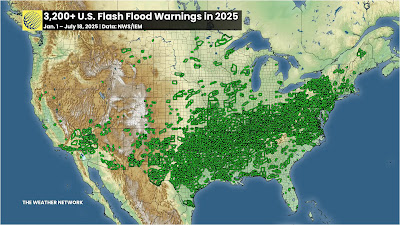
Each tiny green box in this map is one of the flash flood
warnings issued between January 1 and July 18 this year
Source: The Weather Network. 
Inland states, cities and towns are not as prepared for the extremes like the newly ferocious floods that now strike places like they did in western North Carolina during last September's Hurricane Helene, and the tragic floods in the Texas Hill Country in early July. 

We keep hearing these floods described as one in 1000 year events. That means there's just a 0.1 percent chance of that event happening in that place in any given year. 

However as CNN explains:

"But climate change is losing the dice in favor of extreme precipitation. 

'When we talk about e.g. 1,000 year events, we're talking about the likelihood of these events in the absence of human-caused warming (i.e, how often we would expect the from natural variability alone),' said climate scientist Michael Mann of the University of Pennsylvania. 'These events are of course much more frequent 'because' of human-caused warming,' he said in an email."

As the Washington Post points out, for every 1 degree Celsius (1.8 degrees Fahrenheit) of warming air is capable of holding 7 percent more moisture. 

That moisture has to go somewhere. Hence the floods,  Some climate scientists also increasingly think weather patterns can get "stuck" in place more often, due to climate change. 

CNN continues:

"A recent study Mann worked on found such weather patterns have tripled in incidence since the mid-with century during the summer months. The problem is these patterns are 'not necessarily well captured in climate models' he said. This increases uncertainty about future projections for extreme weather events."

WHAT TO DO?

This trend toward more and worse floods will only continue. 

Sure, some summers in the United States and elsewhere will be drier than this one.  A few future summers will feature punishing droughts. After all, depending on the prevailing weather patterns of the season, winds could come from dry sources like central Mexico, or the Desert Southwest. 

But overall, we are now permanent stuck in a world that floods more easily and more dramatically than ever before. And it will get worse.

We are not ready for that. 

As the Washington Post quoted:

"'Any given community can't know if it's going to be the next one that's going to  have a flood that is orders of magnitude larger than the largest flood they've known,' said disaster researcher Rachel Hogan Carr, who co-chairs a World Meteorological Organization project aimed at improving flood warnings. 'But we must all know now that we should be prepared.'"

One reason so many people died in Hurricane Helene - and the mega flood earlier this month in Texas, is that people couldn't imagine things would get that bad. And plans were not necessarily in place to deal with it. 

In western North Carolina, perhaps not enough people fled from the impending danger from the floods, as the Washington Post reported:

 "Though the National Weather Service correctly predicted that the flooding would be deadly, the warnings from local authorities were not forceful or specific enough to sway residents who never imagined a hurricane could hurt them so far from the sea."

The same problem came with the Texas flood. Meteorologists accurate predicted the torrential rains that brought the floods. But authorities didn't order evacuations in many of the hardest hit areas. And warnings didn't reach many until it was too late to flee. Some of those people died. 

The lesson: Detailed disaster plans need to be established, ones that take the warnings from the National Weather Service and get them to the people who need to hear them. And somehow, the public needs to be trained to heed these flash flood warnings, and know how to get out of the way quickly. 

I'm not optimistic we can get there anytime soon, given the Trump-era cutbacks and the National Weather Service and their laissez-faire approach to emergency management.   

THE AFTERMATH

For flood survivors, the mega floods leave incredible destruction that threaten the very existence of their communities.  

An example is Ellicott City, Maryland, a charming, old small city not far west of Baltimore, was devastated three times within a decade, first in 2011, then an even worse flash flood in 2016 and then the worst of them all in 2018,  

Once again, it rained hard in Ellicott City a couple weeks ago and the dreaded flash flood warnings were issued. Nearly 3.5 inches of rain pounded the community within three hours on July 13. Another 1.5 inches fell in less than an hour the next day. That's close to the amount of rain that devastated Ellicott City in 2018.

"When it rains like it did Monday and Sunday, a wave of fear comes over business owner Cindi Ryland told CBS Baltimore. 'What we go through here every time it rains, we all just hold our breath,' Ryland said. 'It's frightening, but we're here and we're resilient."

This time, the water caused only minor damage,  But only because of some painful and very expensive redesigns and rethinking in Ellicott City. 

Per CBS Baltimore: 

"The projects include five retention ponds, two of which are complete, and two water conveyance project, Those include a series of culverts under Maryland Avenue and the North Tunnel project

The third retention pond is expected to be up and running in the fall. The North Tunnel is expected to be complete by fall 2027 while the culvert are in their final design stage"

The changes already completed were apparently enough to prevent another catastrophic flood in Ellicott City this time.  

But the project came at a big financial and community loss, Ellicott City had to tear down four historic buildings. The cost is estimated at $130 million, which includes a $75 million loan from the federal Environmental Protection Agency and $20 million from the state of Maryland. 

This is just one community. Imagine how much it will cost to project dozens, or hundreds, or thousands of communities from the new flood regime we're under. 

There's echoes of Ellicott City parallels Vermont communities like Barre, hit hard by floods in both 2023 and 2024.

The 2023 flood damage 350 properties were damaged. Barre, among other things has been looking at buyouts.. Sixty-seven property owners jumped at the chance to sell their flood-prone properties. 

Those properties would be razed, and the remaining land would just become open floodplain. Maybe parks or farmland, but no houses, no commercial structures. 

This type of buyout, though, is painful to the communities involved. With each demolished house, Barre would lose some of its tax base. Right when the cash-strapped city is also trying to pay for flood recovery. 

It got so bad, that Barre rejected some applications for the buyouts. Barre's city manager said approving all the buyouts would  have gotten rid of roughly $280,000 in property tax revenue. 

Barre isn't a rich little city either, About a quarter of the residents are at or below the poverty level. Plus Barre needs more housing, not less. At last report, the city rejected 40 of the 27 buyout requests. 

Now imagine how many Barres are out there. It's challenging!  

NO TRUMP HELP

To make things worse, the Trump administration is clawing back money set for these flood mitigation projects. Basically, since Trump doesn't think climate change exists, there's no need for the funding. 

It also interesting that Trump signed this into law back in 2018 and now he's dumping the idea 

Virtually all climate scientists disagree with Trump, but the narcissist in chief insists he's always right, so there you go.

Anyway, 20 states, including Vermont, are suing the Trump administration's  decision a couple  months back to end a multi-billion dollar federal program that helps communities gird themselves against future floods as Vermont Public reports.   

The program is called Building Resilient Infrastructure and Communities (BRIC). It covered as much as 90 percent of the cost of things like restoring floodplains, expanding and improving culverts and bridges and protecting wastewater and drinking water treatment plants  

 It looks like Vermont was supposed to get about $5 million in funding through BRIC this year to fund 36 projects around the state.  

So, the floods are going to continue and get worse, and the tools are being taken away from us to deal with that wet future.

Everything is backwards these days.  

Tuesday, July 15, 2025

Climate And Environmental Pessimism In Vermont/U.S: Heat, Smoke, Floods, Invasives And More

This gloomy thunderstorm cloud, photographed Sunday
matched my mood Monday evening as I contemplated
bad weather, climate change, and environmental threats
I fell into a negative mood last evening. 

I was sitting outside, sweating in the tropical Vermont humidity, a few hours after an alleged "cold front" had passed through town where I am, not far from the Canadian border. 

I'd tried to do some needed yard work, but it was too sultry to get much done. I figured I should just sit down and enjoy the day lilies blooming around me. 

 Mid-summer flowers usually improve my mood. Last evening, those flowers, bright as they are, weren't lifting my spirits as much as I'd like. 

Sure, Vermont was lucky with the weather once again on Monday. A few places around the state saw some strong storms, but there wasn't really any damage, no real flooding this time. That was good news.  

But as usual these days, my social media feed last evening was filled with news of new weather emergencies, probably fueled in large parts by climate change. 

A tropical system was brewing near Florida. But once again, it produced news of another one in 1,000 year rainfall event. This time it was around Plant City, Florida, which managed to receive 10 inches of rain in just three hours. Funny how those one in one thousand year flood events keep happening like, every hour. 

I continued on, doom scrolling with my iPhone, coughing a bit in the Vermont air that had once again become smoky from giant, distant wildfires in Canada. I saw we're under another air quality alert. So much for pristine Green Mountain air. 

That air quality alert will stay in effect through at least today.  It's going to be another hot, humid one, too. Health officials are telling us that the combination of sultry, tropical air, the smoke and all that means we should once again limit outdoor activity, especially if you have pre-existing health issues. 

More weather updates on my phone. New York City just had its second wettest hour on record, with 2.07 inches, half its normal monthly installment of rain.  The Central Park downpour was second only to the mega-former Hurricane Ida floods in the Big Apple in 2021.  

Subway service was suspended, roads were under water, cars were trapped, flights were delayed, What a mess!

In neighboring New Jersey, as much as six inches of rain fell in a matter of hours. Flash flood warnings were blaring in most of the Mid-Atlantic states. Parts of the New Jersey Turnpike were really rivers. Fast flowing water raced through homes and businesses in Plainfield, New Jersey, and other towns.  The governor of New Jersey declared a state of emergency

Emergency? Yeah, no kidding. 

Climate change is really turbocharging summer downpours. As I've written previously, it's the summer of floods in the U.S.. and that shows no signs of change.  

Day lilies glow in the hazy morning sun today in St
Albans, Vermont. Despite worries like climate change
and the environment, there's lots to be grateful for, 

I gazed up my phone at the yard as it was growing dark.  A couple fireflies blinked half-heartedly in the humid dusk. 

There used to be a lot more fireflies. I don't know whether this is a one-summer lull at my house or something else. But I do know firefly  numbers are declining. 

I used to enjoy the bats that once swooped around my deck at dusk in the summer. They're gone, too, decimated by something called white nose syndrome, a fungus that kills them, 

My crowded perennial gardens used to buzz with bees. This summer, only a few have been buzzing around. Was it this year's rainy weather or something else? I know bee populations are crashing, mostly because of our use of pesticides and a disease spreading mite that came from overseas in the 1980s. 

Global trade is great on our pocketbooks, but not on the environment.  All kinds of invasive are killing things we love.  Giant chestnut trees were lost at the turn of the 20th century Our big gracious big elms in the mid-century to dutch elm disease.

I glanced upward last night in the gathering dusk around my house at the nearby dead trees. They were deceased white ash trees, decimated by the emerald ash borer. Those dead ash trees are everywhere now, giving a winter look in spots to our oppressively hot, smoky Vermont summer. 

Next on the list potentially is our beloved sugar maples, central to Vermont's identity. Asian longhorn beetles are spreading in the U.S., and could eventually create real, disheartening trouble to our maple syrup industry.

I turned again to the weather forecast before giving up for the evening. We'll have a couple days that reach at least 90 degrees in many locations today and tomorrow.  Great beach days, right? Despite the smoke?

Well, some beaches are closed due to algae blooms. And Burlington has an unfortunate mishap at the sewage treatment plant, and that closed beaches around that city. 

By Thursday, the risk of showers and thunderstorms returns with the approach of a cold front. 

That might be a reason to lift my spirits.   The next cold front looks like it means business. We could actually have some delightfully dry and seasonably cool air by later Friday and Saturday.  A reason to go on living! 

I've always been fascinated and embrace the weather, the outdoors, nature. Sure, I get gloomy sometimes thinking about what's going on.  With climate change. Environment trouble. Invasives.  

The solution, of course, is to not let the negativity that I was experiencing last evening to linger. Do something about climate change and the environment to the best of your ability. There's only so much we can contribute, of course. 

Most importantly we need to love what we still have. And if you think about it, that's still plenty. 

Which brings us to this morning. Songbirds, as usual, were my sunrise happy alarm clock. I ventured outdoors.   The view from my house of Lake Champlain and the Adirondacks beyond was obscured by smoke. 

But those day lilies happily danced in the early morning breeze and hazy sunshine, this time doing their job and making me smile. 

The woods around my house had that beautiful, soothing deep green mid-summer lushness it always has in July. The hydrangeas were decked out in their early season white blooms, flecked with delicate pink. A couple of dragonflies did their helicopter-like aerial acrobatics, expertly removing annoying biting insects from the yard. 

Despite everything, there's still a lot of beauty out there. Enjoy it. For your own sanity. 


Friday, July 11, 2025

Latest Vermont Flood: Details Emerge As Questions Grow About FEMA

Map of rainfall yesterday in Vermont, from data 
collected by the National Weather Service in 
South Burlington. Heavy rains were confined
to parts of the Northeast Kingdom, and a 
couple spotty areas in central Vermont. 
For the third year in a row, some Vermonters are picking up the pieces today after yet another flash flood. 

The tiny town of Northeast Kingdom town of Sutton, population of less than 1,000, appears to be the hardest hit. The good news is that so far, I haven't heard of any serious injuries with this latest flood. 

But the damage was also scattered around the state. A large section of the Middlebury Union High School roof was torn off by intense thunderstorm winds on Thursday. The roof damage allowed some of torrential rains with the storm pour into the boy's locker room, cafeteria and auditorium. 

Officials at the school said the interior damage was thankfully not severe. 

Flood damage was still being tallied in West Burke, East Haven and other Northeast Kingdom towns, along with some spots in Addison County.  But Sutton took the brunt of it. Video from Live Storms Media showed water racing across a road near Sutton, forming a waterfall on one side where the road had washed away. 

 Vermont Public reports that the swift water rescue in Sutton involved a couple and their dog, who were pulled off their roof by the rescue group during the flood. 

Rainfall was highly variable and highly localized. Only a few places received torrents of rain. Many  Vermont towns received little or no rain yesterday. 

The disparity was evident even within the counties hit hardest. West Burke in Caledonia County reported 5.12 inches of rain. But in the opposite end of the county, Wells River and Barton saw only 0.04 inches.  

This is a map of rainfall in the July, 2023 flood. As you
can see here, that one affected pretty much the whole
state, not just a few areas. Pink and purple areas had
at least five inches of rain. Compared to yesterday,
July 23 was many times worse. 
Slow moving thunderstorms parking over certain towns were to blame. Disconcertingly, that same issue of stalled downpours has arisen today. But the storms are very few and far between, and smaller in size than yesterday's.   

If any new flash flooding develops late this afternoon or this evening, it will be highly isolated. However, we're still looking at low but not zero chances of isolated flash flooding Saturday, Sunday and Monday. 

That the chances of new flooding are - fingers crossed - low is good news, as some towns already have a ton of damage. 

Further details from Vermont Public:

"Roughly 20 homes in the Caledonia County town remained cut off from road access as of Friday morning, according to the town fire chief. Town officials said they've made contact with most of these homeowners, but expect it will take several days to make these roads passable.

The storm overwhelmed many of Sutton's roads, culverts and ditches and damaged several homes along Calendar Brook Road. 

According to initial estimates, repairs to the town infrastructure could cost upward of a million dollars - after Sutton has already spent millions on recovery from previous floods."

I don't think anybody knows where Sutton - and other affected towns in the Northeast Kingdom will get the money to fix damage from the latest calamity. 

This is especially true with the Federal Emergency Management Agency's future in doubt. 

FEMA AND VERMONT

We won't know for awhile yet whether the damage in Vermont would qualify for federal assistance even under the "old rules" for federal assistance that were in effect before Donald Trump took office in January. 

Even if Vermont qualifies for help under those old rules, who knows whether we'll receive it? Everything Trumpian is subject to his whims, and information and plans shift like the breeze.

Trump has said he wants to abolish FEMA. Or change it. Or shift all the responsibility to the states. 

Today, as Trump headed to Texas to survey damage from a deadly Fourth of July flood that was many, many orders of magnitude worse than what Vermont saw, his administration's previous vows to abolish FEMA are wavering. 

Per today's Washington Post:

"A senior White House official told the Washington Post that no official action is being taken to wind down FEMA, and that changes in the agency will probably amount to a 'rebranding' that will emphasize state leaders' roles in disaster response."

In other words, nobody has a clue what will happen. 

Which is the question everybody including Vermonters who would deal with disasters are asking. .  

Per Vermont Public: 

"State and national experts say only one thing is clear as of now: The new federal administration wants states to assume a bigger role in disaster response and recovery. The ambiguity over what that looks like, according to Eric Forand, director of Vermont Emergency Management, has complicated the business of disaster preparedness for state officials trying to gird for the next catastrophe."

Given Vermont's track record, this is really an important question.

Vermont Public had an eye-opening stat: 

"Vermont, which has experienced 25 federal disaster declarations since 2011, has been particularly reliant on federal aid. According to a recent analysis, the state has received more federal disaster assistance per capita over the past 14 years than any states but Louisiana, Hawaii, and New York."

There's no reason to think that trend will stop. Vermont is a flood-prone state. Climate change will continue to intensify storms, so more big floods are inevitable. We've already had two damaging flash floods this year, and we're only now getting into the peak of what you might call peak flash flood season.

Those humid July and August dog days can really produce those downpours. More so with climate change. 

 The theoretical solution for this entire mess is for the state, and disaster-prone towns to build up a rainy day fun to deal with inevitable future disasters. 

Good luck with that. The floods of 2023 and 2024 cost several individual towns more money than their entire annual budget. I'm pretty sure local taxpayers can't hand over twice the amount or more they've been paying already. 

We're lucky yesterday wasn't as bad as it could have been.

But still, we're screwed.