Showing posts with label Montpelier. Show all posts

Tuesday, March 10, 2026

Montpelier, Vermont Has Systems To Prevent Ice Jams

The ice jam that caused the devastating flood in downtown
Montpelier in 1992 The city has now created measures
to prevent this from happening again
Ice jams are cropping up in Vermont and surrounding areas of the North Country, threatening abrupt floods as the ice dams up rivers swollen by melting snow. 

Montpelier, Vermont has a rough history with ice jams. In 1992, an ice jam formed along the Winooski River, which runs through the city. Water backed up and flooded virtually all of downtown Montpelier causing millions of dollars in damage.

This is easily one of the most dangerous ice jam seasons in years. A particularly cold winter allowed ice to form thick, strong sheets over the rivers. 

An abrupt and strong March thaw is rapidly melting the snow. That in turn is swelling the rivers and breaking up the ice.  A slower, more gradual thaw would have weakened the river ice, reducing the chances big chunks would pile up against obstacles to form dams.

But here we are. Montpelier, though, has a bunch of ice jam prevention plans and gizmos set up to avoid a repeat of 1992. Or a repeat of the summer of 2023 for that matter, when another flood trashed downtown Montpelier.

This all started in January, as it has every year since 2013 in Montpelier. Since the beginning of the year, the city has discharged treated wastewater into the Winooski River at three locations. That water is around 42 degrees, so it weakens ice in the river and creates channels where water a freely flow, as WPTZ reports. 

=The city has deployed a long-reach excavator to help move ice downstream if it starts jamming up in Montpelier, said Kurt Motyka, the city's public works director. 

So far, there are no reports of ice jam trouble in or near Montpelier during this warm spell. Other areas as of early this afternoon still have ice jams. I was up in Enosburg late this afternoon and, if anything, the ice jam near Boston Post Road is getting a little worse. 

A lot more ice chunks were coming down from upstream and adding to the jam. The jam started moving while I was there, but then stalled again after moving about 100 yards downstream. These things are unpredictable and things change near ice jams in an instant. 

Which is why Montpelier has invested so much in battling ice jams. 

Sunday, September 7, 2025

Dam Removals In Vermont Accelerate In The Age Of Climate Change

The old dam in West Rutland, Vermont before
demolition began this summer. The dam
was removed to improve stream ecology
and prevent flood damage. Old dams
in Vermont are coming under more 
and more scrutiny in the age of 
climate-change driven floods. 
 Back in high school, I briefly had the worst job I ever had.

There was a town reservoir in West Rutland, Vermont that was a municipal water supply. The reservoir was temporarily drained, and we had to muck out the algae and mud left behind to ensure future water quality. 

YUCK!

The town no longer uses that water supply. And I have to say West Rutland now has some of the best tasting tap water of any town I've tried. 

But the dam was still there. Or was. Work began earlier this summer to tear it down. Part of the reason is climate change, of course! 

The dam was growing more and more unsafe due to its age and the increasing severity of rain storms created in large part by that climate change. 

 As WPTZ reports:

"Officials said because of the dam's outdated infrastructure and old age, parts are breaking off during storms and changing the direction of the river. West Rutland Town Planner Mary Ann Roulette said the dam has caused major disruptions over the years. She revealed there as minor damage affecting nearby property this past July."

Karina Dailey, a restoration ecologist and chair of Vermont's dam task force said the West Rutland deconstructions  is one of several dam removal projects. Others are getting going in Newport, Ripton, Berkshire and Winooski. 

DAM SCRUTINY

Communities statewide are discussing removing dams, perhaps hundreds of them. Usually in the name of river health, and the fact removing these small dams can minimize flooding in climate-driven storms. 

 "The best resilience is to let these rivers function naturally," Dailey said. 

Sure, we're having a drought now, but it's only a matter of time before we start running into those super charged rainstorms again. 

It's interesting this is going on now as some Vermont dams were built almost a century ago after the cataclysmic Great Flood of 1927.  

Large flood control dams like Wrightsville, Waterbury and East Barre were built after that flood. Montpelier suffered extensive damage in the July, 2023 flood, but the Wrightsville Dam helped prevent the water from being even deeper. But that dam was almost overtopped in 2023, and that would have caused an even more cataclysmic inundation.

Still, those large dams did their jobs in 2023 and 2024 and did protect some property. It's the small dams that are causing problems. 

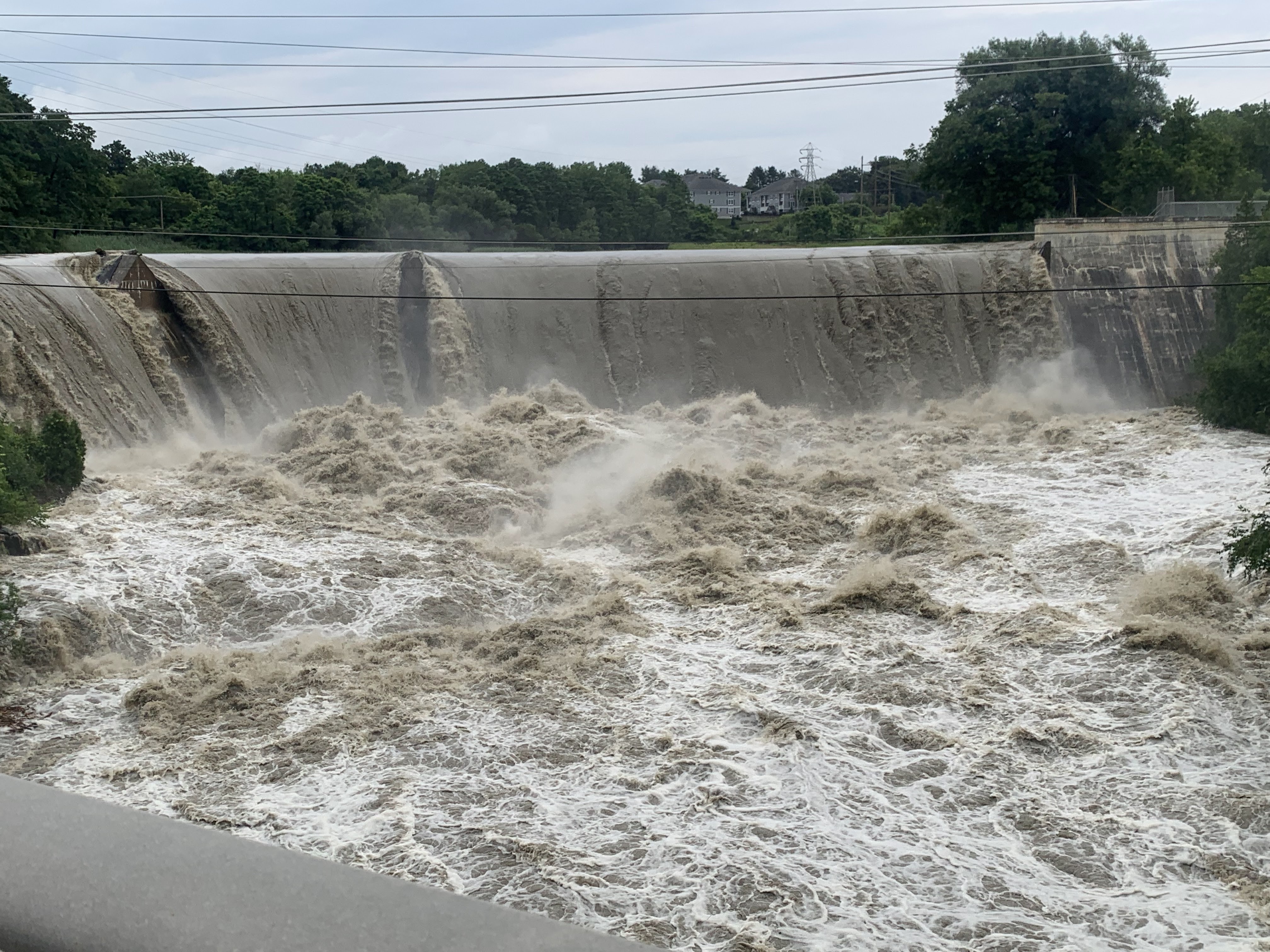
In the 2023 floods, five Vermont dams failed and 60 were overtopped. That event has put new urgency into efforts to remove old dams. 

As Vermont Public reported in a separate article, Vermont has more than 1,000 dams around the state. Many are overdue for repairs or are old and becoming dangerous. As those climate induced storms intensify, those dams become more unstable, and can collapse under heavy rains, worsening damage. 

Even if these old, unstable dams don't collapse during floods, they can create damage in heavy rain storms. 

"Dams not created specifically for flood protection are regularly full and do not provide storage capacity. And they frequently direct water outside the main channel at high velocities which causes bank erosion and impacts to communities,"  said Andrew Fisk, the northeast regional director for the environmental advocacy group American Rivers.

Which is precisely why that dam in West Rutland was removed, and many other dams in Vermont are on their way out. Or, dams like ones recently removed in Dover, and another in Ripton were taken out for ecological reasons. But those removals had the happy side effect of minimizing damage from future floods.

MONTPELIER

Flood-prone Montpelier is looking at removing old dams and has already started on one. 

The Pioneer Street Dam is about 1.3 miles upstream from downtown Montpelier. It's cracked, could collapse in a flood, and could redirect water toward homes and businesses even if it doesn't get smashed down in a future flood. 

Also this summer, right near the Pioneer Street Dam, deconstruction work started on a 19th century home that was on property that once belonged to Jacob Davis, the founding settler in Montpelier was deconstructed.

The property located at 5 Home Farm Way, about two miles upstream from Montpelier consists of a high style Greek Revival house with an attached barn and 19 acres of agricultural land. 

Bricks and planks from the home are being resold for new construction elsewhere. Removing the home and barns opens up new floodplain space, allowing water to spread out over fields before reaching Montpelier during torrential storms. 

Vermont usually tries to preserve historic buildings, but sometimes, there's a greater good that overrides that. "The highest and best use of a floodplain is to serve as a floodplain, said Ben Doyle, president of the Preservation Trust of Vermont, reports Vermont Public. 

Between the removal of the Pioneer Street Dam and the old house, the Winooski River will have more opportunity to spread out into floodplains during big storms before some of that water could reach downtown Montpelier. 

There are three other old mill dams upstream of Montpelier that should be removed, advocates said. They no longer serve the purpose they once did a century ago. They don't even hold back water. The space behind the dams are filled with silt. 

Time for them to go. 

Monday, September 4, 2023

Vermont Strong: Joy In Seeing Businesses Reopen After Horrific July Flood

This is a sad scene inside Bear Pond Books in 
Montpelier during the devastating floods in July.....
 I'll be the first to admit Vermont has a long way to go to fully recover from the catastrophic floods we had in July. 

The rallying cry after the flood has been Vermont Strong, and I don't think I've ever heard of more accurate catchphrase. 

We have been working together to clean up, repair, and get people back in homes, and businesses reopened. Keep it going Vermont!

A case in point is downtown Montpelier. The whole downtown was flooded, and dozens of stores, restaurants and other enterprise were devastated. But these businesses are reopening, and that is bringing joy to everyone, I swear.

A perfect example is Bear Pond Books. It's been there in Montpelier since 1973, and over the years has become a beloved independent book store and gathering place.

 Back on July 14, I posted a sad photo from inside Bear Pond Books, showing a ruined copy of climate activist Greta Thunberg's book, "The Climate Book" dejectedly floating in muddy waters inside the flood-destroyed store.

I was delighted today to see Bear Pond Books post on social media with much happier photos. The store re-opened on September 1, and a giant flood of shoppers - not water - invaded the store. 

....and here's the much happier scene inside 
Bear Pond Books when it reopened September 1.
One Bear Pond Books reopening photo really struck me. It showed a crowded store, its restored old hardwood floors gleaming. 

In the foreground, a smiling shopper looks thrilled to be there. Off to the left, a man and a woman appear to be having a joyful conversation. In the background, a sales clerk is happily ringing up what looks to be a woman's many purchases.

It's a wonderful photo, both emotionally and artistically. It shows a piece of Vermont community the way it's supposed to work. The image actually makes me a bit verklempt. 

You can't escape the climate change angle, though. In that new, happy photo, you see a book on display on the lower right. It's called "How To Live In A Chaotic Climate."

Will these newly climate charged severe storms keep flooding Montpelier again and again? 

 If so, what's the future for what I think is the most charming capital city in the United States. Not just Montpelier, but all of us. 

I'm not going to spoil the joy right now. I just need to drive down to Montpelier to stock up on some books, and see what else is open and interesting. For now, I'll celebrate the ongoing recovery. 


Tuesday, July 11, 2023

Long, Slow Vermont Flood Recovery Begins; Waters Also Slow To Recede, But Glimmers Of Good News

The raging Winooski River drew a crowd in Winooski,
Vermont Tuesday morning. 
 It's time to start bouncing back. 

Yeah, I know, it's going to be a slow trip back from the devastation of the Great Vermont Flood of '23. 

At least along the Winooski River, flood waters were slow to recede today but by late afternoon, the water levels were inching down, except in the Burlington Intervale, where flooding was worsening.

The slow pace of the Winooski River's ebbing has to be frustrating for everybody affected by it. 

Elsewhere in Vermont, the first tiny steps toward disaster recovery had begun this afternoon. 

Those were aided by a return to our regularly scheduled weather for the uncomfortable summer of 2023. The sun came out, which definitely helped, although it was very warm and humid, and of course there was wildfire smoke in the air. As usual. Sigh. 

A LITTLE GOOD NEWS

At least we had flashes of good news today here in Vermont. 

As far as I can tell, the unconfirmed report of a death in Londonderry, Vermont was false.  So far, knock on wood, there have been no fatalities in Vermont from this calamity.  Which is amazing, considering how extensive it was. 

This week's flood is arguably a little worse than Irene in 2011. Irene's Vermont death toll was seven. Do remember, though, the aftermath and cleanup of a disaster can be just as dangerous as the actual event. Let's be careful out there. 

Some other bits of good news. Tentatively, at least, it looks like they won't need to do any major releases from the Wrightsville Dam above Montpelier. That would mean the Capitol City would avoid an even worse inundation.  

The dam on the Winooski River in Essex Junction,
Vermont on Tuesday.

This morning, officials had also announced they would release water from two dams in southern Vermont, which would exponentially worsen flooding. It turns out, the will only release a little water, and additional flooding will be minimal. 

THIS AND THAT

I'm so impressed by how heavy and widespread the rain was. All but one county in Vermont had at least one town with a minimum of four inches of rain. 

Highest totals included 9.2 inches in Calais and 9.05 in Plymouth. Widespread 4 to 8 inch totals were reported along the whole length of the Green Mountains, from Massachusetts to Canada. Valleys on either side had a little less. 

For the record, my place in St. Albans, Vermont had a comparatively modest 3.75 inches of rain from Sunday night to this morning.  That's still about the amount that should fall in an entire July. 

There's a huge pent up demand now from Vermonters wanting to help.  Which is both expected and awesome. It was really too soon on Tuesday to figure out where to put people and what they should do.  Expect to see more information on that starting tomorrow and increasing through the week. 

We are Vermont Strong, so I know we'll all help out as best we can. Watch this space for volunteer opportunities. 

It's best if you avoid Vermont's hardest hit areas for now, unless you are there with a specific job to help with recovery, or media trying to inform the public.   Gawkers are like the rest of the disaster debris: They're in the way and have to be moved. 

LOOKING AHEAD

The only couple of good things I see in the weather forecast is the chances of showers, thunderstorms and downpours are low through Wednesday. The chances are not zero, and a handful of places might get unlucky, but most of us will be fine. 

Except for the heat and humidity. It's relentless. one sign of this is in Burlington's low temperatures. If it stays in the 60s, it's probably humid.  It has not been below 65 in Burlington since June 30. Daytime highs will remain stubbornly in the low to mid 80s. 

A very, very weak cold front might briefly knock the humidity down a peg Wednesday night, and we might actually get down to the low 60s. But that's about it for relief. 

Flooding in Richmond, Vermont Tuesday. 

The humidity will surge back in Thursday and stay with us for an extended period. Probably through much of next week. 

Humidity means the risk of more heavy downpours. Which we need about as much as a submarine needs a screen door.

The best chances of heavy downpours are Thursday afternoon into Friday. 

I know emergency officials and people from Governor Phil Scott on down have been emphasizing the danger from renewed downpours. And they're right.

A hint of optimism is these downpours won't be as horrible as what we just went through. They also won't be as widespread as they were Sunday night through Tuesday morning. 

But even in the best of times, without us being completely waterlogged like we are now, these expected downpours would be capable of generating local flash floods. 

With the ground saturated and roads, river beds and landscape left unstable by the floods early this week, the effects of any local downpours late this week would be magnified. 

Shower chances last into next week, but it's too soon to figure out how light or heavy those might be. 

A slight change in the weather pattern might -  and I emphasize might - make us slightly cooler and slightly drier during the third week of July. 

I don't know for sure that will come to pass. But a man can dream, right?

 

Tuesday, March 15, 2022

30 Years, Already! Since The Big Montpelier Ice Jam Flood of 1992

Ice jam inundated Montpelier on March 11, 1992
 On this date 30 years ago, Montpelier residents and business owners were just starting the cleanup for one of Vermont's most unusual big weather disasters: The big ice jam flood of 1992.   

Ice jams are common in Vermont during the early spring thaw. Usually, they flood a few roads, a few basements and don't cause a whole lot of damage in the grand scheme of things.

This one was different, as it formed in exactly the wrong place: In the Winooski River right in Montpelier.

Just before the ice jam happened, there was quite a bit of water in the snow in the hills surrounding Montpelier than could feed into the Winooski River. The river itself had a thick layer of ice. That winter's temperatures had been pretty close to average, with frequent excursions below zero to lock in those rivers with ice. 

A thaw set in on March 8, and a storm system going by to the west brought an inch of rain and temperatures as high as 51 degrees to Montpelier by the 11th.

Winooski River ice broke up amid the rain and snow melt, and by 7 a.m. March 11, the emergency unfolded with lightning speed in downtown Montpelier. 

Shortly before 7 a.m. an ice jam broke up near Pioneer Street, a little upstream from downtown.  Had that broken ice just flowed through Montpelier, it would have made for a mildly dramatic ice run, but that would have been about it.

But that wave of ice quickly jammed up near the Bailey Avenue bridge. That is precisely the wrong place for an ice jam and guaranteed Montpelier's inundation, 

By 7:15 a.m., propane tanks were floating behind buildings and water began gushing onto parts of State Street. By 7:50 a.m. two to five feet of water had backed up onto sections of State, Main, Langdon, Elm and other small streets downtown. 

Cars stalled in the sudden flood and were soon submerged.  Hundreds of people were trapped by floodwaters in buildings throughout much of Montpelier. 

Meanwhile, as the National Weather Service in South Burlington explains in its event summary,  other people formed human chains to save historic documents from the basement of the Pavilion Building. Similar efforts saved childrens' books from the Kellogg-Hubbard Library and videotapes from the basement of the Savoy Theater. 

A surprising number of kayakers and canoeists paddled up and down State and Main streets during the day 

A young construction company co-owner named Phil Scott, who came into Montpelier to help was quoted in the Burlington Free Press, marveling, "I saw a guy jump in and swim across (the street) just to do it."

(For readers not familiar with Vermont, Scott is now the state's governor).

By mid-afternoon, backhoes and cranes were trying to dislodge the ice near the Bailey Avenue Bridge, but the effort backfired. The jam loosened, the re-asserted itself, leading to the deepest, most destructive water of the day in Montpelier in the late afternoon.

Crews were finally able to dislodge the second jam shortly after 5 p.m. The resulting rush of ice chunks and water destroyed a railroad trestle, and caused rather significant flooding downstream in Middlesex, Bolton, Jonesville and Richmond. 

Temperatures plunged immediately after the ice jam cleared, making recovery a challenge. The temperature fell below 20 degrees in the late evening of March 11, and stayed at or below 20 degrees until the afternoon of March 16.  Temperatures didn't get above freezing again in Montpelier until the afternoon of March 17 and then only briefly.

Meanwhile, basements had to be pumped and HVAC systems had to be repaired quickly as subfreezing temperatures would cause further damage.

One of the first downtown Montpelier businesses to reopen after the flood was Charlie O's, the venerable tavern at 70 Main Street. I, and my drinking buddy Todd decided to head down there Satureay afternoon, just three days after the flood. 

The floor was a bit soggy. On the wall, a damaged poster of Bruce Springsteen's "Born In The USA" album was still on the wall. The poster is a behind view of Springsteen, dressed in blue jeans and a white t-shirt.  The high water line from the flood was at what would have been a particularly painful spot for Springsteen, had he actually been there.  

I think the statute of limitations has passed, so I can report the following. We enjoyed plenty of beer at incredibly low fire sale prices. Labels were missing on the beer bottles Charlie O's served, and I thought I detected a whiff of petroleum residue on the outside of the bottles. 

But the very friendly bartenders rinsed the bottles, and beer tasted fine.  I absolutely did not get sick. 

Ultimately, the ice jam caused $4 million in 1992 dollar damages to downtown Montpelier. Remarkably, given how abruptly the disaster struck, there were no deaths or serious injuries.