Showing posts with label recovery. Show all posts

Thursday, January 29, 2026

Hundreds Of Trucks And Cars Stuck On Ice-Locked Mississippi Interstate Amid Widespread Southern Ice Storm Power Outages

Missouri Department of Transportation traffic cam image
from this afternoon shows I-269 in the northern part of
the state still covered in ice and truck traffic
still backed up of miles. This nearly four days
after the freezing rain stopped falling. 
The Great Ice Storm  of 2026 in the southern United States continues to wreak havoc, days after the icy rains and snow ended. 

There's been dozens of deaths associated by the storm. By one count, 111 people have perished from either direct or indirect effects of the storm and cold wave. causes directly and directly connected to the storm and cold weather.  

The trouble now is it so far not warmed up after freezing rain stopped falling. Though some of the ice has melted from all those sagging trees, many road and highways contain thick, stubborn layers of ice. 

This includes major routes like Interstate 22 and Interstate 55, along with other main roads across northern Mississippi.

The freezing rain might have ended by this past Sunday night. But on Wednesday, the highways in northern Mississippi and parts of Tennessee and Louisiana were still thick sheets of ice. Sunshine that tried to thaw the ice and truck tires left ruts and holes in the highway ice.  

Then it froze again at night, making things even worse than before. For some reason, the Mississippi Department of Transportation did not close the highways until Wednesday afternoon. By then, it was too late. Tractor trailers and some cars were backed up for miles. People were stranded out there for as much as 24 hours. Sometimes more. All in temperatures far below freezing at night. 

 "I've been here since yesterday (Tuesday) about 4:30 p.m.  I haven't moved an inch," truck driver Lee Roy Thomas told ABC24 in Memphis Wednesday afternoon. 

A man from Wisconsin who was stranded on Interstate 22 in Mississippi told WREG: "I tried calling the Mississippi State Patrol all they would do is, there would be a bushy signal and they would hang up after four rings. I must have made half a dozen attempts at that. We were always waiting for someone to come by and check on us but nobody came by. Nobody checked on us."

One truck driver said that when trucks begin to inch forward, they slide sideways because it is so slippery. 

Drone video showed mile after mile of tractor trailer trucks just sitting there, not moving on Wednesday along Interstate 55.

I'm wondering why they didn't shut down these jammed up Interstate highways last weekend and kept them closed until the ice melted, or it could be bulldozed from the roads.  That would have caused huge disruptions, but probably not something as severe as those hundreds of people stuck out there in their vehicles. 

On Wednesday, Mississippi Department of Transportation finally did close down parts of Interstate 55 and Interstate 22 so ice could be cleared from the roads. Hopefully enough so that vehicles could get through reasonably enough.

MDOT also sent in plows Wednesday afternoon, but warned that any ice the sun melted during the day would freeze again at night. The National Guard and more MDOT trucks have been brought in to help clear the highways. However, as the sun set Wednesday, the two major interstates remained at a near-standstill. 

A special weather statement from the National Weather Service office in Memphis this morning urging no travel yet. The statement said main highways remain quite dangerous and most secondary roads across much of Mississippi and Tennessee are pretty much impassable still.

Some thawing was going on in northern Mississippi today as temperatures rise into the mid-40s, but that will not be enough to melt all the ice. An intense new cold snap will drop temperatures back below freezing tonight, and no real thawing is expected until at least Monday. 

Meanwhile, troubles kept popping up in hard-hit Tennessee as well.  

Ten people have died in Tennessee so far as a result of the storm. Residents are worried about more deaths as power remains out in many areas. Those fears are heightened by the prospect of a new cold snap coming in. Temperatures are forecast to drop into the single digits Saturday night after highs only near 20 degrees. 

As of this afternoon, more than 300,000 homes and businesses in the South remain without power. That includes nearly 100,000 customers each in Tennessee and Mississippi and more than 50,000 in Louisiana. 

In Nashville, elderly and disabled residents in a 12 story apartment building have had no heat or elevators for days and are running out of food. Fire crews evacuated some of the residents from the building on Wednesday. 

Videos:

News report on the highway situation in Mississippi from ABC2  in Memphis. Click on this link to view, or if you see the image below, click on that. 


Drone video shows mile and mile after mile of tractor trailer trucks just sitting on the ice along Interstate 55 in northern Mississippi. Again, click on this link, or click on the link below if it is visible.


Sunday, January 4, 2026

Vermont Still Struggles With 2023 Montpelier Flood Damage To State Buildings.

The Pavilion Building in Montpelier in the
immediate aftermath of the July, 2023 flood.
The pipes were for moisture and mold
remediation. The building still needs
a lot of work bringing the HVAC
and electrical systems out of the basement.
In yet another instance that proves it can take forever to recover from a catastrophic disaster, Vermont is still struggling to finish financing and repairs to state buildings from flooding two and a half years ago. 

Extreme flooding hit Vermont on July 10-11, 2023.  In that flood, downtown Montpelier was inundated. That flood affected 17 state office buildings in Montpelier, which is the state's capitol. 

According to Vermont Public, Gov Phil Scott's administration is asking for more time to determine how much it will cost to fully upgrade the state buildings affected by the flood. 

There's a deadline coming up in a few days (January 10) to accept a fixed cost for the work. But the state is going to ask FEMA for six more months to come up with a cost. 

FEMA has already given the state $30 million to clean up the mess left by the floods and to install temporary infrastructure to keep the buildings running. 

Chief Recover Officer Douglas Farnham told Vermont Public the total cost of the project will probably go over $200 million. FEMA would cover as much as 90 percent of those costs.

A main reason for the expense is some of this work is going to be expensive. The five-story Pavilion Building's heating, cooling and electrical systems are all in the basement. Turns out that's a bad place for that stuff when Montpelier floods. They're going to move all that equipment out of the basement, which is a great idea, but it will be a complex and expensive job. 

As Vermont Public reports, three buildings at 132, 134 and 136 State Street are still unoccupied. A fourth flood-damaged building at 144 State Street will probably be torn down. Unlike most of the other buildings involved,  The one-story building at 144 State is not considered a historic structure. so nobody will have to go through hoops to get rid of that building.

Even if the FEMA money comes through after the requested six month delay with that federal agency, it's going to take a long time to get Vermont state buildings up to snuff before the next flood. You need design plans, permits, equipment purchases. Then you have to install and construct everything. 

Another building, at 87 State Street in Montpelier, was flooded and never reoccupied. It's owned by the federal government. Officials this past summer announced the feds are putting that building up for sale. the Vermont state government has expressed interest in buying the building. 

The whole epic is just another example of how long it takes for state governments to fix all the infrastructure taken away by climate related disasters. This is going to keep happening. Perhaps over and over in the same states.

BEEN THERE, DONE THAT

That has already been the case here in Vermont. We've been through this before.  During Hurricane Irene in 2011, the State Office Complex in Waterbury was trashed by flooding. Some buildings had as much as eight feet of water in them. 

Twenty buildings had to be torn down due to the damage and the fact they were especially prone to additional floods. All the rest had to go through extensive repair. And a new, 86.000 square foot, more flood resilient building was added.  The renovated buildings and the new one were raised to above the 500-year flood level. 

Getting the whole 100-acre back together - and more flood proof - cost $130 million, which was up until now the largest state building project in Vermont  history, reports WCAX. 

Vermont taxpayers paid for most of that renovation. FEMA contributed $36 million and the state's insurance company paid roughly $15 million.

Some of that Waterbury reconstruction went toward projects that didn't have much to do with the flooding, but was still worthwhile. For instance, single-paned glass were replaced by weather-efficient windows. 

The grand re-opening after all this work didn't hit until December, 2015, more than four years after the flood. Between the 2011 flood and the late 2015 reopening, about 1,500 employees had been displaced, dealing with a big blow to the town of Waterbury's economy. 

I imagine this type of saga could happen in Vermont again. And in other states, As the federal government keeps reducing aid to states, it'll be harder and harder for some states to even function if a major disaster hits a state Capitol.  

Thursday, October 30, 2025

Long, Hard Recovery Begins In Jamaica As Hurricane Melissa Speeds Away To North Atlantic

Photo of extreme winds from Hurricane Melissa in
Jamaica. The photographer, Josh Morgerman said
this was actually before the peak of the winds. 
The wrath of Hurricane Melissa will soon end as the storm races northeastward away from the Bahamas, but the storm and its aftermath has changed lives forever. 

As of this morning, the death toll from Hurricane Melissa rose past 30 as of this morning, but we still do not have a full accounting of the toll in Jamaica, the hardest hit island in the Caribbean. 

Communications there are still spotty, and many roads are blocked. Which means reaching the hardest hit areas is difficult to say the least. 

Most of the reported deaths so far are in Haiti. Per USA Today:

"Though Melissa did not directly hit Haiti, the Caribbeans' most populous nation, the storm battered the island with days of rain. On Wednesday, authorities reported at least 25 deaths, largely due to floods in Petit-Goave, a coastal town about 40 miles west of the capital, where a river burst its banks."

Several people are still missing in Haiti, and thousands of homes are damaged and destroyed.

That's still nothing compared to scope of the destruction in parts of Jamaica. The search and recovery of victims in Jamaica really hasn't started in earnest yet. 

Weather and climate journalist Jonathan Petramala, in a YouTube video posted this morning, said he and many others had been trying for more than 12 hours to reach the hardest hit coastline of Jamaica. The roads to the southwest coast are an impenetrable mass of mud, twisted trees, water and debris. 

That's bad news, because survivors on the southwest coast are most in need of help.  In the Jamaican town Petramala was reporting from, survivors said they had no drinking water and no food amid the now roofless houses and debris-clogged landscape. Dead goats, drowned in the storm, littered the neighborhood

The storm itself had to be terrifying. Josh Morgerman, a hurricane expert who has now experienced the eyes 83 hurricanes, described Melissa as easily among the scariest he's experienced. On Facebook, he wrote about the scene just before the hurricane reached peak intensity.

"Bone-rattling gusts were making roofs explode into clouds of lethal confetti. The grand palm tree out front was starting to bend obscenely - in a way I found unnatural."

Then the peak of the storm hit. Morgerman described it this way:

"The hurricane's inner eyewall was a screaming white void. All I could see through the cracks in the shutters was the color white - accompanied by a constant, ear-splitting scream that actually caused pain. ....The scream occasionally got higher and angrier and those extra-screechy screams made my eardrums pulse. Meanwhile, water was forcing in through every crack - under the floor and between the window slats."

Drone video taken after skies cleared made it look like a 30 mile wide EF-4 tornado had smashed through western Jamaica. 

Jamaicans are doing what they can to start recovering from then catastrophe. The capital, Kingston, was not all that badly damaged by Melissa, so the seat of government is able to coordinate relief and logistics. 

Video from Jamaica showed people already starting to work on replacing roofs on homes. Bulldozers were pushing mud off roads. People with chainsaws and machetes were hacking their way through walls of fallen trees that were blocking roads. 

At least eight Jamaican hospitals had power restored as of today. Kingston's airport reopened today, allowing planes loaded with aid to land.   Ten commercial flights are also scheduled, so tourists can leave the island.

The airport in hard-hit Montego Bay also opened to relief flights today, but commercial flights are still a no-go, so tourists are still stranded there. 

All this is a start, but it might take years for Jamaica to fully recover. And I'm not even really including the damage Melissa caused in Haiti, Cuba and the Bahamas. 

MELISSA'S ENDGAME

Hurricane Melissa is persistent as hell. 

Top winds had dropped to 90 mph as it was interacting with islands in the Bahamas. But despite strong upper level winds that tend to rip hurricanes apart, Melissa managed to strengthen its winds to 105 mph by late this morning. 

Melissa might even get a little stronger in the next few hours. But colder ocean water temperatures and howling upper level winds will make the storm lose its tropical characteristics as it passes by Bermuda tonight. 

It'll still be a hurricane force storm when it clips the southeast corner of Newfoundland Friday night or Saturday as it races northeastward over the Atlantic.

VIDEO

YouTube video, much of it taken from drone, of the devastation in Haiti from Hurricane Melissa. Click on this link to view. Or if you see the image below, click on that. 


Friday, August 8, 2025

Hawaii Second Anniversary Of Deadly Wildfire: Slow Recovery In Destroyed Lahaina

A sign of hope in Lahaina, Hawaii,
destroyed by a deadly wildfire on 
this date in 2023 Top photo is the
badly scorched enormous banyan
tree in Lahaina immediately after
the fire. Bottom photo is what the
rejuvenated tree looks like now,
 Two years ago today, one of the worst wildfires in U.S. history hit in and around Lahaina, Maui, Hawaii. It killed 102 people, destroyed more than 2,200 structures and caused $5.5 billion in damage. 

It laid to waste a historic tourist city, and it's still just starting to try to bounce back. 

The tragedy is another cautionary tale -  much like the slow fire recovery in destroyed towns like Paradise, California -  that tells us once a community burns down in a wildfire, the comeback is incredibly slow. 

Even worse, the same places burned in previous wildfires are at risk for getting hit again. 

DIFFICULT RECOVERY

The lead paragraphs in an August 5 Hawaii Public Radio piece tells the continued sad story:

"Two years after the fire, Maui survivors still face challenges with housing, insurance, FEMA assistance, building permits and a laundry list of other obstacles. Under the surface, many survivors are mentally struggling right now - and they're not alone."

The University of Hawaii's Maui Wildlife Exposure Study says almost half the adults in their mental health research said almost half of the adults are still living in temporary housing and a quarter remain unemployed despite trying to find work. 

Home rebuilding is only now getting under way in Lahaina. Hawaii Public Radio says hundreds of homes are now under construction, but only 45 have been completed so far. An additional 450 building permits have been issued, and more than 300 are being processed.

The time consuming process of rebuilding is expensive. Many are still paying a mortgage on their destroyed homes, and simultaneously paying rent elsewhere.   Here's an example Hawaii Public Radio provides:

"Fire survivor Jeremy DelosReyes and his wife, Gracie, have poured the cement foundation of their new home He's constructing their own rebuild, but it's been a financial struggle - and they didn't qualify for FEMA assistance.

'I had a 2,200 square foot house.... At $500 a square foot, my house is going to cost me $1.2 million. I have $400,000 of insurance. I pay $4,000 a month in rent. I got to come up with $6,000 just to cover my mortgage and rent.'"

Lahaina residents are also trying to build more fire-resistant houses, which are more expensive that older styles. For instance. a metal roof could cost $30,000 more than older style roofs, 

The main business district on Front Street was obliterated in the fire. The debris was cleaned up, and then.....nothing.  The future of that area of Lahaina is still up in the air. 

The wildfire claimed about 800 business and 7,000 jobs. Only one business has reopened: The Hi Surf Club Maui, operating out of donated van where the original building once stood on Breakwall Beach, according to KHON.

The shell of the building that used to house Fleetwood's On Front Street, s a popular restaurant owned by Fleetwood Mac found Mick Fleetwood, recently announced they plan to rebuild and reopen in 2026.

NEW FIRE SCARE

I imagine pretty much everyone in Lahaina still has PTSD from that fire. So it had to be frightening when a new wildfire broke out Monday near Lahaina. 

It spread over hills around Kaanapali, about two miles north of Lahaina, closing down a highway and forcing about 50 people to evacuate. 

Unlike the tragedy of 2023, this time, firefighters gained the upper hand and extinguished the fire with any homes being lost. The fire did burn through 33 acres. 

BANYAN TREE

One of the biggest potential losses in Lahaina during the fire was an immense banyan tree that was left entire blackened and scorched in the fire. 

The historic tree was planted by Sheriff William Owen Smith in 1873 to commemorate the 50th anniversary of the first Protestant missionaries in Lahaina..

Immediately after the fire, arborists examine the tree determined much of it could be saved with a lot to TLC.

The result, two years after the fire, is a thriving banyan tree, as KHON tells us: 

"'It's really, really healthy,' explained Duane Parkman, arborist committee chair and Treecovery Lahaina president. 'We're super stoked to see as much growth as we've seen in the past year and a half. We've seen aerial roots coming down from almost 20 feet high, and they're almost touching the ground already. There's so much fruit - it's become a habitat again. It's a thriving tree system."

The tree isn't open to the public yet, as some branches are still unstable, but they'll strengthen up. Replacement benches are being replaced beneath the tree. The banyan is the Lahaina gathering place, especially since it's about ten degrees cooler beneath the tree than elsewhere under the hot Hawaiian sun. 

The hope is the banyan, the centerpiece of Lahaina, is a premonition of a future town - one that might be a lot different than the old one, but thriving anyway. 


Thursday, July 24, 2025

This Is The Year Of The Floods, And It Will Only Get Worse With Climate Change

Flash flood damage in Sutton, Vermont on July 10.
This summer has brought an extraordinary
number of flash floods to the U.S. Get used to it,
as this is the new climate change normal. 
The news of deadly, terrible floods have been coming at us pretty much daily lately.

It's the Summer Of Floods.  

And I'll get this out of the way right now. Yes, climate change is much share in the blame for all this.   A warmer atmosphere can hold more moisture than a cooler air. That extra warm air moisture is increasingly wrung out in extreme fashion if a summertime weather disturbance bumps into it. 

The Atlantic Ocean and Gulf of Mexico are both warmer than average, due again in large part due to climate change. Some of that warmer water evaporates into the air, which flows inland as exceptionally humid air, ripe for producing extraordinary downpours.

This isn't going away. And neither is the death, heartache, hardship and sadness the floods bring. Moreover, we're not ready for these things, and not ready for when they get worse. Which will happen.

On top of all that, the political climate in the U.S., such as it is, is not at all conducive for dealing with our new reality. 

What follows is our situation, and it isn't pretty.  

THE FLOODS

July began with the extreme Texas floods that are known to have killed at least 135 people.  Floods and debris flows swept Ruidoso, New Mexico on July 8, killing three people.  Another four people died in North Carolina flooding on July 6.

Davenport, Iowa endured a flash flood emergency on July 11. Another huge flash flood hit New Jersey and the New York City metro area on July 14 claiming an additional two lives. Flash flooding from five inches of rain returned to parts of New Jersey on July 20.  

Other dramatic floods have hit the western Chicago suburbs (July 8 ), the Kansas City area (July 17) parts of Virginia, (July. 18), the northern suburbs of Washington DC on July 19 and Overland Park, Kansas on July 21, where one person died. 

 In the United States, flood deaths last year and this year are far above the annual average of 85. In 2024, the U.S. saw 145 flood-related deaths.  The nation saw at least that many deaths from flooding just this month, never mind the whole year.   

The sheer number of floods this month have been staggering. 

Through mid-month, the National Weather Service had issued more flash flood warnings in the United States than in any year since at least 1986. When I last checked a couple days ago it was at least 3,360 such warnings and counting. 

Here in Vermont, we've so far escaped the worst of it, but we've still dealt with damaging flash floods this year. On May 17, there was quite a bit of flash flooding in towns like Warren, Waitsfield and White River Junction. 

Parts of the Northeast Kingdom were slammed by flash floods on July 10, seriously damaging some homes and several roads. 

TOO WET, TOO WARM

The bottom line of this summer is it's been too warm, and especially too humid. 

Per the Washington Post

"A Washington Post analysis of atmospheric data found a record amount of moisture flowing in the skies over the past year and a half, largely due to rising global temperatures. 

With so much warm, moist air to fuel storms, they are increasingly able to move water vapor from the oceans to locations hundred of miles from the coast, triggering flooding for which most inland communities are ill-prepared.

'We're living in a climate that we've never seen, and it keeps throwing us curveballs,' said Kathie Dell, North Carolina's state climatologist. 'How do you plan for the worst thing you've never seen?'" 

Most places aren't ready for this new, wet reality. Many coastal areas have elaborate systems to evacuate people and bolster defenses against severe storms and hurricanes, which have always been a hazard near the shore.
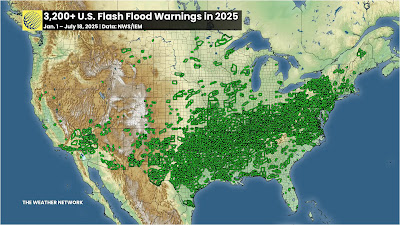
Each tiny green box in this map is one of the flash flood
warnings issued between January 1 and July 18 this year
Source: The Weather Network. 
Inland states, cities and towns are not as prepared for the extremes like the newly ferocious floods that now strike places like they did in western North Carolina during last September's Hurricane Helene, and the tragic floods in the Texas Hill Country in early July. 

We keep hearing these floods described as one in 1000 year events. That means there's just a 0.1 percent chance of that event happening in that place in any given year. 

However as CNN explains:

"But climate change is losing the dice in favor of extreme precipitation. 

'When we talk about e.g. 1,000 year events, we're talking about the likelihood of these events in the absence of human-caused warming (i.e, how often we would expect the from natural variability alone),' said climate scientist Michael Mann of the University of Pennsylvania. 'These events are of course much more frequent 'because' of human-caused warming,' he said in an email."

As the Washington Post points out, for every 1 degree Celsius (1.8 degrees Fahrenheit) of warming air is capable of holding 7 percent more moisture. 

That moisture has to go somewhere. Hence the floods,  Some climate scientists also increasingly think weather patterns can get "stuck" in place more often, due to climate change. 

CNN continues:

"A recent study Mann worked on found such weather patterns have tripled in incidence since the mid-with century during the summer months. The problem is these patterns are 'not necessarily well captured in climate models' he said. This increases uncertainty about future projections for extreme weather events."

WHAT TO DO?

This trend toward more and worse floods will only continue. 

Sure, some summers in the United States and elsewhere will be drier than this one.  A few future summers will feature punishing droughts. After all, depending on the prevailing weather patterns of the season, winds could come from dry sources like central Mexico, or the Desert Southwest. 

But overall, we are now permanent stuck in a world that floods more easily and more dramatically than ever before. And it will get worse.

We are not ready for that. 

As the Washington Post quoted:

"'Any given community can't know if it's going to be the next one that's going to  have a flood that is orders of magnitude larger than the largest flood they've known,' said disaster researcher Rachel Hogan Carr, who co-chairs a World Meteorological Organization project aimed at improving flood warnings. 'But we must all know now that we should be prepared.'"

One reason so many people died in Hurricane Helene - and the mega flood earlier this month in Texas, is that people couldn't imagine things would get that bad. And plans were not necessarily in place to deal with it. 

In western North Carolina, perhaps not enough people fled from the impending danger from the floods, as the Washington Post reported:

 "Though the National Weather Service correctly predicted that the flooding would be deadly, the warnings from local authorities were not forceful or specific enough to sway residents who never imagined a hurricane could hurt them so far from the sea."

The same problem came with the Texas flood. Meteorologists accurate predicted the torrential rains that brought the floods. But authorities didn't order evacuations in many of the hardest hit areas. And warnings didn't reach many until it was too late to flee. Some of those people died. 

The lesson: Detailed disaster plans need to be established, ones that take the warnings from the National Weather Service and get them to the people who need to hear them. And somehow, the public needs to be trained to heed these flash flood warnings, and know how to get out of the way quickly. 

I'm not optimistic we can get there anytime soon, given the Trump-era cutbacks and the National Weather Service and their laissez-faire approach to emergency management.   

THE AFTERMATH

For flood survivors, the mega floods leave incredible destruction that threaten the very existence of their communities.  

An example is Ellicott City, Maryland, a charming, old small city not far west of Baltimore, was devastated three times within a decade, first in 2011, then an even worse flash flood in 2016 and then the worst of them all in 2018,  

Once again, it rained hard in Ellicott City a couple weeks ago and the dreaded flash flood warnings were issued. Nearly 3.5 inches of rain pounded the community within three hours on July 13. Another 1.5 inches fell in less than an hour the next day. That's close to the amount of rain that devastated Ellicott City in 2018.

"When it rains like it did Monday and Sunday, a wave of fear comes over business owner Cindi Ryland told CBS Baltimore. 'What we go through here every time it rains, we all just hold our breath,' Ryland said. 'It's frightening, but we're here and we're resilient."

This time, the water caused only minor damage,  But only because of some painful and very expensive redesigns and rethinking in Ellicott City. 

Per CBS Baltimore: 

"The projects include five retention ponds, two of which are complete, and two water conveyance project, Those include a series of culverts under Maryland Avenue and the North Tunnel project

The third retention pond is expected to be up and running in the fall. The North Tunnel is expected to be complete by fall 2027 while the culvert are in their final design stage"

The changes already completed were apparently enough to prevent another catastrophic flood in Ellicott City this time.  

But the project came at a big financial and community loss, Ellicott City had to tear down four historic buildings. The cost is estimated at $130 million, which includes a $75 million loan from the federal Environmental Protection Agency and $20 million from the state of Maryland. 

This is just one community. Imagine how much it will cost to project dozens, or hundreds, or thousands of communities from the new flood regime we're under. 

There's echoes of Ellicott City parallels Vermont communities like Barre, hit hard by floods in both 2023 and 2024.

The 2023 flood damage 350 properties were damaged. Barre, among other things has been looking at buyouts.. Sixty-seven property owners jumped at the chance to sell their flood-prone properties. 

Those properties would be razed, and the remaining land would just become open floodplain. Maybe parks or farmland, but no houses, no commercial structures. 

This type of buyout, though, is painful to the communities involved. With each demolished house, Barre would lose some of its tax base. Right when the cash-strapped city is also trying to pay for flood recovery. 

It got so bad, that Barre rejected some applications for the buyouts. Barre's city manager said approving all the buyouts would  have gotten rid of roughly $280,000 in property tax revenue. 

Barre isn't a rich little city either, About a quarter of the residents are at or below the poverty level. Plus Barre needs more housing, not less. At last report, the city rejected 40 of the 27 buyout requests. 

Now imagine how many Barres are out there. It's challenging!  

NO TRUMP HELP

To make things worse, the Trump administration is clawing back money set for these flood mitigation projects. Basically, since Trump doesn't think climate change exists, there's no need for the funding. 

It also interesting that Trump signed this into law back in 2018 and now he's dumping the idea 

Virtually all climate scientists disagree with Trump, but the narcissist in chief insists he's always right, so there you go.

Anyway, 20 states, including Vermont, are suing the Trump administration's  decision a couple  months back to end a multi-billion dollar federal program that helps communities gird themselves against future floods as Vermont Public reports.   

The program is called Building Resilient Infrastructure and Communities (BRIC). It covered as much as 90 percent of the cost of things like restoring floodplains, expanding and improving culverts and bridges and protecting wastewater and drinking water treatment plants  

 It looks like Vermont was supposed to get about $5 million in funding through BRIC this year to fund 36 projects around the state.  

So, the floods are going to continue and get worse, and the tools are being taken away from us to deal with that wet future.

Everything is backwards these days.  

Sunday, February 23, 2025

Fallout From Flooding Nearly Two Years Ago Continues To Affect Vermont

Image from Reddit shows the Sterling Market and
other buildings in Johnson, Vermont inundated with
water in July, 2023. Efforts to reopen the
grocery store have failed, and a buyout is
now likely to turn the property into part of a floodplain
 More proof that it seemingly takes forever to recover from a catastrophic flood. 

Towns like Johnson, Plainfield and many other Vermont communities  are still coming to terms and reshaping themselves after the catastrophic floods in the summers of 2023 and 2024. 

The settlement pattern of most Vermont villages, towns and cities in the state.over the centuries is near rivers, in flood plains.   

Water and currents in these rivers aided commerce, transportation, the generation of electricity, and even, unfortunately, garbage disposal.

 Sure, these towns would occasionally suffer serious, damaging floods over the decades and centuries, but they were infrequent enough to be survivable to these communities, at least most of the time.

Modern society does not really need these rivers for economic livelihood as much anymore. That would be OK, if floods didn't happen all that frequently. But they do in our unfortunately age of climate change. 

As that climate change roars on, there's nothing to suggest our onslaught of floods will ease. In fact they'll probably accelerate. 

It's making less and less sense to keep our beautiful, compact and walkable villages and towns near the rivers. But you can't just pick everything up and move it all immediately. 

Still, we're seeing a gradual retreat from the water, and that's slowly changing the face of Vermont. I've brought up this fact before here, but the job continues in fits and starts. It's worth it to keep tabs on this phenomenon, just to assess how it's changing all of our lives and our sense of place. 

It's all about resiliency in the face of climate change. 

 JOHNSON

In Johnson, the flood of July, 2023 filled the inside the Sterling Market, the only major grocery store in town, almost to the ceiling.    

Efforts have been made to re-open the store ever since, with no success. The property is owned by Pomerleau Real Estate, a firm that owns a number of commercial properties around Vermont. 

As VTDigger explains:

"It's former operator Associated Grocers of New England, initially vowed to return, but the proposal was vetoed by its governing co-op board.

....Pomerleau then brought in executives from Shaw's a grocery chain with locations throughout New England. Shaw's was interested opening a store, according to (Pomerleau president Ernie) Pomerleau, but needed the building's owners to commit to installing flood mitigation measures, including a new floodgate, to ensure its protection against future flooding." 

Pomerleau was trying to get a grant through the Federal Emergency Management Agency, with support from the town of Johnson, to help with flood mitigation of buildings in disaster zones, like the town was after the 2023 flood. 

Pomerleau's engineers were coming up with plans to make the building nearly impervious to most future flood events. But that was understandably not good enough for Shaw's. That company pulled the plug on the venture late last year. 

Before 2023, the building housing the market was badly damaged in floods in 1995 and 2011, and had several close misses with floods in recent years. 

So now, the only choice left for Pomerleau is to give up on the building the company built back in the 1960s. 

VTDigger again: 

"Lacking any better alternative, Pomerleau has reluctantly joined other property owners in Johnson seeking to offload their flood-prone homes and businesses and become the 17th property to apply for a buyout since 2023."

These buyouts make sense, as if they go through, the flood-prone properties are razed and replaced buy green space and flood plains in which future floods don't really harm anything. 

This plan is full of uncertainly and risks, however. First of all, none of the 17 properties have completed the buyout process yet. Plus, with the new Trump administration cutting spending willynilly and steadfastly avoiding anything that has to do with climate change, these buyouts might not go through. 

Even if they do, they'll really change the face of Johnson. 

Johnson consists of two municipalities in northern Vermont, the village, where the heart of the downtown is, has about 1,300 people. The surrounding neighborhoods - Johnson Town, has about 3,500 people for a total of roughly 4,800 residents. 

So it ain't big. 

Converting 17 once-thriving properties to green space would have a big effect on Johnson's tax base, and basically the way it looks. 

Climate change related-disasters are becoming more and more common pretty much everywhere, including in Vermont, so it's not just Johnson changing. It's many of the state's compact and picturesque villages and tiny downtowns that must radically change. 

One of the other Vermont towns going through a similar process is Plainfield

PLAINFIELD

Plainfield, about 35 miles southeast of Johnson, suffered a fair amount of damage in the 2023 flood. Exactly a year later, on July 10-11, 2024, things got exponentially worse. 

Flash flooding roared through the middle of Plainfield on the night of July 10. The flood swept away most of a large apartment building known as "Heartbreak Hotel."  Luckily the building's occupants fled shortly before the structure was destroyed. Other buildings in town were severely damaged. 

The remains of the so-called Heartbreak Hotel apartment
building in Plainfield, Vermont, July, 2024. Most of the
building was swept away in the extreme flooding
that hit the town.  

Like Johnson, people are waiting on buyouts, the town's grand list is taking a big hit, and large sections of Plainfield village that weren't already swept away by the flood last July will be gone. 

Twenty-eight homes are awaiting FEMA buyouts. (Again, like in Johnson, we're aren't sure if the Trump administration will follow through with this).

The solution they seem to be settling on in Plainfield is to turn traditional settlement patterns backwards. In other words, Plainfield village is headed for the hills. At least part of it. 

As WCAX reports:

"Now the town is considering a plan to expand the downtown and invest $2 million  in water, sewer and road infrastructure to a 23-acre plot of private land. Some acknowledge it will change the nature of Plainfield, but add they can't endure another summer of floods. 'We don't want another repeat of this, that's for sure' said local resident Butch Lakin.'"

The extension of Plainfield onto higher ground is meant to truly be a part of the village and not isolated. The vision is for people who accepted buyouts to purchase plots of land on the 23 acres and build newer, safer homes. 

Of course, we don't know where this plan is headed. But Johnson and Plainfield are just two of many examples of how climate change will eventually radically change what Vermont looks like, and feels like. 


Friday, January 17, 2025

Deliberate Wildfire Lies Just One Part Of MAGA Plan To Punish Blue States For Not Being MAGA Enough

It's going to cost billions to fix California after this 
month's devastating wildfires. Many of the GOP 
want to withhold aid until blue state California
becomes sufficiently MAGA-like. 
You've got to hand it to the more big mendacious wing of the GOP: They certainly know how to set up a scheme to get what they want. 

They provided a master class on how they operate with the past week's tragic California wildfires. This whole post will sound like a wildly conspiratorial rant, but hear me out. 

First, much of the GOP have bombarded us with truckloads of lies and misinformation and red herrings. Their voices of deception are so loud and big that they drown out the facts and the truth. 

Leading a sizable portion of the population believing them. Propaganda works.  

They're good at packaging up in neat little soundbites. Fox host Jeanne Pirro is especially adept at this, offering a fire hose of lies, exaggerations and fiction Monday evening:

 "To have empty fire hydrants and empty reservoir, no water pressure and you know, it's just, it is just a disaster. And,  you know how to lose billions for the homeless, and all kids of money for illegals, but can't manage forestry and you can't take care - take something that's predictable. And the question now is whether Americans in other states should be paying the bill for their policy, which really ignored the fundamental prevention efforts."

See what she did there? She's got the gullible thinking that California taxes residents to death to lavish wealth on the homeless and illegal migrants, as if that's a thing. 

And now, she concluded, we should withhold aid to desperate, distraught fire victims until, I don't know, California Gov. Gavin Newsom says he has brown people and The Gays and tells billionaires they no longer should pay taxes or something?

IN FOR THE KILL

Next step: Go in for the kill:  With the backing of gullible millions of minions across the nation, they go to work trying to change the "enemy" into an image of themselves.

That enemy to them is California. The giant state is not kind enough to billionaires, not cruel enough to the disadvantaged. California's leaders think climate change is a problem, which of course annoys the GOP's fossil fuel company donors. 

California Governor Gavin Newsom is fighting back
against GOP efforts to withhold aid to California
after this month's wildfires. 

So, departing from the way things have always been done, the GOP wants to attach strings to any disaster aid. 

For now, the proposed "strings" are described in, I guess, code words?  MAGA wants better forest management, whatever that entails.  The Los Angeles fires have burned through brush land and of course neighborhoods, and not forests.

 I saw a clip of Sen. Roger Marshall R-Kansas on Fox giving up the jig and suggesting that some of the strings attached to California aid be that the state abandon its climate initiatives.

That led the Tennessee Holler on sarcastically comment on X: "Republicans want to condition aid unless California takes measures to make sure this DEFINITELY happens again"

In any event, it looks most of the GOP Trump fanboys and fangirls are on firmly on board.

Per the Washington Post: 

"House Speaker Mike Johnson, (R-Louisiana) said Monday that 'there should probably be conditions on that aid,' and pointed to disagreements about California's 'resource management' and 'forest management mistakes,'

(There's that like about forests in Los Angeles again!) 

WaPo continues: 

"Sen. John Barrasso (Wyoming), the No. 2 Republican in the upper chamber, also blames the fires' devastating outcome on 'policies of the liberal administration out there' during a Sunday interview on CBS's Face the Nation." 

Barrasso wants strings attached to California aid, too.  Apparently, liberals should have gotten their act together and somehow blocked the 80 mph winds that fanned the flames somehow. 

WIDER AUDIENCE

California isn't the only audience for this GOP stunt.  It's a warning to everyone who might otherwise go their own way to fall in line with what the Trumpers want. It is very mafia. Nice state you got there. Hate to see anything ruin it. 

Some GOP Congress creatures are completely blunt about this plan. Per Washington Post:

"Rep. Zach Nuns (R-Iowa) said California and other Democratic-controlled states would need to atone for 'bad behavior' if they wanted federal assistance.

'We will certainly help those thousands of homes and families who've been devastated, but we also expect you to change bad behavior,' June said Monday on Fox Business. 'We should look at the same for these blue states who have run away with a broken tax policy. We want to help our colleagues in New York, California and New Jersey, but those governors need to change their tune now."

In other words, become MAGA or die. 

 If we're going to play that game, should we withhold hurricane recovery aid for Republican counties in Florida where wrecked buildings were built in areas prone to storm surges?  Or should we punish red counties in western North Carolina because Republican local leaders allowed construction in flood plains? Maybe we can blame Republicans in Florida and North Carolina for not doing enough to get people out of harm's way?

Sane people wouldn't do that. Disaster victims, no matter their political stripes, need help now if not sooner. So just get it to them and shut up about politics already.

Even the talk of adding strings to wildfire aid is costing money and wasting resources that the GOP is claiming they're so keen on saving. 

California Gov. Gavin Newsom had to go out of his way to create an entire web page devoted to debunking GOP and MAGA falsehoods regarding the disaster. 

Newsom also worked out a deal to create a $50 million war chest to legally defend the state against Trump administration overreach. That's $50 million that could be spent on better things, but this is the world we live in now. 

On X, formerly Twitter, Johnson slammed Newsom for daring to clap back at the misinformation campaign.   

Newsom's response was: "Mr. Speaker, when Louisiana's need help with hurricanes it's Californians -- many of whom were impacted by these fires -- who foot the bill to help your constituents. And they do it without playing partisan games. 

Millions of your supporters are out here and they need your help, empathy, care, and whatever compassion you are willing to express."

At this point, I'm not holding out any hope for compassion or care from the GOP. Newsom probably was wasting his time trying to make that appeal. But I guess he's gotta try. 

 If Republicans open this can of worms, and Democrats eventually seize power again, are we going to force Oklahoma and Texas to adopt strict climate change measures before providing recovery money in a tornado aftermath? Force Alabama to embrace gay and trans people before we help out after hurricane. 

HOW TO INFLUENCE

Besides, there is a way for Congress to influence what happens in California that's fair to everyone, including the victims and the taxpayers they so fervently claim they're siding with. 

After every disaster, there's an assessment. What went right, what went wrong, what can we do better when there's a next time.

Things did go wrong in California, despite the heroic efforts of thousands of people. 

The firestorm was so explosive, and everybody was using so much water, that the water pressure in hydrants fell to almost nothing, so there was nothing to fight the fire with. There was plenty of water in the reservoirs, but it was being used too fast for the hydrants to keep up. Should there be some sort of redesign of that system?

Should rebuilt houses be required to use fire resistant material, with no vegetation or flammable stuff anywhere near these new buildings?  And what about forest management in parts of California and elsewhere. How can we improve that? 

Did the Los Angeles Fire Department have enough resources? Was their initial response adequate? What could have been done better? 

There's a lot of thing to look at to make the response better next time. And there will be a next time. I know California will do such an assessment, but Congress can mandate that, too, without tying it to aid to disaster victims. 

BACKFIRE?

Republicans might already think they have "won" against those silly DEI liberals in California. But they might well have caused headaches for themselves. After all, not all the fire victims are liberal. Surely some of the people who lost their homes in California  voted for Trump. So you're going to punish them for not convincing their neighbors to vote for Trump, too?

This could backfire big time in other ways, too. California is a "donor" state, pumping more revenue into the federal government than it takes in. Most red states are the opposite, taking in more federal dollars than they contribute.

I'd wonder if California could somehow retaliate against Washington if disaster aid is withheld?

After every big disaster, the community comes together in solidarity, helping each other, defending each other. That's happening in California. 

Will the MAGA types in Congress alienate the Republicans in California who might not like their neighbors' politics, but will still help in a time of need. Will they resent the lack of help from Washington?

Even if Congress doesn't go through with attaching strings to wildfire relief aid, they've already slowed down the process. They'll debate the issue of attaching strings, and that will postpone relief for weeks or months. 

Didn't MAGA bitterly criticize outgoing President Biden for supposedly going too slow with aid to flood victims in North Carolina? (Actually, Biden acted pretty fast, but as we already noted, the truth doesn't matter to much of the GOP). 

MAGA has already sown plenty of mistrust in the government, and government aid. It's all contributing to the seething undercurrent of rage against all the major institutions of American society. 

That anger can't stay contained forever,  Hate to say it, but it's going to blow up in somebody's face. Probably the GOP, when too many people decide the Powers That Be aren't on their side after all. 

This won't end well. 

VIDEO:

The person who explain things much better than I can is somebody known as Politics Girl.  She's all over social media, and I highly recommend subscribing to her YouTube channel and/or wherever else you can find her. 

In this video, she goes over the disinformation regarding California's fires and she puts it into excellent context. Video is more than seven minutes long and worth every second. Click on this link to view, or if you see the image below, click on that:


Thursday, January 2, 2025

Helene-Ravaged North Carolina Endures New Flooding

Screen grab from WCNC shows a footbridge built
after Hurricane Helene being carried away downstream
by renewed flooding in western 
North Carolina last weekend. 
 The storm system that spread tornadoes across the South last weekend also caused renewed flooding and heartache in parts of North Carolina still reeling from the cataclysmic Hurricane Helene floods that struck in late September. 

The flooding wasn't anywhere remotely as bad as what happened in September, and wasn't even that extreme by North Carolina standards. 

But the post-Helene western North Carolina landscape is far from rebuilt.  A lot of ad hoc repairs that weren't meant to be permanent were washed away, creating a new, big setback. 

The storms dumped several inches of rain on some mountainous areas of North Carolina. 

As WCNC video showed, a temporary bridge that connected families to the outside world floated away amid high water in Avery County, northeast of Asheville. 

"We did do a lot of work early on to get footbridges build for folks so they at least had access to their homes, and those were all washed away," Robin Allis of the group Bridges for Avery told the television station. 

The group will need to raise more money to once again replace those bridges. It looks like they'll have to replace up to 100 temporary bridges wrecked by the weekend's heavy rain and high water.  I can only imagine the emotional toll the heavy rain and renewed flash flooding also had on people traumatized by Hurricane Helene. 

Officials in Avery County and elsewhere in western North Carolina said Helene has left rivers more unstable and debris-choked, so even relatively modest storms can cause renewed damage.  

In neighboring Tennessee, officials this weekend had to release water from behind the Walters Dam on the Pigeon River because of the heavy rain running off from the North Carolina mountains. The release caused a flood that swept away large pieces of equipment being used to repair a hydro station on the Tennessee/North Carolina border. 

A temporary ford giving access to residents across a river in Yancy County, North Carolina also washed away, but repairs to the makeshift path across the river was expected to finish by the New Year. 

This episode illustrates how important it is to rebuilt fully as quickly as possible after a big disaster, and to make that rebuilt environment as climate and disaster-resistant as possible.

Meanwhile, people still trying to recover from the Helene disaster are facing nighttime temperatures crashing down into the single numbers and teens and highs on some days remaining below 32 degrees. An ugly mix of rain, freezing rain, sleet and snow are in the forecast for the disaster zone Sunday and Monday.  

Monday, December 16, 2024

Current Congressional Government Shutdown Threat/FEMA Fight Is Small Hint Of Discord We'll See In Trump Administration

Congress has until Friday to pass a continuing 
resolution, and hopefully fund FEMA disaster
relief, though neither is a sure bet. 
The U.S. Senate plans to adjourn December 20, and there's a last ditch effort to pass some badly needed disaster relief money for the Federal Emergency Management Agency, or FEMA.  

That FEMA money would hopefully one part of a continuing spending resolution must pass or there will be a government shut down.  Yeah, Congress is kicking the can down the road again instead of just doing the budget like they're supposed to.

FEMA funding is emerging as a major sticking point. 

As NewsNation reports:

"While there is broad bipartisan support for disaster relief, some Republicans have raised concerns with the size and scope of the White House's request, particular proposed fund in areas like the Department of Education and the Environmental Protection Agency."

Against that backdrop,  Sen. Peter Welch, D-Vermont is pushing for giving FEMA at least $98 billion in emergency funding to cope with a slew of big U.S. disasters in recent months. As we well know, some of those disasters have occurred in Vermont. 

Welch said Congress hasn't passed comprehensive disaster aid since 2022 and the need is piling up. 

"The longer we wait to help disaster victims, the more disaster victims we will have. The list of needs will only grow Delay hurts, it doesn't help. That's why I am asking my colleagues in the Senate and the House to act now and act quickly. 

For Vermont, and for every state hit by a disaster since we passed a disaster bill so many storms ago....We cannot wait. We have common ground in our common crisis. We must send a disaster bill to President Biden's desk," Welch said. 

FEMA funding is more important than ever because, as Welch just told us, those disasters are piling up. More and more people live in places with dangerous weather, and climate change continues to make those disasters worse than they otherwise would be. And they're expanding in scope.

In the short term, between now and December 20, the biggest obstacle to potential FEMA funding is the so-called Freedom Caucus, 

The caucus would only support disaster funding if money is taken out of the budget somewhere else. In a statement last week, members of the Freedom Caucus said. "The House should consider only what is absolutely necessary right now to prove critical relief to hurricane victims and farmers, and pay for it with offsets from wasteful spending elsewhere in the government, then wait for President Trump to take office to better manage disaster relief."

As of Saturday, at least some observers seemed optimistic some disaster aid will be approved in a stopgap measure, even if it's not the $98 billion the Biden administration - and Sen. Welch - want.

No matter what happens with Congress and FEMA funding this week, the problem is going to keep getting worse.  Like it or not, the federal government is going to have to fund more and more money for disaster relief in the coming decade. 

Even though Donald Trump, about to enter the White House doesn't want to spend money on things like that. 

The Trump and MAGA people seem intent on making life as hard as possible for most working class people, including disaster victims.  I think disaster aid will be severely curtailed during the Trump administration, even as those disasters will almost surely keep piling up.

 If Trump and his minions have their way, disaster victims will be on their own more than ever.  Eventually, there will be a lot of angry people out there.  Before I go on, I'll make things clear that I don't want anybody to threaten violence or actually cause it. 

But you saw the visceral anger in the past couple weeks at the murderous and dystopian U.S. health care industry after the murder of the United Health CEO. 

If the new administration dares screw over disaster and climate victims over the next four years, it could get ugly. Even some of Trump's biggest fans will turn on him, though I admit his most rabid followers will make excuses for him.

The inevitable upcoming disasters and a lack of response to them will sow even more discord in the U.S., as if we don't have enough already.   

Friday, November 22, 2024

Post-Helene Asheville, North Carolina Reaches A Clean Milestone

Hurricane Helene devastated parts of Asheville, North
Carolina and cut off its water supply. As of this week
the water is on, and doesn't require boiling before use.
Although sections of the city remain devastated, the
majority of this tourist town is open and 
looking for visitors to return. 
On Monday, for the first time in 53 days, Asheville, North Carolina residents could put a glass under their kitchen tap, fill it, and gulp down a refreshing slug of water.  

Without boiling it first. 

That simple task had been impossible since Hurricane Helene devastated the region on September 27.

Among a million other things, the extreme hurricane and flood trashed water treatment plants in the region cutting off water supplies for most of the 94,000 or so residents of Asheville.

Water service returned to Asheville in the middle of October, but that water was still unsafe to drink.  The reservoir that provides most of the water for Asheville was a muddy, turbid mess. Treatment plants couldn't purify the water enough. 

But, things slowly got better. Last weekend, the city tested 120 water samples. They all came back good. So the boil water order is finally gone. 

Residents are being told to not use huge amounts of water, because that could still introduce dirt and muck into the system. So, no filling swimming pools, no watering the lawn for hours on end, no half hour long luxurious showers. 

I'm sure that's a good trade off. Better than always having to boil water. 

The return of potable water is a relief not just because it's a pain in the butt to boil water. Asheville is a big tourist town, so the lack of good water was one of many reasons tourists understandably stayed away.

After Helene the road network in the region was pretty much destroyed. Since then, many roads have reopened. 

Much of Asheville's River Arts District was obliterated by Helene's flooding. It'll take years for some of these areas to recover

But huge swaths of the city were not touched by actual floodwaters. Hotels, brew pubs, shops and attractions, including the famous Biltmore Estate.

Tourists were understandably discouraged from visiting Asheville and the rest of western North Carolina in the immediate, chaotic, tragic aftermath of Helene.  But now, parts of the region, including the city of Asheville, and much of Buncombe County, where Asheville is located, are open for business, and could use your tourist dollars.

Per the Asheville Citizen Times:

"Buncombe County could experience a 70 percent decline in tourism over the last there months of the year, the Buncombe County Tourism Development Authority told the Citizen Times in an email - translating to more than $584 in last revenue.

The travel and hospitality industries generate $3 billion in local spending, representing 20 percent of the local economy, the agency says."

I was in Asheville as a tourist years ago. It is a lovely city, and it's worth the trip. 

The city is moving ahead with its annual Christmas celebrations, which is an obvious move. People really need that distraction.  

Saturday, August 31, 2024

More Vermont Summer Flood Updates As Recovery Continues

Floodwater beginning to recede in Hinesburg, Vermont
on July 11 after causing a lot of damage. Recovery from
the summer floods continues, with a variety of updates
coming in as we move on from the disasters. 
 Now that we're leaving our hot, humid, awful flood-wracked Vermont summer, there's always a few updates to the stories of the disasters, so here's just a few. 

Lyndonville Bridge

The Sanborn Covered Bridge will return to its perch over the Passumpsic River in Lyndonville after all.

The bridge had been removed from its spot over the river for restoration. There was never any question of whether the bridge would be restored. But would it need to give up its function as a river crossing?

The Lyndon area and the Passumpsic River have flooded with increasing frequency and severity in recent years, thanks in large part to climate change. People in the region are looking for ways to mitigate these floods.

The Sanborn covered bridge and its abutments are a pinch point in the Passumpsic River, possibly worsening floods upstream. So the question was whether the bridge should go back up where it has been so long. 

As WCAX reports, after feedback from Lyndon residents, the bridge will be placed back over the river this fall. However, adjustments will be made to its abutments to allow water to pass through more easily. 

Tourism Steady

Despite the international headlines regarding Vermont's floods this summer, the all-important tourism traffic  to Vermont seemed to be steady, WCAX also reports. Their article didn't have much in the way of numbers, revenue and that kind of thing. Mostly, I believe because it's too soon to tally things like sales tax and rooms and meals tax revenue for the summer. 

Bookings for the fall foliage tourism season in Vermont seem to be running a little ahead of last year, too. 

Still, as reported earlier this summer, not everyone is doing well after the flooding. Nearly 350 Vermont businesses have already reported flood damage.  And businesses in some of the hardest hit communities like Lyndonville, East Burke, Plainfield and Barre are still struggling. 

Snowmobile Trails In Rough Shape

Vermont has about 5,000 miles of snowmobile trails, and those are an important part of the state's winter tourism. As WPTZ reports, so far, there's at least $1 million in damage to the trails and that damage is scattered over wide areas. 

Getting things fixed in time for winter will be complicated. As WPTZ says:

"The trails that span near 5,000 miles across the state are split between locally owned land, state land and private property, which makes it harder to qualify for flood help."

Still, the Vermont Association of Snow Travelers, which maintains the trails, say volunteers are helping fix the damage and the trails should largely be in good shape this winter. 

If it snows for a change.  

Humidity, Rain Contribute To Late Schools

Some schools in Vermont have delayed openings this fall because of hazardous mold. The problem is a combination of outdated HVAC systems and an especially humid summer that contributed to moisture in school buildings, and resulting mold. 

By some meteorologists' estimates, this has been the most humid summer on record in Vermont. All that lingering moisture has created mold issues in schools like Otter Valley High School, Milton Elementary, and Moretown Elementary. 

Moretown Elementary was damaged by flooding last December. 

"We are seeing a lot of flooding, a lot of rain, a lot of moisture and similar to our roads and infrastructure, our schools are not ready, they're not prepared for these kinds of changes," Sen. Brian Campion, the chair of the Vermont Senate Education Committee told WPTZ. 

Some FEMA Aid Delayed

The Federal Emergency Management Agency is once again out of cash, and that will delay some assistance to Vermont towns and cities that suffered damage this summer, Vermont Public reports. 

Individual homeowners and renters in seven Vermont counties can still get funds from FEMA.  More than 500 people have applied.

But as Vermont Public tells us, FEMA is technically out of cash, so they can't pay local and state governments to fix roads, bridges and other infrastructure. 

That money should come through eventually, but Congress has to pass a budget first. Good luck with that, as the U.S. Senate and especially House can't seem to get anything done these days.