Showing posts with label legislation. Show all posts

Monday, June 9, 2025

Florida Meteorologist/Hurricane Expert Now Fears Storm Prediction Accuracy Gone With NOAA Cuts

Florida meteorologists John Morales, one of the nation's
top hurricane forecasters, worried on air that NOAA
cutbacks would mean critical hurricane forecasts 
would be less accurate this year, which in turn
would endanger lives
In the first couple of days of September, 2019, Category 5 Hurricane Dorian crawled through the Bahamas, causing extreme damage. 

Dorian seemed headed straight for Florida, and residents there began to panic. 

Florida meteorologist John Morales, and one of the nation's top hurricane experts, told his audience to relax. 

Morales reassured viewers that Dorian would make a sharp right turn just before reaching Florida, sparing the state from great harm. 

For non-meteorologists, a hurricane making such a sharp, sudden turn didn't sound plausible. But Morales was confident. 

And he was right. That sharp turn came on the afternoon of September 3, and Florida was more or less safe.

I'm bringing this up now because Morales was on the air as usual recently at NBC 6 in South Florida, one day earlier this month. This time, he his audience he no longer has the confidence that he could forecast a hurricane so precisely and so correctly like he did with Dorian

Morales' skill set is as good as ever. NOAA, which is responsible for providing the data for meteorologists like Morales, is not as good as ever. 

".... I am here to tell you that I am not sure that I can do that this year because of the cuts, the gutting, the sledgehammer attack on science in general," Morales said on a June 9 broadcast on NBC 6 South Florida. 

The massive cuts the Trump administration has made to NOAA has led to staffing shortages at National Weather Service offices across the nation, including those in central and southern Florida. Fewer weather balloons are being launched to study the details of what the atmosphere is doing and how that atmosphere will steer storms, and how the strength of those storms change. 

Because of these developments, less data is being collected, "What we're starting to see is that the quality of the forecast is becoming degraded," Morales said. 

There's also a chance that we'll have fewer hurricane hunter flights into hurricanes. Those flights collect detailed data that really help forecasters pin down exactly where a hurricane will come ashore and how strong it will be once it gets there. 

"We may be flying blind, and we may not know exactly how strong a hurricane is before it reaches the coastline," Morales said.

He concluded by telling viewers to call their representatives and tell them these cost must be stopped.

TRUMP'S PEOPLE RESPOND, WHILE MUSK FADES

Unfortunately, I keep getting less and less trustful about the truthfulness of anything a federal spokesperson says under the Trump regime, but here goes:

People magazine, reaching out to NOAA, said a spokesperson said the National Hurricane Center "has a sufficient number of forecasters to fill mission-critical operational shifts during the 2025 hurricane season."  The spokesperson said the hurricane center "remains dedicated" to providing timely weather forecasts and warnings."

We'll see about that. 

Public pressure to provide enough staff to allow NOAA/National Weather Service to perform its mission to protect the public might actually be having a little bit of positive effect on the Trump administration.

Especially with Elon Musk pretty much out of the picture for now. 

Musk was exceptionally keen on getting rid of practically everyone working for the federal government including those in NOAA, To his mind, the only person that needs to be protected from scary weather is himself.  Screw everyone else. He is, after the all, the ultimate Main Character Syndrome poster boy.

Now, Musk's bromance with Donald Trump seems to be over.  (Bill Maher, in the spirt of "Brajalina" or "Bennifer"  called the Musk/Trump bromance "Elump" which is kinda fun).

With Musk out of the way for now and public pressure growing to keep the Nation Weather Service functioning,   there is a tiny bit of appetite for hiring back some of the lost staff at NOAA,  Not enough to solve its problems, but maybe ease them a tiny bit. 

IMPROVING NOAA STAFFING

NOAA says they will reshuffle staff to areas where staff shortages are especially acute. Basically encouraging remaining staff to move to offices that are really short on workers, Which doesn't really solve the overall problem of not enough resources, but I suppose it's a tiny start.

Even better news came a little over a week ago, which is a nice symptom of Musk's departure:  

The National Weather Service lost more than 560 employees to layoff and early retirement incentives., Now, the NWS has managed to get permission to hire about 125 new meteorologists, technicians and specialists for forecast offices around the nation, CNN reported.

This might help with National Weather Service offices that can't be staffed overnight during periods of non-threatening weather. Or even better, keep enough staff to meteorologists can adequately keep their eyes on the ball when there is dangerous weather. 

The new hires still won't be enough to overcome the effects of the bigger staff losses. I, like Morales, am not comfortable with the lack of NOAA staffing, even if those 125 replacement people come on board. I still think weather forecast quality and accuracy is degraded, despite the heroic efforts of remaining meteorologists with NWS. 

SENSIBLE LEGISLATION

I was intrigued with a bill recently introduced by U.S. Senators Jerry Moran, (R-Kansas) and Gary Peters (D-Michigan) that would exempt National Weather Service employees from any executive order or memorandum imposing a hiring freeze,

It would essentially designate NWS employees as public safety officials, sort of like FBI agents or Border Patrol officers. 

Makes sense, since National Weather Service meteorologists' main job is public safety, right?  I also find it interesting that this is a bipartisan bill coming out in these bifurcated times. 

I have no idea whether this bill will go anywhere, but it's another sign the Trump administration is out of step with the majority of Americans who agree with Morales and want to continue receiving the best possible information when deadly storms threaten. 

I imagine the Trump administration isn't a fan of this good idea for Moran and Peters, so we'll see.

Still, under the increasingly autocratic Trump, it's getting riskier to criticize the prez and/or his  administration. Especially if you're a widely watched public figure like Morales. The Trump people have a habit of unleashing their MAGA goons on them by launching social media attacks, doxxing them, even threatening them with arrest. 

Or trying to demand the corporations that employ these outspoken truth tellers "or else."

After the broadcast, The Guardian asked Morales if "he was worried about retaliation from an administration that's south to defund and disparage scientists. Morales said 'No,  not at all. Science is science."


Tuesday, January 7, 2025

To Nobody's Surprise, Vermont Being Sued Over Its "Climate Superfund" Law

People watch the raging Winooski River rip past
buildings during catastrophic flooding in Vermont
on July 11, 2023. Business groups are suing
Vermont over its "climate superfund" law, which 
seeks to make fossil fuel entities help pay for
damages from climate-related floods like this one. 
 Lawyers are gearing up in Vermont as business groups fight back against a first of its kind "climate superfund" law.  

According to the Associated Press:

"The U.S. Chamber of Commerce and a top oil and gas industry trade group are suing Vermont over its new law requiring that fossil fuel companies pay a share of the damage caused over several decades by climate change. 

The lawsuit argues the U.S. Constitution precluded the act and that the state law is preempted by the federal Clean Air Act. It also argues that the law violates domestic and foreign commerce clauses by discriminating 'against the important interest of other states by targeting large energy companies located outside of Vermont."

The lawsuit is no surprise and the legal arguments are along the lines of what experts predicted when the law was passed last year. 

The lawsuit, reports the AP, also says that the federal government is already addressing climate change. I guess the argument is, "Why is Vermont sticking its nose in the issue?" Mostly, I think, because federal efforts to combat climate change are inadequate, at least in the opinion of some activists and scientists. 

The lawsuit also argues that greenhouse gases come from billions of individual sources so it's impossible to "accurately and fairly" measure the impact emissions from a particularly company in a specific location over decades.

To me, that argument is sort of as if some dude who bought gas in someplace like Idaho to fire up is Ford F-250 last year is just as much to blame for climate damage in Vermont as some fossil fuel giant like Exxon. 

Vermont's law, by the way does not target businesses that distribute fossil fuels, like gas stations and fuel dealers. It does target big fossil fuel companies, like the big oil giants. 

This Vermont statute, and lawsuit is an interesting battle between the federal government and states regarding who has control of pollution regulation, and for that matter, interstate commerce. The Chamber of Commerce and Petroleum Institute doesn't believe little old Vermont should be meddling in the global fossil fuel trade. 

More from the AP:

"'Vermont wants to impose massive retroactive penalties going back 30 years for lawful, out-of-state conduct that was regulated by Congress under the Clean Air Act,' said Tara Morrissey, senior vice president and deputy chief counsel of the Chamber's litigation center. 'That is unlawful and violates the structure of the U.S Constitution - one state can't try to regulate a global issue best left to the federal government.'"

The interesting question this raises is what is a state or even local government to do when they believe federal laws and regulation are not adequately protecting them.  

So far, lawsuits and threats of lawsuits have not dissuaded other states from considering enacting version's of Vermont's "climate superfund" law. As noted here just week, New York Gov, Kathy Hochul recently signed into law that state's version of this type of legislation, despite threats of lawsuits from the fossil fuel industry. 

Other states are considering these types of laws, too. 

Vermont passed this law less than a year after repeated floods in the summer of 2023 caused widespread, at times catastrophic damage across the state. Renewed, severe floods hit the Green Mountain State months after the legislation was adopted.

Scientists keep saying climate change is making many rain storms more intense, which leads to more intense and more frequent flooding. 

Anthony Iarrapino of the Conservation Law Foundation told the AP the fossil fuel industry is "trying to avoid accountability for the damage their products have caused in Vermont and beyond."

As New England Public Media reports, the Vermont law is modeled after the federal Superfund program.  It allows the state attorney general to seek payment from fossil fuel companies for a share of what climate change has cost Vermonters since the 1990s. 

I'll be first to admit it would be hard to tease out the proportion of last summer's flood, for instance that was created by climate change and which flood damage would have happened anyway. 

But not impossible. There's the growing field of attribution science, which use computer models, data  and other resources to assess to what extent a particular event was influence by climate change. 

I mentioned attribution science in another piece in this here blog thingy over the weekend, in which the World Weather Attribution concluded many of the world's deadliest weather disaster of of 2024 were made worse by climate change. 

Vermont hasn't finished tallying the damages from climate change and hasn't yet figured out how much to bill the fossil fuel companies.

Which, according to New England Public Media, is making legal scholars wonder if the Chamber and fossil fuel industry jumped the gun with their lawsuit against Vermont. The fossil fuel interests don't yet know how much Vermont wants to bill them, because Vermont itself hasn't figured that out yet. 

Then again, given that other states are interested in this type of legislation, maybe they want to try and nip this sort of legislation in the bud.  Who knows? 

Friday, May 24, 2024

Florida's DeSantis signs "Don't Say Climate Change" Bill. We'll See How That Works Out. Meteorologists Rebel

We can always rely on Florida for easy but stupid answers.

s
Florida Gov. Ron DeSantis signed "don't say climate
change" legislation that scrubs reference to it from
state statutes. I guess if you pretend it doesn't
exist, then it doesn't exist?
Gov. Ron DeSantis signed a "Don't Say Climate Change" bill into law that eliminates that supposedly awful phrase from state documents and regulations.  

As the Associated Press reports:

"Opponents of the bill DeSantis signed say it removes the word 'climate' in nine different places, moves the state's energy goals away from efficiency and the reduction of greenhouse gases blamed for a warming planet."

References to climate change will disappear from state statutes. I guess DeSantis doesn't want Floridians to say much.  After all, under DeSantis, Florida is the home to "don't say gay" laws. 

By the logic of DeSantis and his Republican-led legislature, if you pretend climate change doesn't exist, it goes away, I guess. Never mind the record spring heat wave that's been hitting parts of Florida. Or the increasing rate of sea level rise that keeps causing nuisance flooding in Miami. Or the enhanced hurricane risk later this summer and autumn. 

The bill DeSantis signed into law earlier this month also bans wind turbines offshore or near the state's huge coastline. 

Additionally, as NPR reports:

"(The law) would also boost expansion of natural gas, reduce regulation on gas pipelines in the state and increase protections against bans on gas appliances such as stoves, according to a news release from the governor's office."

DeSantis claims that the law is "restoring sanity" on energy issues and "rejecting the agenda of the radical green zealots."

This comes at a time when Florida is really under assault from climate change and its side effects. A record heat wave this month sent heat indexes up to the 110-115 range, much higher than ever observed in May. 

Due to sea level rise, Miami has seen so far in 2024 water above mean high tide more often than in 1996, 1997 and 1998, said Brian McNoldy, a meteorologist specializing in sea level, climatology and hurricanes. 

Speaking of hurricanes, we know Florida is prone to hurricanes. Climate change tends to make those storms bigger and more powerful.  Due to unprecedented warmth in the parts of the Atlantic Ocean that brew hurricanes, forecasters say this could be a record season.  Florida could be in the crosshairs again. 

Insurance rates are going up because of this threat. Want to retire to Florida? If you do, remember that these higher insurance rates are forcing many Florida senior living centers to close.

Meteorologists are among those starting to rebel against DeSantis and his climate nonsense. 

Steve MacLaughlin, a meteorologist at a NBC affiliate in Miami, tore into DeSantis on social media and a video posted on his stations web site. "As Florida is on fire, underwater and unaffordable, our state government is rolling back climate change legislation and language, " he said on X, formerly Twitter.

On the video, MacLaughlin says, "The world is looking to Florida to lead in climate change, and our government is saying that climate change is no longer the priority it once was."

Other Florida meteorologists are starting to follow MacLaughlin's lead. John Morales, a longtime South Florida meteorologist, urged colleagues in broadcast media to do the same as MacLaughlin.

On X, formerly Twitter, Morales linked to MacLaughlin's video and said, "this is the time like no other to be courageous. Here's how."

MacLaughlin emphasized he was not telling people how to vote or who to vote for, but rather was emphasizing the science and the risks. 

Pointing out the obvious dangers of climate change can affect a television meteorologist's career. Last year, Chris Gloninger, a meteorologist at KCCI in Des Moines, resigned from his position after he got tons of hate mail and threats from MAGA types because he dared to note how climate change was endangering Iowa. 

Gloninger is now a Senior Scientist at Woods Hole Group.  

I'm not sure why so many far right politicians think that not mentioning things they don't want to deal with makes them go away. For better or worse, Americans tend not to want to shut up.  

I have a feeling that DeSantis and his minions will find this "Don't Say Climate Change" nonsense will eventually backfire on them. 

Climate change is powerful enough to eventually overrule any type of right-wing legislation.  Talk about backfiring! 

Wednesday, May 8, 2024

Vermont House Passes Superfund" Law, Could Become First In Nation

Vermont is now close to becoming the first state in the
nation to establish a climate "Superfund" law that would
demand money from oil giants to pay for climate-
related disasters, like last summer's flooding.
 Back on January 31, I told you about legislation in Vermont that would create a "Superfund" to pay for recovering from climate-related disasters in the Green Mountain State.  

The money would come from large firms like oil producers and others who emit or at least cause to emit huge amounts of greenhouse gases.

This week, the Vermont House was approved in Montpelier by a veto-proof majority.   It now goes to the Vermont Senate for a final review before landing on Gov Phil Scott's desk.

As Vermont Public reports, Scott has vowed to veto the bill, saying he's worried about the cost to taking Big Oil to court and how long it would take to pry money out of these corporations to pay for this Superfund thing.  

A few Republican legislators are also opposed to the proposal, saying we are all complicit, really. Did you drive to work this morning? Unless you have an EV, you emitted greenhouse gases purchased from Big Oil. 

A two-thirds vote in both the Senate and House would be needed to override the veto. The House vote this week is veto-proof if pretty much everybody there votes the same as they did this week after the potential veto. We'll have to see what the Senate does. The Senate did pass the preliminary version of the bill in March by a 26-3 vote. That's veto-proof if history repeats, which seems likely. 

There's no question that disasters made worse by climate change are costing Vermonters big bucks. Last summer's flooding is thought to have caused more than $1 billion in damage. Some people are still displaced from their homes because of that event. 

Other events in the past year, like another big flood in December and twin, powerful wind storms in January, added to the toll on Vermont. 

Meanwhile, most of the largest oil companies in the world raked in record profits over the past few years. 

Proponents of the climate Superfund want a piece of that pie to pay for bolstering ourselves against future climate disasters and paying for ones we've already had. 

If enacted, Vermont would become the first state to enact this type of law. Because we are first, climate activists are watching this whole thing closely.  They hope it opens the floodgates for more such laws elsewhere. Already, other states like California, Maryland, Massachusetts and New York are considering similar bills.   

We're getting close to the end of the Vermont legislative session for this year, so the final denouement is coming on this soon. 

So, watch this space for an update on whether this gets enacted or not.  

Friday, March 29, 2024

Well-Intentioned Caution Has QAnon Wing Of The GOP Fighting Fictitious "Chemtrails"

 Here, we go again.

Protecting the public or chemtrail lunacy? 
Sometimes shady lawmakers going after geo-engineering.
Not sure if public safety is the motive, or whether
catering to conspiracy-minded 
constituents is behind this.  
Some well intentioned caution is making the conspiracy theorists go into a tizzy again. This time it's back to the old "chemtrail" theme. 

GOP lawmakers in Pennsylvania and Tennessee, and probably a few other places have latched on to the the idea of banning the release of chemicals from aircraft to modify the weather. 

It's a little tough to figure out if those proposing this type of legislation have honest public safety goals, or if they've signed on to this chemtrail stupidity.  

To review, chem trails aren't a thing, despite the intense blowback I'm going to receive on social media when the wing nuts read this post. 

Like most wacky conspiracies, this one starts with a whiff of actual fact. As Raw Story explains:

"The false belief that condensation trails left by high flying aircraft are actually trails of chemicals released by the government for nefarious reasons has become conflated with techniques being explored to reduce the amount of solar radiation absorbed by the atmosphere."

Specifically, some scientists are beginning to looking into a field of research known as geo engineering. 

Says the Washington Post: 

"Scientists have suggested that spraying sulfur particles into the atmosphere could help reflect sunlight, cooling the planet, though the technology remains controversial and untested, as researchers worry about potential unintended consequences."

There are reasonable calls to more closely regulate climate modification schemes through federal laws and/or rule making. Which makes sense 

To be clear, nobody is taking planes up in the air to spray boatloads of sulfur Mostly because not enough is known about this idea to try it. 

However, some believers think this sulfur spraying is ongoing and widespread, despite the lack of evidence that it is happening. Of course people will believe anything. 

The legislation or proposed legislation in Tennessee and Pennsylvania expressly deal with weather and  climate, and not the wackadoodle claims of extreme chemtrail conspiracy theorists.

For instance, the Tennessee bill prohibits the release of chemicals "with the express purpose of affecting temperature, weather or the intensity of sunlight."

At first glance, that sounds reasonable enough. Since we don't know whether we'd see unpleasant side effects from geo engineering to combat climate change, maybe we should hold off on any large scale atmospheric experiments. 

If you read between the lines of interviews with Tennessee lawmakers pushing the legislation, it seems like they're trying to have it both ways: Show intelligent concern over geo engineering, while giving a tacit nod to constituents who are into the chemtrail conspiracy theories. 

In Pennsylvania, State Sen Doug. Mastriano, who was the GOP gubernatorial candidate there he wants legislation because of a supposed proliferation of weather modification patents "owned by a combination of Federal Government Agencies, Non-Government Organized and large multinational corporations."

But apparently there's more to Mastriano's motivation than just that, 

Pennsylvania Capital-Star notes Mastriano has gone beyond just scientific concerns and has embraced the chemtrail conspiracy.

"In a November Facebook post with a photo of condensation trails in the sky above Chambersburg, Mastriano wrote, 'I have legislation to stop this.... Normal contrails dissolve/evaporate within 30-90 seconds.'"

Au contraire!, contrail man.  The water vapor in condensation trails often freeze, and depending on wind conditions, can linger in the sky for many  minutes or even hours. 

Some of the wackier types are conflating this climate geoengineering idea with this conspiracy theory over chemtrails.

As WaPo explains:

"The risk experts say, is that discussion of such unfounded claims may get in the way of real public discussion about solar geo engineering research. At the moment, chemtrails accusations interact and meld with concerns over legitimate academic research, creating more confusion and blocking further scientific research."

The chemtrail conspiracy crowd seems like it might be behind the scenes with the proposals in Pennsylvania and Tennessee and maybe elsewhere. Sort of a back door way of trying to "legitimize" their odd beliefs.

I'm all for being careful not to harm people when science is being done. Let's just not succumb to the conspiracy theorists among us.  

Tuesday, March 12, 2024

Now The Fun Begins: Vermont Lawmakers Gov Wrangle Over Flood Legislation

The Vermont Legislature is working on a bill that backers hope will limit the kind of flood destruction the Green Mountain State saw last year. 

But the bill's future is iffy. 

As VTDigger tells us, the Vermont Senate Natural Resources and Energy Committee voted 5-0 last month on S.213, a bill that require a state permit to build in river corridors.  

Sounds simple, right? If we don't construct new buildings where rivers flood, we won't have new structures to see damage from said flood. 

North Branch of the Winooski River in downtown 
Montpelier, Vermont on July 10, 2023. Photo was
taken less than three hours before the river inundated
the downtown, causing many millions of dollars
in property damage. Now, the Vermont legislature
is working on ways to boost flood resiliency 
in the age of climate change. 
As always, though, it's more complicated than that. 

There's more than just construction at stake in the legislation. As VTDigger explains:

"It would require the state to manage for a net gain of wetland acreage, and it would install measures ti improve dam safety, such as strengthening oversight and setting up funding mechanisms for emergency and nonemergency dam maintenance and removal."

Then there's process. S.213 needs to go through more committees then get a vote in the entire Senate. Plus, reports are, Gov. Phil Scott is not a big fan of this legislation.   

The big sticking point will probably be opposition to how the bill would shift management of development near waterways from municipalities to the state. That's where Gov. Scott's distaste for the legislation comes up

Scott said the bill would shift "responsibilities for certain types of land use regulation from Vermont municipalities to (the Agency of Natural Resources) that will put Vermonters in jeopardy of violating laws they don't even know exist."

Scott likes local control, and I see his point. People naturally chafe under state and federal regulation, and seem to trust the local leaders they run into at the the grocery or hardware store. 

But do flood-prone Vermont cities and towns have the wherewithal to manage development in and near flood plains, on top of trying to recover from the disasters that befell them last summer, and to a lesser extent in December?

VTDigger also reports people in the ANR believe they don't have the bandwidth and personnel to take on all these new responsibilities. 

Plus, ANR officials worry about environmental justice. Roughly a third of manufactured home parts in the state have a least some land in floodplains. People without resources would have trouble affording and sifting through the permit process.

Then again, people without resources would have trouble affording and sifting through the process of experiencing and recovering from a flood. 

The bottom line is the backers of the legislation are right that we need to take bold action to build every defense we can against the inevitable next big flood, made ever more possible with climate change. 

But that bold action is daunting when faced with the scope of the problem. Just that one flood last summer damaged around 4,000 Vermont homes and about 800 businesses. We're still managing the after effects of that, and at the same time we need to carefully plan for the next flood or storm?

Vermonters can walk and chew gum at the same time, but they can't also juggle flaming chainsaws, write the next Great American Novel, cure cancer and send people to Mars while walking and chewing that gum. 

This wrangling is a cautionary tale for states in the rest of the United States that will need to scramble to make new rules to build resilience against the effects of climate change.  Depending on where you are, these risks include but are not limited to more intense hurricanes, sea level rise, worse heat waves, wildfires, pollution and more unpredictable severe weather events. 

Vermont has a reputation for a relative level of political civility.  Sure, we have plenty of spats among elected officials, but things aren't nearly as weird and fraught as in other states. Hi there, Florida and Texas! 

We'll probably work out some compromises with the proposed flood legislation. Or, if Scott vetoes the bill, the heavily Democratic legislature might override it.   

Whether or not this all gets resolved, we'll still have plenty more legislative battles in Vermont and pretty much everywhere else as we reckon what to do with climate change.


Wednesday, January 31, 2024

A Vermont "Superfund" For Climate Disasters?

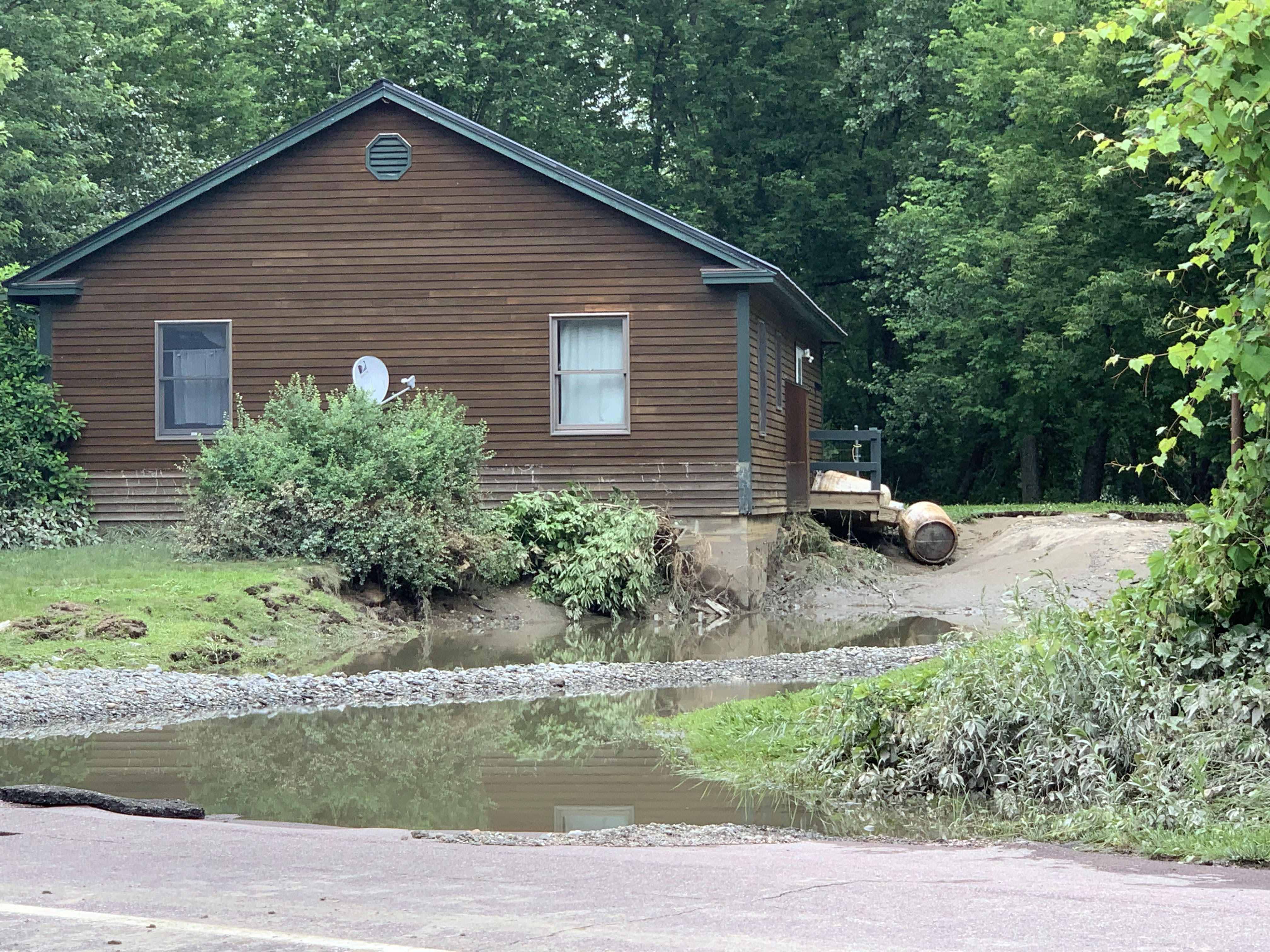
A Cambridge, Vermont home damaged by flooding last
July.  Vermont lawmakers have introduced legislation
to create a "climate superfund" to help with climate
related disasters. The money would come from 
fossil fuel businesses, who would surely sue
if this law is enacted. Lawmakers say they
are confident the bill will withstand court scrutiny.
If Vermont is a supposed refuge of sorts from climate change, why are disasters caused by this phenomenon costing us so much?"  

More importantly what are we going to do about that cost?   

The Vermont Legislature is among those asking those questions. And they have another question: Who should pay? 

Here's what VTDigger reports:

"A slew of state lawmakers - 20 out of 30 senators and 87 out of 150 representatives - are invoking a precept from kindergarten. The person who made the mess should clean it up."

The Vermont legislature is looking at you, fossil fuel industry. 

SUPERFUND

The legislations really isn't that much different from the federal pollution Superfund idea that's been running for decades. Big businesses that create hazardous waste pay for pollution cleanup. 

The climate superfund idea means we now have two companion bills, one in the Vermont House the other in the Senate, that would establish a climate change "superfund." 

Vermont Public explains how this would work:

"Companies that produced more than 1 billion metric tons of carbon dioxide equivalent between 2000 and 2019 would have to pay a share of what climate change has cost Vermont, based on how much the company contributed to global emissions during the same period." 

Environmental groups in the state have been lobbying for this sort of thing and are happy the bills have been introduced. 

There's no doubt climate change is already costing a lot of money. The big flood in July - very likely supercharged by a warming world - will end up costing Vermonters more than $1 billion, notes Vermont Public. 

Vermont Public also reminds us that a 2021 University of Vermont study estimated climate change fuels flooding in just the Lake Champlain basin could end up costing $5 billion by the end of this century.

Never mind flooding elsewhere in the state, larger storms, more wind damage, searing heat and other hazards brought on by a changing climate. 

But how much money should Vermont collect and how do we do the accounting?

The answer in the legislation is somebody will have to do some detailed and accurate accounting of the damage in Vermont due to climate change. The legislation says that somebody is Vermont State Treasurer Mike Pieciak, and the would  have to get that accounting done by 2025. 

Pieciak told Vermont Public he's excited about the task and he thinks he and his staff can gather an accounting of damages in the Green Mountain State due to climate change.  Pieciak says he expects the accounting to be airtight and able to withstand litigation.

It'll have to. 

The legislation might be a great idea, but good luck collecting the money. 

 More from VTDigger: 

"The idea is to target companies that produced fossil fuels between the start of 2000 and the end of 2019 resulting in the emission of at least one billion metric tons of greenhouse gasses. Each of those companies would be held liable for its proportion of the cost of those emissions to the state. The 'cost recovery' payments would go into the 'climate superfund' earmarked for infrastructure projects that help Vermont adapt to climate change."

Awesome! 

But it's not like the fossil fuel industry is going to start enthusiastically writing checks to the State of Vermont.

First of all, VTDigger says Vermont's governor, Phil Scott, isn't sure he's on board with this. The Republican is rather pro-business, so this idea might give him pause.

On the other hand, Scott isn't exactly enthusiastic about relying on taxpayers to fund recovery from climate disasters. He says (reasonably enough) that Vermonter are taxed enough. 

No doubt Scott is aware of this little tidbit from VTDigger: 

 "According to the ominously-named Vermont Atlas of Disaster report, the Green Mountain State ranks fifth in the nation for per-capita spending on climate disasters. And conversations among lawmakers this year make clear that Vermont taxpayers don't have much more to give."

Let's say Scott decides to sign the bill, or he vetoes it but the legislature overrides the veto. Then what?

I guarantee the businesses Vermont targets for payments would sue.  However, at least some Vermont Legislators are cautiously optimistic.

VTDigger again: 

"Rep. Martin LaLonde, D-South Burlington, who is a lawyer himself, said lawmakers 'can't judge, in the end, whether this is going to make it all the way through the court cases." Still, he said lawmakers have worked with the Vermont Attorney General's Office and legislative counsel, 'and we're all confident that we have a very good case to make.'"

Well, maybe in the lower courts. 

But I see this sort of thing making it all the way to the U.S. Supreme Court. The current makeup of that court is probably the most right wing in memory, so they won't go for it.  

Still, I have to give lawmakers credit for trying.  It's time, anyway, to keep pushing for solutions rather than just giving up. Even if the U.S. Supreme Court does prove unsympathetic. 

Meanwhile, U.S. Sen. Bernie Sanders introduced a climate superfund bill at the federal level which would act much like the Vermont idea.   Other states like Maryland, New York and Massachusetts have also introduced climate superfund bills, says Vermont Public. 

Court cases and litigation will surely postpone Vermont's climate superfund and similar plans in other states and on the national level. 

However, I doubt the push to make the fossil fuel industry pay for climate change will go away. It'll be a long slog, like the battle to make the tobacco industry pay for the harm it caused. 

Climate change is obviously an even bigger deal than the health havoc created by cigarettes.