Showing posts with label repairs. Show all posts

Wednesday, February 25, 2026

Blizzard Update: More Snow, Power Outages Linger, Damage Assessments Begin

Satellite views of the Blizzard of '78 and the Blizzard of 
26 look eerily similar. The Blizzard of '78 was
more destructive because it brought storm surges
through four high tide cycles. This week's
blizzard caused coastal flooding through one
high tide. However, snowfall was greater this
time compared to 1978 
It was snowing again this morning in the areas hardest hit earlier this week in the Blizzard of 26. It's not much snow, but it's adding insult to injury as people continue to dig out. 

More than three feet of snow fell in some areas.

The death toll from the storm is still being assessed. Many winter storm deaths come in the days after the snow has stopped falling. 

That's when people have heart attacks shoveling snow, die from carbon monoxide as snow blocks vents and exhaust systems.  There's also car crashes on icy roads and accidents during storm clean ujp. 

So far, six deaths have been reported just on hard-hit Long Island, New York. Five people died on the island from heart attacks as they were shoving the deep snow

A sixth person was  found deceased beneath mounts of snow in Deer Park, Long Island. A worker hired to shovel snow at the complex for residents age 55 of over found the body. The cause of death has not been determined, but police said it's not suspicious. 

In Rhode Island,  a college student was found dead in a running car Monday evening. Snow blocked the tailpipe, which means carbon monoxide backed up into the car. Another person died when he was struck by a truck on the Mass Pike as he  were trying to remove snow from a vehicle.

AccuWeather is estimating $36 billion in damage and economic losses from the storm.That includes damage to homes and businesses, disruptions to commerce and supply chains, problems with shipping operations at majorhubs, financial losses from power outages, travel delays and damage to infrastructure. 

A neighborhood full of people try to dig their street
out of record deep snow in Providence, 
Rhode Island on Tuesday. 

AccuWeather did not tease out how much of the total was in damage and how much was economic losses due to power and transportation disruptions. 

As of noon today, more than 150,000 homes and businesses still had no power in Massachusetts, mostly on or near Cape Cod.  

Power was still out across most of Cape Cod on Tuesday. Six towns on the Cape had virtually no powFew gas stations were open, and those that did had long lines. Things had improved by this morning. Only Wellfleet was completely without power. Service was partly restored to the other towns. 

Utility officials said they hope to have electricity restored to almost everybody on Cape Cod by Friday night. 

Vermont  has sent help in the form of snow clearing equipment. Thirty-two VTrans employees left Vermont this morning to help clear snow in Massachusetts. Video showed a convoy of state dump trucks and bucket loaders an Interstate highway Tuesday morning bound for Massachusetts. 

 We can spare the equipment because only southern Vermont received snow from the blizzard and even that amounted to only a few inches. No large snowstorm are in the Vermont forecast. 

As the snow its cleared, damage to buildings is becoming apparent. 

A high school gym room in Kingston, Massachusetts collapsed under the weight of the snow.  A gas station canopy on Cape Cod was shredded by high winds and heavy snow.  Fallen trees are still blocking some roads in southeastern Massachusetts. 

In New Jersey, a church steeple was left leaning after the blizzard and will have to be torn down. 

Other cities are beginning to emerge as having set all time records for a single snowstorm. New Bedford, Massachusetts received 37 inches of snow, its biggest-ever snowstorm. We have a new front runner for city with the most snow. Fall River, Massachusetts reported a storm total of 41 inches. 

It's late in the winters, so you'd think a thaw would come along and just melt all this snow fairly quickly But nope! 

Temperatures in the blizzard zone will get above freezing this afternoon, tomorrow and Saturday, but not be overly wide margins. A late season Arctic blast will keep temperatures below freezing Sunday and early next week. 

Even worse, a little more snow is in the forecast. An inch or two of new snow fell from New York City to Cape Cod this morning. A little more snow might fall Thursday night and again Sunday. Luckily, these snowfall do not look very big. At least at this point. 

I'm sure a several million people that got hit by this blizzard are seriously pining for spring. 


Friday, July 11, 2025

Latest Vermont Flood: Details Emerge As Questions Grow About FEMA

Map of rainfall yesterday in Vermont, from data 
collected by the National Weather Service in 
South Burlington. Heavy rains were confined
to parts of the Northeast Kingdom, and a 
couple spotty areas in central Vermont. 
For the third year in a row, some Vermonters are picking up the pieces today after yet another flash flood. 

The tiny town of Northeast Kingdom town of Sutton, population of less than 1,000, appears to be the hardest hit. The good news is that so far, I haven't heard of any serious injuries with this latest flood. 

But the damage was also scattered around the state. A large section of the Middlebury Union High School roof was torn off by intense thunderstorm winds on Thursday. The roof damage allowed some of torrential rains with the storm pour into the boy's locker room, cafeteria and auditorium. 

Officials at the school said the interior damage was thankfully not severe. 

Flood damage was still being tallied in West Burke, East Haven and other Northeast Kingdom towns, along with some spots in Addison County.  But Sutton took the brunt of it. Video from Live Storms Media showed water racing across a road near Sutton, forming a waterfall on one side where the road had washed away. 

 Vermont Public reports that the swift water rescue in Sutton involved a couple and their dog, who were pulled off their roof by the rescue group during the flood. 

Rainfall was highly variable and highly localized. Only a few places received torrents of rain. Many  Vermont towns received little or no rain yesterday. 

The disparity was evident even within the counties hit hardest. West Burke in Caledonia County reported 5.12 inches of rain. But in the opposite end of the county, Wells River and Barton saw only 0.04 inches.  

This is a map of rainfall in the July, 2023 flood. As you
can see here, that one affected pretty much the whole
state, not just a few areas. Pink and purple areas had
at least five inches of rain. Compared to yesterday,
July 23 was many times worse. 
Slow moving thunderstorms parking over certain towns were to blame. Disconcertingly, that same issue of stalled downpours has arisen today. But the storms are very few and far between, and smaller in size than yesterday's.   

If any new flash flooding develops late this afternoon or this evening, it will be highly isolated. However, we're still looking at low but not zero chances of isolated flash flooding Saturday, Sunday and Monday. 

That the chances of new flooding are - fingers crossed - low is good news, as some towns already have a ton of damage. 

Further details from Vermont Public:

"Roughly 20 homes in the Caledonia County town remained cut off from road access as of Friday morning, according to the town fire chief. Town officials said they've made contact with most of these homeowners, but expect it will take several days to make these roads passable.

The storm overwhelmed many of Sutton's roads, culverts and ditches and damaged several homes along Calendar Brook Road. 

According to initial estimates, repairs to the town infrastructure could cost upward of a million dollars - after Sutton has already spent millions on recovery from previous floods."

I don't think anybody knows where Sutton - and other affected towns in the Northeast Kingdom will get the money to fix damage from the latest calamity. 

This is especially true with the Federal Emergency Management Agency's future in doubt. 

FEMA AND VERMONT

We won't know for awhile yet whether the damage in Vermont would qualify for federal assistance even under the "old rules" for federal assistance that were in effect before Donald Trump took office in January. 

Even if Vermont qualifies for help under those old rules, who knows whether we'll receive it? Everything Trumpian is subject to his whims, and information and plans shift like the breeze.

Trump has said he wants to abolish FEMA. Or change it. Or shift all the responsibility to the states. 

Today, as Trump headed to Texas to survey damage from a deadly Fourth of July flood that was many, many orders of magnitude worse than what Vermont saw, his administration's previous vows to abolish FEMA are wavering. 

Per today's Washington Post:

"A senior White House official told the Washington Post that no official action is being taken to wind down FEMA, and that changes in the agency will probably amount to a 'rebranding' that will emphasize state leaders' roles in disaster response."

In other words, nobody has a clue what will happen. 

Which is the question everybody including Vermonters who would deal with disasters are asking. .  

Per Vermont Public: 

"State and national experts say only one thing is clear as of now: The new federal administration wants states to assume a bigger role in disaster response and recovery. The ambiguity over what that looks like, according to Eric Forand, director of Vermont Emergency Management, has complicated the business of disaster preparedness for state officials trying to gird for the next catastrophe."

Given Vermont's track record, this is really an important question.

Vermont Public had an eye-opening stat: 

"Vermont, which has experienced 25 federal disaster declarations since 2011, has been particularly reliant on federal aid. According to a recent analysis, the state has received more federal disaster assistance per capita over the past 14 years than any states but Louisiana, Hawaii, and New York."

There's no reason to think that trend will stop. Vermont is a flood-prone state. Climate change will continue to intensify storms, so more big floods are inevitable. We've already had two damaging flash floods this year, and we're only now getting into the peak of what you might call peak flash flood season.

Those humid July and August dog days can really produce those downpours. More so with climate change. 

 The theoretical solution for this entire mess is for the state, and disaster-prone towns to build up a rainy day fun to deal with inevitable future disasters. 

Good luck with that. The floods of 2023 and 2024 cost several individual towns more money than their entire annual budget. I'm pretty sure local taxpayers can't hand over twice the amount or more they've been paying already. 

We're lucky yesterday wasn't as bad as it could have been.

But still, we're screwed. 


Monday, June 16, 2025

Burlington National Service Radar Won't Be Working Much Of This Week

 A head's up:

A National Weather Service radar image, I used this 
one from Fargo, North Dakota because there were
no rainstorms to show on the NWS local radar,
The NWS radar from the Burlington office will
be down most of this week for repairs, 
If you're used to checking out the National Weather Service Burlington web page, note the weather radar won't be up and running  most of this week. 

So during this time, you won't be able to see the location and direction of any rain or storms that develop in the area.  

You'll have to find alternative weather radar images during that time.  

The National Weather Service radar is down because they need to repair the radar dome in Colchester. The radar that services Albany, New York will also be turned off for repairs. 

The radar installations look like giant white balls atop a tower.

 Strong winds and temperature extremes over time damage some of the panels on these radar structures, so the panels have to be be replaced.  Those pieces can crack, or develop leaks, or even fall apart.

Damaged panels interfere with radar's ability to receive and transmit information, according to the National Weather Service. 

So the repairs are needed. The radar serving northern and central Vermont and northeastern New York will be down starting today. It should be up and running again sometime Thursday. 

While the repairs are  happening, showers and thunderstorms are forecast Tuesday, Wednesday and Thursday around the area.

A few of the showers and storms could have fairly heavy rain Wednesday. Depending on cloud cover and other factors, we could have a few strong storms and spots of torrential rain Thursday as well. 

Given that,  let's find those alternative ways to find weather radar to keep an eye on any storms that may or may not be headed your way while the National Weather Service fixes their radar. 

Television station WPTZ's radar is quite interactive, which is nice. If you click the "layers" button on the lower right, you have options of seeing what current temperatures, dew point and wind speeds are like, along with  rainfall amounts in the past 24 hours and other information. 

The radar for television station WCAX-TV is set up in a very similar fashion to WPTZ and is just as good. 

The WVNY radar doesn't seem quite as interactive, but does cover a wide area, which is good. 

Of course the big dawgs like The Weather Channel and AccuWeather have weather radar you can use, too. 

All of these radar options are good, but I'll be happy to get the National Weather Service radar back. Only because that's the one I'm used to, I guess.

I wouldn't really recommend downloading a weather app onto your phone, as some of them seem a little dubious to me.  

Sunday, December 8, 2024

More Examples Of How People Need To Keep Reacting, Recovery From Climate Disasters Long After The Event

Hardwick Vermont got nearly $4 million in FEMA
money to shore up the town after two devastating floods.
Three recent new series stories here in Vermont show how the work after a climate disaster continues long after the initial crisis.  

The Town of Hardwick just got a boatload of money to shore up the town after flood damage nearly a year and a half ago. Per VTDigger:

The U.S. Federal Emergency Management Agency has awarded more than $3.9 million to the town of Hardwick for July, 2023-related flood repairs and mitigation, the most of any municipality in the state. 

A $2.7 million chunk goes to fixing a retaining wall along Main Street in Hardwick that's adjacent to the Lamoille River. Town Manager David Upson said the retaining wall needs to be repaired and fast, or "The whole street could be washed down the river," he said. 

Another chunk of the money is going toward a Hardwick bridge that was hit twice. Flooding destroyed the bridge in July, 2023. It was rebuilt, only to be destroyed again a year later. The FEMA money is going toward engineering and architectural work to come up with a permanent, flood-resilient bridge. 

All this goes to show how expensive it is to recover from a climate-related disaster.  I'm not arguing the Hardwick money wasn't necessary. It clearly was. But $4 million for just one small Vermont town. Multiple that by the hundreds of more likely thousands of towns and cities across the United States that need help recovering from these events. 

RAISING THE HOUSE

Repeated climate disaster floods are changing what Vermont's traditional towns and villages look like, even if the changes involve structures not totally destroyed by the flooding. 

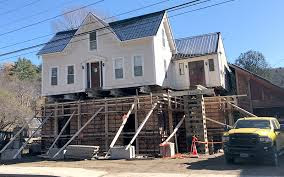
The result, at least in the Mad River Valley, is a historic old house that now frankly looks weird, but because of the repeated flooding, the owners really had no choice. 

This 19th century house in Moretown, Vermont
is being raised to keep it above future flood levels.
The home has been flooded several times in recent
years by the nearby Mad River. Photo from the
Valley Reporter. 

Per WCAX:

"Howland Brown, who along with Beki Auclair, lives on a section of the river in Moretown. Their home, which dates back to 1834, took on five feet of water during Tropical Storm Irene. History repeated itself with back-to-back devastating flood this year and last.

They considered moving. 'Then we'd be passing the problem over to the next owner. Even if they were aware going in, we just couldn't square that,' Brown said."

The house was raised up on hydraulic jacks, so now it sits atop a tall concrete structure that is designed to allow water to pass through it. 

As WCAX points out, we're seeing more and more of this type of construction, or  home buyouts in which the federal government buys homes in flood prone areas, demolishes them and leaves the land undeveloped as part of a flood plain. 

Frankly, the house does look a little odd now, a traditional, antique 19th century hope perched atop a monolith of modern concrete. Once the work is done, the house will be lowered on its foundation, so it will be two and a half feet lower than it is now 

But it's necessary, as we have to adapt any way we can to our changing, stormier, warmer climate. The face of the state's communities is slowly changing because of it.  

The concrete area will have room to park two cars and for storage of nonessential items. According to the Valley Reporter, the couple is paying for the work themselves. It will also mean the house will be high enough so that they won't be required to purchase flood insurance. 

SAVING THE SKI AREA

The Bolton Access Road just after the flood in July, 2024
This road to the Bolton Valley Ski Area has just been
fully restored saving the season for the resort. 
Last July, flooding wiped out large sections of the Bolton Access Road, a steep, winding mountain road connecting Route 2 in Bolton on the valley floor to the Bolton Valley Ski Area way up above that valley. 

Temporary repairs shortly after the flood created a narrow, one lane gravel road that at least connected the resort and homes along Bolton Access Road to civilization.

WPTZ now tells us that the Bolton Access Road is now completely restored, with spanking new culverts and pavement and such. That will save the season for the Bolton ski resort. 

No word on how expensive it was to fix this road, but it had to cost a pretty penny.  Let's hope it holds, as the steep mountain road is prone to damage from flash floods, which seem to be increasing in Vermont. The road was severely damaged in a 1990 flood, and has frequently suffered comparatively minor damage in several other downpours in recent years. 

Parts of Route 100 were also damaged in the July flood, and the sections that were trashed provide access to Sugarbush Resort and Mad River Glen. Repairs are complete on those roads, so people shouldn't have trouble accessing those areas for a day on the slopes.