Showing posts with label skies. Show all posts

Monday, March 2, 2026

If Skies Stay Clear, A REALLY Cool Lunar Eclipse Early Tomorrow Morning

Get up early tomorrow morning to view the total lunar
eclipse. The moon will look red like in this photo.
It'll also be near the western horizon as the sun is 
coming up during totality. 
A lunar eclipse is going to be visible across the United States early tomorrow morning, but the eastern United States, including here in Vermont are in for a special treat. 

The lunar eclipse will happen right around sunrise. As the sun is coming up in the east, the moon will be a deep red color because of the eclipse just before it sinks below the western horizon. 

To time it out here in Vermont, the total eclipse of the moon will start at 6:04 a.m and end at 7:02 a.m. But you won't see the end of it because the moon will be below the horizon by then. 

Here's the fun part: The maximum of the eclipse is at 6:25 a.m, when the moon will be at its reddest color. Meanwhile, the sun will rise at 6:26 a.m. Burlington time. And depending on where you are in Vermont, the moon will set in the west sometime between 6:18 and 6:28 a.m 

During totality, the moon will look red like it does in most total lunar eclipses. However, the moon will be near the horizon, so you'll have that perspective. I imagine views from the Champlain Valley toward the Adirondacks while this is going on will be awesome. This is cooler than the "typical" lunar eclipse. 

The moon obviously doesn't have its own light. We see the moon shining brightly because the sun's light is blasting it. During a lunar eclipse, the Earth gets between the sun and moon, casting its shadow on the moon. 

The moon looks red during a total eclipse because the Earth's atmosphere bends sunlight and indirectly lights up the moon's surface. 

A total lunar eclipse will happen at any given location on average once every 2.5 years

After tomorrow, the next total lunar eclipse that will be visible from Vermont will be on June 25, 2029.

Of course, you can't see a lunar eclipse if it's cloudy. Too bad the eclipse wasn't this morning since it was crystal clear. Of course, temperatures were below zero, so you would have frozen your butt off watching it. 

As it looks now, some high clouds will be coming into Vermont at the time of the eclipse. That might not be such a bad thing. During the much more rare total eclipse of the sun in April, 2024, there were some high clouds overhead but those clouds actually enhanced the event, making it all the more fantastic.   

The high clouds might make the eclipse even more interesting than it otherwise would be. High, thin clouds tend to glow red, orange and pink at sunrise.  This could get really interesting.

The bottom line is depending on where you are in Vermont at dawn tomorrow, the eclipse might look at little milky behind the high clouds, and in other areas the high clouds will be so unsubstantial it won't interfere with the viewing at all. 

It will be cold again, however. Temperatures at that hour should be in the single numbers to low teens. Pretty chilly, but not as bad as this morning  

Wednesday, November 12, 2025

Huge Northern Lights Display Delights Much Of Nation; Vermont Gets Glimpses Between The Clouds

Photo of Northern Lights peeking
through the clouds over 
Shelburne, Vermont posted to
Facebook by Amanda Delude
A big display of northern lights lit up the skies across much of the U.S. last night as a big geomagnetic storm targeted Earth. 

Tonight might bring another big display. 

The northern lights were seen as far south as Florida, where residents must have felt like they were transported to the Arctic, where northern lights are very common. 

Florida was also experiencing record cold temperatures early this week, too. 

Social media was filled with color images of the sky over locations from Minnesota to Colorado to Texas to Alabama. 

Here in Vermont, our usual overcast skies prevented much of a northern lights view in many areas  But the aurora was so spectacular you could sort of see it through the clouds. The overcast north of my St. Albans, house definitely had a green cast. 

Near Lake Champlain and in parts of southern Vermont, there were breaks in the clouds that offered glimpses of the show.  Facebook had some great photos out of Weathersfield and Royalton, for example. 

Photographer Adam Silverman, probably the most enthusiastic and best northern lights photographer in Vermont, captured some great images from Malletts Bay, along Lake Champlain in Colchester. 

There were only a few breaks in the clouds, but that was enough. He captured some spectacular shots, like the one he posted on Facebook, that you can see in this link. 

Silverman, ever the fan of nature and skies, wrote: "The sky absolutely burned and glowed with amazing aurora colors, clearly visible to the naked eye. Even the clouds let through enough light to take on surreal hues as they zipped overhead in the stiff, cold breeze."

If you missed any of it last night, people across the northern hemisphere, even at points well south, have another shot at a spectacular show tonight. 

Vermont State Police posted this photo of the northern
lights to Facebook from their Westminster, Vermont barracks. 

 Reports NBC:

"...forecasters at the Space Weather Prediction Center have said the geomagnetic storm could intensity as the 'final and most energetic CME' meaning coronal mass ejection, is yet to arrive and could reach Earth on Wednesday afternoon.

A CME is an eruption of massive clouds of protons, electrons, and magnetic fields from the Sun's outer atmosphere at very high speeds."

Here in Vermont, unfortunately, it's another very cloudy forecast for tonight. The National Weather Service in Burlington predicts about a 96 percent cloud cover for most of the night, which is about as overcast as you can get. The cloud cover declines to 88 percent after midnight, which is still pretty bleak.

Unlike last night, when we had a break in the snowfall, it will very likely be snowing at least lightly overnight across most of northern Vermont.  

Note that the valleys of southern Vermont might have a few more breaks in the clouds than in the north.   

Sunday, October 12, 2025

Weird, Cool Clouds At Edge Of Nor'easter Over Vermont

Puffs of clouds with little streaks beneath them over
northwest Vermont today. Those wisps were
actually rain strangely coming from the tiny 
clouds, but evaporating well before 
hitting the ground. 
People (correctly) tell me I have my head in the clouds. 

And it's true I'm always staring up into the sky. Which makes me notice things. 

My sky gazing today gave me a couple of rewards: The tiniest little showers I've seen in ages, and quite a contrast between clear and cloudy.

The first photo in this post show the sky looking north from Colchester, Vermont. They're just a patch of bumpy mid-level clouds. 

But notice those wisps beneath many of them. That's rain falling from them. It shows that even the tiniest clouds can form rain under the right conditions 

The rain never came close to reaching the ground. The raindrops evaporated in the very dry air overhead. The relative humidity was only about 35 percent at the time, so that's really dry air. 

Sharp line between clear skies and overcast looking
southwest from Colchester, Vermont this afternoon. 
The second photo is looking southwest from the same spot in Colchester at about the same time as our tiny little rain showers were hovering off to the north. 

It's a remarkably sharp cutoff between mostly clear skies and overcast. 

It was part of the northern edge of a huge cloud shield associated with the big nor'easter hitting the East Coast today. 

I'm guessing the clouds, running into the dry air over northern New York and Vermont, was having an effect on these clouds

Satellite photos show that this sharp band between clear and cloudy extended from northwest Vermont clear across far northern New York. 

That sharp cut off of clear skies and overcast is 
visible on satellite photos across northern 
New York and a piece of northwest Vermont
If you click on the image to make it bigger,
you can see the shadow the clouds cast on
areas near Burlington. 
In the satellite photo, also in this post, if you look closely, you can see the shadow cast by the cloud shield as well. 

The sun was fairly low in the sky when the phot was taken around 3:30 p.m this afternoon.

The satellite photo also shows a southwest to northeast band of feathery clouds across Vermont. That is part of the upper level outflow of moisture from the big storm. 

You can also see in the satellite photo thicker clouds off to the south. 

Those will be in Vermont tomorrow, though far northern Vermont is still not likely to see much rain. 

Southern Vermont is still up for a half inch to an inch of rain, which will be nice for a bit of drought relief. 

The gray overcast we expect on Monday won't make the sky as interesting as it was today, though.  

Tuesday, April 8, 2025

One Year Anniversary Of Great Vermont Eclipse Of 2024: Still Basking In The Afterglow

The view from my St. Albans, Vermont house during
the total eclipse of the sun, April 8, 2024,
 Today is the first anniversary of the Great American Eclipse of 2024.

I'm still in awe of what I saw, as lucky for me, the center of totality passed right over my St. Albans, Vermont home.

 My husband Jeff and I parked ourselves in chairs on our back deck, with a perfect view to the southwest, where the sun was that day. 

Vermont got really lucky on April 8, 2024.   The weather is seldom nice in the Green Mountain State this time of year.  

I mean, look at today. There's lots of clouds, it's colder than hell, and snow showers keep dusting the early spring landscape. 

There had been an 80 percent chance that that eclipse day would be overcast, based on past weather records. 

Instead, the weather was absolutely, improbably perfect on April 8, 2024. The day featured mild weather as temperatures reached the upper 50s to mid 60s. There were quite a few high, thin clouds in the sky, but that actually enhanced the experience. You could still clearly see the actual eclipse, as the moon blocked the sun and you could just see the outer edges of the sun during totality. 

Those high clouds created a beautiful sunset effect during the eclipse, with the horizon lighting up in beautiful yellow, orange and blue tones. 

The whole thing was thrilling. I laughed out loud with joy as I heard a crowd in downtown St. Albans, a mile away, let out a loud cheer when totality hit. Then I sat and watched the sky, slack-jawed, during totality. I didn't want it to end. 

And as if to end the day with a flourish, hours later, we were treated to a spectacular, post-eclipse sunset. 

Barely a month later, Vermont and much of the rest of the nation experienced one of the most spectacular northern lights displays in memory. Once again, Vermont skies were mostly clear, and we got to enjoy it.

It's been back to reality with more recent celestial events. There was a total lunar eclipse early in the morning of March 14. Skies were clear for that, but it peaked at like 2 a.m. I admire anyone who stayed up for that, but I was unfortunately too lazy. I slept through it. A bad hour for this decrepit old man. 

There was a partial eclipse of the sun on the morning of March 29.  Not nearly as wild as last year's total eclipse. But it would have been fun to dig out the solar glasses from last year and take a peek as the moon took a bite out of the early morning sun.

But alas, northern Vermont was experiencing a snowstorm that morning. So much for that. 

Other than that, we have our usual meteor shower and super moons to look forward to in the rest of 2025, but not much else.

But that's OK. The sky is always interesting, even when supposedly nothing special is going on. 

Sometimes, on a clear night, it's fun to just go outside after dark on, day a mild June night. The fireflies at the edge of the woods will compete with the tapestry of twinkling stars in the sky. 

Or there's meteorological displays.  On a muggy night in July, I might sit in our outdoor tub on the deck, glass of wine in hand, Patsy Cline singing in the background as heat lightning lazily flashes in the sky from thunderstorms somewhere over Quebec. 

The year 2025 will end with three "super moons" starting in October. That's when the moon is closer to Earth than it usually is, so the full moon looks even bigger and brighter than usual. It'll be worth grabbing a jacket or coat on those nights if it's clear to enjoy the moon glow, maybe do a little moon dance, I don't know. 

 Maybe the December 4 super moon rise over a snow covered landscape, turning night into day as the moon glow reflects off the snow. 

I'll probably never see another total eclipse of the sun, but I've got the memory. I can look forward to our always fascinating sky and weather to keep me looking up to the heavens in search of both peace and joy.  

Monday, June 10, 2024

Another Picturesque Thunderstorm Day In Vermont, With A Cold Air Funnel For Added Fun

Dramatic thunderstorm clouds near Sheldon,
Vermont late Sunday afternoon
 After a gloomy start to our Sunday in Vermont with steady rains and a bleak overcast, the sky turned interesting once again over the Green Mountain State.  

That's one of the things I love about summer. The sky is almost always more fun to look at than in the winter.

The pattern was the same as it's been since about Friday. Upper level low pressure was parked nearby. That's a pool of chilly air aloft. 

If you get that weather pattern in the winter, all you usually end up with is a flat overcast and snow showers. 

In June,  you have the sun at peak strength. The surface warms quickly as soon as the sun comes out. The air cools quickly with height with the upper level low around. The updrafts inspired by the sun condense into those big billowing clouds that: A. Are often very pretty and dramatic B. Create showers and thunderstorms (I always like hearing thunder for some reason)  C. Offer cool surprises.  

So it was Sunday, with black clouds gushing downpours and pea sized hail right next to bright sunshine and deep blue skies over emerald green Vermont forests.  It was one of those days that were simultaneously inclement and gorgeous, and even exciting, at least for a few moments. 

THE COOL SURPRISE 

One thunderstorm that passed through St. Albans, Vermont Sunday afternoon had a literal strange twist. The storm fell well short of severe limits. If featured a few flashes of lightning, rumbles of thunder, a torrential but rather brief downpour and outflow wind gusts I'd estimate at a very tame 25 mph. 

An apparent "cold air funnel" forming over St.
Albans, Vermont Sunday afternoon. 
As the storm began to depart, I saw a small but noticeable rotation overhead. It was nearly directly over the house when I first saw it, and it moved on to the northeast, in tandem with the parent storm. 

A section of clouds were clearly spinning, and there was a sort of bulbous-shaped funnel type thing associated with it.  

I was witnessing what was likely  a cold air funnel. WPTZ Meteorologist Matt DiLoreto took a look at a video I shot of this, and concluded I was probably watching a cold air funnel. 

What I saw was not a wannabe tornado or anything dangerous.  A "real" tornado involves a supercell thunderstorm within a soup of very warm, very humid air.  

The supercell usually spits out damaging winds and hail and very often develops a large scale rotation that can easily be detected on radar. This spin can sometimes translate into a dangerous tornado. 

As you noticed, Sunday was not especially warm or humid. 

Cold air funnels can form in showers and weak thunderstorms when the air aloft is much colder than normal.  That was certainly the case Sunday, as an upper low - that pool of chilly upper altitude air - was centered nearby. 

These spins in the clouds or funnels happen with a steep lapse rate, meaning temperatures cool with height at a greater rate than usual.  The spin associated with cold air funnels is pretty weak and small, and weather radar usually doesn't detect it. Cold air funnels almost never touch down and are not dangerous. Just kinda fun to watch. So I had a nice treat Sunday afternoon. 

MORE RAINS

The storms were able to squeeze out more locally heavy rain, so some areas are pretty soaked from the showers and storms that started Thursday. Between Friday and Saturday, I collected another inch of rain, making the total here in St. Albans since Thursday evening an impressive 3.8 inches. 

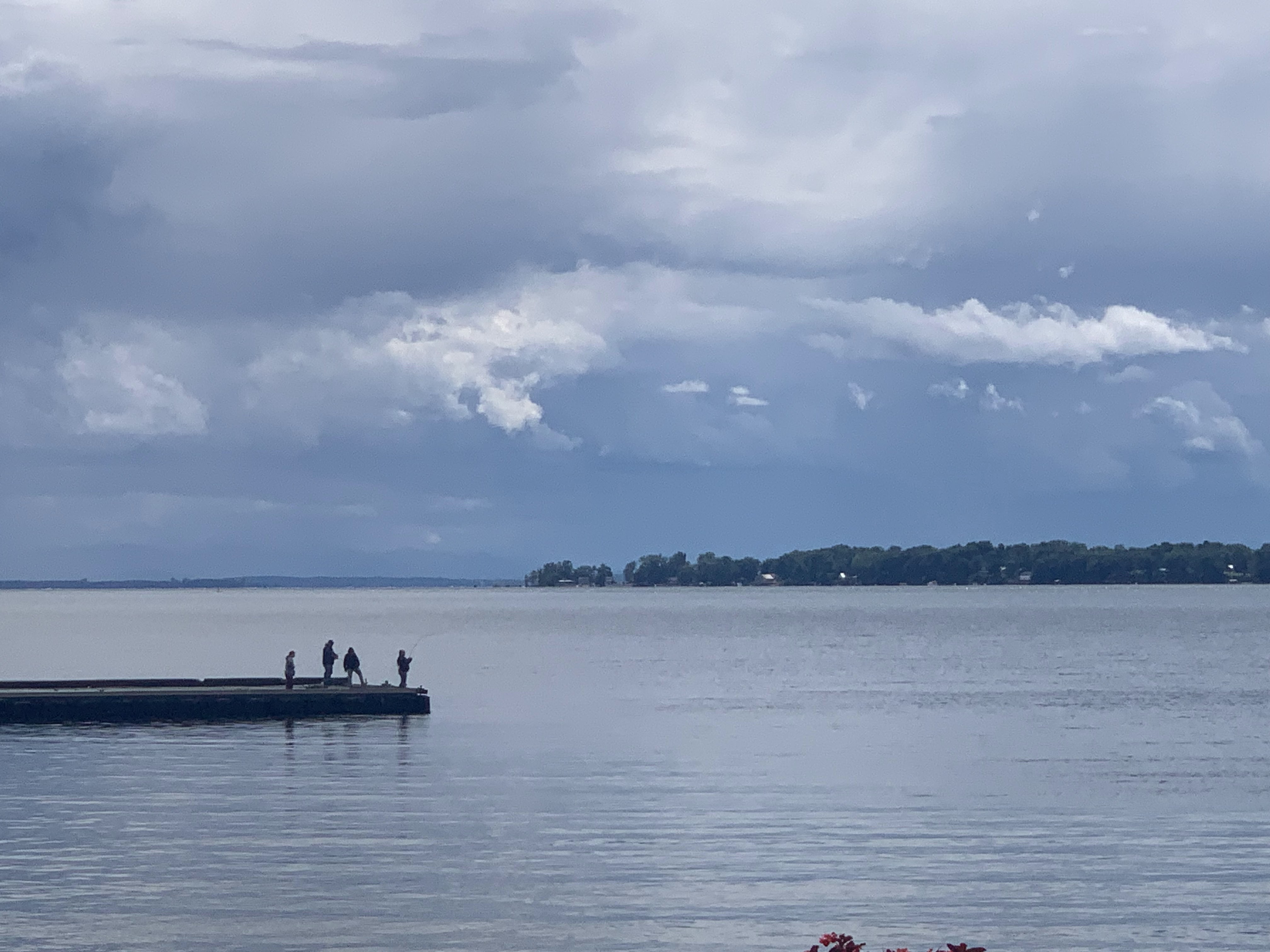
Storm clouds loom over fishing enthusiasts at St. 
Albans Bay, Vermont Sunday afternoon.

I think a few areas a short distance to my north and east have had four or five inches. I noticed some very minor flash flooding around Sheldon Sunday just after an especially intense downpour had passed.

We're near the end of the rainy regime as that pesky upper level low begins to depart. We had quite a few showers around northern Vermont this morning. It was raining at a pretty good clip at around 6:45 am here in St. Albans.

I think those showers will be fewer and further between by this afternoon so you'll be able to get more done outside. 

From there, we have a brighter week with a noticeable warming trend in store. Tuesday will be in the 70s, Wednesday will get close to 80 and by Thursday it should be in the 80s with higher humidity. 

Another cold front appears to be due Friday, so we'll need to watch that for showers and storms.  It might turn briefly cooler, but not chilly by next weekend. 

Long range forecasts, though, suggest any comfortable weather next Saturday or Sunday will be fleeting. If these forecasts are correct, (and that's a big if as forecasts beyond a few days can change dramatically) we could be seeing some awful heat and humidity in a little more than a week from now,

If that happens, I don't know how long it would last or how bad it'll get. But take advantage of the cool weather now to do anything outdoors that would work up a sweat.  

Friday, August 12, 2022

Time To Declare Peak Summer Over

About this time every year, I get the sense that the Vermont summer's days are numbered.
A pretty sky over Williston, Vermont after low clouds finally
cleared Wednesday. For some reason, I associate this kind
of sky more with early autumn, not summer. 

I've gotten that sense over the past couple of days. I declare high summer over. 


Don't worry, summer-like weather is not gone until next year.  We'll still have our share of warm, humid days. There might even be another spell or two of 90 degree weather thrown in there between now and the middle of September. Plenty of pleasant days await us between now and winter. 

But it's time to put a fork in summer.  It's now what us Vermonters call "Fair Weather. 

Most people think of fair weather as blue skies dotted with puffy clouds and pleasant temperatures. And that's a top characteristic of Vermont's "Fair Weather." season

In the Green Mountain State, and I'm sure in other places, fair weather corresponds to the time of year in late summer and early autumn when all the county fairs roll into town.  It's the bridge season between summer and autumn.

Fair weather is characterized as conditions that don't exactly feel like mid-summer, but it's still warm.  Too warm to regard temperatures as "autumnal." It's something in between.  On the Midway at the fair, you're down to a t-shirt and sweating a little in the afternoon, but you'll need a sweater or fleece for the nighttime grandstand show. 

Being a person who focuses on all the subtle change of seasons,  I'm seeing all the signs  that high summer has ended.  

I noticed it on Tuesday, and especially Wednesday, when the now waning summer sun was not strong enough to overcome an inversion that put us under some relatively cool low clouds and fog.

When the low clouds finally cleared Wednesday afternoon, the sky had that late summer/early autumn character of broken clouds, but not the billowy, towering kind you see in mid summer. 
Showers bubble up in the distance Thursday as viewed from 
Georgia, Vermont.  Storm clouds in late summer to me often
don't look as vigorous as they do in mid summer, and
these clouds are an example of that. 


A couple of lines of showers and thunderstorms passed through Vermont Thursday, but they lacked the oomph you see with these things in say, July.  

Mid-summer cold fronts are lame things; you don't even notice when they pass through. Last evening's cold front brought a quick gusty, chilly shower, followed by cool north breezes. The air obviously changed.  Felt like a September cold front to  me. 

During the height of summer, temperatures usually hit at least 80 degrees in the afternoon. Such warmth begins to become less likely after mid-Auguts.

 According to the latest forecasts, we probably won't see 80 degree readings again for at least a week. 

I've often seen it cool off in the middle of August in Vermont only to return at least briefly to mid-summer heat toward the end of the month or around Labor Day.

Chances are that will happen again this year. Especially since the climate is warmer than it was decades ago. 

I remember at least one August (1982) when it snowed on the ski slopes of Killington. I've also seen frost in August (1965 and 1976) That kind of thing is not going to happen this year! 

So, don't put those air conditioners away just yet. Keep those swim suits and that sun screen handy. The peak of summer is over, but that doesn't mean summer weather is that far way. At least for now. 

Sunday, July 3, 2022

Be On The Lookout For Rare Noctilucent Clouds.

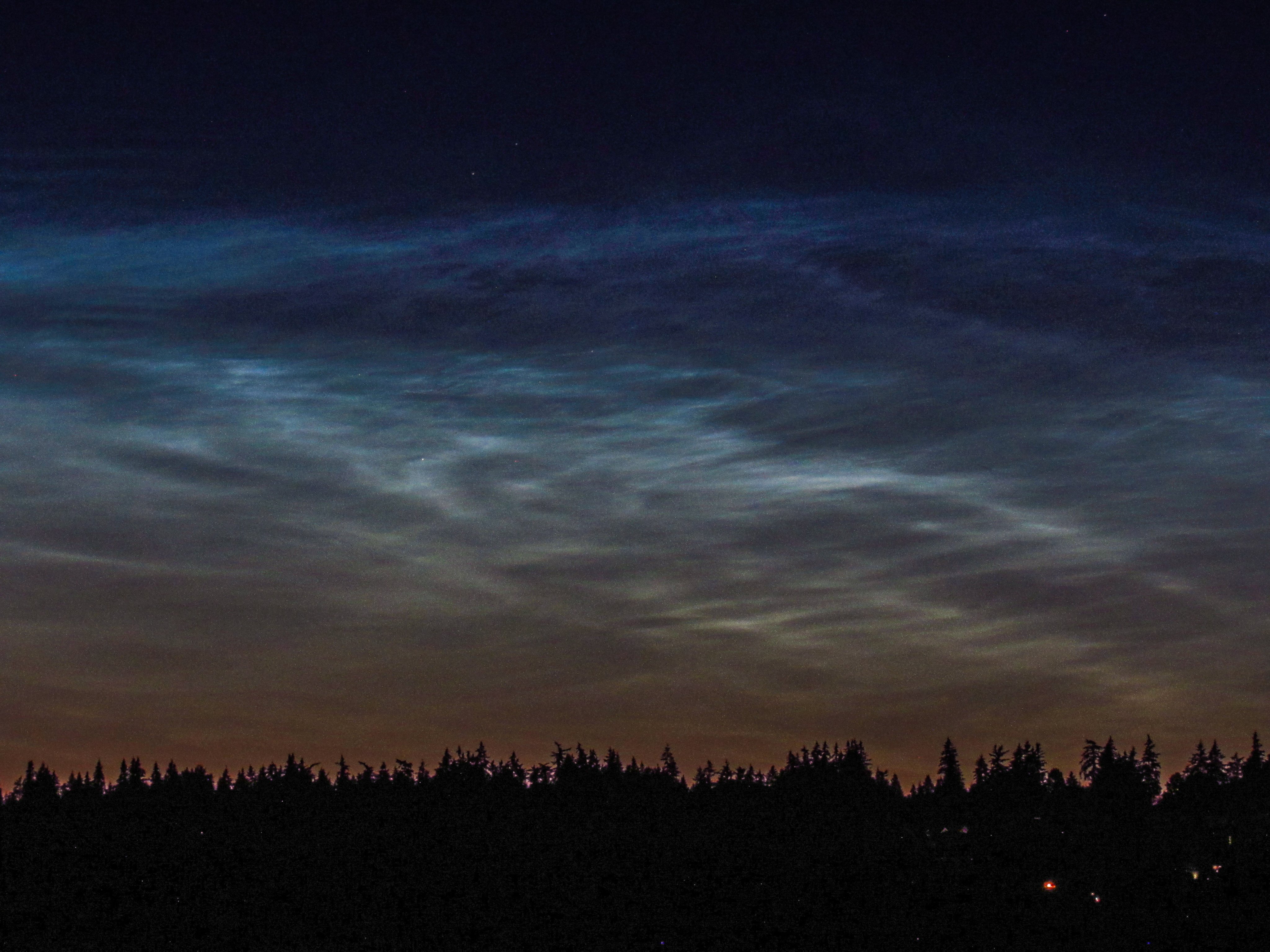
Meteorologists at the National Weather Service office
in Seattle, Washington took this photo of beautiful,
eerie and rare noctilucent clouds last week
 If skies are clear enough for the next few nights, take a look toward the north after dark. 

There's been an outbreak of rare noctilucent clouds, an eerie, beautiful blue glowing wispy cloud that is as high in the atmosphere as you can get. 

They're most likely to be seen near the poles in the summer. In early summer, they're sometimes visible in places like northwestern England, Canada, Alaska, that sort of thing.  Sometimes people in the northern United States get to see them. This year, they've been the most pronounced in decades.

Here's how the Washington Post explains these clouds:

"Noctilucent clouds, also known as polar mesopheric clouds, appear during the summertime in each hemisphere at about 50 miles high in the layer of the atmosphere knows as the mesosphere. They form when water vapor congregates around specks of meteor dust floating in the mesosphere and freezes, forming ice crystals."

They're usually visible not long after sunset and before sunrise. The clouds are so high up they are illuminated by the sun that has, at ground level slipped below the horizon. It looks like it might be clear enough tonight to go out and take a look toward the north,  just in case these clouds appear.

The Washington Post said there's a clear reason why this has been such a good year for noctilucent clouds. The mesosphere is an incredibly cold, dry place. There's little moisture up there to work with. But for some reason, at least by the standards of the mesosphere, it's wet up there. 

Another shot of the noctilucent clouds over Washington
State last week taken by NWS personnel.

Nobody is sure why. Perhaps it's rocket launches. There were 16 launches in June. It could have been the It could have been the huge Hunga Tonga volcano eruption back on January 15, which put a remarkable amount of stuff high in the atmosphere. The eruption could have dragged some moisture from the Earth's surface way up to the mesosphere.  It's so high up that I doubt climate change has anything to do with the increase in these clouds. 

Sky watchers are certainly excited about these clouds now.  Last week, the National Weather Service office in Seattle, Washington urgently tweeted that anyone who was awake at that late hour should head outdoors to see what they regarded as the best display of noctilucent clouds in decades. 

They had the photos to prove it, too. Other spectacular sightings of these clouds have been reported this past week over places like British Columbia, Denmark and Great Britain.

This won't last long.  As the days slowly start to get shorter, the chances of seeing these beautiful clouds begins to diminish. 

Friday, October 22, 2021

Relatively Rare (Possibly!) Asperatus Clouds Create Weird Vermont Skies

Before sunset, the odd clouds overhead in St. Albans, Vermont
on Tuesday consisted mostly of bluish and gray waves.
On Tuesday, an overcast, sprinkly, somewhat chilly day here in St. Albans, Vermont, the sky definitely got weird.  

What appears to be a fairly rare cloud called undulatus asperatus graced the skies. This type of overcast looks sort of like what a choppy sea must resemble if viewed from just under the water's surface.

This cloud was only recognized as its own category of cloud by the World Meteorological Organization back in 2017.  

The headline on the linked article is titled "Earth's Newest Cloud Is Terrifying," but not really.

In some cases, asperatus clouds do look threatening.  The ones over St. Albans on Tuesday were just weird.  You are not in danger if any of these clouds happen to be overhead. 

I'm not entirely sure these were true asperatus clouds over St. Albans.  They usually form near convective showers and thunderstorms.  While there were some weak showers in the area, there weren't any robust storms nearby. So they might just be cool clouds. 

I'll leave readers and the experts to judge.

Keep scrolling for more photos of the clouds, and at the bottom of the photos is a quick YouTube video I put together of the phenomenon.  You'll need to click on this link to view the video on mobile devices.

The setting sun began to add color to the strange skies. 

Between the odd clouds and the setting sun lighting up
trees in a strange orange hue, it suddenly felt like
St. Albans, Vermont was on some other planet. 

Sunset and odd clouds on Oct. 19 over St. Albans, Vermont.

Here's the video: Click on the arrow, and then the YouTube logo to view in fuller size: