Showing posts with label Australia. Show all posts

Friday, August 8, 2025

A Story To Cool You Off: Rare Australian Snow

A kangaroo bounces through the recent unusual
snow in Australia. 
 Its winter Down Under, which usually isn't the kind of cold, snowy hell or heaven (depending on your perspective) we go through here in New England.

But the relative warmth of an Australian winter was shattered earlier this week by a bunch of snow. Some areas received the biggest accumulations in decades. 

As The Independent tells us:

"A cold air front dropped as much as (16 inches) of snow on parts of northern New South Wales on Saturday the most since the mid-1980s, said Miriam Bradbury, a meteorologist at Australia's Bureau of Meteorology."

Bradbury said the storm was also odd because it covered an unusually large area.

It wasn't all fun and games.   At least 100 vehicles were stranded by snow, some buildings were damaged and power outages hit tens of thousands of homes. At lower elevations, heavy rain led to flooding, which killed at least one person.

Videos:

News video shows what it looked like. Kind of a typical December day here in New England, but for Australia, a new winter wonderland. Click on this link to view, or if you see the image below, click on that.


Saturday, March 8, 2025

Rare Cyclone Menaces Brisbane, Australia, With Damage Already Mounting

Screen grab from Sky News video shows damage
around Brisbane, Australia from Cyclone Alfred.
 A rare cyclone has blasted Brisbane, Australia's third largest city and surrounding cities Friday and Saturday, and it has already caused widespread power outages, flooding, wind damage and storm surges.

A cyclone is exactly the same as a hurricane. It's just what they call hurricanes in Australia.  

Cyclone Alfred has been menacing and damaging parts of eastern Australia for days now.  It has dumped up to 16 inches of rain on some towns. 

Brisbane was last hit by a cyclone in 1974, though there were close misses with such storms in 1990 and 2019.  Technically, Alfred didn't hit Brisbane because its strength fell just below official cyclone intensity before splashing ashore early Saturday local time. 

Video footage showed howling winds swirling past Brisbane high rises, fallen trees and flooded streets. At least 350,000 homes and businesses were without power, and it could take a week or more to get all the electricity back. Numerous houses and cars were damaged by falling trees. 

The storm moved only slowly westward into Brisbane early Saturday local time.   The winds weren't the real problem. The rain was. 

Its slow forward motion raised fears of intense flooding. Up to 16 inches of rain have fallen in parts of New South Wales already. One person is already reporting missing in the floods. Nearly 40 others had been rescued from high water at last report. 

Forecasters warn areas near Brisbane could see an additional 15 inches of rain, which could give some areas a storm total of nearly 30 inches of rain. That's a recipe for major flooding that will remain a threat for days yet.t.

Even though Alfred had moved inland and was weakening, winds in the region gusted to as high as 65 mph Saturday night near Brisbane. 

WEIRD STORM

Cyclone Alfred was weird from the beginning. 

Alfred was one of three cyclones that formed almost simultaneously in the South Pacific in late February.  Usually, you don't have three storms forming from the same large area of disturbed weather, but this was an exception.

The other two cyclones headed off in different directions, but Alfred targeted Australia.  Usually, when a cyclone targets Australia, it makes a beeline for the nation's northern or northeastern coast.

Instead, Alfred meandered slowly southward toward Brisbane. Its slow pace ensured that its battering waves caused extra serious amounts of beach erosion, since storm waves hit the beaches day after day. 

It also ensure heavy rains in eastern Australia for days, causing the extensive flooding. 

It's hard to say whether climate change influenced Cyclone Alfred. It's not the only weird cyclone to ever hit Australia. Odd things just sometimes happen. 

It's possible cyclones might be able to get further south along Australia's coast than they once did.  

Ocean temperatures off of southeastern Australia are usually too chilly to support tropical storms. But climate change is heating up the oceans, which expands the area in which tropical system can survive.

Also, a warmer atmosphere holds more moisture than a cooler one. So it's possible Alfred's rains were a little heavier than they would have been without climate change. 

One more weird thing about Cyclone Alfred. It was supposed to actually be named Cyclone Anthony. 

However, the Prime Minister of Australia is named Anthony Albanese. Australia's Bureau of Meteorology thought it best not to name the storm the same as the prime minister, hence the switcharoo to Alfred. 

Video:

A tour around Brisbane as the worse of Cyclone Alfred hit the city. Click on this link to view, or if you see the image below, click on that. 


Wednesday, December 20, 2023

Not Just Vermont: Severe Storms In Argentina, Australia, California

If you think the flooding recently in Vermont has been
bad, check out Australia. Bonus: Vermont floodwaters
weren't infested with crocodiles like those Down Under
 If misery loves company, we in Vermont - as usual - have plenty. 

While we've been dealing with another major flood and its aftermaths, storms have been continuing around the world, often with terrible results. 

Here are a few this week:

ARGENTINA 

Much of South America, including Argentina, is having a hot summer hemisphere summer, and that heat can be fuel for severe thunderstorms. 

That kind of thing happens in Argentina pretty frequently, but a storm this week was way beyond what they usually see. 

The storm struck the city of Bahia Blanca, about 355 miles south of Buenos Aires on Saturday. The storm collapsed a sports center that was hosting a roller skating competition, killing 13 people, the BBC reported.

Two additional deaths were reported in nearby Uruguay. 

Many buildings were damaged in Bahia Blanca before the storm moved north into Bueno Aires. Video shows  parked passenger jet being buffeted and moved by the wind, forcing it to collide with other objects. A set of boarding stairs can be see blowing across a tarmac before smashing into other equipment. 

Other video showed a stage at an outdoor concert collapsing in the wind as festival goes fled. The video also shows glass from shattered windows blowing around in the wind at a horse racing center. 

Winds gusted to 93 mph in the storms. 

AUSTRALIA

Bad weather surprises are always awful, as we learned here in Vermont on Monday when the flooding turned out to be worse than expected. 

In northeastern Australia, a surprise storm proved much worse than we experienced here, 

The Washington Post explains: 

"Remnants of a tropical cyclone unexpectedly dropped 30 to 40 inches of rain across a swath of Australia's northeastern coast in recent days, inundating an area known as the gateway to the Great Barrier Reef and at least briefly threatening drinking water supples."

Even worse for flood victims, the storm has brought crocodiles into populated areas hit by the storm. 

At least one area had close to an incredible 80 inches of rain, near Cairns which might threaten the national record for largest single storm.  That amount is roughly what the region should expect in an entire year. 

The storm started when Tropical Cyclone Jasper moved inland and then rapidly weakened. But it then sat over the same region for five days, unleashing those incredible amounts of rain. 

The hardest hit area was around Cairns, which often has tropical cyclones and is well prepared for such storms. But they weren't ready for the unprecedented heavy rains. It's probably another case of a turbo-charged climate changed atmosphere dumping more torrential downpours than we remember or designed or towns and cities for. 

CALIFORNIA BRACING

El Nino winters generally make California wet, but their winter rainy season has been off to a fairly slow start.

Until now.

A very wet storm is moving in promising to bring inches upon inches of rain to southern California. The valleys and coastline are expecting two to five inches and the foothills a whopping six to 12 inches of rain. Some spots could get over a foot of rain. 

The long-lasting storm is sure to cause debris flows, especially in areas burned over by wildfires in recent years.  Flash flooding, mudslides and wind damage are all in the cards now through Friday. 

A years-long drought ended in California during a very wet winter a year ago. Still, things could get bad again if winter rains were to fail.  

Los Angeles only got about a tenth of an inch of rain in November. No rain fell in December until Monday and Tuesday, and even then it was super light.

Overall, the oncoming storm is a good thing for California, if only it wasn't coming so fast and hard. 

The California storm is expected to slowly trudge across the southern United States over the next several days. The storm could eventually turn north and affect us here in New England in about a week but we don't know what form that storm would take, if even does hit us. 

Thursday, March 23, 2023

Gross! Millions Of Dead, Rotting Fish Is Australia's Latest Climate Change Disaster

Dead fish cover a river in Australia. Receded floodwater
and an intense heat wave are blamed for this gross disaster.
 This is a great week to thank your lucky stars you do not live in Menindee, New South Wales Australia.

Along the Darling River there, millions of fish died and are rotting in this enormous, disgusting pack. The Associated Press said highly variable weather is to blame. Record heat blanketed the region, and fish need more oxygen in hot weather. 

But the hot weather helped recent floods recede, and that reduced the oxygen levels in the water.  

As the Associated Press reported:

"Police Assistant Commissioner Brett Greentree said keeping the town's water supply put was the main priority and removing the dead fish was the next pressing issue. Trained contractors had been contacted about removing the fish with nets, but dates for the work haven't been set."

Well, they better get on it pretty quickly, this seems like it can only get worse. Unfortunately, this might be a task too big for anybody.

"I'm certainly not making promises that all the millions of fish will be removed by contractors because that is really a logistical nightmare," Greentree said, as reported by the AP.

Authorities  have been supplying safe drinking water to the town.....

As CNN reports:

"Heat waves across Australia have become more frequent and intense as climate change worsens and global temperatures continue to rise. 

Expert and government agencies have warned that Australia will continue to see spikes in extreme rainfall and heat, as well as more dangerous fires."

The town with millions of dead fish is small, with about 500 residents. So this has to be pretty overwhelming for them. 

Smaller fish mass die-offs have been reported in other towns in the region. 


Sunday, July 10, 2022

Parts Of Australia Drown In Floods, Again, Two Years After Mega-Wildfires

Areas around Sydney, Australia are experiencing
serious flooding for the third time in 18 months. 
Sydney, Australia and much of the rest of the southeastern Australia just had another epic flood, the fourth big flood disaster in 18 months.  

The rain just won't stop. As the Washington Post explains, Sydney received 8.6 inches in just four days, and some nearby areas had more than two feet of rain in that time period. 

Sydney has had 70 inches of rain so far this year, and it's only July. If not another drop of rain falls on Sydney through December 31, it will still be their 11th wettest year on record.  

Several atmospheric conditions contributed to Sydney's latest deluge, but climate change surely played a role. It would have been wet without climate change, but warm air holds more moisture, which can supercharge precipitation in storms.

Probably an even bigger factor is the unusually warm ocean temperatures off the coast of southeast Australia. Climate change is heating up the oceans. The relatively warm water fed plenty of extra energy into storms along the Australian coast, leading to the heavy rains. 

Two years ago, much of the same region burned in the worst wildfires in Australian history. In a world of increasing weather extremes, Australia is becoming a poster child for those extremes. 

From the Washington Post:

"'Australia has long been a continent of droughts and flooding rains; having said that, projections indicate that climate change will supercharge this variability,' Chiara Holgate, a researcher with the Australia National University and ARC Center of Excellence for Climate Extremes, said in an email. 'Observations show there's been an increase in the intensity of heavy rainfall events in Australia including the short-duration events, which can be associated with flash flooding."

Enduring a flood that trashes your house is awful, of course, but if it's a once in a lifetime event, most of us can find ways to recover from such a calamity.  It's a lot harder if it happens over and over again. 

As the Washington Post reports:

"For some Sydney residents in historically flood-prone areas, the deluge was the third in four months. 

'Where do you start? Mentally, physically, financially, it destroys you,' Judy White told the Australian Broadcasting Corp. She said she was still cleaning up from the last flood when the waters again inundated her home in the Sydney suburb of Londonderry." 

The same repeat and rinse flooding and disaster fatigue is also true for entire nations. 

Australian floods in February and March cost about $3.35 billion in insured losses, making that disaster the costliest in the nation's history, the Washington Post reports.

So climate change induced disasters are definitely a real drain on the economy.  

The flood waters will recede, people will begin to recover, and then another flood will arrive. Or things will really dry out, and the big bushfires wills start again in Australia. 

Remember, much of this area had some of the most devastating bush fires in Australian history back in 2019-2020.

Australia seems especially prone to climate change driven extremes.  They might be a parable for the reset of us. 

Monday, February 28, 2022

Huge Australian Floods Kill At Least 7, Major Damage Around Brisbane

Just  one of many flooded neighborhoods in 
Queensland, Australia as record heavy rains hit the area. 
 Australia is having yet another tough go with the weather, this time coming in the form of in some cases record breaking floods that have so far killed at least eight people.  

The flooding in Brisbane was just slightly under the levels of  a 2011 inundation that was then described as a once in a century flood.  Other areas in the region had record flooding 

According to the Associated Press:

"Police warned downtown Brisbane businesses along the river waterfront to evacuate after a pontoon carrying a crane broke from its moorings upstream and began riding the floodwaters toward them.

Multiple emergency flood alerts were in pace for Brisbane suburbs, where 2,145 homes and 2,356 businesses were submerged on Monday. Another 10,827 properties were partially flooded above the floorboards."

The Brisbane River was just two feet below the record crest established in 2011.

In some ways though, this flood is worse than 2011 because the Brisbane River rose more slowly then, allowing better warnings and more time to evacuate and move property. This time, a tremendous amount of rain in a short period of time made the Brisbane and other rivers rise rapidly, notes the Associated Press.

Some areas are experiencing record flooding this time around. The downtown of Lismore in Australia was completely inundated and 15,000 people had been evacuated, the AP reported. 

Video on social media showed storefronts in Lismores downtowns completely under water with water lapping at second floors A McDonald's was completely under water except for the tall sign in front of the restaurant. 

Though the rain was tapering off today around Brisbane, residents of Sydney, also on the Australia's east coast but further south, were warned to expect severe storms and flooding. 

Australia has been violently lurching between destructive floods and severe droughts and wildfires in recent years. Though local weather patterns contribute to this, climate change is making matters worse and more extreme. 

Videos. If you don't see the videos displayed below, click on the hyperlinks in the introductions to each one. 

News video from Australian Broadcasting:


More video from The Guardian


And a news report from the hard hit town of Linsmore. Reminds me of Houston during Harvey back in 2017


Tuesday, January 18, 2022

Southern Hemisphere Summer Already Setting Heat Records

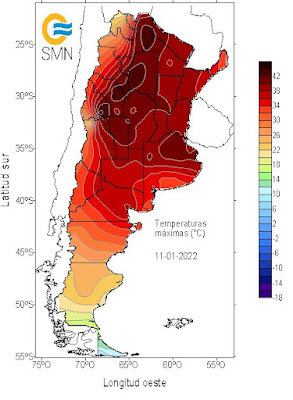
A heat map of Argentina showing
last week's record breaking high
temperatures in the 
South American nation 
While we shiver up here in Vermont, at least it's hot somewhere.

Too hot, as it turns out. 

It's halfway through summer in the Southern Hemisphere, and heat records are falling all over the place, another sign of climate change. 

In Australia, a town in Western Australia got up to 123.3 degrees Fahrenheit, or 50.7 degrees Celsius. That ties the record set in 1960 for the hottest on record anywhere in the Southern Hemisphere. 

Two other Australian towns got to 122.9 degree, or 50.5 degrees Celsius.   Before last Thursday, Australia had gotten that hot only three times. Thursday, in one day, it happened in three different towns, reports Gizmodo.  

Several other areas of Western Australia reported record heat this week.  Dry conditions during the Australian spring are helping create conditions for the hot weather. Inevitably, bush fires are starting to break out. That makes Australians shudder, as the immense bush and forest fires of 2019-20 are still fresh in people's memory. 

Meanwhile, far away, Argentina is burning up in a record heat wave. Buenos Aires hit 106 degrees last Tuesday, the second hottest temperature on record in that city, behind 110 degrees in January, 1957.

The heat wave, which has been ongoing since the second half of December, strained electric utilities in Argentina, leaving 700,000 people without electricity in and near Buenos Aires. 

In Uruguay, the temperature reached 111 degrees, tying the record for the hottest on record in that nation.

The South American heat wave largely ended in the past couple of days with an onslaught of severe storms and flooding. Uruguay's Capital, Montevideo, suffered severe flooding from torrential rains. During the peak of the storm, four inches of rain fell in just two hours. 


Thursday, December 30, 2021

The Kind Of Civil Unrest I Love, Weather Related

A "riot" during record heat on Christmas Day in western
Australia was quelled by spray from firehoses and police
armed with water balloons. 
 A record heat wave struck western Australia over Christmas, bringing temperatures of 117 degrees to the town of Karattha.  

Heat waves can bring out the beast in people.  Seems like there's often civil unrest during hot spells. 

So it was in Karattha. 

It had all the hallmarks of those riots we see on the news.  A firetruck blasting crowds with water cannons.  Residents hurling objects at police, who cowered behind riot shields while counterattacking with thrown objects of their own. 

In this case, fortunately, the water cannons were gentle, the objects thrown by the "rioters" were water balloons, and the police were not firing rubber bullets. They had their own stash of water balloons.

Following is the video.  As often is the case, mobile phone users might not be able to view the video on this page, so click this hyperlink.

Otherwise, to best view the video, click on the arrow and then the YouTube logo:


Monday, March 22, 2021

In The Land Down Under, Extreme Floods Rage

A house floats away during the current extreme flooding
in Australia, one year after devastating fires
 Australia can't seem to catch a break with their summers and early autumns.  

Last year, it was some of the worst wildfires in the nation's history.  This year, it's extreme flooding. 

This is the worst flooding Australia has seen in at least five decades. More than 18,000 people have been evacuated in New South Wales because of the high water, and that figure is expected to rise.  An area the size of Alaska is being affected by the flooding. 

Already, hundreds of homes have been damaged or destroyed by flooding. Video on social media shows some homes floating downstream in bloated rivers. As is usual with such widespread disasters, there were tales of absolute heartbreak.

One house widely broadcast floating down a river belonged to a couple who were to be married the day the home was destroyed.  Their pet dog was trapped in the house and presumably died. 

Wildlife was fleeing the flooding, too. In some areas, houses and property were covered by probably millions of spiders fleeing the high water. 

This will probably get a lot worse, as downpours are forecast to continue for the next several days.  As noted, the flooding is an example of extreme weather whiplash. 

At this time last year, the areas hard hit from the flooding were recovering from extreme wildfires that burned 7 percent of New South Wales in late 2019 and early 2020. s burned in wildfires. 

Videos:

Overview of the flooding situation:


First half of this video shows that house floating away:


It wasn't just humans fleeing the Australian flooding.  Check out all these spiders!


Thursday, December 3, 2020

Finally Colder In Vermont, But Hot News; Other Weather/Climate Problems Continue Elsewhere

Motorist fleeing a southern California wildfire last night.
Photo by Leonard Ortiz/Orange County Register/Getty
We've definitely cooled off from our record December heat, and it looks a little more normal outside my St. Albans, Vermont window.  

We had a dusting of snow Wednesday, and at least a little more snow is in the forecast later in the weekend and next week. So for now, record heat is not in the cards for us. 

However,  that's not true for different parts of the world, as heat waves and worrying climate trends continue on. 

AUSTRALIA WILTS

Spring time is moving on to summer Down Under in Australia, but for many who live there, summer has been broiling for a month now. 

As The Guardian points out:

"Australia has sweltered through its hottest spring and November on record, with both the season and the month more than 3.6 degrees warmer than the long term average."

A heat wave capped the warm month of November. 

"The extraordinary heat last weekend broke heat records for November in South Australia, Victoria and NSW (New South Wales).  Smithville, in northwest NSW reached 46.9C (116F). Andamooka, in the far north of South Australia hit 48C (118F) and Ouyen in Victoria equalled the previous high for the month of 45.8C (114F)"

This early season heat is ominous for Australia. It seems like eons ago, but last January, weeks of record heat in Australia dried things out and created the worst bush fire season in that nation's history.  Will history repeat itself a year later?

SPEAKING OF WILDFIRES

Lots of climate scientists have noted that wildfire season in the west keeps getting longer and longer, almost never ending, due to increased heat, and altered weather patterns due to climate change. 

A seeming case in point is going on in California right now. Extremely critical fire danger alerts are up for much of southern California near Los Angeles and San Diego.  The winter rainy season is a little bit late there. Strong Santa Ana winds, ultra dry vegetation and very low humidity is creating this latest danger.

One large wildfire has already erupted today.  What started as a house on fire spread to vegetation and raced onward, covering 5.5 square miles overnight southeast of Anaheim, California. Mandatory evacuations are ongoing.  The situation is expected to continue worsening today. 

It's somewhat unusual but certainly not unheard of to have wildfires this late in the season in southern California. That part of the state is usually the last to enjoy the winter rainy season.  Still, there should have gotten some rain by now, so this is definitely odd. 

What might actually turn out to be unprecedented is the potential for wildfires in California later in the weekend and next week.

This fire forecast is still iffy, but the fact that anybody is even talking about it is strange. By early December, northern California should be pretty damp, as the usual parade of Pacific storms should have introduced the rainy season a good month ago.

San Francisco,  for instance, only had a third of an inch of rain for all of November and no precipitation since November 18. No rain is in the forecast for more than a week.  Vegetation is the driest on record for this time of year in northern California. 

If wildfires break out in northern California in the coming days, it will be unprecedented. 

ALASKA FLOODS

Serious flood damage in Haines, Alaska after the wettest storm
on record in that region. Photo by Darwin Feakes via
Anchorage Daily News
The weather pattern so far this season has diverted storms northward away from the United States West Coast and toward the southeastern panhandle of Alaska - Juneau and that area.   

That part of the world is normally quite wet to begin with. After all, there are some beautiful rain forests in this area.

Recent rains, though, have gotten extreme. At last report, six people are missing due to flooding and mudslides after the wettest day on record hit cities like Juneau, Haines and Skagway. 

A landslide swept through homes and the cruise ship dock in Haines. Numerous roads are washed out. 

Nearly a foot of rain fell on the town of Pelican in one 48-hour period. Juneau had about five inches of rain just on Tuesday, its wettest day on record. 

This was an "atmospheric river" storm, in which a channel of warm, very moist Pacific air directed itself like a fire hose into coastal southeastern Alaska. Atmospheric river storms are common in this neck of the woods, but this one was extreme.  

The latest Alaska storm is also consistent with climate change.  We've been warned that some normally wet storms could become even wetter as the world warms.