Showing posts with label UK. Show all posts

Tuesday, January 27, 2026

Italy Slammed By Ferocious Storm; Damage $Billions, Other Destructive Storms In France, Britain

A massive landslide left this Sicilian town hanging
on a big precpice. Heavy rains from what was likely
the severest storm the region's history contribute to
the landslide. 
While we in the United States have been distracted with its own mega storm, another intense storm has caused havoc and severe damage in Italy this month. 

The storm, named Harry by meteorologists swept Italy from January 18 to 21. 

The storm was likely the worst in the region's history. At the very least, it was the worst in recent memory. 

It hit hardest in Sicily and Calabria.  Huge waves towering to over 30 feet smacked into shorelines, blasting through beachside restaurants and other businesses.   

Waves off the coast of eastern Sicily reached to nearly 40 feet, which is said to be unprecedented for the Mediterranean Sea. Waves (10 meters) in height battered coastal buildings. 

"The force of the waters swept away protective barriers, debris, and large quantities of sand onto the public roads of Catania. The receding tide on the Sicilian coast only began to be observed around 3 a.m. Wednesday," Italianismo.com reported

 Surprisingly but happily, there's been no reported deaths so far. Officials said evacuation warnings ahead of the storm and rescue crews helped a great deal. 

There were some close calls. According to Italianismo.com, waves struck the mayors of two cities as they were jointly doing a live broadcast on social media to report on the bad weather.

 Locals and officials were stunned by the storm. 

"The Calabria regional director of the civil protection department, Domenico Costarella, described the cyclone as a 'once in a century event,'according to WantedinRome.com, an English language Italian news site. 

Damage in Sicily alone was over 500 Euros, or about $590 million U.S. dollars. Total damage in Italy is estimated at $1.7 billion.  

On land, torrential rains caused extreme flooding and landslides. San Sostene in Calabria had more than 22 inches of rain in three days. 

A couple days after the storm tapered off, a huge landslide struck the town of Niscemi, Sicily. The slide is about two and half miles long and is carving out a drop of about 150 feet. The slide at last report was still active and additional houses have fallen in the past 24 hours and more will probably go. About 1,500 people have been evacuated.

Separately, Storm Ingrid hit hard in parts of the UK and France on Saturday. Huge waves damaged a sea wall on a main railway around Devon and Cornwall. A historic pier was washed away and coastal homes were heavily damaged when waves smashed into them. . 

Storm Ingrid hit less than a month after Storm Goretti left widespread wind damage in the UK and elsewhere in Europe. A new system, called Storm Chandra is now moving into the United Kingdom with strong winds, heavy rain and higher elevation snow. 

Storm Ingrid also caused damaging floods in parts of France. 

Videos:

Huge ways crash into the Italian Coast in last week's Storm Harry. Click on this link to view or if you see the image below, click on tbgat


 Waves crash through the window of a seaside restaurant in Italy. As always, click on this link to view, or if you see the image below, click on that. 

You have to be careful these days about AI slop, but I believe the images of the storm are the real deal in this summary video. Again, click on this link to view, or if you see the image below, click on that.

One more: Destruction on the coast in Messina. Again, click on this link to view, or if you see the image below, click on that. 


Video shows houses and buildings teetering on the edge of a huge landslide in Sicily. Aerial view shows how huge slab of land sloughed away, leaving a huge cliff that is eating away at the hilltop town. Click on this link to view, or if you see the image below, click on the arrow within the image. 


Tuesday, November 18, 2025

Another Odd Tornado Disaster Location: Portugal

Damage left behind after a tornado killed an elderly woman
and injured several others recently in southern Portugal

Earlier this month it was Brazil, now it's Portugal. 

As in Brazil, a destructive, deadly tornado hit a campsite in Albulfeira, Portugal.  Numerous trees fell in the campsite, including one that killed an 85 year-old woman from Britain. The tornado seriously injure two other people  and caused minor injuries to about 20. 

Alburfeira is on the central southern coast of Portugal. Video showed what appeared to be a partly rain-wrapped tornado moving through an area that seems like a very nice tourist district. 

 The tornado was part of a larger system, dubbed Storm Claudia, which caused serious flooding in northern Portugal and in  Great Britain. 

Two people were reported killed by the flooding in northern Portugal

Severe flooding also hit southeast Wales, near the English border, where as much as 4.7 inches of rain fell.

The town of Monmouth, Wales was inundated as the River Monnow rose to a record high level. Other flooding was reported in other parts of England and in Ireland. 

There's been a spate of tornadoes in places that historically do get tornadoes. But the recent twisters have been unusually deadly and destructive. 

Earlier this month, a strong tornado killed six people, injured about 750 and essentially leveled a large town in the southern Brazilian state of Parana.

In October, another strong tornado swept through Ermont, France, a city about 13 miles north of Paris, killing one person, injuring several others and causing widespread damage.  

Saturday, October 4, 2025

Former Hurricane Humberto, Reborn As Storm Amy, Blasts UK With 96 MPH Winds

Storm Amy, which had its origins in Hurricane 
Humberto, slammed much of the UK with damaging
winds. Here, a derelict building crashed down on
a car in Glasgow, Scotland. 
The UK was just blasted by what used to be Hurricane Humberto. 

At least one death has been reported in Ireland, in what has been re-named Storm Amy by the UK Met Office.  

Gusts as high as 96 mph were reported in the Inner Hebrides, a group of islands off the west coast of Scotland.  Northern Ireland recorded its highest October wind gust on record, at 92 mph. 

Storm Amy also set a record for the deepest area of low pressure in the UK during the month of October. In general, the lower the air pressure at the center of a storm, the stronger the storm is. 

As of Saturday morning local time, 62,000 homes and businesses across Scotland were without power and another 22,000 had no electricity in Northern Ireland, the BBC reported

Winds were not as strong further south, but still gusty enough to be dangerous. All eight of London's royal parks closed Saturday and opening times will be delayed Sunday, says the BBC. 

This past week, Hurricane Humberto transitioned to what is know as an extratropical storm - which is basically they type of system most storms are.

Hurricane have warm core and no warm and cold fronts. Extratropical storms have colder cores and those weather fronts. Once hurricanes get far enough north and away from the warm water needed to feed them, one of two things will happen.

The hurricane might simply dissipate. Or, especially if there is another disturbance around, like a cold front, the dying hurricane might reinvent itself as a regular storm.  Since the storm had its origins in the tropics, that energy might be an added boost to the re-formed storm.

That's what happened to Humberto. It transitioned to an extratropical storm. The UK Met Office even gave it a new name - Amy - so we no longer call it be its dead name, which was Humberto.  (The Met Office gives names to the powerful storms that often sweep the UK, especially in the winter. ) 

Storm Amy took off into the North Sea today, so conditions were improving in the UK and Ireland. 

Wednesday, August 20, 2025

Delete Old Emails To Save Water? Despite UK News, It Probably Won't Help.

UK environmental officials advocated for people to
delete old emails to save water, as data centers'
use a lot of water. Technology experts 
questioned whether this would help much.
 I'm terrible at deleting old and unwanted emails. 

It's just such a tedious pain to do, as I keep getting deluged with junk. If you try to get off email lists, it just creates a larger tidal wave of this junk.  

Does that make me a person that wastes water?

I know you wouldn't think a full email box means I make droughts worse somehow, but apparently that's a thing. Or at least some people think so. 

Via The Verge, here's an excerpt form a press release from Helen Wakeham, UK Environmental Agency Director of Water: "Simple, everyday choices - such as turning off a tap or deleting old emails - also really helps the collective effort to reduce demand and help preserve the health of our rivers and wildlife."

Your accumulated emails supposedly make drought worse because data centers use a lot of water to keep power servers cool, which is necessary to allow them to work properly.  According to The Verge,    a small data center can use more than 25 milliliters of water per year, if it uses old-school methods of allowing water to evaporate.

But there are a lot of reasons why the UK Environment Agency's worries about accumulated email might be misplaced, at least in terms of water usage. Tech companies are using new cooling methods to try and limit the amount of water they use.

That in itself might be a losing battle, since surging AI technology uses enormous amounts of water due to the big elaborate data centers AI and other technologies demand. 

But several other sources say deleting your emails, which might improve your efficiency a bit, might not help much at all with limiting water usage. 

 According to ZME Science:

"Most cloud data, especially your old photos and emails, lives on  high-density, low-power hard drives or archive tape. These use very little energy, and in some cases, almost none at all when idle. Secondly deletion isn't immediate. Files persist for weeks or months after deletion, usually (in a) system  similar to a "recycle bin." Only when data is overwritten, and only if it leads to hardware decommissioning is any energy (or water) actually saved."

Additionally, says ZME Science, 

"Perhaps most importantly, it's the 'flows' of data that use up the most resources, not the 'stocks.'  In other words, the real environmental cost of digital life comes not from what you keep, but what you do

Watching an episode of a Netflix show uses as much energy as storing 50 GB of photos for a year. Using AI tools, video conferencing, TikTok scrolling - these 'live' activities are far more resource-intensive."

So, if you want to be environmentally friendly, and save water in a drought, there are things you can to that are much more effective than deleting old junk emails from some clothing company you bought a scarf from umpteen years ago. 

Up here in Vermont, we're gotten into a burgeoning drought. It's not severe, at least not yet.  So, we're trying not to take long showers, making sure faucets are shut tight. When I can, I let what little rainfall we get accumulate in containers and use that water to soak down plants a little bit. 

I could spend my day deleting the zillions of old emails I have. But that's boring. So, I'll take my chances. I don't think those old emails will drain Lake Champlain 


UK water managers also don't appear to know how much water deleting emails would save,

"The Environment Agency didn't immediately respond to an inquiry from The Verge about how much water it thought deleting files might save, nor how much water data centers that store files or train AI use in the UK's drought-affected areas."


Thursday, August 7, 2025

Out Of Season "Winter" Storm Blasts UK, Disrupts Peak Tourist/Festival Season In Scotland

Satellite view of powerful Storm Floris blasting the
northern British Isles earlier this week. 
A type of storm that usually hits the British Isles in the winter just blasted parts of that region in full summer. 

The system, Storm Floris, swept across mostly Scotland and Northern Island and northern parts of England earlier this week.

Some 70,000 homes and businesses in northern Scotland were without power, which brought gusts to over 100 mph in some areas. a gust to 134 mph was reported at the summit of Cairngorm in the Scottish Highlands.

In lower elevations, Wick airport in Scotland had a gust to 82 mph, with several other stations going over 70 mph according to the Met Office, which is the British equivalent to the U.S. National Weather Service. 

SSEN, the electric utility in northern Scotland, said Floris was "the most damaging summer storm in recent memory, " reported the BBC.

Storm Floris was the equivalent of a strong nor'easter hitting New England this time of year, something that just doesn't' happen. 

Train services and some ferry crossing were canceled in much of Scotland, which happens from time to time in winter storms but rarely in the summer,

The storm really affected Edinburgh, not because it caused a huge amount of damage, but it disrupted the peak of its summer tourism season. 

Some venues and performances at the famous Edinburgh Fringe Festival had to be canceled because of the unseasonably stormy weather.  Edinburgh Military Tattoo, massed ranks of bagpipers and drummers at Edinburgh Castle that's one of the city's biggest tourist draws, canceled its outdoor performance on Monday. 

An Oasis concert in Edinburgh did went ahead as schedule.   . 

DEXTER 

Meanwhile, a former tropical storm from waters near the United States is forecast to briefly become an oddly intense non-tropical, more winter type storm in the central North Atlantic. 

Tropical Storm Dexter formed off the North Carolina coast and moved northeastward, out to sea. It will become a powerful storm with top winds of 70 mph roughly halfway between Newfoundland and Ireland. Luckily for the British Isles and elsewhere in Europe, former Dexter should weaken quite a bit on approach to the continent. 


Sunday, April 13, 2025

Even Normally Damp UK Is Burning This Spring

Wildfire burning this past week near Cumbernauld, Scotland
 There's been more of our share of spring wildfires around the world in the winter and so far this spring. 

The latest place to burn: Damp Old England, Ireland and Scotland. Hundreds of brush and wildfires have been burning, and are still burning in the UK. 

Yep, you read that right. 

They've had a stretch of unusually dry weather, and wildfires are burning through vast areas of the UK.  The worst was expected to peak this weekend.

Per a Washington Post report from Friday: 

"Firefighters in Northern Ireland reported nearly 300 wildfires in the week ending Thursday. Many were significant and started intentionally, but then ran rampant under conditions conducive to fire.

One large blaze was ongoing near Glasgow, in southwestern Scotland. It started Thursday and glowed ominously in the hills near the city overnight. Conflagrations were also burning or being tamped out near Galloway in Scotland and Cornwall in England, among other spots."

Extreme wildfire warnings were up in Scotland through Saturday. 

A BBC map showing the many locations of wildfires
this past week in, of all places Scotland. 
A change in the weather is forecast for Great Britain, which might finally bring some rain next week. But ahead of that rain, winds are expected to increase, so the fire danger will get even worse. 

The reason it's been so oddly warm and dry in the British Isles is a blocked weather pattern that has kept warm high pressure sitting over or near the region. 

This has blocked the usual parade of storms and cold fronts from moving eastward off the Atlantic Ocean to spread the usual April showers into England, Ireland, Northern Ireland, Wales and Scotland

This has led to a spring drought, exacerbated by unusually high temperatures for this time of year. It's been in the 70s on some recent days in Northern Ireland and Scotland.  Usually, high temperatures in that region are in the low to mid 50s during April. 

Climate change might have also had a hand in all this. Spring is the most rapidly warming season in the UK as the world keeps heating up. 

The UK has followed in the footsteps of other areas have exceptionally bad spring wildfire seasons. 

Late March wildfires in South Korea killed at least 24 people and destroyed hundreds of buildings, some of them historic. 

In the United States, damaging forest and wildfires swept through parts of several eastern states, especially in the Carolinas back in March.

Earlier in March, wildfires destroyed hundreds of homes in Texas, Kansas and especially Oklahoma. 

It's spring fire season here in Vermont, too, but we've been lucky so far. True, it hasn't been a nice spring lately, but frequent rain and snowfalls have so far tamped things down. Through April 8, Vermont has only see 13 small brush and wildfires that have burned a total of 8.5 acres. 

Still, we're not out of the woods. Until it green up out there, a few days of dry, windy weather could set things ablaze. In the short term. rain and even a little snow are in the forecast Tuesday, Wednesday, Friday and Saturday. 


Sunday, January 26, 2025

Update: Storm Eowyn, As Expected Leaves Big Trail Of Destruction In Ireland, Scotland

Fallen trees across railroad tracks in Scotland after 
Storm Eowyn.  Photo helps explains why the Scottish
rail system and to shut down during and after
the storm due to wind damage. 
As expected, Storm Eowyn, as it's known, crashed into Ireland, Northern Ireland and Scotland Thursday night and Friday, leaving behind a trail of power outages and damage. 

So far, only one death has been reported, which is one glimmer of good news.

At least a million power outages were reported in Ireland and northern Ireland, with 100,000 more across Scotland.  Power could be out for some people for as many as ten days. 

Photos and videos from the area show many roofs and building walls damaged and collapsed from the winds, along with countless trees blown over.  

Winds gusted as high as 114 mph at Mace Head on Ireland's west coast, the highest wind gust on record in Ireland. A storm in 1945 brought a 113 mph gust. 

The storm was well advertised by meteorologists and people heeded warnings to stay indoors, which minimized the death toll. The Associated Press said cities like Dublin, Belfast, Glasgow and Edinburgh were eerily quiet as normally bustling streets were nearly devoid of people, cars and public transportation during the storm. 

Scotland's rail system remained shut down Saturday as crews assessed damage to its network. 

Tree damage is enormous, and some of the damage is to rare or historic specimens. 

In Edinburgh, 15 valued trees in the Royal Botanic Garden were destroyed, including the tallest tree there, a 95-foot tall Cedrus deodara, planted in 1859. The storm also damaged greenhouses in the garden. 

On Glasgow, the more than 500 year old Darnley Sycamore was badly damaged, with several branches torn off.  This tree is reportedly the tree under which Mary Queen of Scots and her cousin and second husband, Henry Stewart, Lord Darnley, sat while she nursed him back to health from an illness in 1565.  

Behind the storm, wind and precipitation continued. Wind, snow and ice alerts remained in effect Saturday  and Sunday as a new storm roared in from the Atlantic Ocean. Though not as strong as Eowyn, the new weather system will causing strong, gusty winds and a risk of flooding in various parts the UK. 

Storm Eowyn had a long history.  It began as the bonkers, record breaking snowstorm along the Gulf Coast of the United States on Tuesday. 

Fueled by a combination of an insanely fast jet stream over the Atlantic Ocean, a cold outbreak originating from North America and much warmer than normal ocean waters just to the south, the storm explosively grew into a monster. 

 It mugged the British Isles as it raced past, hitting the west coast of Ireland Thursday night and rocketing away from Scotland's northeast coast by later Friday. 

VIDEOS

Good news account and summary of all the trouble Storm Eowyn caused. As always, click on this link to view, or if you see the image below, click on that. 


First half of this video is the most interesting. It shows a 100 year old building partly collapsing after damage from the high winds. Also lots of trees down along a highway and other damage. Click on this link to view, or if you see the image below, click on that.


Wednesday, November 27, 2024

Storm Bert Departs, Leaves UK Destruction Behind

Damage in England after severe flooding from Storm 
Bert. Photo from Northampton Chronicle.
One of the two "bomb cyclones" I mentioned in an entry I posted here this past Saturday was Storm Bert in the UK, that I said was a dangerous storm.  

You bet it was. 

Storm Bert focused much of its fury on central England and Wales, where several communities were inundated by flood waters. Five deaths have been reported with this storm.  

A flood wall collapsed in TenburyWells (see videos below) sending a surge of water through town. 

Later,  a 57 year old man proved that weather-related stupidity is not just a creature of the United States. This idiot blasted through the flooded town on a large farm tractor through floodwaters, causing a huge wake and waves that damaged shops far beyond just what the existing flooding would have done. 

The man was later arrested. 

Storm Bert flooded a large mobile home park, affecting 114 families. It was the third time the neighborhood had been flooded within a year.

Parts of Wales also suffered debris flows from what are known as coal tips. Those are big piles of waste material from coal mining. These piles have sat largely abandoned after the coal industry collapsed decades ago. 

Some of the flooding extended into Northern Ireland, where some towns were flooded over the weekend. 

Flood warnings remain in effect in parts of England and Wales. New rains are due in the coming several days, but they are not forecast to be as intense as those that hit with Storm Bert.

 Video shows the moment when flood defenses failed and a gush of  floodwater surged through the small town of Tenbury Wells in Worcestershire. Click on this link to view, or if you see the image below, click on that:


Video of people bailing water, being evacuated and a dog being rescued as water rises in a Welsh town after Storm Bert. Again, click on this link or if you see the image below, click on that:


And here's the idiot I mentioned above who blundered through a flooded town with a tractor, causing a lot of added damage. The driver has since been arrested.  Click on this link to view, or if you see the image below, click on that: 


Monday, December 4, 2023

Vermont Storm Not Quite As Bad As Could Have Been, Still Messy

Judging from this screen shot from a WCAX-TV web
cam in Burlington, this was decidedly a rainy not
snowy storm in the immediate Champlain Valley.....
 It seems like lower elevations were mostly spared the worst of the latest storm in Vermont. 

Mid and higher elevations are struggling with wet snow and scattered power outages, but it does not appear to be as bad as last time. 

What saved the day is the fact that an expected band of heavy precipitation didn't really materialize. That band would have changed a mixture of rain and snow in the valleys to all snow.  

The snow statewide would have accumulated rapidly, causing a cascade of fallen branches and power lines and a real mess on the road.

There was a fair amount of rain and snow with this storm, but it was steady as she goes all of Sunday afternoon and night, and that minimized the effects. Many warmer valleys stayed almost all rain. 

As go 4 a.m., it looks like Burlington managed at most a slushy coating of new snow but had a fairly decent 0.61 inches of rain.

There are power outages out there from the wet, heavy snow in mid and high elevations. The outages zoomed up from about 1,500 at around 2 a.m. to around 5,600 as of 4:30 a.m. Orange, Lamoille and Washington counties seem to be the most affected. The number of outages continued to creep up to 7,200 by 6 a.m. 

Still, this isn't as bad as the 34,000 homes and businesses without power after the November 27 surprise wet snow event. 

Snowfall reports are spotty this early in the morning.  Snowfall seems limited mostly to places above 1,000 feet. Even places away from Lake Champlain, like Jericho and Underhill, and along the Lamoille Valley floor in Johnson, received little to no snow.

It looks like some areas a little higher in elevations got quite a bit. Some top amounts include 8.7 inches in Greensboro and 7.0 inches in Eden, Lunenburg and Norwich. It looks like the Montreal metro region received about nine inches of new snow.  

.....but another WCAX-TV web cam in Newport,
Vermont indicated a winter wonderland. 

Bottom line: If you are in the Champlain Valley and other warmer valley floors, your Monday morning commute is looking fine. 

Just wet roads and light rain to greet the drive in.

If you're up higher, you're going to need some extra time to negotiate slushy, icy, snowy roads this morning. 

The outlook in Vermont is calmer this week..  Rain and snow showers will continue to day, but won't amount to all that much.

 Snow showers and subfreezing temperatures tonight will probably make roads slick by Tuesday morning.  Tuesday through Friday look chilly before a warming trend starts. 

Some of the summits and ski slopes could see an additional two to five inches of snow between now and Tuesday afternoon

All in all the ski areas are off to a great start this season with plenty of snow. There is some potential bad news for winter enthusiasts toward next Saturday or Sunday.  At this point, that next storm is forecast to move by solidly to our west, which would give pretty much everyone in Vermont a rain and thaw.

It's still nearly a week away so that could change. Stay tuned!

UK STORMINESS

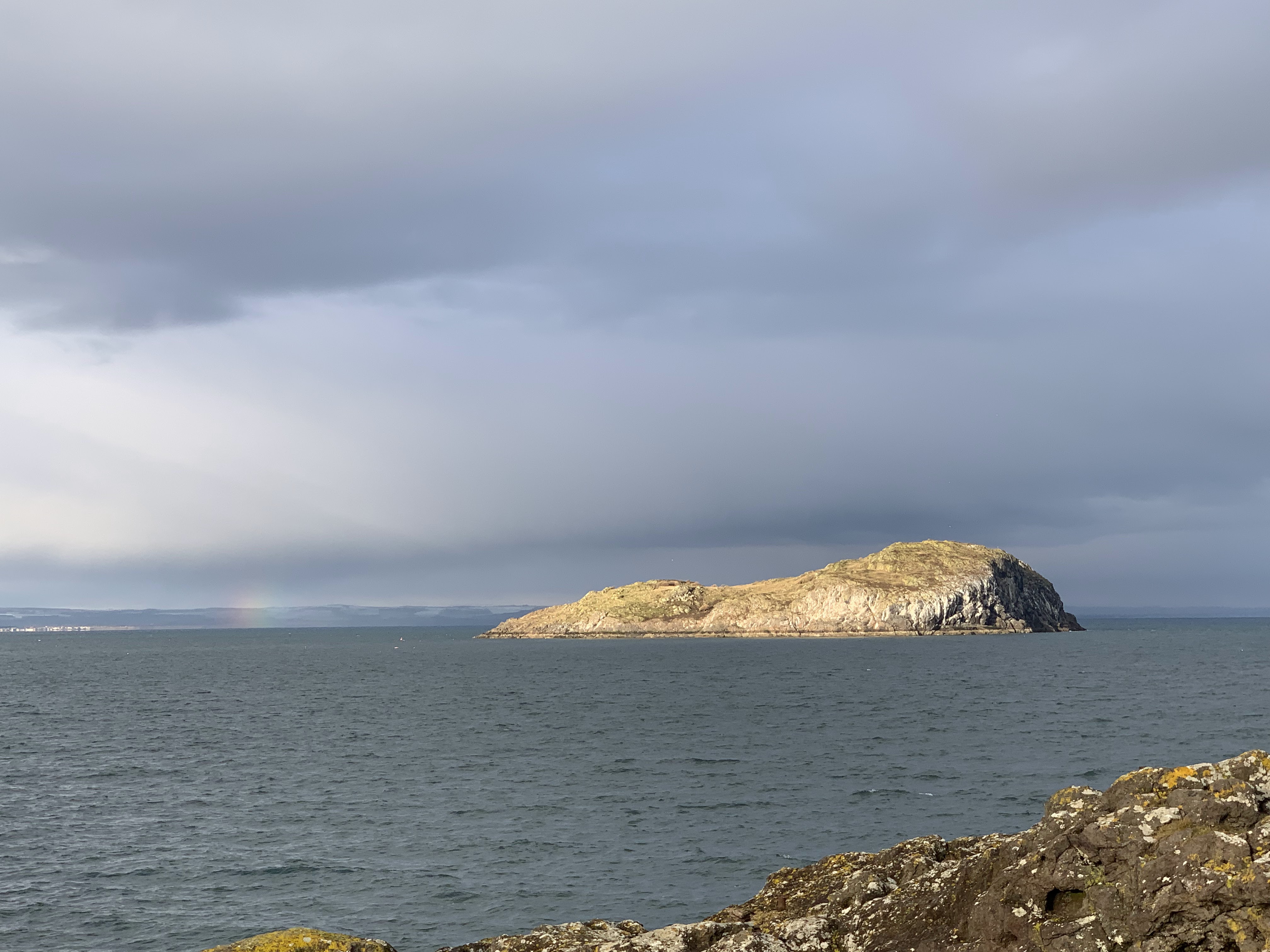
A hint of a rainbow near islands in the North Sea Sunday off
of North Berwick, Scotland. Gusty light showers swept the
coast.  Areas higher up and much
further to the west had more snow. 
Snow continued to pester parts of the UK on Sunday.  Where I'm at in Edinburgh, Scotland, some mixed rain and snow showers developed Sunday evening, but didn't accumulate.  

Elsewhere, it certainly did pile up. In Cumbria, a section of northwest England, more than 2,500 homes and businesses were without electricity after more than 8 to 10 inches of snow fell.  People had to abandon cars on highways as snow rapidly piled up

Officials in parts of northern England, Wales and Scotland were warning of "ice rink Monday" as rain and snow froze on highways. 

Today, I'll see the first truly stormy day in Edinburgh since I got here last Thursday. 

They're expecting steady rains with wind gusts as high as 39 mph during the day.  So we're going to the National Museum of Scotland since it's an indoor venue. 


Sunday, December 3, 2023

Snow Trouble Both Sides Of The Atlantic

Latest snow forecast from the National Weather Service
in South Burlington. Mid and high elevations can
expect perhaps six inches wet snow. Be alert, as
these totals might change substantially in the actual storm.
 EDINBURGH, SCOTLAND -  At my temporary perch in this Scottish city, we haven't gotten any snow so far in my stay. The hills around town yes, but not in the city center.  

But I see there's a snowy mess on both sides of the pond. Swaths of the UK, and elsewhere in Europe, have gotten some disruptive snows.

Meanwhile, it still looks like disruptive snows are in the cards for Vermont and surround areas. Let's take Vermont first.

Like the wet, heavy snowstorm back on November 27 that caused a mess and power outages, the one that's coming today and tonight in the Green Mountain State will easily surprise folks one way or another. 

Temperatures, like last time, will be marginal, very close to the freezing mark. That means, as  mentioned yesterday, if it ends up being a degree or two warmer than expected, it'll be mostly rain. If it's a degree or two cooler than what's in the forecast now, then the wet snow will be much more widespread.

Expect surprises.

The worst of the storm will run from this afternoon to early Monday morning.  Before we get there, freezing drizzle and freezing fog this morning near the Canadian border will cause some spotty ice and travel trouble, especially on bridges and overpasses. 

The heavier precipitation will move in this afternoon. It'll come down heavily at times tonight. The best chances of accumulating snow will be during the heavier bouts of precipitation overnight. That heavy stuff tends to cool the air enough so that if you're above freezing and raining, you'll likely switch to snow.

Once again, the higher you go the more snow you'll get. A winter storm warning is up for the Northeast Kingdom and high elevations of northeast New York, where six inches or more of wet slop is in the cards. 

Elsewhere in Vermont, a winter weather advisory is up for areas outside the immediate Champlain Valley and so far not including the state's southernmost counties. In these areas two to seven inches of sloppy wet snow is forecast, but there could be some surprises with higher totals if temperatures dip just a degree or two downward more than expected.

The immediate Champlain Valley can expect one or two inches, but again, be wary of any surprises that could boost totals overnight. 

As you've noticed, I keep mentioning heavy, wet snow. That means power failures are likely. That's especially true in  mid and high elevations where the snow should accumulate the most.

I can't emphasize enough the predicted snow amounts are not cast in stone.  This is a tricky storm.  My gut is sort of pushing me to expect a little more snow that's currently in the forecast, but it could really go either way.  Either a huge dump of wet snow, something in the middle, or perhaps, not as big a deal.

I'd get ready for a wet snowy mess with difficult travel early Monday and the risk of power outages. Get the LED candles and charge your devices by this evening to be on the safe side.

Whatever comes down will be quite a bit. Rain and melted snow will amount to 0.75 inches to 1.25 inches most areas, with some spots seeing higher amounts. That makes it a pretty substantial storm. 

Much lighter wet snow and rain will keep going Monday in most areas, but accumulations will be lighter and many areas will be above freezing. So things should improve during the day. 

Of course, it will get colder Monday night, so a combination of water freezing on roads and light snow showers will make the roads annoying again overnight and Tuesday morning. 

BRITAIN/EUROPEAN SNOW

Vermont isn't the only place that's dealing with heavy, wet snow. In some places on this side of the pond, there's plenty of it.

Here in Scotland, Edinburgh on the northeast coast hasn't gotten any snow, but we might get some today. The Met Office, the British equivalent of the National Weather Service has Edinburgh and most of eastern Scotland under a "yellow warning" for some snow and us. 

A yellow warning is the equivalent of a winter weather advisory, and not quite as dire as the equivalent of a winter storm warning.   

Snow is visible in the hills near Edinburgh, Scotland. 

Snow is already affected other areas of the UK. The Glasgow, Scotland airport had to suspend flights Saturday morning due to a burst of heavy snow.  The Midlands, Yorkshire and large parts of Wales are snowy, with roads and railways icy and slow.

Jackknifed trucks (I've learned to call them lorries here) blocked a major highway in Cumbria.  

Elsewhere in Europe, heavy snow shut down parts of Germany. Munich had no bus or train service Saturday after 16 inches of heavy, wet snow fell there.

Intense cold and heavy snow are also causing problems. Traffic was at a standstill around Prague in the Czech Republic. Austria and Switzerland are on the alert for avalanches. 

In both Vermont and western and central Europe, longer range forecasts call for somewhat milder conditions in about a week. 

Friday, January 6, 2023

In One Of World's Hottest Years, 2022 In UK Was Off The Charts

United Kingdom had its hottest year on record in 2022.
Other nations might follow suit, and globally, 2022
will be among the top 10 hottest. Where the world
ranks will be known for sure by the middle of this month.
 We won't begin to get great data just yet on how 2022 stacked up in the list of world's hottest years.

So far, the expectation is it certainly won't be the hottest year ever, but still will crack the top 10, probably somewhere between sixth and eighth hottest. Pretty remarkable for a year with a La Nina, which tends to cool the world a bit. 

The United Kingdom, though, came in with a scorching hot year.  The UK has been keeping track of temperatures since 1659, the longest period of instrumental data in the world.

After all those years, 2022 will be the hottest, according to provisional data from the UK Met Office.  The Met Office is the British equivalent to the National Weather Service in the U.S. 

As the Met Office reports:

"Dr. Mark McCarthy is the head of the Met Office's National Climate Information Centre. He said, '2022 is going to be the warmest year on record for the UK. While many will remember the summer's extreme heat, what has been noteworthy this year has been the relatively consistent heat through the year, with every month except December being warmer than average.'"

Every month of 2022 was warmer than average in the UK, with the exception of December, which looks like it will be a little cooler than average. That's thanks to a cold snap during the first half of the month. 

As the year closed, it was unusually warm in the UK, and as the New Year began, unprecedented winter warmth spread into most of the rest of Europe. 

Several other European nations might have also had their warmest year in 2022.  If the way 2023 is beginning continues, those records won't last all that long.

Data is starting to come in regarding how 2022 ranked globally, and we'll have a very good idea of that ranking by the middle of this month. 

I'll keep you posted. 


Monday, November 29, 2021

British Storm "Arwen" Gets UK Storm Season Off To Destructive Start

Police ban crushed by falling trees during Storm Arwen
in the UK
Great Britain is no stranger to wild winter storms blowing in off the North Atlantic, but the first major one of the season was a doozy.  

The storm focused the worst of its fury on Scotland, Northern Ireland and the north of  England, where some people have been without power for three days as temperatures fall to well below freezing behind the storm. 

Winds gusting to 90 mph unroofed buildings, collapsed brick walls and tossed down too many trees and power lines to count.  Three people died when trees fell on them. 

Train service in wide areas was canceled, too, because of power outages and trees and debris on train tracks. 

Britain's Met Office (the equivalent of the U.S. National Weather Service) issued a rare red weather warning ahead of the storm for high winds in the northeastern UK.  It was the first red warning since the infamous "Beast From The East" storm of February, 2018.

The Met Office has three levels of warning, yellow, amber and red, which helps judge the severity of a weather risk. A red warning means there will be significant disruptions and life-threatening conditions.   Which meant Arwen was a lot more than the usual British winter storm. 

The storm has departed, but a sharp cold snap descended on Great Britain in its wake. Temperatures fell into the teens in many areas across the north. 

It is forecast to turn milder again in England this week, though more storminess is due Tuesday. The next storm won't be nearly on the same scale as Arwen. 

Here's some videos. Click on this link to view the first one if using a mobile device:


Another video. Again, mobile users please click on this link: