Showing posts with label thoughts. Show all posts

Tuesday, January 14, 2025

In The Age Of Climate Change, Your Life Can Be Upended At The Drop Of A Hat

The family who lived in this destroyed
California house presumably had a 
joyous Christmas. The burning 
Christmas tree inside just seems like
another one of billions of blows
the fires have landed on so many people.
The California wildfires prove once again that climate change makes all of our lives that much more unsettled and insecure.   

Thousands of lives changed for the worse at the drop of a hat last week as the wildfires tore through houses, neighborhoods, whole communities. The disaster might not have happened without climate change, or at least wouldn't have been nearly as bad. 

It was all just another example of how our own little bubbles of bliss are invaded by a sense of doom sometimes in our warming world.

Things for any individual have always been capable of suddenly going south.   A loved one might suddenly die,  you get a devastating diagnosis, you become a victim of a major crime, or your house burns down due to some stupid electrical short in an appliance. 

Those things have always been at the back of our minds, but we shove it away. We want to enjoy life, not fret about all the bad things that could happen. 

In the age of climate change, we still try not to think about the bad stuff that might or might not ever occur. And that's a good thing. Constantly worrying or obsessing over how the world can harm us is completely unhealthy. 

But the California wildfires have shoved this possibility into our faces. Just like the steady parade of mega-disasters the world is increasingly experiencing, 

Like Hurricane Helene in September. That's when people living in their corner of mountain paradise in North Carolina, seemingly safe from the worst of hurricanes that sometimes roam and wreck the coastal areas found their lives awash in epic flood ruins. 

In Helene, walls of mud swept down those beautiful North Carolina hillsides, wiping out homes and lives in an instant.  Houses and businesses seemingly too high above those pretty mountain rivers to be in harms way just washed away in a few hours from seemingly impossible floods. r 

It was the same in California. All those gorgeous homes in gorgeous neighborhoods in Pacific Palisades, Pasadena, Altadena, Malibu and other communities gone in a night. Homes full of memories and comfort just went poof and disappeared. 

Leaving all those residents to mourn and face a much too uncertain future. 

The rest of us don't really have the right to complain about how unsettling climate change is, given the trauma California fire victims are experiencing. 

But it makes us think. It can happen to us. It has in Vermont. I think of the residents of that apartment building in Plainfield, who woke up on July 10 last year in a quintessential Vermont village with a pretty little brook gurgling by beneath the rich green of the sugar maples standing guard over the town.  

In less than 24 hours, it was all gone, literally washed away in a flash flood.  Thousands of other Vermonters faced misery and ruin amid the floods of 2023 and 2024.  It hurt to watch, never mind experience it.  

The rest of us try to help out, sympathize, to do something about it, whatever we can. But otherwise, we try to live our lives in peace, and hope we're not next.

By the way, western North Carolina and Vermont were considered as two places relatively "safe" from the ravages of climate change. 

These days, we get nervous every time our homes are rocked and battered by the next extreme storm and thank our lucky stars to wake up in the morning to find little or no damage. 

I am one of those extremely lucky ones in Vermont. By my calculation, my St. Albans property has sustained about $1,500 in damage from severe storms over the past decade. That's not bad at all, and we were even more fortunate to be able to absorb those little hiccups with a minimum of discomfort. 

The California firestorms hit in the dead of winter. Most of the nation is frigid, gray, colorless this time of year. Calfornia should be greening up in what should be the usual winter rains, but it's burning down instead.

Yesterday, I ventured outdoors for awhile near my northern Vermont home, under a dark, hazy overcast, occasional snowflakes racing past me in the wind.  Winter is not my favorite season to begin with. Now, the winter seemed more depressing than usual, given the heartache in California, and the worry over what might come next. 

The classic Mamas and Papas tune "California Dreaming," popped into my head. I thought how bitterly ironic the song's lyrics have become in the tough winter of 2025:

"All the leaves are brown
And the sky is gray
I've been for a walk
On a winter's day 
I'd be safe and warm
If I was in L.A."


Thursday, November 7, 2024

The Elephant In The Post Election Room

I post this photo of Shelly Winters when the boat
turns upside down in the "Poseidon Adventure"
whenever I feel like things re heading south, so....
You might have noticed that until now, I have not yet mentioned the election, which apparently has been decided in favor of Donald Trump. 

Readers of this blog know full well I'm a vocal critic of Donald Trump.  Like many of you - nearly half the nation - this isn't a good time for us, to put it mildly.  

To be honest,  I'm disappointed in the people who voted for Trump.

We have to accept that lots of people were willing to throw away so much of what many in this country holds dear in favor of reducing the price of a dozen eggs at the supermarket.

Or something like that. 

Yes, I'm cynical. But you knew that already. 

Something snapped in me Wednesday morning. It's clear that until now, I was misunderstanding the rule of the game. 

The whole thing is about bullying. That's the name of the game voters have decided upon. Trump is a bully, his minions are bullies, and so are his most ardent fans. They're proud of it. 

I knew right along they were bullies. But until now, I thought our better angels might prevail. I was wrong. 

Trump gave his worst follows "permission" to be the awful people they really are. I'm not talking about all Trump voters, of course. Just the snarly ones you always see at his interminable rallies.

The situation we're in now is way different than other instances when a presidential candidate whom I didn't favor won. In those cases, I didn't like their policies, but could easily agree to disagree with them and their supporters.  I still respected these presidents and like-minded politicians. I knew they would (mostly) uphold the law, adhere to the Constitution and were serving their country. 

Here, despite his fans' beliefs, we'll have a president who is only serving himself and perhaps some of his minions. Some of his more thuggish supporters will continue to menace their enemies, especially the more vulnerable. Just because they can. You can't respect anything like that. 

One of my regrets in life is I haven't adequately stood up to bullies, whether their aim was against me or someone else. No more. I'm now ready to be as nasty as the rest of them. 

Of course, I will continue to show kindness and warmth to everybody who deserves it.   But if I encounter the lying liars who lie who created this whole moment in history, then I'm coming out with guns blazing.

Not literally, obviously. I'm never been a violent person and I'm not going to start now.  Any "cruelty" I show toward those who deserve it will be with words and non-violent deeds. I'm not Crazy Harry, the mad bomber from The Muppet Show, after all. 

The lying liars who lie I refer to are mostly the mendacious operatives who spread disinformation regarding just about everything. With the aim to get richer and richer by gaslighting their fans into submission. A lot of 'em fell for it hook, line and sinker in this election.

Brace yourself for a ton more fabrications during the Trump administration. 

This is of course a weather and climate blog, so that's what I'll continue to focus on here.    I'm sure there will be a lot of denying of climate change, or anything to do with basic science during the next four years at least.  Might we see another Sharpie that will "alter" the path of a  hurricane?

You know I haven't been shy at criticizing those who spread all these lies, like the weather conspiracy theories, the supposed nonexistent federal response to recent hurricanes, you name it. 

I've determined I need to step up my efforts to name and shame even more. 

That's not to say this blog will just be a grim vendetta against the people I don't like. I'll happily celebrate the people and organizations who are making a positive difference. There will be plenty of regular news, forecasts, even fun. In fact, the fun element might be me bullying the bullies every once in awhile. 

I know my efforts won't change the world, and it might have me end up in the gulags or something, but like I said, I'm done with the bullies.

To quote the classic movie "Network," I'm mad as hell and I'm not going to take this anymore. I'll just need to work on the right way to not take it anymore. Suggestions are welcome.

I also won't become a bitter old man in this process. I don't have the stomach for that, either. 

Through the Trump administration, I'll continue to see beauty and feel the joy in my flower gardens glittering in the sunshine after a spring shower. I'll embrace the kindness in my husband's eyes and the sound of his goofy laugh when he watches some slapstick comedy. 

I'll experience the awe of watching those summertime storm clouds erupt into displays of strength and majesty. And I'll savor the companionship as me and Jackson the Weather Dog, his tail wagging, when we go out first thing on a winter morning to measure how much snow fell the night before. 

There's still a lot of good in the world, and good people in the world, despite the fact the bad seems to  have taken the lead in the game of life right now.  .

This whole screed I've just written could well lose me some regular readers. It's the price I have to pay, I guess.  

When I woke up Wednesday morning, the future looked a lot more uncertain than it ever did. I guess I don't get to coast quietly into older age as I'd planned and hoped. I'll probably lose a lot, but I'm going to cling to my self-respect. 

Much more importantly, I'm going to respect and love the people that really matter, from climate scientists and meteorologists to innocent Trump victims to my own family and friends. 

And to the bullies that are on top of the world right now, I have one not so friendly message: Sooner or later, reality comes around to bite you in the ass. 

Monday, February 5, 2024

Longing For Color: Photo Shows Exactly Why We Look Forward To Spring

A beautiful spring evening in my St. Albans, Vermont 
back yard. Photo taken on May 5, 2023.  Click on the 
image to make it bigger and easier to see. 
The snapshot photo in this post was taken in my St. Albans, backyard on the evening of May 5, 2023.

As far as composition and artistry and all that, the photo isn't much. But this time of year, I can't help just staring at it. 

The colors! As we are in this especially drab, gray, relatively snow-free winter, you're going to want to click on the photo, make it bigger and stare lovingly into it. 

The greens, with the speckled blue sky and the pops of yellow from the daffodils just bring such joy and, I don't know, ahhhh.

In three months or so, we will be free from this imprisonment of monotonous gray, brown, and dirty white.  With any luck, by early May, our surroundings will look something like the photo in this post. 

By the way, if you want more spring images to warm your heart, I've added a video to the bottom of this post. 

Anyway, sure we had blue skies for a change on Sunday, which were extremely welcome. But by February, we all wait desperately for the color that true spring brings. 

Click on the photo to make it bigger and easier to see. The late afternoon/early evening light and shadows in the photo bring out every possible shade of green. It helps that the tiny new leaves have that tender new born sort of bright baby green. 

You can see that the lawn could stand a mowing, but that tall grass looks so luxurious.  If I'm not mistaken, Jackson the Weather Dog that evening spent quite a bit of time rolling around in that grass. Which was a great idea. So I joined him. 

Whether you admit it or not, you would have done the same. 

 Check out that sky.  Sure, the beautiful blue skies on Sunday were a nice switch from the weeks of gloomy overcast we had, but Sunday's sky was still a cold, winter blue. 

The springtime blue sky in the photo has a benevolent, warm feeling to it. The scattered clouds complete the painterly feel of the atmosphere. They also have a vaguely unstable look to them, as if promising some springtime showers. 

You might guess from the photo that I like daffodils. Those pops of yellow just make me happy every spring. I have varieties that bloom early, mid-season and late to keep the show going. 

My only regret is I only have about 600 or so daffodils planted on my property. I wish I had thousands. Worse, I ran out of time to plant additional ones this past autumn. Well, there's always next year.  

I have lots of photos of my springtime gardens. My excuse for having the photos is it helps me plan improvements to the property. 

But frankly, I spent an embarrassing amount of time in February looking at those photos as entertainment. Just to take my mind off winter. Even winters as mild as this one has been.  

I know many people like winter. There's a lot of reasons why people would. But those green spring days and evenings  are absolutely heavenly. If there is a heaven, I hope it looks something like what's in the photo.

Video: Spring images from 2023. Click on this link to view, or if you see the image below, click on that. 


Monday, October 23, 2023

Winter Forecasts Mostly Think Vermont/North U.S. To Be Warm. *Results May Vary

For what it's worth, NOAA predicts a warm winter
across the northern tier of states, including here in
Vermont. But don't hang your hat on this. Long
range forecasts are notoriously unreliable.
 It's that time of year when everybody and their brother attempt a forecast for the upcoming winter's weather.  

Fine, I'll play along again, but as always, don't be the least bit surprised if things turn out to be completely different than the various winter forecasts you see in this post.

I'll tell you what the winter of 2023-24 will end up being like in, I don't know, March?

For what it's worth, NOAA this past week released its winter forecast.

It calls for a classic El Nino pattern. Overall, the nation is in for a warm winter, if NOAA is correct. The strongest chances of having a warm winter, relative to average would most likely be in the Pacific Northwest, New England and Alaska.

The NOAA winter precipitation forecast is also classic El Nino, feature a greater chance of drier than normal weather in the northern Rockies, far northern Plains and around the Great Lakes.

Chances for above normal precipitation would extend across the southern tier of the United States from California to the Carolinas. The greatest chance of a wet winter would be across Florida and southern Georgia.

Here in Vermont, NOAA says it's a tossup as to whether it will be wet or dry this winter. 

In my experience during El Nino winters in Vermont, it seems like the early winter is the warmest relative to average and then it gets colder toward late winter. I have no idea whether this will be the case this year, but I'm just throwing that out there, as I've seen it before. 

For what it's worth, NOAA got last winter's forecast right, at least here in the Green Mountain State. The prediction was for a warm winter with equal chances of it being wet or dry. 

The reality was last winter was the third warmest on record,  and was a little wetter than average. However, NOAA got other regions wrong. They did not forecast a remarkably wet winter in California, for instance.

The Weather Channel's winter forecast roughly mirrors NOAA, with the most of the nation, except the Southeast, having a mild winter. The Weather Channel maps overall have the best chances of a warm winter north of a west-east line from about San Francisco to New York City.

Here in Vermont, the Weather Channel kind of echoes my gut feelings. Early winter could be very much on the warm side, but by February, things would be closer to normal, says the home of Jim Cantore.

The Weather Channel missed the mark - at least for us in Vermont - last winter. They said it would be somewhat colder than average (but not extremely cold). But it was extremely warm, so that's a miss. 

AccuWeather is also predicting a classic El Nino type winter with warmer conditions to the north and somewhat cooler south, relative to average.

The difference is AccuWeather is not nearly as bullish on the warmth as NOAA or The Weather Channel. Although AccuWeather thinks the northern third of the U.S. will be on the warmish side, the only really warm regions would be the northern Rockies and the western Great Lakes. They're also predicting more snow in the eastern United States than last winter.

AccuWeather is predicting somewhat above average snowfall for interior New England, including all of Vermont this winter. 

I'm afraid to say AccuWeather kind of botched last year's forecast. They did expect a fairly warm early winter in the Northeast, which turned out to be true. But New England was supposed to have a fairly snowy winter, great for skiing, which didn't happen. Their worst mistake was saying that California would remain dry, and drought would continue. Oops. 

The other usual suspects have also issued their winter forecasts. The Old Farmer's Almanac said that most of the central and western United States will have a cold, snowy winter. New England is in for a mild, but snowy winter, says the publication. 

The Old Farmer's Almanac got it wrong for Vermont last winter. They predicted a cold snowy winter. As noted, it turned out very warm. Also, snowfall was somewhat below normal. 

The rival Farmer's Almanac (I guess it's not so old) is forecasting a cold, stormy winter in northern New England. The same publication also said we would have a cold, stormy winter last year, which of course didn't happen.  

As noted, I have no idea who among these prognosticators who is right. Another mystery for me is all the emphasis on winter outlooks every year. We do see spring, autumn and summer outlooks, but those predictions lack the breathless anticipation and certainty of the forecasters, despite their weak track record. 

Anyway, enjoy your winter. However it turns out. 

Tuesday, June 13, 2023

Smoke Gets In Your Eyes (From The Political Spin Reaction To Canadian Wildfires)

Wildfire smoke from Canada casts a brassy hue on 
St. Albans Bay, Vermont on June 5. Wildfire smoke
from Canada has also gotten political.
 Wildfire smoke from basically all of Canada's provinces continues to drift through much of that nation and the United States, though the fumes are noticeably thinner than the choking pollution we saw in the Northeast last week. 

Now, inevitably, we're choking on the political and climate debate/unpleasantness in the wake of the smoke attack. 

Social media and the "news" stations we deal with amplify and distort what's going on with the fires. 

First of all, few people are saying that climate change "caused" the big fires in Canada, but you'd have a solid argument in saying a warming world made the conditions that created those fires much more likely. 

And no, climate activists or governments or other bad actors didn't spend the first Saturday in June setting the Quebec fires to fuel their anti-fossil fuel activism and supposed contempt for the general population. 

Yes, that conspiracy theory has been going around, along with more outlandish ones like heat causing missiles, or, I don't know, Jewish space lasers setting Quebec ablaze in early June. 

I'll never convince the hard core conspiracy theorists that their creative ideas are wrong, but let's get some of the facts straight on what's been happening.  Yes, some of this is my opinion, some of the facts and causes are open to a little interpretation and second guessing, but the basics are pretty clear.

QUEBEC FIRES

Although fires have been burning in much of Canada all spring and spreading smoke into the United States since at least early May, the thick smoke this month really got people's attention.  Especially since the worst of it hit the nation's media, political and government epicenters, namely New York and Washington DC.

The suddenness of the fires and the severity of the pollution really had people talking. And guessing wrong. 

The Quebec fires really did seem to erupt suddenly, giving rise to those conspiracy theories. One Facebook page that said the Quebec fires were a terrorist attack had more than one million views.  

For the most part, the "terrorist" in Quebec was lightning. 

A strong, but relatively dry cold front swept southward through Quebec on June 2.  This cold front generated lots of thunderstorms.  The downpours associated with the storms were very localized, and really didn't produce all that much rain. Many areas in dry Quebec saw no rain, or only a trace.

But those lightning strikes set countless small fires in trees and underbrush throughout central and western Quebec.

Those fires smoldered overnight Friday.  Then on Saturday, a big gush of very dry, strong north winds swept through Quebec. Those little smoldering fires quickly became raging blazes.

Conspiracy theorists focused on the satellite loop in this link, showing fires seemingly erupting simultaneously in Quebec, as if in a coordinated attack.  But the loop is speeded up, covering nearly a 12 hour period. That's plenty of time for fires to spread and grow. 

This might not be visible on some devices, but here's the loop. If you can't see the image, click on the above link. Then I have more after this. 

IS IT CLIMATE?

The endless debate on what climate had to do with this mess is full of distortions and oversimplifications. 

Climate skeptics note that Canada sees fewer fire starts in recent decades than it did earlier in the 20th century. 

That's actually true. 

According to CBC, the 1980s saw more than 80,000 wildfires start in Canada. Since then, the number each decade has declined, to about 60,000 between 2010 and 2019.

But note we're talking about fire starts, not the size of the blazes. I think the decline is due mainly to public service warnings. We'll never know how many fires didn't begin because somebody made sure all the embers were cold as they left their campsite, or decided not to set their brush pile alight, or concluded it was too dry and windy to set off fireworks. 

The problem is, the fires that are starting tend to be larger. The CBC report notes that acreage burned in Canadian wildfires has slowly increased since the 1970s. 

A warmer world is often a drier world. Sure, there's more intense rain storms. But when the rain stops, evaporation is usually more efficient when it's hotter out. Things dry out more quickly, leading to the conditions that can create out of control wildfires. 

Haze from Canadian wildfire smoke on May 23 obscures a 
Lake Champlain view from South Burlington, Vermont.

Canadian environmental officials also say that climate change is leading to more lightning strikes across much of that nation. That's precisely the problem that started the chaos this month that originated in Quebec. 

Climate change skeptics also point out there used to be epic fires -  much bigger than current blazes - in Canada and the U.S. a century ago. That's also true. But a century ago, you didn't have armies of firefighters and flocks of planes and helicopters dropping tons of water and fire retardant on those wildfires.

To repeat: Climate change did not directly cause the onslaught of fires in Canada. Lightning, human error and probably a few arsonists started the blazes.  There probably would have been a bunch of wildfires in Canada this year with or without climate change.

But the warming world probably made a hot, dry Canadian spring hotter and drier than it otherwise would have been. Which means the fires were probably worse than they otherwise would have been.

It's pretty much impossible to measure how much worse the fires became because of climate change. But the trend line is bad, since we're only going to get hotter. And weather extremes will keep getting more extreme.

ATTENTION GRABBER

As noted, the smoke really captured a lot of attention. It was the first time in memory that so much of the eastern United States was choking on smoke. 

The Washington Post went with this in a June 10 article:

"The East Coast, along with the rest of the planet, has entered a new fire era or - a Stephen Pyne, an emeritus professor at Arizona State University calls it - the "Pyrocene."

That assessment is a little melodramatic, in my opinion. But it does point to the fact that different parts of the nation - and the world for that matter - have increasingly seen a lot more of these smoky days in recent years. 

With Canadian fires not expected to end until at least this fall, we can look forward to more smoky days, too.

But will this change anything? 

I doubt it. 

That millions of people in the eastern U.S. endured dangerous wildfire smoke was the talk of the town. And probably made climate change hit home for more people. But politics is stalemated in a way I can't recall in my 60 years.

It's tribal. It's the "religion" on one side to stop climate change now, or at least mitigate it, by, I don't know, walking out onto highways and blocking traffic. The "religion" on the other side is that climate change activists and experts are trying to take away all our "freedoms," whatever that means. 

The sensible group is probably the minority. We do need to shift away from fossil fuel consumption now if not sooner. If only entrenched interests and lobbyists in certain industries, oil and gas chief among them would get out of the way, we could probably make more progress.

But we don't live in that world, unfortunately.  Which leaves for the younger generation a worse future than there needs to be.


Saturday, October 8, 2022

The Annual Autumn Vermont Garden Disassemble Is Like A Natural Theatrical Production Closing

The closing fall act of part of my gardens in St.  Albans, Vermont.
Time to tear it down for the season and plan for an even
bigger, better show next season.

 I'm always a little sad this time of year when a Vermont gardening season ends for the autumn.  Like the feeling you get at the end of the best play or movie you've ever seen. 

I'm mostly a flower gardener, so I picture the growing season as a theatrical arc. 

The opening act of the show are the early springtime crocuses and daffodils, and end with asters and surviving sunflowers. In between, a big cast of actors, I mean flowers, have their big moments.

My husband is a theatrical set designer. When a play runs its course, and it's time to close it down and disassemble everything, that process is known as "strike."

So as the air cools, what's going on in my Vermont gardens is "strike."  It's time to tear everything down, and lay the groundwork for the next big production, which will of course open next spring. 

Garden "strike" is a lot of work. You have to cut back the dead and dying perennials, heavily mulch the most sensitive plants, protect the evergreens from marauding winter deer and other animals. That's just the start. There's tons of other tasks to complete before the snow really flies. 

"Strike" is an all hands on deck activity in the theater, and in the garden. 

As much work as it is, and the regret we feel from the annual loss of garden color as winter sets in, there's a lot of positives. The annual autumn ritual of "strike" makes me feel in tune with the seasons, with nature, and its cycles. .

I have ADHD, which makes routines a challenge for me. Ma Nature forces me to pay attention to her routine. I'd better act on her directives or else. If I don't the next gardening theatrical production collapses. 

The chit chat during a theatrical strike often involves what went right, and what went wrong with the just-ended production.  The conversation also looks forward to what the crew will do for the next play or show. How to make the next performance even better than the last. 

It's the same way in a Vermont garden this time of year. It's time to assess, and plan what to do next year to make the show better, more spectacular, able to draw a crowd. 

During the garden strike, I tear out a fixture that once worked great, but no longer does. The plant is now ugly, or doesn't fit with the scheme anymore. It's often too late in the autumn to put something in the failure's place, so that goes into the plan for next year's show. 

The show will get bigger, so I'm adding beds. And throwing in some bulbs to expand the early spring cast next April and May. 

Some of the actors will have new roles. For instance, over time, some nice ferns have gotten lost in a sea of larger flowers where they are now. Time to transplant the decorative ferns into a shade garden, so they can have a starring role for a change. 

Theatrical strikes move quickly.  It's amazing how fast an entire set is taken down, disassembled, and stored away neatly for next time. Just like the theater, I'm under a deadline, too.

Everything has to get done before the snow flies and the ground freezes. Winter is part of the production, too.

Now that I'm getting my ideas together, winter will be a time of table reads, set designing, rehearsals and other preparations.  After all, it's only a matter of time before opening day arrives in the theater that is a big perennial garden. 

Thursday, July 7, 2022

Vermont's Long Streak of Benign Weather: When Does The Other Shoe Drop?

A peaceful scene on one of our decks in St. Albans, Vermont
this morning. We've been mostly lucky with safe weather
in the Green Mountain State for a few years now. When
will the other shoe drop?
 My husband says I can be too negative sometimes.

He's absolutely right. 

Although I very often see the positive side of things, I just sometimes find the dark cloud in the silver lining.  I just can't help it, I guess. That's what I've been feeling about the weather in Vermont lately. 

By lately, I actually mean the past two or three years. 

Every day, I wake up to some new weather extreme and catastrophe somewhere in the world. We've always had weather disasters, but climate change is making many of those calamities worse than they otherwise would be.

Here in Vermont, almost nothing in that regard lately, thank goodness. We've been coasting along with pretty benign conditions for a few years. Our current beautiful, relatively cool summer is Example A.  Don't get me wrong, I'm really, really enjoying every minute of this benign weather. 

Also, think about it.  We've been lucky for awhile now. Oh sure, we've had our share of weird weather. Sometimes stuff we hadn't experienced before, like 95 degree heat in May in 2020, or the unprecedented March tornado that touched down in Middlebury last year, things like that.

And we've had our usual local flash floods, wind storms, ice storms, snow storms, rain storms, droughts, strange temperature swings. It's Vermont. The weather can be challenging every once in awhile. We deal with it.   

But honestly, truly destructive weather has been pretty rare in Vermont since the big flood and windstorm of Halloween, 2019, which prompted disaster declarations in several Vermont counties. (True, another federal disaster was declared for damaging floods in Bennington and Windham Counties in July, 2021, but flooding was fairly localized, and not super extreme by modern standards).

We in Vermont have been blissfully skating by for the past three years. In that time, some areas of the nation have been blitzed by repeated storms, floods, wildfires or other emergencies. Examples are everywhere. It seems like every time I turn around, a new extreme derecho or storm is sweeping South Dakota and Iowa.  Yeah, yeah, I know they get a lot of storms there, but the ones lately have been bizarre.

Fires keeping hitting California, floods seemingly come one after another along the East Coast and Midwest, and hurricanes seem to be competing with each other, trying to see which one can wreak the most havoc on the American coastline. 

Meanwhile, on our safe little island in Vermont, we've been lucky.  T weather has been benign. Nice. Pleasant. Safe. You won't hear me complain about that!  

Arguably the last really serious weather disaster in Vermont
was the flood and windstorm on Oct. 31-Nov. 1, 2019.
This tree fell over in our yard during that storm, '
crushing Jeff's Jeep. 

Today's another gorgeous day in Vermont. We had a lovely sunrise.  It'll be another mostly sunny afternoon with pretty, puffy clouds dotting the blue sky, comfortable temperatures and low humidity. Looking ahead over the next few days, the weather will stay nice. We're blessed again! 

Since I can't help myself, though, a small part of me is waiting for the other shoe to drop. Sooner or later, we'll have a year like 1998 or 2011, when weather disasters swept Vermont over and over again. Or will we have something else, like the deadly heat waves that attacked Europe, Russia and southwestern Canada in recent years?

Climate change is in the back of my mind, too. The weather in the Green Mountain State has been generally gorgeous, but still, certainly warmer than what was considered average back in the day.

Climate change is also driving storms that are more fierce, wetter, more violent than in the past.  When will our luck run out? 

I guess it's not worth obsessing over, because all we can do is enjoy what we've got. Sure, we can adjust our lifestyle to help combat climate change and elect leaders who will do the same. Yes, we can still mitigate things and make the future climate less bad than it otherwise would be.

But really, the next Big Bad Thing in Vermont is inevitable, and we'll just have to brace for it. Hopefully it will not come anytime soon.  After work today, I'll go out on the deck, maybe with a gin and tonic or a glass of wine, enjoy the gorgeous summer landscape, smell the flowers Jeff and I planted and listen to the symphony of bird song. 

If that's what it takes to calm me down and erase my fears, well, there are worse things I can do. 

Saturday, May 28, 2022

The Hero Lilac

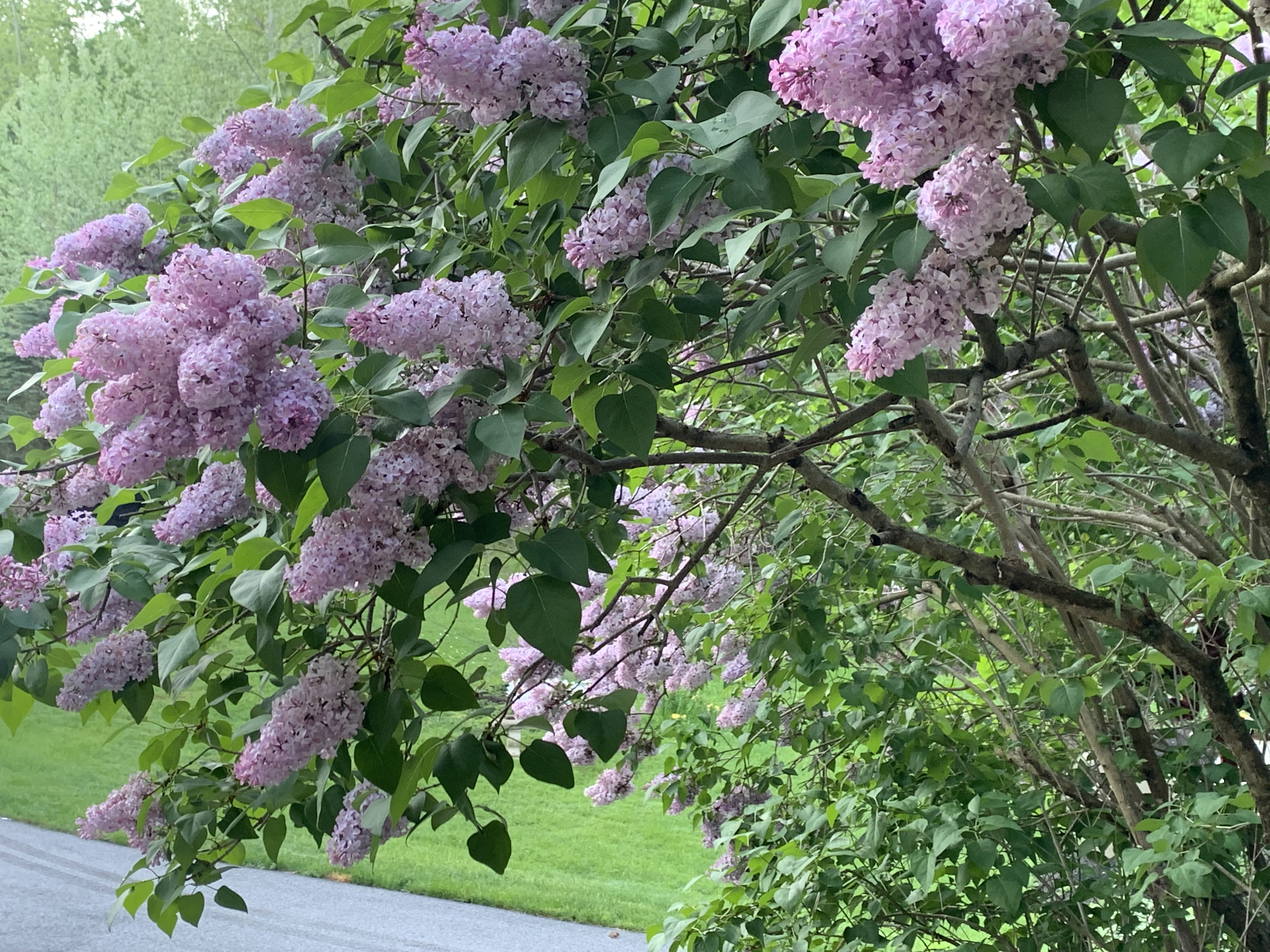
The big lilac in front of my house put on a huge, aromatic
show this spring, infusing me with a bit more confidence
in the rest of the garden season. 
When I bought my house back in November, 2007, the place was a wreck.  

Before me, it had been owned by - no lie - a schizophrenic pot dealer with a penchant for guns and a huge overestimation of his plumbing and electrical skills.  

But I needed a bargain fixer upper and this was my ticket. 

The house had good bones, though it was a wreck. The plumbing leaked, the electrical system was about as far from code as you could get. The property comprises an acre, all overgrown with weeds, dead shrubs and tangles of wild grapevine. 

However, I envisioned a place that would eventually become a paradise, a comfortable home with beautiful gardens where a weather geek like me can watch and measure the change of seasons, the pluses and minuses of Vermont weather, and for better or worse, changes in the climate.

Thanks to my husband Jeff and his exquisite design vision, the house is now gorgeous. (Bonus: Also safe and up to building code standards).And because of my love of playing in the dirt, the gardens aren't too shabby. 

This process from beast to beauty has to start from a place of potential. The house was just a simple rectangle, a blank slate on which Jeff could work his magic. 

The property had pieces that promised beauty, too. The back yard has three enormous poplar trees, The Triplets as I call them, that anchor the back yard gardens.

When I bought the house, there was a large but battered lilac bush out front just begging for some TLC.

I'm a Vermonter, and I know it's sacrilegious to destroy a lilac. And this old lilac had potential, like the rest of the property. Lilac and I were fast friends.

I quickly tore out all the dead limbs and stems. In December of 2007,  pruned the tangles. Contained the tendrils running out toward the drive. Lilac rewarded me in May, 2008 with gorgeous blooms and hasn't let me down since.

Except for one incident that wasn't Lilac's fault. I'll get to that in a bit. 

Blooms on my lilac were so profuse the branches sagged,
leaving me with this gorgeous view at my front door

Lilacs are tough old birds. They'll survive just fine for decades after the house they were near has long since disappeared. So I learned never to worry about Lilac. This guy fights back. 

In April, 2010, we had an early spring. By the last week of the month, Lilac had leafed out and had plenty of flower buds. Then on April 27-28, thirteen inches of snow flattened twelve-foot-tall Lilac to the ground. 

Then it thawed and Lilac sprung back almost as if nothing had happened. I had to remove one relatively minor branch that had cracked. 

Lilac became my measure of how late or early spring was. Lilac bloomed spectacularly by the first of May, 2012, the earliest I'd seen that happen. It was a remarkably warm spring. It ran a little late in May, 2014 after a cool spring. 

But Lilac was always reliable.

Maybe it's a sign of how off the rails the climate has gotten, but last year was the first time I've seen Lilac's spring glory diminished by goofy weather. 

Spring, 2021 was very early, almost as early as 2012. The florets were budding and growing by April 20. Then, on April 21-22, it snowed.  No problem, Lilac has proven it can handle that. Then, with temperatures in the 20s, roaring northwest winds and snow squalls ripped through during the morning and early afternoon of April 22.

That managed to kill many of the florets on Lilac.  It subsequently bloomed a little bit, but the show was very much diminished last spring. It made me wonder a little bit if gardening is even worth it. If climate change can diminish tough Lilac, what will it do to everything else, eventually. 

Apparently, Lilac wants me to buck up.  This year, another early spring, but not as early as last year arrived. There was one scare of sorts with another super heavy, wet snowstorm on April 19 that weighed down the branches, but that ended quickly with no problem.

The blooms this year were more than I've ever seen. Everyone in Vermont appears to have had a great lilac year, but Lilac by my house outdid itself. You can scarcely see any leaves, the blooms were so profuse. The branches were so heavy with blooms they sagged almost to the ground. 

Talk about encouragement! The breeze blowing the aroma of the lilacs through the house was enough to snap me out of my negative mood.'

A too-early bout with heat and humidity (yay, climate change again) made the lilac show come and go faster than usual. The blooms have faded now, but they did their job. 

Yes, I'm way behind on gardening this year.  But I can go forward with confidence, with Lilac's spring blessing. I don't know what kind of setbacks I might suffer this summer, - drought, floods, severe windstorms, spongy moth caterpillars - who knows? 

In the age of climate change, you need any type of confidence I can collect. 


Friday, September 3, 2021

Northeast Ida Death Toll Now 46; Billions In Damage, Hurricane Season Not Over

Satellite view of many of the hundreds of houses flooded
in Manville, New Jersey Thursday.
OK, the headline on this post is quite the opposite of cheery, but what can you do? 

The incredible rainfall and flooding associated with former Hurricane Ida in the Northeast is as grim as it gets. 

Deaths in disasters are always tragic to say the least and the 46 reported so far is no exception.  It's an overwhelming disaster, so all I can do is give just some of the many thoughts I've had about this horrible storm.

BY THE NUMBERS

9.64.  Inches of rain in from the storm in Staten Island

10.  Number of tornadoes confirmed in the Northeast so far in this storm

150 mph: Strength of wind in strongest of the tornadoes, an EF-3 in New Jersey, likely the strongest in state history

113 Number of people confirmed rescued by FDNY.  The actual number is likely much greater than that. 

500 Minimum number of cars and trucks towed from the Major Deegan Expressway in the Bronx after water receded and revealed the destroyed vehicles.

27.66 feet: Record high crest on the Raritan River in Manville, New Jersey.

4 Number of tropical systems that have already affected the Northeast this year. We're only half way through the hurricane season. 

DEATHS AND WARNINGS

Most victims were in cars that were swept away. I wonder about the messaging pre-flood that might have saved lives. I know this is Monday-morning quarterbacking.

People were warned days in advance that this flooding could be particularly severe. The National Weather Service offices in Philadelphia, New Jersey and New York areas did an excellent job and issued flash flood emergencies.  Calling it an emergency is supposed to be a kick in the pants.  You're never supposed to be out driving in a flash flood anyway, but broadcasting an emergency is a hair on fire moment - this is really serious.

I think the problem is in an urban environment, people think they are safer.  Sure, the car might stall in sudden high water, but you can get out. People picture truly dangerous flash floods as those walls of water, rock and mud that pour out mountains and into canyons out west, or rage through creek beds in the Appalachians.  

They don't think the Garden State Expressway or the Major Deegan Expressway in the Bronx  can become a death trap. 

I also think people understood a lot of rain was coming, but didn't realize it would be in such a short period of time. After all, eight inches of rain over the course of a day is bad, but not as bad as eight inches of rain in six hours. 

I read an article in Vice this morning that disturbed me.  A lot of those gig outfits, think Uber, Door Dash, etc. offer bonuses to these gig workers if they work in very bad weather.  So, looking to make extra money, a lot of these gig workers were out in the flash flood emergency working, and putting themselves in danger .

While these gig employers say they evaluate whether to continue to deliver in dangerous weather, I'm not buying that they do enough.  And please, if you are under any kind of weather emergency or warning, please don't contact those food delivery outfits.

You are hunkering down to avoid going out in a flash flood, blizzard, tornado, whatever. Please don''t make delivery people go out in hazardous weather. Just stay in your house and cook your own goddamn dinner.

NYC/NEW JERSEY TRAGEDIES

In New York City itself, most of the deaths were people in basement apartments. The water burst through doors and walls, and people couldn't fight the extreme torrents to get out.  

I really feel for the rescuers in New York who, as always in an extreme emergency, saved who knows how many lives.  Think about how overwhelmed they must have been.  FDNY wrote on Instagram:

"We were operating and getting numerous calls nonstop all night. We had everything from people trapped on their roofs, people trapped in completely submerged cars, trapped in basements with the doors stuck and water rapidly rising and with heavy currents of water everywhere."

Response times were slowed not only by the widespread flooding, but because the FDNY encountered lots of unreported emergencies on their way to the calls they received.

The news was horrifying to say the least, and you know there's going to be tens of billions of dollars in damage.  Aerial shots of Somerset, New Jersey showed hundreds of flooded homes in just one neighborhood.

In other areas the flash flooding came and went, with water marks left behind reaching the first floor ceilings in some buildings.

CLIMATE CHANGE

One after another, elected officials and emergency officials in the affected Northeastern states went on camera Thursday and brought up climate change.

As always, that immediately turned into a political football. Against the backdrop of this disaster, Congress is struggling with a $3.2 billion infrastructure bill that would include a lot of funding to help mitigate climate change.

Republicans and conservatives panicked. Fox News desperately worked to downplay the issue, saying Democrats are "grifting" on the issue of climate change. Another Fox pundit went so far and ridiculous to say that data proving climate change is "never there."

Um, try a simple Google search, Fox bros!

LOUISIANA

Meanwhile, we can't forget Louisiana.  The death toll there has risen to 11 and 900,000 people still don't have electricity.

More deaths are inevitable down there as stifling heat and humidity and the long-lasting lack of electricity are combining to make things deadly.  The heat can kill people, generators can create deadly carbon monoxide and people can get hurt and killed trying to clean up with chain saws and whatever tools they're using. 

Once again, as in Katrina, and in so many disasters in the United States, the poor, vulnerable and elderly seem targeted for abuse by profiteers or crooks just trying to save a buck.

In one incredibly infuriating case, more than 800 residents of seven  evacuated nursing homes in Louisiana were literally warehoused.  They were brought to a decrepit warehouse where they were put on mattresses on the floor, not fed and not socially distanced to protect against Covid. So far four of those elderly people died.

According to NBC: "The (Louisiana) Health Department...alleged that when health inspectors visited the center two days after Ida hit, they were 'expelled' and prevented from assessing conditions."

A lot of facts still need to come out, but why did the operator of the nursing homes put these people in the warehouse, try to cover it up, and not reach out for help to move the people in their care to safer places? To not lose money, probably. Hell, who cares of some old people die, as long as I keep my cash, right?

That seems to be the prevailing attitude in some circles today.  The 843 people who were brought to that awful warehouse have since been moved to safer locations.  

I worry more said crimes against disaster victims will surface. The vast majority of Americans are super generous toward people hit by these weather extremes. Too bad a few cheats want to dismantle that aid. 

Sunday, May 16, 2021

It'a Beautiful Peak Spring in Vermont, And Kinda Into Summer Now

Flowers blooming in my St. Albans, Vermont garden
this morning. It's peak spring! 
It is such a pleasure to be outdoors this time of year. 

The new leaves on the trees are now unfolding so fast you can almost watch them expand if you just stare at them  Fragrances of lilac and apple blossoms and the organic aromas of new growth make everything outdoors (except for me) smell so wonderful.  

The warm light of peak spring starts earlier than most of us get up in the morning and lasts well into the evening. 

Happy birdsong fills the air with eggs and hatchlings in the nests built in the past month or so in the shed rafters, atop outdoor lights and the crooks and crannies of the house deck supports. 

Take the dogs outside, and the roll around blissfully in the cool, sweet green grass.

Only the clouds of black flies that descend as soon as the breeze slackens takes away from this heavenly panorama.

I've always felt lucky to live in Vermont, where we're rewarded with such a glorious time of year after a long winter. I feel doubly blessed this year. The Covid pandemic has so far spared my family, my husband, myself. 

I've never taken springtime in Vermont for granted. This year, that's especially true. 

At this time last year, as the terrible pandemic took hold and grew, I wondered it that would be the last time I would be able to enjoy the season. Like everyone, I was at risk of losing the physical ability to fully enjoy the outdoors. Or lose my sense of smell, which is a real tragedy for anyone this time of year. 

The risk isn't over of course. But I'm still healthy, and I've had my Covid shots. So have my husband, siblings, mother, in-laws.  This all makes this sweet, colorful and busy season all the better. 

Even though it's the height of spring, I also have a broad definition of what constitutes summer, and to my mind we've arrived at that season. 

Oh, sure, we'll still have chilly days. There could still be a late frost. It's not unheard of to snow in Vermont this late in the season, though that's quite rare. 

Hosta leaves  unfurling in my St. Albans, Vermont
gardens this morning

But we've entered our first sustained period of what can easily pass for summertime weather. It got up to 78 degrees in Burlington Saturday, making it the warmest day so far this year. It could reach into the 80s later this week. 

We're lacking the rain we need, but we at least see attempts at the summertime ritual of afternoon and evening showers and thundershowers popping up in the afternoons and evenings. 

The showers will be few and far between and generally light for the next few day, but they'll be there. 

I see a familiar summertime pattern in the meteorological charts, too.  A big northward bulge in the jet stream is developing in the eastern United States this coming week. 

It will bring bonafide heat to parts of the East, with many places hitting 90, with of course those aforementioned 80s in Vermont by midweek. 

Another familiar summertime pattern are what a lot of us weather geeks call "ridge runner" disturbances. Those are little weather systems that ride the northern periphery of those northward bulges, or ridges in the atmosphere. 

As is often the case in the summer, we might well be in the path of those ridge runners later this week. If that's the case, those ridge runners could set off a few more of those scattered afternoon and evening showers and storms by late week. 

Please do yourself a favor and go outside and enjoy nature at its full glory. It'll clear your mind, bring you a measure of piece, improve your mood. Peak spring in Vermont is some of the best psychiatric medicine available in the world. And it's free!