Vermont weather geek's hodgepodge of weather and climate news and opinion. Often Vermont focused, but taking a national and global approach, with sometimes an appropriate dash of fun, outrage, cynicism and compassion.
This is Trishul Bazaar, Nepal, before and after the immense water and debris flow on August 26 World Weather Attribution says that climate change was a very likely culprit in this calamity
Climate change was a core contributing factor in last month's horrific glacial mountain collapse and mega-flash flood and debris flow that killed thousands of people in Nepal last month.
The death toll made this disaster was especially horrific. In Nepal, 1,403 bodies had been recovered as of last week. The number of missing people has been revised upward to 6,150. In neighboring Tibet, 43 are known dead and 519 are missing.
Several factors went into the disaster, but climate change got the ball rolling, according to areport from World Weather Attribution, a group of scientists who study how individual disasters are influenced and often made worse by climate change
"Relentless warming has lifted the altitude of the freezing threshold on the high Himalayas, exposing ic and permafrost deep in the bedrock to higher and longer thaw temperatures, weakening mountain slopes," according to the report.
World Weather Attribution formed a team of researchers from ten countries. They were experts in glaciology, mountain hydrology, climate science, humanitarian aid, seismology and social science to study how this calamity unfolded and what caused it.
The disaster started when a large rock wall collapsed on the Langtang Lirung Mountain, elevation 23,734 feet. The rock slide also caused part of an overlying glacier to collapse. The rock-ice avalanche quick turned into an incredible debris and water flood that traveled downstream at speeds of up to 117 mph.
The calamity happened on August 26, but may have had its roots in 2015. A magnitude 7.8 earthquake that year might have further weakened the slope, but the precise role of that earthquake remains uncertain, says WWA.
Then there's climate change
"Warming and permafrost degradation likely weakened the source rock wall by increasing bedrock temperatures and thawing ice within fractures. Loss of ice bonding reduces fracture strength, while meltwater can increase water pressure and further destabilize pre-existing geological weaknesses. Thus, permafrost degradation may have acted aa an additional climate-related factors pre-conditioning the slope for failure."
On top of that, glaciers in the region have been losing mass for decades under the onslaught of climate change. Since 2010, the rate loss of the Lantang-Lirung glacier has accelerated. Thinning glaciers can change stresses on adjacent rock walls, which in turn can increase slope instability. Combined with more meltwater than in earlier decades. It's possible this could have worsened the event.
All this is because it's above freezing at higher and higher elevations in the Himalayas more frequently due to climate change.
It didn't help that the area where this disaster started, and the river valley it pummeled, had their warmest July and August on record. This came after unusually heavy snowfall in late 2025 which contributed extra meltwater before the collapse.
WWAwouldn't go so far as to say that this disaster couldn't have happened in the days before climate change really started to alter the world. It would require a lot more study to absolutely prove the connection. "Rapidly rising temperatures at a rate beyond the global mean as a result of fossil fuel emissions increase the likelihood and severity such hazards in the Himalayas,WWA concluded.
In other words, this could happen again.
With this in mind, Nepal is planning to use the World Weather Attribution study to request $20 million from the United Nations. It's from the UN Fund for Responding to Loss and Damage, which helps countries affected by climate change.
If the funding goes through, it will be a drop in the bucket compared to what Nepal needs. It's estimated that Nepal will need about $5 billion to recover from this tragedy.
They've always warned us climate change would be expensive, and there you go.
The tragic aftermath of the epic Nepal flood last week. We're not 100 percent sure yet whether climate change was a contributing factor to this calamity. However scientists say a warming world increases the odds something like this will happen again in Nepal, or anywhere else with tall mountains and glaciers.
You've probably seen those horrific images by now of that impossibly enormous flash flood that blasted down a Nepalese river valley this week.
The news on the aftermath keeps getting more and more tragic and horrifying.
As of early Sunday, the death toll from the wild flood stood at 794, according to the BBC. Another 2,502 people are missing.
The flood occurred on the Nepal-Tibet border, but many foreigners were in the disaster zone. India reports 320 missing people. China has nearly 100 nationals missing. Ninety people from the United States are also missing. So are dozens of people from Ukraine, Malaysia, Australia, the UK and other countries.
There were some bright spots of survival. A school headmaster made a snap decision to evacuate 900 studentsin the building after hearing reports something was wrong upstream. He also got word to another 800 students who were on the way to school to stay uphill and away from the school.
All the students ran up a hill and survived. The headmaster said that had he waited another 10 minutes, himself and all the students would have died. He could have made another decision. The school was a fair distance above the river and normally would not have been threatened by floods. This time was different.
The Nepalese calamity was shocking, beyond tragic, and scary as hell. And something like this could happen again as climate change warms the planet and thaws ice and permafrost on tall mountains around the world.
WHAT HAPPENED
We don't yet know whether climate change had a hand in causing the tragedy in Nepal. It could have been a freak occurrence. More research on the disaster needs to be completed before we can draw firm conclusions. A full understanding of what happened will take months.
"High-resolution images taken by satellite monitoring company Planet Labs show the site of the apparent landslide high in the Himalayas, close to the Nepal-China border." (Editor's note: China claims Tibet, but Tibetan exiles dispute that. The China in that quote is actually Tibet). ....."In the 'before' image a glacier can be seen looming some 4,000 feet above a narrow valley, emptying into the meandering Lhende River.
Afterward, the glacier appears smaller by about 2 million square feet - equal to the area of about 25 professional soccer fields. The valley is strewn with ice and mud. And the river is swollen beyond its banks, submerging the surrounding vegetation beneath murky brown floodwater."
When the glacier and rocks collapsed into the valley, seismographs detected it. At first geologist thought there had been an earthquake measuring 5.2 on he Richter scale, but the vibrations detected were the actual glacial collapse,not an earthquake.
Friction of the rocks and avalanche debris as it fell 1200 meters (nearly 4,000 feet) melted some of the ice. By the time the whole thing reached the valley it was a slurry, like wet cement. The New York Times was able toobtain and verify a videoof huge chunks of ice falling from the Langtang Lirung mountain and crashing to the valley floor below.
The debris briefly blocked the river on the valley floor and water piled up behind all those rocks and ice. But this wasn't a classic glacial lake outburst.
Those outbursts are caused by meltwater trapped behind glacial ice. It finally breaks through, and a rush of water flows downstream.
This was much worse. Water behind that enormous pile of unstable debris finally collapsed it, and the huge volume of slurry raced downstream. As it roared downstream, the mass of water and debris absorbed more trees, rocks and other debris, making the onrushing tidal wave larger and more powerful.
Nobody in the valley below knew what was about to hit them. It hadn't rained much in the days prior to the huge flood. It was rather sunny and nice that day. For many, the first warning was the roar of the onrushing debris, mud and water. It was too late to escape.
CLIMATE CHANGE?
As I mentioned above, we don't yet know if climate change had anything to do with the calamity in Nepal.
However, those rising temperatures across the globe thaws permafrost in high cold mountains. That permafrost is sometimes the "glue" that holds rock and ice together atop steep mountain slopes. Melt the permafrost and everything falls apart.
Scientists are saying that fact makes disasters like this one more likely in the coming years. Not only in Himalayan mountains, but any high mountain range in the world with glaciers clinging to their upper slopes.
As the Washington Post notes, we have seen several glacial collapse disasters in recent years, either through the actual collapse or the floods they often cause. Glacial collapses buried a village in Switzerland in May, 2025.
Investigators want more information on exactly what happened in that Himalayan mountain valley. And in the rocks and glacier above.
The fear is this type of thing will happen more frequently. "Glaciers are going to shrink and melt. Permafrost....will be warming and weakening and degrading over time. You'll get landslides and debris flows.....You take all that together and you can say climate change is going to have a destabilizing effect on these high mountain regions,"said Simon Cook, a University of Dundee glaciologist, who is part of a team reviewing satellite images that show where the disaster began.
The planet's tectonics might have worked in concert with climate change to cause the calamity.
The glacier involved in the disaster is way up high on a Himalayan mountain called Langtang Lirung, with an elevation of 23,734 feet. At least right now.
Langtang Lirung, like the rest of the Himalayas are slowly rising due to the collision of tectonic platesdating back tens of millions of years. The Himalayan mountains continue to grow in elevation at roughly the rate of 0.3 inches per year. Over millennia, that's thousands of feet.
Glaciers have been on these mountains for millennia, too. As the mountains grow taller, they ever so slowly get steeper. Over thousands of years, the steep slopes become too much for the glaciers, and pieces of them break off.
Now, with the permafrost melting, making the rocks and the ice become more and more unglued, the chances of those steep slope glacier collapses happening prematurely have increased exponentially.
Early warning systems in the region where this disaster happened weren't great. Let's hope governments upgrade these systems in Nepal, and near other risky mountains, including some in the United States.
Videos:
The giant, sudden flood overwhelms and destroys a hydroelectric dam that was under construction. Click on this link to view, or if you see the image below, click on that.
This one has been all over social media, but it's still incredible dramatic and scary. A family is trapped on the upper floors of a house amid the raging torrent of the Nepal flood. Somehow the house remained standing and the family survived.Click on this link to view, or if you see the image below, click on that.
This is a good video with several clips that give you an idea of the breadth and power of the extreme Nepal deluge. Click on this link to view,or if you see the image below, click on that.
One video, taken from one location, shows how quickly the disaster escalated and how fast it engulfed surprisingly large areas, including some that at first you would have thought were safely above flood level. Click on this link to view,or if you see the image below, click on that:
Hundreds of hikers being rescued from a blizzard near Mount Everest after the unseasonable storm.
About 1,000 hikers were caught in a blizzard Friday and Saturday up on Mount Everest, or near it as unseasonable weather took hold.
Hiking in the region is most popular this time of year because the wet monsoon season is usually over and October skies are usually clear in the region.
Temperatures are also usually mild in the region this time of year. And the weekend coincided with a local holiday in which tens of thousands of people traveled to the mountains.
Most of the hikers weren't the type seeking to reach the top of the world's highest mountain, but they were pretty far up there. The stranded hikers were at an elevation of around 16,000 feet above sea level. Mount Everest is about 29.000 feet tall.
USA Today reported that officials recruited hundreds of local villagers and rescue teams to help remove snow blocking access to the area the hikers were trapped.
"'About one-third into the trek, it began to rain and the rain kept getting heavier,' Chen Geshuang, a 28-year-old astrophotographer who began climbing Saturday afternoon but decided to retreat Sunday, he told NBC in an online video interview.
'Later, it turned into sleet, and eventually a full-on blizzard.'
Overnight Saturday the snow intensified, with almost continuous lightning. Hikers had to keep shoveling snow out of their tents, and by Saturday morning, much of the area was under three feet of snow.
"It was the most extreme weather I've ever faced in all my hiking experiences, without question," said Dong Schuchang, a Chinese trekker who was caught in the storm. He said the blizzard a "violent convective snowstorm."
As of today, it looks like most if not all the hikers are out of the danger zone. Some have been treated for hypothermia but so far, no deaths have been reported.
However, at lower elevations, the heavy snow was of course heavy rain. That rain set off a deadly flood in Nepal.
The Nepalese government on Saturday grounded all domestic flights because of the bad weather, but flights resumed Sunday. Major highways connecting the Nepal capital Kathmandu were closed by landslides, but some of them have since reopened.
The entire region affected by the storms is popular with tourists, but the bad weather illustrates how chaotic things can get when the weather doesn't behave the way it usually does.
Extensive flooding in Kathmandu, as seen in this aerial view. AP Photo by Gopen Rai.
While we in the United States are dealing withapocalyptic floodsin the Southeast, other spots in the world are dealing with much the same thing.
Both Nepal and Mexico in the past week have endured floods on the scale, or nearly on the scale of what we've seen in North Carolina and surrounding states.
NEPAL
The flooding in Nepal focused in and around Kathmandu, where torrential rains have hit since Friday. In Nepal, at least 193 people have died and more are missing,according to the Associated Press.
Much like Asheville, North Carolina, Kathmandu was largely cut off from the outside world due to the flooding. Though Kathmandu is much bigger than Asheville, with a population of about 850,000.
Rainfall with this storm ranged from about nine to 12 inches in and around Kathmandu, leading to the flash flooding. That's about the normal rainfall there for the entire month of September.
The trouble in Nepal was also wide-ranging and multifaceted. One example, according to the AP:
"A landslide killed three dozen people in a blocked highway about 10 miles from Kathmandu. The landslide buried at least three buses and other vehicles where people were sleeping because the highway was blocked."
The flooding hit near what is usually the tail end of Nepal's monsoon season.
Poor land use made the flooding in and around Kathmandu worse than it otherwise would have been, as Al Jazeera reports:
"Urban planner Neeraj Dangol said multiple factors were behind the latest disaster.
The Basmati River, he says, was narrowed due to haphazard planing and urban development that took place after a drastic population boom in Kathmandu in the early 1990s.
'In the past 40-50 years, houses and roads have been built on areas that used to be part of the river system,' Dangol explained."
Formerly porous agricultural land, which used to absorb water, is now covered in concrete, which increases runoff. There's also been a lot of deforestation in Nepal, which also contributes to worse flooding.
Finally, as in so many other places the world, climate change has increased the intensify of rain storms, which of course worsens flooding.
MEXICO
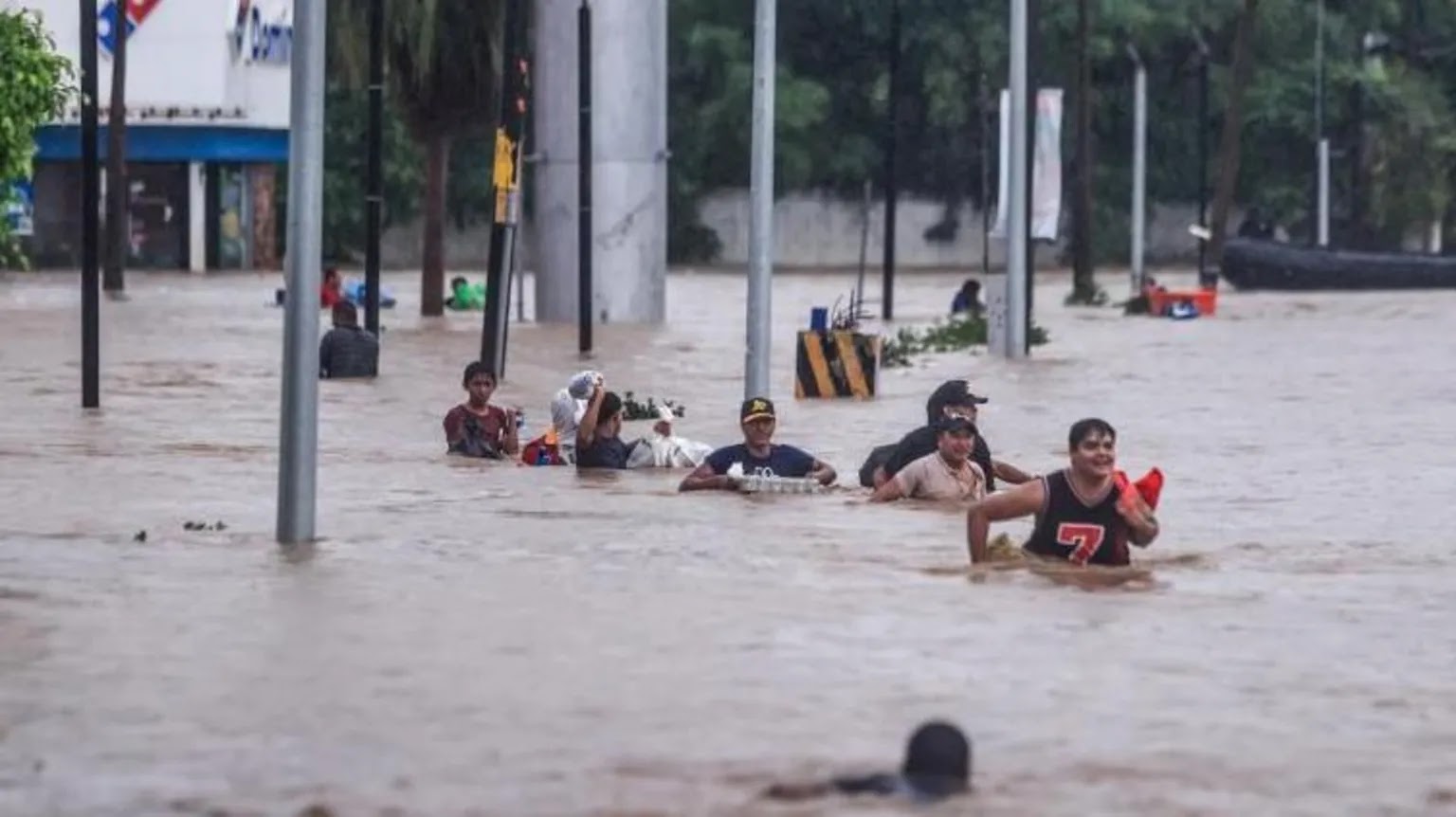
Severe flooding in Acapulco due to Hurricane John
Parts of Mexico's Pacific Coast and nearby mountains are reeling from what's been described as "Zombie" Hurricane John.
It was called that because it smacked into the Mexican coast southeast of Acapulco last week as a Category 3 hurricane. It then dissipated inland, and you'd think that was that.
But then the remnants drifted back out over the warm Pacific Ocean waters, regenerated into a hurricane and then again hit the Mexican coast. That's why Hurricane John has been called "zombie."
The effects were devastating.The BBC reportssome places had nearly a year's worth of rainfall in just a few days.
Acapulco, completely trashed by Hurricane Otis last year, was only just getting a recovery into swing when Hurricane John hit, flooding swaths of the resort city. City officials pleaded with anyone had boats to help rescue people in flooded neighborhoods. Some families were stranded on roof while the water rose around them.
Scenes from Nepal this week really are similar to those I've seen from North Carolina.Click on this link to view, or if you see the image below, click on that:
In Mexico, landslides were also part of the disaster due to "Zombie" Hurricane John. Again, click on the this link to view or if you see the image below, click on that.
Computer imagery showed intense heat in Asia this past Monday. Since then the heat continued south, eased in northern China and increased in Japan/South Korea.
Sure, we had summer in April this month in Vermont.
But if you thought our heat wave was something, check out these temperatures from parts of Asia. Around the time we had our heat wave, here's how theWashington Post describesbig swaths of Asia:
"Numerous heat records have been broken across Southeast Asia, China and other parts of the continent in recent days as the region remains in the grip of a dangerously scorching heat wave, with Thailand in particular experiencing unusually extreme conditions. Weather historian Maximiliano Herrera is describing it as the' worst April heat wave in Asian history.'"
April and May are usually Thailand's hottest months, but last week got absolutely ridiculous. The temperature last Friday reached 114 degrees in the town of Tak. This established the record for the hottest temperature anyone has ever seen in Thailand.
As that record heat hit, Thailand was celebrating that country's New Year's festivities. Because record hot weather enveloped the country, people were advised to tamp down their parties and stay indoors to avoid heat stroke.
Up in China, at least 109 weather stations in 12 provinces recorded their hottest April temperatures on record, says the Washington Post.
"The hot days had been accumulating over the past few weeks, with Yuanjiang in Hunan province having exceeded 95 degrees for 22 straight days as of last Friday."
Other nations in Asia shared in this weird heat wave.
Bangladesh ties its national April highest temperature at 109 degrees. The Bangladesh capital, Dhaka, reached 105 degrees, its hottest temperature since 1960. Temperatures reached as high as 111 in Myanmar and 107 in Nepal. Intense heatkilled at least 13 people in India. Concern was rising in India with memories fresh from an even more intense, deadly heat wave last year.
Early season heat waves like the one in Asia can be more dangerous than similar hot spells later in the season. People become somewhat acclimatized to the heat later in the season. Early heat wave come before people's bodies are ready for it. Some evidence suggests early season heat waves can be more deadly than later ones.
If you're a regular reader of this here blog thingy and you think I've put up a lot of posts about record heat pretty much everywhere, you're right.
And you will have seen this disclaimer, which I need to repeat. Heat waves have always happened all over the world. Now, however, we are in a mostly man-made climate change regime. Heat waves have become more frequent, more widespread and more likely to exceed all time record highs.
It can happen anywhere, anytime. This month, it's been in places as different from each other as Vermont and Thailand.