Showing posts with label Greenland. Show all posts

Tuesday, January 20, 2026

Trump Says Climate Change Is A Hoax. But That's Partly What Got Him So Obsessed With Greenland

Donald Trump's desire to seize Greenland is likely less
about national security and more about mining the 
island's riches, and climate change. 
If I had a penny for every time Donald Trump said climate change is a hoax, I'd be as rich as he claims to be. 

And yet. Trump's latest foolishness with Greenland has been brought about in large part by the very climate change he denies. 

Let's set the scene: 

As you may have heard, Trump is insisting that the U,S. annex Greenland. He keeps yakking about "national security," that Russia or China will arrive in take over Greenland in about an hour unless the U.S. does so first.

In reality, it probably isn't so much about security. Existing security agreements, and NATO, preclude Russia and China from causing too much trouble in Greenland.

Remember, the basis of NATO is if one member is attacked, the whole organization is attacked. So in a world without Trump, if somebody invaded Greenland,  U.S. and NATO forces would defend the Arctic island. 

I don't believe China or Russia would take such a big risk. I've seen a lot of analysis out there that says the same thing. 

Of course, if the U.S. attacked Greenland, that would be a war against Denmark. As PBS notes, NATO has no obvious way of dealing with open conflict among its members. 

That's why an American invasion or non-consensual takeover of Greenland would probably end NATO.

Here's why Trump might want to see NATO go the way of the dinosaurs: 

Trump and his oligarch cronies really want to exploit the natural resources up there in Greenland, including diamonds, lithium and copper.  These minerals are super valuable nowadays because we need them to build things like batteries and smart phones.

I also surmise that Trump sees NATO as an obstacle to obtaining those riches. He's probably looking for a convenient way to put NATO into the garbage dumpster of history.

Or something like that. 

Trump doesn't even have to take over Greenland for "national security." 

A 1951 treaty with Denmark gives the U.S. military carte blanche to do pretty much whatever we want in Greenland's territory. We could send thousands of troops up there tomorrow if we need to. So, as futurism.com tells us, there's no national security need for us to take over Greenland. 

Which means "national security" is just a fig leaf for Trump and his gang to make more money off his presidency. It's all transactional. 

IT'S CLIMATE

The Washington Post had a nice analysis of the situation in Sunday's editions. This one paragraph helps crystalize the situation. And tells us why climate change matters in all of this.  

"The prospect of the United States using military force against the NATO ally, as Trump has floated, could end the decades-old defense pact. His bid for the territory is one of the most concrete examples of how climate change is influencing geopolitics. As the northernmost parts of our planet continue to warm, the effects could change the ways the international community operates."

 The Arctic is warming at four times the rate of the rest of the world. The extent of Arctic sea ice is declining. That, in turn is exposing some potential tantalizing sea routes on top of the planet. 

 Here's how WaPo lays out the stakes:

"'The freeing of the Arctic from sea ice, at least seasonally, will create an entirely new theater for economic and security competition,' said Joseph Majkut, director of the energy security and climate change program at the Center for Strategic and International Studies. 'And while we've know that is going to be the case for some time, it seems we're at an inflection point.'"

A study in the journal Nature said that if the planet warms by a total of 2 degrees Celsius over the average in the late 19th century, the open water period in the Arctic would increase to 63 days each summer.  If that warming goes above 3,5 degrees above the Victorian Age climate, the Arctic could be open for shipping at least three months out of the year.

Of course we don't know how long it will take to get that warm, so all bets are off. 

There's another issue related to the climate change that Trump says is a hoax. As Greenland's vast ice cap inexorably melts, the diamonds, lithium and copper Trump and his billionaire buddies covet become more accessible.  

"His fixation on Greenland is an admission that climate change is real," John Conger, and advisor to the Center or Climate and Security said in the New York Times, as futurism.com points out

Trump probably also wants Greenland so he can change the rules up there. 

The New York Times notes that Greenland has banned uranium mining. Uranium is often found right alongside rare earth minerals like lithium. The ban is already facing legal challenges, and if Trump takes over Greenland, that no uranium rule would be gone in a flash.

It turns out Trump thinks climate change is real. The "hoax" language he uses for our warming world is just one of many ploys to gin up his cup. 


Sunday, December 28, 2025

Trump Administration's Obnoxiousness With Greenland Is Tacit Acknowledgment Of Climate Change

The United States is again making dumb noises about
annexing Greenland, diplomacy and legality be
damned. While the Trump administration denies
climate change exists, this whole mess
is largely about climate change. 
Greenland is back in the news again, as the Trump Administration is ramping up its efforts to take control of the big Arctic ice heap.  It's a move that practically nobody else wants other that Donald Trump and his not-so-merry band of MAGA cultists. 

One irony is that Donald Trump denies the existence of climate change, yet that very real warming of the planet is a big part of what's behind all this. 

To back up here, Trump last week appointed Louisiana Gov. Jeff Landry as his envoy to Greenland. Landry said he would travel to Greenland to convince people living there to become part of the United States. 

Good luck with that. 

Greenland is a self-governing Danish territory. Officials in Greenland, Denmark and the European Union unanimously condemned Trump effort to annex Greenland.  A big majority of Greenlanders want increased independence from Denmark, but they really, really don't want to become part of the U.S.

Somebody from MAGA always says the quiet part out loud, and the ever-reliable Fox host Brian Kilmeade gave us this:

"Greenland has been ignored by Denmark for decades. Now they're not, because we have shown interest. They have about 60,000 people there and we have a huge military base. Look, we are going to need their natural resources to mine them - you'll (Denmark) be able to get some of that. But in the meantime, we have to expand our base there and access to the waterways, because the Arctic is melting and we need access there. 

Russia and China is (sic) trying to dominate. Plus, what are we in, the era of the Viking? What is Denmark doing in our backyard?"

Phew! There's a lot to unpack there. Our "need" for natural resources, as if we could just go in and take them.  Sure, Donald Trump said we need Greenland for security, not minerals. But it's about the minerals as much as it is about security. Especially in the sense of  how much money the grifters associated with Trump can make from exploiting Greenland.  

Kilmeade seems to think it's horrible that puny little Greenland wants to control its own future and puny little Denmark should have the gaul to be in control of Denmark.

Greenland is in our backyard, since it's hooked on to North America. Trump is like the homeowner who sees a ball accidentally thrown into his yard by neighborhood kids. He's the type that would keep the ball instead of throwing it back over to the kids. 

CLIMATE CONNECTION

But since this is a climate and weather blog, there's one piece in Kilmeade's screed that I want to focus on. It's where he said "the Arctic is melting."

I thought all the MAGA types deny human-caused climate change. They say it's a hoax. So why is the Arctic melting? It's true that Greenland is pretty steadily losing some of its massive ice cap to a warming world. 

Maybe Kilmeade will sputter that the climate changes "naturally," but how do you explain such a massive melt that developed over decades, not centuries like most of Earth's past episodes of natural warming and cooling?

Ultimately Trump's one-sided crush on Greenland is about the climate change that he publicly denies exists. 

As Al Jazeera tells us:

"Climate change and a rapidly melting ice sheet are the main reasons the Arctic has become a geopolitical hotspot

The Arctic is heating at a rate four times faster than the global average, increasing its accessibility for maritime trade routes and resource exploration - including by non-arctic countries as well as those with an Arctic presence. 

China has deployed vessels capable of serving both military surveillance and research functions in the region. The purposes are to collect data and secure access to resources and shipping lanes, which are emerging as a result of melting ice."

In addition, Russia is deploying missile systems and weapons testing in the Arctic, and has grown its naval presence near the top of the world. Canada is planning to shore up its military and diplomatic presence in the Arctic because of those Chinese and Russian moves in and near Greenland. 

So the security risk is real, but as usual, Trump's bluster, lies and utter untrustworthiness is botching it. 

Russia and Chinese military and espionage geeks are undoubtedly loving all of this.

What probably would have made a lot more sense was to light a fire under the European Union over the Arctic security threats, then negotiate some sort of alliance involving Denmark, the U.S. and other European nations as a counterweight to Russian and Chinese threats in Greenland and elsewhere in the Arctic.  

But nope! Trump just has to be a clownish bully to appease his own fragile ego and the expense of the rest of the world. 

For years we've been told that a warming planet would make political, social and military conflicts more likely. It's too bad Trump is working os hard in aiding and abetting the "hoax' climate change to make all that happen sooner and more dangerously than most of us thought.   

Saturday, August 23, 2025

Arctic Sea Ice Melting Slows Despite Hotter Atmosphere

Dire warnings that Arctic sea ice would be a thing of
the past by several years ago hasn't happened. A 
new study explains why those warnings were
false alarms - but only for now. 
This sounds like great news:

Despite the increasing pressure of climate change, Arctic sea ice decline has slowed quite a bit. 

The slowdown has been noticeable in all months of the year.  The month of September has seen no statistically significant decline in sea ice over the past two decades. 

The melt rate per the past 20 years has been at least twice as slow as the longer term rate. 

But when it comes to climate change, there's never good news.  This slower melt won't last forever. More on that in a bit. 

Arctic sea ice is important because what goes on at the North Pole doesn't stay at the North Pole. If the ice went away entirely during summers,   the pace of Earth's warming could increase. White ice reflects away the sun's heat. Blue ocean water absorbs it. 

The Arctic is already warming faster than the rest of the planet and if the ice goes, the heating up there would really ramp up. 

An ice-free Arctic would accelerate climate change and throw things even more off balance than they already are. That, in turn could lead to even bigger climate extremes than we're seeing now.

Even if all that climate bad stuff doesn't happen, an ice-free Arctic would invite even more ships, resource mining,  geopolitical conflict, population and everything else that would dangerously pollute what has been a rather pristine environment.

THE STUDY

This slow Arctic melt all comes from research recently published in Geophysical Research Letters. 

Per the study's abstract:

"Most of the evidence from these climate models suggests that natural climate variations have played a large part in slowing the human-driven loss of sea ice. However, it is not entirely certain whether changes in the human influence on climate (the "forced response") have also contributed.

Overall, while it may sound surprising that Arctic sea ice loss has slowed down even as global temperatures hit record highs, the climate modeling evidence suggests we should expect periods like this to occur somewhat frequently."

The researchers ran climate models which show natural cycles can create these pauses in Arctic melting.

"Even though there is increased emissions (and) increased global temperatures, you can still get periods where you have very minimal loss of Arctic sea ice for sustained periods," said Mark England, lead author of the study. 

Energy always transfers back and forth between oceans and the atmosphere, with the oceans able to store much more energy than the air. 

There's natural cycles in which the oceans take in a little more energy than normal, which makes the atmosphere a tad cooler. Those cycles also sometimes allow the atmosphere to keep a slightly greater share of energy, so the climate warms up. 

The study concluded that natural cycles kept waters around the Arctic a little cooler, so the rate of ice loss has slowed. 

Mark England,  lead author of the study, said that without climate change, sea ice might well have expanded during the cycle we're in now.  

The study helps explain why dire predictions of an imminent summer time ice-free Arctic never came to pass. 

Sea ice in the Arctic hit record minimums in 2007 and 2012, leading to speculation the Arctic could have its first ice-free summer by 2020.  In hindsight, the researchers wrote, that idea was overly alarmist. 

MELT TO RESUME?

All good things must come to an end, though, and so will this cycle that's been preserving the Arctic sea ice. 

The current melting slowdown could last another five to 10 years, according to the climate models and the study. When that happens (It's a when, not an if) the ice loss would accelerate and at that point we might actually see the demise of Arctic sea ice during summers. 

In the short term, the ice up there is clearly in short supply up in the Arctic, despite the slowdown in melting. 

In its recent July climate report, the National Centers for Environmental Information said Arctic sea ice was the fourth smallest on record for July, at 420,000 square miles below average.  

Another melt zone scientist watch closely is Greenland. That ice will never entirely go away, at least not for hundreds, more likely thousands of years, if ever

Greenland matters even more than the Arctic because whatever melts off of Greenland becomes sea level rise.   If the ice on the Arctic ocean melts, it doesn't really raise se levels. It's like the ice in your gin and tonic melting. 

Greenland is probably subject to cyclical weather and climate patterns too, but the research we're talking about in this post didn't address that. 

This year, the Greenland melt has been above normal once again, but it's not setting records. There was a lot of melting between July 7 and 20, which tipped the scales to above the 1981 -2019 average for total melt extent, say the National Snow and Ice Data Center. But overall, the number of days with melting lagged behind some of the warmer summers in the recent past. 

There has been a last minute spike in Greenland ice melting in the past few days, but once that tapers off, that'll be mostly it for 2025.   By early September, the Greenland melt season is pretty much over.  

Wednesday, March 12, 2025

Greenland Atmospheric River Temporarily Slowed The Island's Inexorable Ice Cap Meltdown

A massive atmospheric river hit Greenland in March, 2022
and dumped so much snow that it temporarily  halted
the dangerous melting of its massive ice cap. 
As land-based glaciers melt and wilt under pressure from climate change, sea levels keep rising as a result . Long term, it's easily one of the biggest threats to us humans as the world warms. 

That's one of the reasons why climate scientists are obsessed with Greenland. There's a lot of ice up there, and the more it melts, the more the sea levels rise. 

 If all of Greenland's ice mass melts, which I admit won't happen anytime soon, global sea levels would rise by an average of 23 feet. 

Which would be absolutely devastating. Even a couple feet of rising seas would be a zillion dollar, life threatening, world-changing  mess. So you see why Greenland is important.

It's mostly bad news as big bits and pieces of Greenland's ice melts every year in the stew of a climate change summer  Because they are human, scientists do look for, ore at least vaguely celebrate, any piece of good news. 

They found one of those happy pieces of news in a massive atmospheric river that hit Greenland in 2022. 

I've told you about atmospheric rivers in past posts.  Those are those ribbons of high moisture air that come off oceans, hit land and dump often incredible amounts of rain or snow over a relatively narrow area.

In one sense, they're good, as they supply a lot of the needed moisture that the West Coast of the U.S. and other place need. But they're very often bad, causing intense flooding. 

The atmospheric river that scientist seized upon from 2022 turned out to be a good thing. 

Per Gizmodo:

"A research pair has investigated the recent impact of an intense atmospheric river - a channel of water vapor that brings moisture and heat from warmer oceans to colder regions - on Greenland's ice sheet. 

Unexpectedly, they found that this phenomenon deposit 16 billion tons of snow on Greenland, thought to temporarily slow its ice melt. As detailed in a study published March 3 in the journal Geophysical Research Letters, atmospheric rivers might have a more positive impact than researchers had theorized.."

A positive impact, sure. But certainly not a cure-all.

The uber-snowy atmospheric rive that struck Greenland in March, 2022 slowed the island's yearly ice melt but didn't stop it. 

The Greenland ice sheet ultimately shrunk in 2022, just as it did for the previous 26 years and just as it did for the subsequent two.

But at least for now, atmospheric rivers might not always be the ice destruction events in Greenland scientists feared.  

The March, 2022 event suggests that Greenlandic atmospheric rivers could be snowy. Very, very snow. That buys just a bit of time in the Greenland ice melt derby. After all, the amount of snow that hit Greenland in that 2022 event boggles the mind. 

THE STORM

That same atmospheric river pummeled Svalbard, an island in the Arctic north of Norway with intense , highly unseasonable rain. 

Researchers who took samples and ice core readings after that epic atmospheric river found some surprising results in Greenland, as Gizmodo tells us:

"The ice core section revealed that the atmospheric river had brought 16 billion tons of snow to Greenland, single-handedly offsetting the ice sheet's yearly loss by 8 percent in just three days." An additional 4.5 billon tons of snow fell over the next few days as the atmospheric river slowly waned. 

Spring, 2022 in Greenland was otherwise unusually warm, so the atmospheric river prevented a LOT of potential ice melt. 

There's no guarantee, of course, that atmospheric rivers will bring welcome snow blitzes to Greenland. As the world continued to warm, a future March 22 mega snow could end up being a mega-rain.

Inches and inches and feet of rain on the Greenland ice cap would really set off a wave of melting that would dwarf any of the big melts we've seen up there in recent summers.  

Monday, January 20, 2025

Climate Change IS Affecting Greenland, Say Trump Minions When It's Politically Expedient

The Trump tribe will admit that climate
change is affecting Greenland, but only
when it helps their cause. 
It turns out Trump, or at least his minions, think climate change is a thing after all.

At least when it comes to some of the things they want. 

Like Greenland. things they want. Including ridiculous things.

It has at least temporarily faded from the news a bit, but Donald Trump, being inaugurated as president once again today, wants to purchase Greenland. 

Or invade it. Or something.  

Greenland is a semi-autonomous territory of Denmark. The giant island's prime minister, Mute Egede advocates full independence from Denmark. Both Denmark and Greenland officials adamantly oppose any takeover of Greenland by Trump. 

That's not deterring anybody in Trump world. 

Robert O'Brien, a former national security advisor for Trump, was recently on the Fox News show "Sunday Morning Futures."

O'Brien said: "Greenland is a highway from the Arctic all the way to North America, to the United States.... It's strategically very important to the Arctic which is going to be a critical battleground of the future because as the climate gets warmer, the Arctic is going to be a pathway that maybe cuts down on the usage of the Panama Canal."

Did you catch that?  "as the climate gets warmer."

Up until now, climate change was apparently a hoax, at least in the minds of the MAGA fan boys and girls. All that ice melting off of Greenland's big ice cap and raising sea levels is all in our imagination, I guess. 

Greenland is the world's largest island and 80 percent of it is still covered by an ice sheet. There is a large U.S. military base up there, but Trump wants more.  It appears he has his eyes on money as usual. Looks like there's oil under them thar ice caps. Plus profitable minerals. 

Trump paints it all as a national security issue. He recently wrote: "For purposes of National Security and Freedom throughout the world, the United States of America feels that the ownership and control of Greenland is an absolute necessity."

Well, not everybody in the U.S. thinks that, but you get the idea. 

The interesting thing is, the Arctic in general really is becoming more accessible and more strategic with less and less ice up there due to climate change. 

Greenland itself is becoming more accessible, partly due to a slightly more temperate climate that has developed along its immediate seashores and mostly because of more economic interest concerning the island:

Per CNN

"The problem for travelers over the years has been getting to Greenland via time-consuming indirect flights. That's changing. Late in 2024, the capital Nuuk opened a long-delayed international airport. From June, 2025, United Airlines will be operating a twice-weekly direct service from Newark to Nuuk.

Two other international airports are due to open in 2026. Qaqortoq in South Greenland and more significantly in Illulissat, the island's only real tourism hotspot."

Trump and his band of unhappy warriors on some level know about how climate change is altering the Arctic and making it more desirable economically and militarily.  They'll admit to climate change when it suits their purpose. But to keep their most brainwashed followers happy, they'll just keep telling us climate change is a giant hoax.  

It plays well on Fox News, after all.  

Saturday, March 30, 2024

Is Climate Change Making Days Longer, Slowing Earth's Rotation?

 Apparently, Earth is spinning more slowly than it used to because of climate change.

Earth's rotation has slowed down ever so slightly, due
to, believe it or not, climate change.
It's definitely not slow enough for you to notice it, though. 

It does turn out that melting ice from glaciers and ice caps and such are messing up the Earth's rotation just a little bit.  

According to Nature.com:

"An analysis published in Nature ......has predicted that melting ice caps are slowing Earth's rotation to such an extent that the next leap second - the mechanism used since 1972 to reconcile official time from atomic clocks with that based on Earth's unstable speed of rotation - will be delayed by three years.

'Enough ice has melted to move sea level enough that we can actually see the rate of the Earth's rotation has been affected,' says Duncan Agnew, a geophysicist at the Scripps Institution of Oceanography in La Jolla, California and author of the study."

This is all being looked into by metrologists, who are scientists who study measurements, not to be confused with meteorologists, who study weather. 

Precision timing via atomic clocks means every once in awhile adjustments need to be made to match the Earth's rotation. 

Probably due to changes in the Earth's core, the planet's rate of rotation had been increasing a little since the 1970s or so. That has made those occasional leap seconds necessary.

The world-wide bodies that keep track of this sort of thing had scheduled a "leap second" in 2026.  But since the Earth's rotation is now that itty bitty bit slower than it used to be, the leap second has been postponed to 2029.

You wouldn't think Earth's rotation slowing by such a minuscule amount would matter to you and me, but it turns out it does.

Nature.com explains: 

"A delayed leap second would be welcome by metrologists. Leap seconds are a 'big problem' already, because in a society that is increasingly based on precise timing, they lead to major failures in computing systems, says Elizabeth Dooley, who heads the time and frequency division at the National Institute of Standards and Technology in Boulder, Colorado. "

So, in this case, climate change is doing people a favor, for a change. Obviously the bad greatly outweighs the good, but I suppose there's a bright side to everything.

For now anyway. 

If the Earth's rotation slows enough to require a negative skipped second rather than one being added, it would create a nightmare. There's no accounting for it in all the existing computer codes, so nobody is sure how to make a negative second work.

We should also probably explain why melting glaciers and such are making the Earth's rotation slow down. To understand, it try to think of Earth as a figure skater. 

Nature.com gets into it:

"Data from satellites mapping Earth's gravity show that since the early 1990s, the planet has become less spherical and more flattened, as ice from Greenland and Antarctica has melted and moved mass away from the poles toward the Equator.

Just as a spinning ice skater slows down by extending their arms away from their body (and speeds up by pulling them in), this flow of water away from Earth's axis of rotation slows the planet's spin."

Climate change is why metrologists are worries about "negative leap seconds."  As more and more ice melts from Greenland and Antarctica, the Earth's slowdown will probably continue. 

Scientists plan to eliminate leap seconds in 2035 in favor of much less frequent leap minutes. Leap seconds are just not worth the trouble. 


Monday, January 22, 2024

Greenland Ice Loss Worse Than Thought, Says New Study

A new report says ice loss from Greenland - already 
known to be bad - is even worse than thought.
 Climate scientists and others interested in climate change really monitor Greenland as one measure of how bad things are getting as the world warms. 

That's why you disproportionately read about Greenland in the news, and in this here blog thingy. 

Well, here's another one, 

It turns out Greenland has lost more ice than people thought. Even if  the original lower estimate was pretty huge. 

Per the Washington Post: 

"Researchers had previously estimated that the Greenland ice sheet lost about 5,000 gigaton of ice in recent decades, enough to cover Texas in a sheet 26 feet high. The new estimate adds 1,000 gigaton to that period, the equivalent of piling about five more feet of ice on top of that fictitious Texas-sized sheet."

According to The Guardian, if you include the ice loss found in this study, the Greenland ice cap is losing an average of 30 metric tons of ice per hour due to climate change. 

The additional ice loss researchers found came from the glacier's edge, where it meets the water. That portion of the glaciers float on the water. Any floating ice that melts won't raise sea levels like ice loss form inland portions of Greenland ice. Inland ice melt runs downhill into the ocean, raising its level. 

 The ice floating on the waters around Greenland is like the ice cubes in your gin and tonic. If the ice melts in your drink, the water level won't rise, but you won't get as much punch from the gin, as it will get diluted.

The ice loss on the edges of the glacier - on the water - has some similarities to your now ice free, diluted gin and tonic. 

The melting ice dilutes the amount of salt in the North Atlantic. That can mess up the ocean currents that bring relatively warm water - and air - to western Europe in the winter.   

The big Atlantic Ocean circulation is known as the Atlantic Meridonal Overturning Circulation, or AMOC.  Worst case scenario would be this circulation collapsing completely due to too much fresh water gumming up the system. 

A collapse of these large scale currents could really disrupt the climate of western Europe and parts of North America at the very least.  It would probably have worldwide effects, such as frigid weather in western Europe, some parts of North America turning much colder even as the world warms, while other parts of the same continent become hot and arid.

The good news is that most scientists don't see the AMOC collapsing anytime soon. But it is slowing down, so even that could cause lesser but still important weather and  climate headaches around the globe. 

Even if nothing at all happens to AMOC, all that ice melting off Greenland is of course bad news. The melt water raises ocean levels around the world. 

 Ominously, it's not just glaciers melting along the Greenland shores in just parts of that vast island. It's everywhere. "There's basically no part of Greenland that's safe from climate change," said Chad Greene, the study's lead author and a scientist at NASA's Jet Propulsion Laboratory.

Zeke Hausfther, noted on X, formerly Twitter, that the Greenland ice sheet has lost over 6 trillion metric tons of ice since 1970, or more than 700 tons of ice lost per person for every person on the planet today.    

Greenland is actually having a very cold winter. That doesn't matter very much because ice doesn't melt up there even in super warm winters. It's the summers we have to worry about. 

Last year, Greenland lost 196 billion tons of ice.  That's better than some previous years. There was a LOT of melting in 2023, but that was partly offset by lots of snow earlier in the year, which added some mass to Greenland before melt season started. Still the ice loss in 2023 was the most in four years. 

Still, the last year  Greenland actually to its ice mass was in 1996. It's been on a losing streak since. Which also means the rest of the world has been on a losing streak, too.

Thursday, March 9, 2023

"Greenland Block" Causes Remarkable Heat Wave Up There; But Kinda Boring Vermont Weather

Upper air pattern featured intense, record warm (for them)
temperatures over Greenland, chilly low pressure off the
east coast of Canada and the Pacific Northwest, and
boring weather for us here in Vermont. 
We're in a weather pattern known as a "Greenland Block."

When this happens, weather systems tend to get gummed up. The Greenland Block is an intense area of high pressure that parks itself over or near the island. 

This situation has low pressure spinning aimlessly off the east coast of Canada, massive high pressure in central Canada, and a diverted storm track that's sending rain and snow storms well to the south of New England, pretty much missing us here in Vermont. 

MAKES VERMONT BORING

The whole set up causes pretty boring weather here in Vermont, as you might have noticed. Temperatures have been sort of near normal if the first eight days of this month. Aside from last Saturday, we've gotten some valley snowflakes and some light accumulations in the mountains.

Temperatures night to day and day to day have varied remarkably little, too. This time of year, on any given day, there's usually an 18 degree difference between the morning low temperature and the afternoon high. 

Early March usually features wildly variable weather, with deep freezes and big thaws and back to deep freezes. But this year, in the entire eight day span of the month so far, there's only been a range of 18 degrees between the highest and lowest temperatures,  at least as measured in Burlington. 

By contrast, last year, the first eight days of March had a huge 67 degree range in Burlington, ranging from minus 3 to 64 above.

So yes, comparatively speaking, this month's weather in Vermont has been something of a yawner so far. 

MAKES GREENLAND HOT 

There's one place, though, that has had some extreme temperatures in this Greenland Block set up. And that is right in Greenland. 

As the Washington Post tells us, temperatures up there in Greenland were as much as 50 degrees above normal.

Greenland's capitol, Nuuk, on the southwestern coast of the island reached 59 degrees on Sunday. That set a record for the entire month of March. More remarkably, it was warmer than any day ever record in Nuuk during April. 

Climatologists and climate scientists always get nervous when there's a big heat wave in Greenland. In the summer, of course, this leads to big melts on the island's ice sheets. 

In this case, it's so early in the season that, even though it was incredibly warm for this time of year, most of the island was still too chilly to get the vast ice sheet melting in any significant way. 

However, every winter, bright white snow falls on the huge ice sheets. The snow is whiter than the underlying ice, and acts to reflect the early summer sun's heat.  That, in turn, can shorten the ice melt season in Greenland. 

This week's Greenland heat wave melted a lot of that bright white snow, the Washington Post reports.   That means there will probably be a lot less snow from the winter of 2022-23 on the ice sheet in late spring than there usually is. That's true even though more snow is inevitable in Greenland before summer. '

Also, the temperature of this snow will be warmer than it usually is, so it won't take as long as normal to get it to melt.

If big summer heat waves hit Greenland in the summer, as they did in 2012, 2018 and 2019, comparatively large amounts of ice will melt and flow into the oceans.  

What goes on in Greenland doesn't stay in Greenland. If too much ice up there keeps melting summer after summer, it will contribute to global sea level rise. 

Greenland has an incredible amount of ice.  But even if just 3 percent of its massively thick ice sheet melts, global sea levels would rise by almost a foot, WaPo reports. 

Scientist say that even if the world stopped releasing greenhouse gases from fossil fuels this very second, we would lose at least 3 percent of Greenland's ice cap.  

OUTLOOK

The Greenland Block is getting ready to break down slightly, at least. Temperatures will return to much closer to normal frigid weather in Greenland in the coming days. Average high temperatures in Nuuk this time of year, for example, are in the low to mid 20s. Highs are forecast to be in the low 30s there in the coming days. 

This will make the weather in Nuuk similar to that in Vermont over the next several days. The Green Mountain State's weather is forecast to remain boring for the next several days. For the next week, we'll continue to have daily highs in the 30s and lows around 20. We will continue to see little day to day variation. 

It's possible Vermont could see a decent snow, rain or mixed storm around Tuesday, but that's extremely iffy. Forecast models disagree hugely on this at the moment.  So as usual, stay tuned. 

Friday, January 27, 2023

More Bad Climate News: Frigid Top Of Greenland Isn't So Frigid Anymore

There's still an incredible amount of
ice in Greenland, but unfortunately.
recent studies suggest it is 
melting faster than first thought. 
 The top of Greenland's massive ice sheet is something like two miles above sea level. Given how high that is, and how far north it is, it's a frigid place. Thaws are rare, even in the summer. 

But even there, the climate change news is bad, as it seems to be everywhere. It's hotter up at the tippy top of Greenland than it's been in at least 1,000 years.  

Yes, yes, I know nobody was around to take the temperature of the Greenland ice cap 1,000 years ago, but scientists can still figure out how cold it was centuries ago.

As the Washington Post reports, that warmest in at least 1,000 years conclusion was reached by scientists  who looked at oxygen bubbles in ice taken from deep inside the ice sheet. '

The Washington Post tells us: 

"The samples allowed the researchers to construct a new temperature record based on the oxygen bubbler stored inside them, which reflect the temperature at a the time when the ice was originally laid down. '

'We find the 2001-2011 decade the warmest of the whole period o 1,000 years,' said Maria Horhold, the study's lead author and scientists at the Alfred Wegener Institute in Germany."

Warming has continued to ramp up since 2011, so the study's findings are probably underestimating how much the climate in Greenland has changed, the Washington Post reports. 

As I've said several times in this blog thingy, what goes on in Greenland doesn't stay in Greenland. Obviously, when any ice up there melts, it eventually flows into the Atlantic Ocean. This contributes to global sea level rises. 

If all of Greenland's ice melts, worldwide sea levels would rise by 20 feet. Obviously, the entire Greenland ice cap won't completely melt anytime soon. But any sea level rise, is bad, considering that melting glaciers around the world, and never mind all that ice thawing in Antarctica is feeding into the oceans, too. 

The warming at that high altitude top of the Greenland ice cap will eventually introduce a nasty feedback loop. 

Part of the reason why the ice cap over millennia has maintained itself is it's so high up. The higher you go, the colder the atmosphere is. That's why you have snow capped mountains in the summer if said mountains are high enough. 

But as the top of Greenland's ice cap melts, its surface will inevitably be at lower and lower elevations. So you end up combining increased temperatures from global warming with higher temperature for simply being at a lower altitude. The rate of melting would then increase for two reasons, not just one.

Climate denialists will note that at some point this winter, it was 65 degrees below zero at a station in Greenland. Yes, that's damn cold. But something called "winter" is going on. Greenland is a frigid place, and climate change has not altered that. 

All the warming we're talking about occurs in the summer. It's chilly in Greenland at the height of July, too, as we already explained. But those thaws are getting more and more disconcerting. 


Thursday, January 12, 2023

The Arctic:: Humid, Rainy, Stormy, Smoky And A Typhoon?

A storm surge pushes into Nome, Alaska earlier this year
as a former typhoon raked much of the state. The Arctic is
turning wetter, stormier, more fiery and less icy due to
climate change. 
When you think of the Arctic, torrential rains, smoky skies, fires, storm surges, humid weather and typhoons don't really come to mind. 

As the latest annual report on the Arctic tells us, though, those weather patterns might not dominate the top of the world just yet, they are increasingly become factors in a rapidly warming environment.  

NOAA releases an Arctic report card every year. The latest publication, released last month,  is the 17th annual summary of a vastly changing Arctic.

Some of the top takeaways from the latest report as quoted from the document: 

"Arctic annual air temperatures from October 2021 to September 2022 were the sixth warmest dating back to 1900, continuing a decade-long trend in which Arctic air temperatures have warmed faster than the global average. The Arctic's seven warmest years since 1900 have been in the last seven years."

My take: Being the sixth warmest and not #1 is no big accomplishment. Earth has been in a La Nina pattern for three years now. That tends to cool the world a little bit. Sixth warmest isn't a great sign if we've been in a La Nina for so long. 

"Arctic sea ice extent (coverage) was higher than many recent years, but much lower than the long-term average. Multiyear ice extent, sea ice thickness and volume rebounded after a near record low in 2021 but was below conditions in the 1980s and 1990s, with older ice extremely rare."

My take: I'm glad to hear Arctic sea ice rebounded somewhat. I bet that won't be a long term trend, even if the coming year has good ice, compared to recent years. You're going to get periods when ice rebounds, then melts away again. You want to see many years of increasing sea ice to breathe any kind of sigh of relief. A year or two tells you nothing. 

"The 2021-2022 Arctic snow season saw a combination of above average snow accumulation but early snowmelt, consistent with long term trends of shortening snow seasons in several areas. 

Wetter than normal conditions predominated over much of the Arctic from October 2021 to September 2022. Precipitation has increased significantly since the 1950s across all seasons and datasets. Heavy precipitation events are more common in the North Atlantic subarctic, while much of the central Arctic shows increases in consecutive wet days and decreases in consecutive dry days." 

My take: No surprise there. A warmer world is in general a wetter world. Warmer air can hold more moisture. Given the right conditions, it can rain and snow a lot. The Arctic is still really dry compared to places, like, well, here in Vermont, but it is getting a lot wetter pretty fast on and near the roof of the world.

"The Greenland ice sheet lost ice in 2022, the 25th consecutive year of ice loss. In September, 2022, the Greenland ice sheet had unprecedented late season warming, creating surface melt conditions over 36 percent of the ice sheet on September 3, including the Greenland ice sheet's summit at 10,500 feet. This followed a July 18 large surface melt observed across 42 percent of the Greenland ice sheet surface."

My take: I'll be really surprised if there ever is another season in which the Greenland ice sheet actually expands over the course of a year. Decades ago, this happened pretty frequently. Not every year, but often enough. 

On some years the net loss of Greenland ice won't be that much, relatively speaking. But I think we're going to see more years like 2012 which was a super melt year that still has scientists gasping.

By the way, the remnants of Hurricane Fiona, which trashed southeastern Canada in late September, moved on toward Greenland, causing a smaller, but still unprecedented late season melt. 

The unseasonable melts are "challenging how researchers define the Greenland summer melt season," according to the report. 

The earlier than usual snow melt, and this summer's hot dry conditions in interior Alaska contributed to major wildfires. By July, 2 million acres in Alaska had burned. Visibility at the Fairbanks airport was reduced on several days by smoke. 

There's some geopolitical aspects to the melting Arctic as well. Shipping is increasing up there, which adds political, environmental and society effects to those living in the Arctic, and for governments competing for commerce on top of the world.  

The annual Arctic report has been generally been getting more comprehensive and detailed as the years go by. This year's edition was compiled by 147 experts from 11 nations. 

This year's model pays more attention to the indigenous population near the top of the world. Says NOAA:

"The 15th chapter of the report card, authored by a team that includes Native Alaskan scientists, describes how warming air temperatures, shrinking sea ice, shorter periods of snow cover, increased wildfire, rising levels of precipitation and changes in animal migration patterns and their abundance profoundly affect the safety, food security health, economic wellbeing and cultural traditions of indigenous people."

This chapter on how the changing Arctic is affecting indigenous people is pretty fascinating, and disturbing. 

As the Washington Post reports:

"The sea ice retreat forces hunters to travel as far as 100 miles from their homes to find walruses during the spring harvest. The thinning of sea ice has also made seal hunting dangerous in some communities."

It takes longer for indigenous people to hunt, given the more challenging conditions. With a lack of sea ice, wave heights are higher, which makes hunting on the water more dangerous. People near the Bering and Chukchi seas are also seeing more die-offs of birds like ducks and puffins because of starvation and a lack of sea ice.

Although there are naturally yearly ups and downs in the Arctic, I don't see any evidence suggesting that climate change will slow its assault on the top of the world. In fact, few people would be surprised if it all accelerates. 

Just remember: What goes on in the Arctic doesn't stay in the Arctic.


Tuesday, October 11, 2022

Oh, Great! Another Climate Change Monster: "Zombie Ice"

"Zombie ice" from Greenland is
yet another in a long and growing 
list of threats created by
climate change. 
 The characters in "The Walking Dead" are scary, but at least they aren't real, so we're good, right?

Maybe not. The zombie apocalypse isn't upon us, but a "zombie" from Greenland poses real trouble.  

A study released in August warns us of "zombie ice."

No, the Abominable Snowman is not going to come down and eat your brains. Instead, the zombie ice is going to eventually flood your favorite coastal town.

According to the Associated Press, Greenland zombie ice is:

"....doomed ice that, while still attached to thicker areas of ice, is no longer getting replenished by parent glaciers now receiving less snow. Without replenishment, the doomed ice is melting from climate change and will inevitably raise seas, said study co-author William Colgan, a glaciologist at the Geological Survey of Denmark and Greenland. 

'It's dead ice. It's just going to melt and disappear from the ice sheet,' Colgan said in an interview. 'This ice has been consigned to the ocean, regardless of what climate (emissions) scenario we take now.'"

This whole thing makes projections of how much Greenland will contribute to sea level rise worse. Previously scientists thought the current rate of Greenland melt would, on average, raise global sea levels by five inches.

But if you take into consideration the "zombie ice," we're talking something like ten inches. 

That doesn't sound like much, really, but it does make a big difference. Many coastal areas are pretty flat, and a modest increase in sea levels can bring water pretty far inland. Plus, if you add ten inches to the storm surges associated with hurricanes and powerful coastal storms like nor'easters, you can add a lot of damage to what would have already occurred with the storm.

Already, in some parts of the world, including many coastlines in the United States, sea level rise has caused an increasing number of sunny weather coastal floods. Those occasions are when the tug of the moon creates higher tides. That never used to be a problem, but the higher moon tides, combined with the now higher sea levels, creates minor but still nuisance coastal floods

These take the form of flooded streets, water surrounding coastal cottages and salty water infiltrating aquifers.

When I started reading the article, the problem I had is, OK, ten inches of sea level rise....when??

The study says "within this century" but doesn't seem to be more precise than that. Scrolling down the AP article does provide some context:

"Time is the key unknown here and a bit of a problem with the study, said two outside ice scientists, Leigh Stearns of the University of Kansas and Sophie Nowicki of the University of Buffalo. The researchers in the study said they couldn't estimate the timing of the committed melting, yet in the last sentence they mentions, 'within this century' without supporting it, Stearns said."

Colgan acknowledged he's hazy on the timing. It depends on how many years are especially warm. The year 2012, and to a lesser extent 2019, were bad melt years in Greenland. Huge amounts of ice were lost as water to the oceans.

Those years were pretty abnormal, but Colgan points out that years that seem normal would have been really abnormally warm half a century ago.  

This study, of course, is just one piece of the puzzle. On a larger scale, climate "tipping points" loom if the world continues to warm, even just a little bit more.

Zombie ice will raise sea levels some. Factor in all the other reasons why climate change will raise sea levels, and you can see why coastal areas area in real trouble. 


Wednesday, February 9, 2022

Other World Weather News: Madagascar Cyclone, More South American Heat, Canadian Ice

Cyclone Batsirai bearing down on 
Madagascar this past weekend. 
While we contend with winter storms here and there in the United States, other parts of the world continue to tally their own weather disasters and extremes.  

MADAGASCAR HURRICANE

A cyclone, which is what a hurricane is called in the Indian Ocean, on Saturday struck  Madagascar, the island nation off the east coast of Africa. 

Tropical Cyclone Batsirai with winds of up to 115 mph and torrential rains slammed into the central east coast, killing at least 20 people and causing widespread damage. Emergency workers said the death toll will almost certainly rise a lot more.  

The storm was the equivalent of aa Category 3 hurricane. 

It had been packing winds of up to 145 mph Thursday as it cruised through the Indian Ocean, headed toward Madagascar. That island is still trying to recover from extensive flooding from Tropical Storm Ana a few weeks ago.

As Batsirai passed by, an incredible 56 inches of rain fell in one spot on Reunion Island within 72 hours. That island is notorious for freaky rains. Reunion holds the world record for most rain within 24 hours - 71.8 inches in January, 1966. For perspective, is normally takes nearly two years to accumulate that much rain here in Vermont. 

Madagascar does have a history with tropical cyclones, as it averages one hit per year. The problem is, the hits are getting harder. 

The nation of 28 million people has been hit by 12 landfalling storms of Category 4 or greater, but eight of those have struck since the year 2000, notes CNN.

While this one was a Category 2 storm, the fact that this one comes on the heels of another tropical cyclone a few weeks ago makes this one all the worse.  

ECUADOR MUDSLIDE

Winter is summer south of the Equator and that part of South America has had a terrible summer of alternating heat waves and vicious storms.

One of the latest hit the capital of Ecuador with immense mudslides in torrential rains. The disaster killed at least 24 people and injures more than four dozen others, reports the Washington Post.

Numerous homes collapsed or were carried away by mud and water

NOVA SCOTIA ICE 

Damaging ice storm in Nova Scotia last weekend.
Storms don't stop at borders. Last week, a crippling ice storm cut power and damaged trees from Texas to New York. The ice kept going into southeastern Canada after leaving New England Friday, and dealt a messy blow to Nova Scotia.  

The storm cut power to 53,000 Nova Scotians and plenty of branches and trees collapsed under the weight of the ice. 

ICELAND/GREENLAND BLAST

The storm that hit the United States from Texas to Maine with snow and ice, then Nova Scotia, as I described above did not actually have a strong center of low pressure.  It had boatloads of moisture, which is why precipitation was so heavy. But the storm center itself wasn't that strong.

Until it was. Once the storm rolled past Nova Scotia it blew up to become the strongest storm of the season in the North Atlantic. That's saying something, because there's tons of wicked strong winter storms in the North Atlantic

The center of this thing went up to between Greenland and Iceland. It blasted southern Greenland and Iceland with hurricane-force winds in spots, blizzards, along with storm surges and destructive coastal waves.

The storm cut power to swaths of Iceland, including parts of the capital Reykjavik as winds gusted to as high as 90 mph on parts of the island. Repairs to power lines were slowed by lightning, which is quite rare in Iceland, especially in the winter.  


Friday, August 20, 2021

Some Climate Change Thoughts As We Await Henri

The prospect of Henri and its weirdness has me thinking
more of the consequence of climate change and how it 
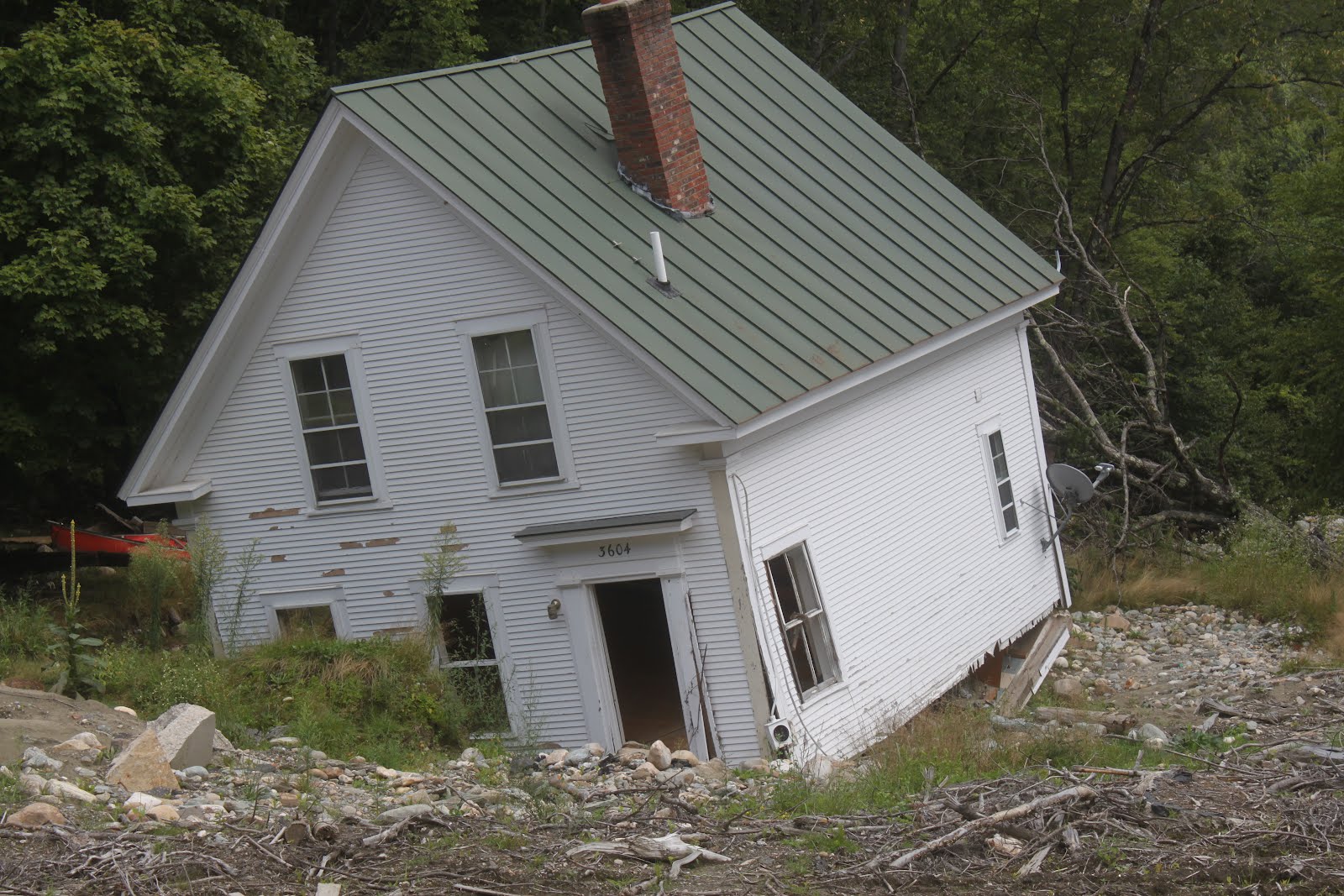
can terrorize us. This is a lovely, old Vermont house
destroyed by Tropical Storm Irene in 2011,
This weird global summer of scarey weather surely makes one worry more about climate change.

Not all the weather events we've endured this year can be directly tied to climate change, but some of them can. 

The prospect of Tropical Storm or Hurricane Henri in New England is one of those cases where I suspect a climate change link, but it's too complicated for little ole me to prove.

But hear me out.  One predicted consequence of climate change has been the idea of hurricanes and tropical storms slowing down or stalling over one area, intensifying their destructive power.

After all, hurricane force winds or torrential rain will cause much more damage if those conditions last for 12 or 24 hours instead of three or four hours. 

We've seen these stalls happen with Hurricane Harvey in Texas back in 2017, and that resulted in probably one of the most catastrophic floods in U.S. history around Houston, Texas.

In 2019, powerful Category 5 Hurricane Dorian stalled over parts of the Bahamas, inflicting total destruction on some islands.  It's very weird for a hurricane that strong to stall.  Their forward motion might be slow, but they do tend to make progress.

Though stalling hurricanes are still somewhat a matter of debate among climate scientists, it does seem to be a thing as the world warms. 

As I mentioned in this morning's post, the forward speed of tropical storms in New England tends to be pretty fast. It seems most of them go blast northward here at around 30 mph or more. The forward speed of the Great New England Hurricane of 1938 was more than 50 mph.

Current forecasts have Henri moving inland into New England at a forward speed of less than 4 mph. That is just insanely slow for this time of year. Since Henri would linger for a long time in the cold North, its winds might diminish pretty quickly, but its torrential rains would continue much longer than a "normal" New England tropical storm. 

I worry greatly about catastrophic flooding in New England from Henri.

Speaking of flooding and rain, I want to pivot over to Greenland for a minute. 

The middle and highest point of the Greenland ice cap is insanely cold.  It's almost always below zero there.  Usually way, way below zero.

But on August 14, at a 10,551 foot elevation at the highest poiny of Greenland's ice cap, it rained.  That's the first time rain has ever been observed there. If any precipitation falls from the sky at that station, it's snow. Until now.

It almost never gets above freezing at this location.  Temperatures above 32 degrees have only been noted there in recent history this year, and in 2019, 2012 and 1995. But until now, they never had rain, as far as anybody knows

Also, by mid-August, winter usually is arriving in the middle of the Greenland ice sheet. The August 14 rare thaw is the latest above freezing temperature on record at that weather station. 

I tied this in with the word "flooding" because if more ice melts off Greenland yearly than accumulates in their long winter, global sea levels rise. Lately the melt has been exceeding the ice accumulation, because of global warming. 

Meanwhile, as previously reported, the world had its hottest month on record in July, places too great in number to count hit all time record highs, the West, Siberia and other places are burning, the normal clean air of Vermont keeps getting clouded by smoke from out west and there have been ridiculous floods have hit Germany, Japan, Turkey and other places.

Here in Vermont, the weather this summer hasn't been quite as destructive, at least so far, but still damaging. And incredibly confounding.  Henri has just made my unsettled state over the pace of climate change even worse.

Wednesday, August 4, 2021

Greenland Suffers A Last Minute Meltdown

After a first half of summer that didn't bring much melting
to the Greenland ice sheet, relatively speaking, a heat
wave last week caused a massive melting spurt. A melting
Greenland is not good, as it contributes to sea level rise. 
This summer had been shaping up as one in which the dreaded annual ice sheet melt in Greenland seemed like it wouldn't be quite as bad as in recent years.  

But the last week of July brought a heat wave and big melt to the Greenland ice sheets. 

Melting there is never good.  Thawing ice in the Arctic Ocean is also not a good thing, but at least that won't raise global sea levels.  That ice is like the ice cubes in your gin and tonic. If the ice melts, the level of liquid in your glass doesn't rise.

Greenland is different. The ice is all on land, above sea level. When it melts, it pours into the oceans and stays there. Unless Greenland gets colder again and snow and ice accumulate year after year. That ain't going to happen with climate change. 

Virtually every summer Greenland will lose of its ice mass. Each year, you want to hope the melting doesn't amount to much.  That way you can hope the winter brings decent additions to the snow and ice mass up there to blunt the impacts of the melting.

With climate change, though, it's a losing battle. A greater and greater proportion of ice melts now each summer than is replenished in the winter.  The excess water runs off into the oceans, worsening global sea level rises. 

Which increases the risk of flooding in coastal cities. It's not as if you can pick up an entire city and move it inland, uphill, in just a few years. Or decades. 

This summer wasn't too bad up there, at least at the start. There was melting ice, but not to the extremes we saw in recent years. 

Then last week. When that heat wave hit.  Enough melt water came off of Greenland to cover all of Florida with two inches of water, reports phys.org news. 

This wasn't the biggest meltdown Greenland has had, that one was in 2019.  But the one last week covered a larger area than the one two years ago. 

Parts of northern Greenland got up as high as 68 degree last week, well above average, says phys.org news 

Nerlerit Inaat airport in northeastern Greenland got up to 74 degrees, an all-time record high for that site.  

This new melt means the ice sheet albedo - the proportion of sunlight reflected of the surface of the ice sheet has worsened. 

The more melting, the dirtier the surface of the ice.  Dirty ice is darker and can absorb more of the sun's energy, increasing its ability to melt.

Fairly luckily, this past week's meltdown happened fairly late in the summer. The sun angle up there is decreasing rapidly, and the chances of new snow to whiten up the ice, is rising.  This would have been worse had this happened in May or June.

The melt season in Greenland typically ends in early September. 

Still, it's bad.   

Melting of the Greenland ice sheets began in earnest around 1990 and accelerated around the year 2000. Scientist believe the Greenland ice sheet is melting at a fastest rate in at least 12,000 years.