Showing posts with label extremes. Show all posts

Wednesday, April 8, 2026

Looming El Nino Getting More Likely To Become "Super" It Means Ever More Extreme Weather On Climate-Fatigued Planet

A forecast map for the equatorial Pacific for 
late summer an early fall shows a strong El Nino
In the box, it shows much above normal water
temperature in the central and eastern Pacific
near the equator. 
Scientists have been telling us for months now that a new El Nino global pattern is about to start. That type of thing tends to warm up the world. Combine an El Nino with climate change, and you can take the global climate to new, hot, heights. 

Now, we're being told this could well turn into a "Super El Nino" and that makes the news even more potentially grim. At least if you're not a fan of punishing droughts, super storms and dangerous, record smashing heat waves.

Yes, that sort of thing is going on already, but a Super El Nino could make things much, much worse.   

Per the Washington Post: 

"During a typical El Nino, a warming patch of water in the equatorial Pacific Ocean influences what regions experience droughts, floods, extreme heat, hurricanes and declining sea ice. During relatively rare super El Nino events, happening once every 10 to 15 years on average, the effects may be stronger, more persistent and more widespread."

The Washington Post reports;

This El Nino "could break the record for El Nino intensity set in December, 20125, when sea temperatures in the central equatorial Pacific reached 2.8 degrees Celsius (5.04 degrees Fahrenheit) above average."

Each El Nino is different, because underlying natural weather patterns can affect it. And climate change makes the effects of El Nino even less certain. The effects of El Nino will probably peak during the upcoming winter. Overall,  some of those effects include:

Drought:

Sone tropical countries, like the Caribbean and Indonesia, could face serious droughts.  So could central and northern India, where a super El Nino can disrupt and even stop the annual monsoon season. Serious droughts have an excellent shot at developing in portions of Central Africa, Australia, the Philippines, Central America and northern Brazil.

The  El Nino could be really bad news for the western United States. Coming off a record warm winter, and unprecedented March heat that has already set the stage of water shortages, the El Nino could create an especially hot, dry summer in the West. 

However, El Ninos can cause unusual humidity in the West. That could lead to some beneficial rains, but also severe storms that would extend into the Plains.  Usually, the worst of the United States severe weather season usually tapers off in June, but this year, it could help extend the season longer, if the El Nino develops fast enough. 

While certain areas of the world would get much drier under a super El Nino, the overall threat of flooding in the world would increase due to higher levels of atmospheric moisture brought on by the el Nion

Storms and Hurricanes

On the bright side, the potential Caribbean and Central African droughts would be related to a suppressed Atlantic hurricane season.  Disturbances coming off the west coast of Africa would be weaker and less frequent, lessening the chances that any of them would develop into hurricanes. 

Much more importantly, El Nino would contribute to strong upper level winds in areas of the tropical Atlantic. Those strong upper winds cut wannabe hurricanes off at the pass, destroying tall thunderstorms before they can organize into a tropical storm.  

The U.S. got a break last year with no landfalling hurricanes. An El Nino could make us lucky for the second year in a row. But that comes with a big caveat. El Ninos tend to reduce the number of hurricanes. But it doesn't eliminate them. It takes only one hurricane to cause a cataclysm. We're not entirely safe. 

There will be enough cataclysms with or without hurricanes anyway. Next winter, if the strong El Nino develops, the South, including Florida, would become cool and stormy, with the risk of wintertime severe storms and tornado outbreaks. 

We'd also see an increase in flooding across Peru and Ecuador, sections of northern and eastern Africa and in the Middle East. 

Heat Waves

Virtually every place on Earth would be at risk for punishing, record heat waves. Africa, parts of the Middle East, Africa, Europe, the southern U.S. and possibly Australia would be most at risk. 

If this super El Nino does in fact get underway, 2027 has an excellent shot of becoming the hottest year on record, even besting the especially torrid 2024, the current record holder. Because of a lag between the development of an El Nino and how it affects global weather patterns, I doubt this year will be the world's warmest. 

Climate change has created a sort of step-up trend in which pretty much every El Nino creates a new record for global warmth. Between El Ninos and during La Ninas, which should cool the Earth, global temperatures tend to just level off.

"Due to the increasing concentration of greenhouse gases, the climate system cannot effectively exhaust the heat released in a major El Nino event before the next El Nino comes along an pushes the baseline upward again," Defense Department meteorologist Eric Webb said in the Washington Post

 VERMONT EFFECTS

It's always nearly impossible to tease out what effects an El Nino might have on a pinpoint area like Vermont. But we can give some general thoughts that aren't exactly a forecast, based on what we've seen in past super- El Ninos

The most noticeable effects here are warm winters. During the 2016 super El Nino, Burlington what was its warnest and second warmest winters on record in 2015-16 and 2016-17.  (The warmest winter is now 2023-24)

The 2015 El Nino might have helped contribute to the hottest December readings in Vermont that year, breaking records set December, 1998 during a previous strong El Nino. 

Chances are next winter won't be the kind of long, drawn out, persistently cold affair we endured this year. 

As for storms, it seems that Vermont is at a higher risk of trouble, but no guarantees. It's hard to know whether El Nino had anything to do with it, ut the Great Ice storm of January, 1998 and serious flooding in June and July of that year were doing a super El-Nino.

I also recall some spring floods during the 1982-83 El Nino, mostly along Lake Champlain due to persistent rains and snows in April and May, 1983. 

Although we had some notably wet months during the 2015-16 El Nino in Vermont, there wasn't really much in the way of serious flooding, though there were some local flash floods in the warmer months. 


Monday, April 6, 2026

Unprecedented Heat From March Still Has Climatologists, Others, Losing Sleep At Night, But It's All A Scary Sign Of The Times

March was so hot in the western and central U.S. was so
extreme it's still keeping climatologists up at night.
These kinds of "unprecedented" hot spells and 
extremes are now becoming regular occurrences
in this age of climate change. 
There's patches of record warmth remaining in the United States as we make our way through the first week of April, but the extreme, whackadoodle heat of March has subsided. 

Scientists are still agog from March, which is easily going down in history as among the most extreme, over the top, seemingly impossible climate-related events hot spells ever seen.  The heat wave completely rewrote the March weather record books in the western and central U.S. 

It was the kind of event that keeps climatologists up at night.  Especially since these "impossible" events are coming along in a steady stream now. Each one bigger than the last. And each one potentially more deadly. 

We're lucky this one hit in March, months before summer. Had it happened in July, who knows how many deaths would have been created by just the hot days themselves? Even so, the heat set the stage for a potential summer of out-of-control wildfires and deep water shortages. 

Already, fires are burning months before they should. A raging wildfire threatened homes in Moreno Valley , California last week. It was the kind of fire you see in parched late summer and early autumn and not moist March. But the rules have changed. March is the new summer, apparently.  

Nebraska just experienced their largest wildfires in history, burning an area larger than Rhode Island. 

And we've probably only just begun with the fires.

THE EXTREME MARCH HEAT

It's hard to know where even to begin with the accounting for March's heat. 

AccuWeather gives just a glimpse of the breadth of the March heat wave: 

 "During the unprecedented mid-March heat waves in the central and western United States, more than 8,200 daily records and more than 2,000 monthly records were broken at weather stations across the West."

Incredibly, 17 states set new March record highs.  And these are large western and central states, not smaller Eastern states where it's a bit easier to accumulate numerous record highs. Many of these states broke monthly record highs, only to have those records broken in subsequent days. 

The nation saw its hottest March temperature on record at 112 degrees. It came close to setting the April national record of 113 degrees.

No fewer than 16 western cities not only broke their all-time highs for the month of March, they also broke or tied the mark for April, which is beyond insane. 

On March 19 alone, nearly half of the 900 or so long term U.S.. weather stations in the Global Historical Climatological Network set or tied daily record highs. 

More than four dozen major reporting stations with data since at least the 1960s had their warmest March in history.  Major cities that had their warmest March on record, - most of them by a wide margin - include Dallas, San Antonio, Oklahoma City, Albuquerque, Denver, Salt Lake City, Phoenix, Las Vegas, Los Angeles and San Francisco. 

Once all the numbers are crunched, it looks like Colorado will end up with a March that was three or four degrees warmer than any other in the past 130 years or so. For a state to break its statewide record for hottest March by a degree is wild. By three degrees ----there's no words for it. 

We still don't have confirmation as to whether March, 2026, is the nation's hottest on record. That will come in a week or two. But it was at the very least as warm as what was considered the impossibly hot March of 2012.

CHAIN OF EXTREMES 

Climate change doesn't just warm up the world uniformly. It sets traps. Springs surprises. 

As Yale Climate Connections notes: 

"Since climate change is also fundamentally disrupting atmospheric circulation patterns, we now have mega-unprecedented extreme events occurring with regularity. These circulation changes allow the biggest regional and local heat extremes to intensify by a much larger margin than the roughly 1.4 degrees Celsius increase in average global temperature since preindustrial times."

Honestly, climate change contributes to new extremes every weeks, or so it seems. But the standouts - the weather events that make climatologists and other scientists deeply worry about the future  - seemed to begin almost exactly 14 years prior to this March's heat.

In March, 2012 most of the heat focused on the central and eastern United States.  Thousands of daily record highs were set, as were hundreds of all time record highs for March.  Among those thousands of record highs, nearly four dozen were broken by at least 22 degrees, which is beyond insane. Four record highs were smashed by 30 degrees. In a handful of cases, the low temperature on a particular date on March 12 was warmer than the record high.

 "An initial assessment led by Martin Hourlong at the NOAA Earth System Research Laboratories concede that human-produced warming likely contributed on the order of 5% to 10% of the magnitude the heat woven March 12-23, 2012, The report added: "the probability of heat waves is growing as (greenhouse gas)-induced warming continues to progress," notes Yale Climate Connections. 

Still, we figured we wouldn't see another March, 2012 in our lifetimes again. Until we did.

The March heat of 2012 came at the tail end of a La Nina, and led to an extreme, punishing drought across the nation's middle that summer.  We're in the same situation now. It might not be just the western mountains that are running out of water. 

Much of the central and southern Plains are already in serious drought. Will this key crop growing area further dry out? There's already plenty of other stresses out there with food production - political instability, tariffs, war, a feckless president.  

We are set up for a rough summer, and March probably just made it much, much more rough. 

WATER SHORTAGES?

Colorado's snow pack ended the month at less than a quarter of average. Eighty-nine of 94 snow pack measuring stations were at record lows by the end of March. 

It's not just Colorado. It's virtually all of the West. Per the Guardian: 

'This year is on a whole other level.' say Dr. Russ Schumacher, a Colorado State University climatologist, speaking about the intense heat that began rapidly melting the already sparse snowpack in March. 'Seeing this year so far below any of the other years we have data for is very concerning."

On April 1, media went out to join California water officials to take a measurement of the water content of snow at a spot in the Sierra Nevada. Normally, the group would be standing on five feet of snow. This time, they were standing on a muddy field, flecked with melting remains of snow patches. 

Snow water equivalent is a measurement is the amount of water of that would melt out of the snow that's still on the ground.  This figure is now terrifying throughout the West. 

The overall snow water equivalent in the Sierra Nevada on April 1 was just 18 percent of average for this time of year.  In the Great Basin, snow water equivalent was just 16 percent of normal. In the lower Colorado River basin area, including most of Arizona and Nevada, it was 10 percent. The Rio Grande, which covers New Mexico, Texas and Colorado was at 8 percent. 

Because of a record warm winter, the snow pack was far below normal before March arrived. Everyone hoped for a "March Miracle," as some bad years in the past were relieved by cold, stormy Marches. Not this year. Not by a long shot.

If this were just one bad year, we'd be OK. But the six lowest April 1 snowpacks in California have happened since 2007. The state thought it was finally catching a break in January as it fully emerged from drought for the first time since in a quarter century. 

Reservoirs are pretty full in California, thanks to warm rains in recent winters that filled them even though the state couldn't build a decent snowpack. So at least for this year, the problem for most of that state would be intense wildfires but not necessarily widespread water shortages. 

Elsewhere, things are not nearly so serene. 

In the Colorado basin, Lake Mead is 25 percent full. Lake Powell was only 33 percent or so full at last check. Both lakes usually rise somewhat in the spring due to snow melt. It doesn't look like that's really happening this year. 

Water managers area already urging conservation in the West. 

Salt Lake City has called on residents and businesses to start conserving now, with a goal of cutting overall water usage by 10 percent, Also, as the Guardian reports:

"Across Colorado, there are local orders that list lawn watering, and in Wyoming, residents were warned that full restrictions on outdoor irrigation could come come as early as May."

Farmers and ranchers across the West are also having to make hard decisions and big adjustments with smaller allocations of water and a recognition that supplies will be strained. 

TIMING

What if a heat dome like the one we just saw in March hit during the middle of summer? And hit in a place not accustomed to extreme heat. 

We found out in late June and early July, 2021 when an unprecedented - here's that word again - intense, heat settled into southwestern Canada and the Pacific Northwest of the United States.

 All-time heat records in the Pacific Northwest were not just broken, they were obliterated. Portland Oregon reached 116 degrees. Salem, Oregon was 117 degrees. Rainy, cool Seattle reached 108 degrees.

The heat of 2021 was even more punishing in British Columbia, Canada. On June 29, 2021, the town of Lytton, British Columbia reached 121 degrees, the hottest temperature ever recorded anywhere in Canada. By a long shot. Before this heat wave, the hottest it had gotten anywhere in Canada was 113 degrees back in the Dust Bowl days of the 1930s. 

The next day, Lytton burned down in a massive wildfire brought on by the scorching heat and drought. 

The 2021 heat wave is estimated to have caused at least 1,400 deaths in Canada and the U.S. 

What if a heat dome like that in 2021 settled into the heavily populated eastern United States and southeastern Canada? And what if it lasted a month, not a week? Nobody is prepared for such a nightmare. 

However, we'll find out soon enough. Perhaps this summer. Or the next. And it won't be pretty. 


Wednesday, April 1, 2026

This Time Of Year, Temperatures Are Usually All Over The Place

Cold and gloomy early this morning in St. Albans, Vermont.
Temperatures before dawn ranged from near 32 at Canadian 
border to near 60 by the Massachusetts border. 
Temperatures will continue to swing wildly over the
next few days, which is common this time of year, 
 Before dawn today, temperatures were either cold or balmy, depending on where you are. 

At 5 a.m. it was 34 degrees in Burlington. Ice is underfoot closer to the Canadian border.  Meanwhile, it was 61 in Bennington. In between readings were in the 40s and 50s. 

Depending on where you are today in Vermont, you'll need your tired old winter coat or that cute new spring lightweight sweater  you just bought. 

Yesterday, it was more of the same. In far southern Vermont was actually sort of humid, with springlike showers and thunderstorms. 

Up in the far north, yesterday ended up overcast, dark, foggy, drizzly and cold, the temperatures having dropped to chilly levels shortly after midnight

In the middle of the state, most of Vermont, really  it either stayed mild into early today, or it was still on the warm side. 

The relative warmth combined with rain that's been melting the mountain snow has created sharp rises along the rivers of Vermont .  Most have stayed within their banks, but a flood warning was in effect along the Walloomsac River in Bennington County for minor flooding. The warning has since expired. 

 Looking over the past week, we have seen the same the same big temperature swings. It was 58 degrees on March 26, then we endured a couple days in the 30s. 

By Monday, it was back up to 68 degrees in Burlington. Dry south winds created perfect conditions for brush fire starts, and they certainly got going in a couple places. A brush fire on Monday in Ferrisburgh, burned through more than 100 acres, which is unusual for a Vermont fire, It took about 75 firefighters several hours to put out the flags. 

Another, much smaller brush fire in Waterbury on Monday was also extinguished.

WILD SWINGS CONTINUE :

These wild swings in temperature are because Vermont is usually near the border between frigid winter air in Canada and balmy air across  the southern United States. The contrast is usually greatest from mid-March to mid April, give or take. 

Ma Nature doesn't celebrate April Fool's Day. It celebrates April Fools Month. 

By April Fools Day, spring hasn't usually made many inroads across most of Canada In the central and southern U.S., it's hard core spring. When the front essentially separating winter an spring pass over Vermont, which is frequently, the weather goes wild.

Every once in awhile, this can create big disruptive, damaging storms in Vermont. That's not the case this time, which is great news.

For the next couple of days, it'll be on the cool side, especially north. 

An approaching warm front could spread a little rain in the warmer areas, and a little ice mainly east of the Green Mountains. The National Weather Service is toying with the idea of issuing a winter weather advisory for that potential ice Thursday night and early Friday, 

They'll wait for a little more data to come in before deciding whether to trigger such an advisory,

By Friday, temperatures should reach the low 60s across many areas of Vermont, so if we do get any ice from freezing rain, it'll disappear fast. The warm front's parent storm will pass far to our north and west. It won't really be able to pull down much of that cold air from Canada. 

Which means for now, it looks like it'll be a springlike weekend. Springlike means a risk of showers, of course. The warm temperatures and the rain will make rivers rise again. But just like yesterday, no flooding is expected. 

There's also a wrinkle. There's always a wrinkle, Some forecasts keep Saturday and Sunday in the 40s, so we'll have to keep an on it. 

Variable weather is hard to predict sometimes. 

By early next week, it'll be breezy and chilly once again and the Canadian air will flood back in. It is April, so daytime highs next week should get into the low or mid 40s.  


Friday, March 20, 2026

Videos Show The Wild And Often Scary March Weather This Year

A huge tornado in Illinois early this month. Video of the events
is included in this post 
The first three weeks of March have been a wild weather ride in the United States. The weird weather is continuing, but as we often do, we're looking back at some of the most dramatic weather videos in recent weeks. 

We have a real variety pack this week so let's settle in and watch the excitement. 

This is a view of a deadly tornado in Union City, Michigan on March 6.  It's a view from the south side of Union Lake as the tornado tears through the north side. This view is closer, though, and also includes its initial development. You also see at the end it crosses the still partially frozen lake. Click on this link to view or if you see the image below, click on that.

Drone footage showing the aftermath of the tornado in Union City, Michigan. It looks like it hit a nice lakefront area. As always, click on this link to view or if you see the image below click on that.


Kind of a long video, but it's worth if for the visuals. It's distant shots of the powerful tornado on Tuesday in Kankakee, Illinois. If  you ever wondered about the green clouds that people talk about when a tornado is near, this is it. 

The greenish bluish hue was due to the fact there as an enormous amount of hail in the storm clouds. The large hail caused a lot of damage even outside the path of the tornado. Click on this link to view, or if you see the image below, click on that.

More locally, we had our abrupt March thaw in and near Vermont that brought temperatures to record high levels. The sudden thaw helped create ice jams in area river.\

Here is an iIce jam on the Ausable River in New Yor breaking loose.  Click on this link to view or if you see the image below click on that:


Next up, my own video of an ice jam, this one on the Missisquoi River in Enosburg, Vermont. Note at 2:30 the birds all go silent just before the jam starts to move. Click on this link to view, or if you see the image below, click on that. 


If you want to feel chilled to the bone, watch this Fox Weather video of the March 14-16 blizzard in Marquette, Michigan. Click on this link to view or if you see the image below click on that. 


People stuck on an interstate after March 15 blizzard near Green Bay, Wisconsin. Click on this link to view, or if you see the image below, click on that. 

In Oshkosh, Minnesota, Lake Winnebago created what is known as an "ice shove." The ice  on the lakebroke up in thawing temperatures. Strong winds blew the ice onshore onshore, forming immense piles. The ice piles threatened homes but at last check hadn't reached them. Click on this link to view, or if you see the image below, click on that. 


Wednesday, March 18, 2026

sSpring Arrives Friday: What To Expect, And Hopes For A (Slightly) Wet Season

Astronomical spring starts this coming Friday. I
am definitely ready for it!

 Spring arrived on March 1 for people enmeshed in meteorology and climatology. 

But the rest of the world goes by the start of astronomical spring. For us, spring starts at 10:46 a.m. this Friday. Hallelujah! 

The early signs of spring are already here: 

Red wing blackbirds have been doing their "conk la REE" song for a week or two now. There's rumored sightings of crocuses in protected southern exposures around the state. The first green nubs of my daffodils have tentatively poked through the ground in may gardens. 

Clearly,  the worst of winter is over for most of us. Don't tell that to anybody in the Upper Peninsula of Michigan, which just had a record blizzard there, and some places in the region have four to as many as six feet of snow on the ground. I'm glad that's not our problem!  

Average temperatures around rise fastest from around mid-March to mid-April.  In Burlington, the  normal high temperature today is 41 degrees. By April 18, a mere month from now, normal afternoon temperatures will be 57 degrees, so that's quite an improvement.. 

Even though a generally cooler the normal weather pattern has set up, it will get more and more difficult to see some truly wintry cold waves. Difficult but not impossible. It's been below zero in Burlington as late as March 29 1923   Widespread subzero cold froze Vermont as late as April 7, 1972.

But spring is volatile in Vermont. It's also been as hot as 84 degrees in March (1946 and 1998) and 92 degrees in April (1976).

On the negative side, measurable snow has fallen well into May in the past. Let's hope that history doesn't repeat itself this year.  

As far as how the weather will turn out this spring, the short answer - as always, - is "Who knows?" The folks at NOAA pretty much throw up their hands at this one. They give us in the Northeast equal chances of above or below norma temperatures this spring. They also give us equal chances of above or below normal rainfall. 

Believe it or not, there's still a lingering drought in parts of the Green Mountain State. It's not nearly as bad as it was last summer and autumn, but it's still a potential problem. Since things have been frozen all winter, the U.S. Drought Monitor maps have also been "frozen," in Vermont, with no change since mid-December.

The U.S. Drought Monitor maps still show drought in northeastern Vermont and abnormal dryness in southern areas of the state through the winter. The next Drought Monitor maps comes out tomorrow, and it will be interesting to see if anything changed now that things have begun to thaw out. 

In any event, precipitation hasn't been that impressive this winter. The first half of the season brought is near to slightly below normal precipitation.

February and so far March have been dry. It seems for the past couple months, the bigger storms have sent their heaviest precipitation west, north, south and east of us, but never quite hitting Vermont directly. It's almost as if last year's drought has a kind of "muscle memory" that causes precipitation to avoid us.

Sure, we want a lot of bright, sunny, balmy spring days. We also want a wet spring to erase the last vestiges of last years's deep drought.  

Too bad we can't put in an order for what what would really work: Rainy nights and sunny days through the spring. 

But it's Vermont. Expect anything. Sunny and 80 one day, snow the next. Vermont's weather always keeps us on our toes. Especially in the spring 

Friday, January 16, 2026

U.S. Just Had Fourth Warmest Year On Record. Was Also A Busy Storm Year

Virtually all of the Lower 48 had a warmer than normal
year in 2025. Those little white spots were close to 
average. Overall, it was the fourth warmest year on record.
The United States had its fourth warmest year on record in 2025, and it was an active storm year, according to a year in review from NOAA's National Centers for Environmental Information. 

The report from NCEI came out the same time as their global report for 2025. That report, as I posted about Thursday. indicated the the world had its third warmest year in 2025 and that the past three years have been by far the world's warmest on record. 

Per NCEI:

"Temperatures were above average nationwide, with the most pronounced warmth across the western third of the country. The Rockies and Westward region, stretching from the West Coast through the Rocky Mountains, recorded its warmest annual temperature on record."

The United States might have had its warmest year on record, or close to it, had we not experienced January, 2025 the way we did. It was the coldest since 1988.

But things quickly heated up from there, as NCEI explains.

"This was followed by the second-warmest spring on record, driven by widespread warmth across the Southeast, where Florida recorded its second warmest May. Summer heat included a late June heatwave affecting over 100 million people ad record warm July overnight temperatures across the Mid-Atlantic.

Anomalous warmth persisted into the latter half of the year, as meteorological fall ranked as the nation's third warmest. Following a November that saw five states set monthly records, nine states - Arizona, California, Colorado, Nevada, New Mexico, Oregon, Washington and Wyoming - recorded their warmest December on record." 

In the end, Nevada and Utah had their warmest year on record. Including those two states a dozen had one of their four warmest years on record. Here in Vermont, the state as a whole had its 18th warmest year. As always, the relative temperatures within the Green Mountain State varied. Burlington had its ninth warmest year. 

The United States as a whole had a drier than normal year. The lower 48 had an average of 29.19 inches of precipitation, which was 0.73 below average.

No state had an extremely high or low amount of precipitation. Kentucky had its ninth wettest year on record and Florida had its 11th driest. The Plains were a little on the wet side, and the East Coast and Southwest were somewhat on the dry side. 

STORMS/DISASTERS

The United States suffered through 23 weather/climate disasters in 2025 that cost at least $1 billion, according to Climate Central.

These 23 disasters cost a total of $115 billion, which is above the inflation-adjusted average of $67.6 billion. Only five other years were more expensive, with 2017 being the worst, with $405.2 billion in damage. 

Tornadoes

The United States had a preliminary count of 1,559 tornadoes in 2025, which is above the average of 1,225 twisters. The past year had the fifth highest tornado count on record. 

 Despite the extra tornadoes, and the strong ones that occurred in 2025, the death toll from twisters was close to average. Sixty-eight people died in tornadoes in 2025, compared to an average of 71.

North Dakota had quite a tornado year in 2025. The first EF-5 tornado - the strongest you can get - since 2013 touched down near Enderlin, North Dakota on June 20. North Dakota also had the most tornadoes in a single year with 72 of them. The old North Dakota record for a single year was 61 in 2010.

Hurricanes/Tropical Storms 

The Atlantic basin had 13 named storms in 2025, which is a smidge under the average. For the first time  since 2015, no hurricanes made landfall in the United States, which was a welcome break from a string of disastrous hurricane years. 

We were especially lucky since many of the hurricanes that did form were unusually strong. Three Category 5 hurricanes formed, which is the second  most on record. There was also Category 4 Gabrielle.

Easily the worst hurricane of the bunch was Melissa. A dropsonde recorded a wind gust of 252 mph at an elevation of 820 above the ocean as the hurricane was approaching Jamaica. That was a world record, exceeding the previous dropsonde record of 248 mph in Typhoon Mega in the western Pacific Ocean in 2010. 

DECEMBER IN REVIEW

December was incredibly warm in the West, with nine
states having their hottest December on record.
The Northeast was a little on the cool side. 

As mentioned above, the notable news about the December was the huge area in the West that had its hottest December on record. Overall, last month in the Lower 48 was the fifth warmest on record, NCEI tells us.    

Most months this year had very few areas in the United States that were cooler than normal However, in December, chilly air in the Northeast slightly offset the heat in the west. This helps explain why December was only the fifth warmest, and not the warmest.  

Nine northeastern states were cooler than most months in the 131 years of record. But none were particularly close to the coldest on record. The closest to the record was Pennsylvania, which had its 36th coolest December, so not that impressive. Here in Vermont, we had our 42nd chilliest December out of the past 131 years. Again, not an impressive record.

The West was impressive, however.

Three of the nine western states (Utah, Nevada and Arizona) that had their hottest December broke the previous record by more than 2.5 degrees. It's exceeding rare to break a previous hottest month record by one degree or more. 

Also three states - Utah, Wyoming and Colorado - were more than 10 degrees warmer than average. Again, that's an incredible feat. 

Precipitation in the Lower 48 averaged out to 2.01 inches, which is 0.33 inches below average. Like temperatures in December, precipitation was maldistributed. 

The central and southern Plains and most of the Gulf Coast were much drier than they should have been. Oklahoma had its driest December on record. Oklahoma City, for example, had just 0.09 inches of rain in December. They should have had about 1.8 inches. 

Seven other states in the parched region had one of their top ten driest Decembers on record.

On the opposite extreme, Washington, Montpelier, Idaho and Wyoming had one of their top ten wettest Decembers on record. 


Tuesday, August 12, 2025

"Death Valley" Weather Hit Vermont Today. I've Never Seen Anything Like It

I left this thermometer in the sun against the west side
of my St. Albans, Vermont house and it ended up at 120 
degrees. The actual temperature (in the shade)
was still a record 97 degrees. 
Today will go down in history as one of the strangest and really, one of the more worrying weather days I've ever seen in Vermont. 

The high temperature in Burlington today was 98 according to preliminary data. That broke the old record high for the date of 93, set in 2002.

Yes, it's been that hot in Vermont before, but not that often. But the combination of heat and dryness is absolutely unprecedented as far as I can tell. 

At 3 p.m. in Burlington, it was 97 degrees. The dew point was a bone dry 46 degrees yielding a relative humidity of 17 percent. 

 That kind of heat/low humidity combination is something you see in places like Phoenix or Death Valley. 

For comparison, at noon local time Tuesday, it was 113 degrees, dew point 44 with a relative humidity of 10 percent at Furnace Creek in Death Valley, so you can sort of see the similarities.   The relative humidity in Phoenix was 22 percent, so it was "muggier" there than in Burlington. 

As you can imagine, crops in Vermont are stressed. The forest fire danger is sky high. Burn bans are in effect statewide. There was already a relatively small grass fire in Georgia, Vermont Monday. A fallen power line in Shrewsbury sparked another fire Tuesday, but that one was quickly contained, too. Another one-acre wildfire in Au Sable Forks, New York today was at last report mostly contained.  

Those were small fires, but showed the potential of what could happen. 

What we're going through now in Vermont is a classic example of weather whiplash - when conditions go from one extreme to another. When summer began, it was really, really wet in the Green Mountain State. As recently as July 10, damaging flash floods hit parts of the Northeast Kingdom.

Now, suddenly it's super dry.  These one extreme to another events are getting more frequent in the age of climate change. Get used to it. 

For all I know, we'll be talking about floods again in another month or two. Watch this space.

HOT DAYS ACCUMULATING

Today was also the 16th day this year it's gotten into the 90s in Burlington. This is only the tenth year of the past 140 or so in Burlington that has had that many days reaching 90 degrees or  more. 

Tomorrow, ahead of our desperately anticipated cold front, it will get much more humid. The increase in clouds will keep actual temperatures a little lower than they were today, but the higher humidity will make it feel worse than it was this afternoon. 

So, the heat advisory in the Champlain Valley has been extended to Wednesday evening. It might or might not reach 90 degrees in Burlington. It depends on how fast the clouds and showers arrive. 

That cold front still looks like it will set off some badly needed showers and thunderstorms. But typical of summer, they will be hit and miss. A few towns will receive nice downpours, other places will get a little rain. A few of us will get nothing at all.

Even those neighborhoods that have a brief torrential blast of rain won't be out of the woods. It will dry out quickly again amid low humidity Thursday into Saturday. Especially in northern Vermont. Southern areas might at least stay somewhat more humid, with a low risk of showers. 

Another cold front Sunday still looks like it might spark off more showers, but no heavy rain.  But it is looking like a bonafide spell of cooler than average August weather will come in early next week. Good news for those of you thought upper 90s temperatures were a little much for Vermont. 

Monday, August 11, 2025

Milwaukee Latest Target In Summer Of Flash Floods

Car roofs barely visible in Milwaukee,
Wisconsin late Saturday night/early
Sunday morning as that region became
the latest victim of an epic summer'
of flash floods in the U.S. 
 Milwaukee, Wisconsin was the latest city over the weekend to drown in extreme rains in a summer that has brought a series of record-busting floods.    

More than a foot of rain was reported in some areas near Milwaukee Saturday night and early Sunday.   

One section of Milwaukee reported an incredible 14.49 inches of rain.  If confirmed by the National Weather Service, that would set a new 24 hour rainfall record for the entire state of Wisconsin. (The current record is 11.92 inches in Mellon, Wisconsin back in 1946.) 

The National Weather Service office at the airport roughly six miles south of downtown Milwaukee reported 6.69 inches.  Two inches of that fell within an hour. 

As in many flash floods of this type, the rainfall was highly localized. Mount Pleasant, just 30 miles south of Milwaukee, reported just over an inch of rain, with no trouble there. 

Since the heaviest rain targeted a large urban area, the trouble escalated almost immediately late Saturday night. Hundreds of basements suddenly flooded, dozens of streets and roads became instant rivers.  The Milwaukee River at Estabrook Park reached a record crest of 10.52 feet.

Residents described their cars suddenly submerged, and water cascading through trim, doorframes and vents, filling houses knee deep or worse. As you might imagine, the damage is severe, especially since so many homes and businesses took on water. 

 The storms forced the early closure of the Wisconsin State Fair Saturday night. Its final day on Sunday did not open because of the flooding, notes Wisconsin Public Radio.

The USA Triathlon canceled its Sprint National Championships and Paratriathlon National Championships Sunday due to flooding and damage to the courses.

The Milwaukee Mitchell International Airport temporarily shut down due to flooded runways, taxiways and an underpass tunnel.

Milwaukee and several surrounding communities were under states of emergency Sunday. The city's dispatch center received over 500 calls regarding flooded basements, inundated roads and stuck cars. 

Across Milwaukee, and in nearby suburbs like Wauwatosa,  people were rescued from homes by boat.

So far, no deaths or serious injuries have been reported from Milwaukee.

The Milwaukee flood was part of the same system that also caused 80 mph winds in Nebraska that led to at least one death. 

Separately, wild downpours this weekend dumped 11 inches of rain around Sanibel Island and St. James City, Florida over the weekend, causing serious flash flooding there. 

The Milwaukee storm was one of a serious of extreme flash floods that have hit various parts of the nation this summer. 

The most notable, of course, was the extreme floods that hit the Hill Country of Texas on the Fourth of July weekend, killing 136 people.

Other exceptional floods hit places like Ruidoso, New Mexico, parts of New Jersey, Illinois, Oklahoma and other states this summer. 

Flash flooding is a risk every summer, but some of these floods have gotten more extreme and more frequent. 

Climate change allows the atmosphere to hold more moisture than the cooler global air we had decades ago.  If the right storm comes along, that added atmospheric water unleashes itself in torrential downpours, causing floods much bigger than what would have been expected, say, a century ago.  

Tuesday, June 24, 2025

Incredible Record Highs In, Near Vermont Monday, More Records Will Fall Today Amid Afternoon Storm Threat...

Not what you see too often in Vermont. This time/
temperature sign in downtown St. Albans, Vermont 
showed 97 degrees Monday. The city ultimately
reached 99 degrees as record high temperatures were
shattered across Vermont.
Monday was about as hot and humid and dangerous as I think I've ever seen in and around Vermont. 

This is one remarkable heat wave.  Easily one of the most extreme on record, especially for so early in the season. 

The only hot spell I can remember that had anything close to this extreme combination of heat and humidity was in July, 2018. 

The only thing keeping this week's heat from being one of the biggest hot spells on record will be its short duration. The extreme heat will have only lasted two days. Mercifully.

INCREDIBLE RECORD HIGHS

The heat over-performed in some places around here Monday, exceeding some of the wildest forecasts.

The big winner was Plattsburgh, New York, which ultimately reached 101 degrees. That ties the city's all time record high, set on August 1 and 2, 1975 and August 5, 1955.

Burlington's Monday record high of 99 degrees was almost as impressive as Plattsburgh's. It's the second hottest day on record for the month of June. It's a tie for the third hottest day on record in Burlington.  Monday was only the ninth time on record that it has been 99 degrees or hotter in Burlington. Those records go back to the 1880s.

Back in the day, June was usually not a particularly hot month.  The real heat of summer usually hits in July and August. 

I suspect the effects of climate change first began to noticeably hit in the late 1980s.  In the 87 years that passed between 1900 and 1987, only five Junes in Burlington had temperatures of 95 degrees or more. In the mere 37 years since 1988, it's now gotten to 95 degrees or hotter 14 times in Burlington's Junes. 

I guess we need to expect more of this in our increasingly climate-change driven world.

Elsewhere in Vermont and New York, record highs fell like dominoes. St. Johnsbury reached 97 degrees on Monday, breaking the old record of 93 set in 1989.  Montpelier got up to 93 degrees, breaking the old record of 90 degrees.

Other high temperatures in and near Vermont include 99 degrees in St. Albans, Vermont and Lebanon, New Hampshire; and 97 in Springfield, Vermont.   A full list of Monday high temperatures provided by the National Weather Service in South Burlington shows there was no escape from the heat in Vermont. Everybody was in the 90s.  

HUMIDITY/HEAT INDEX

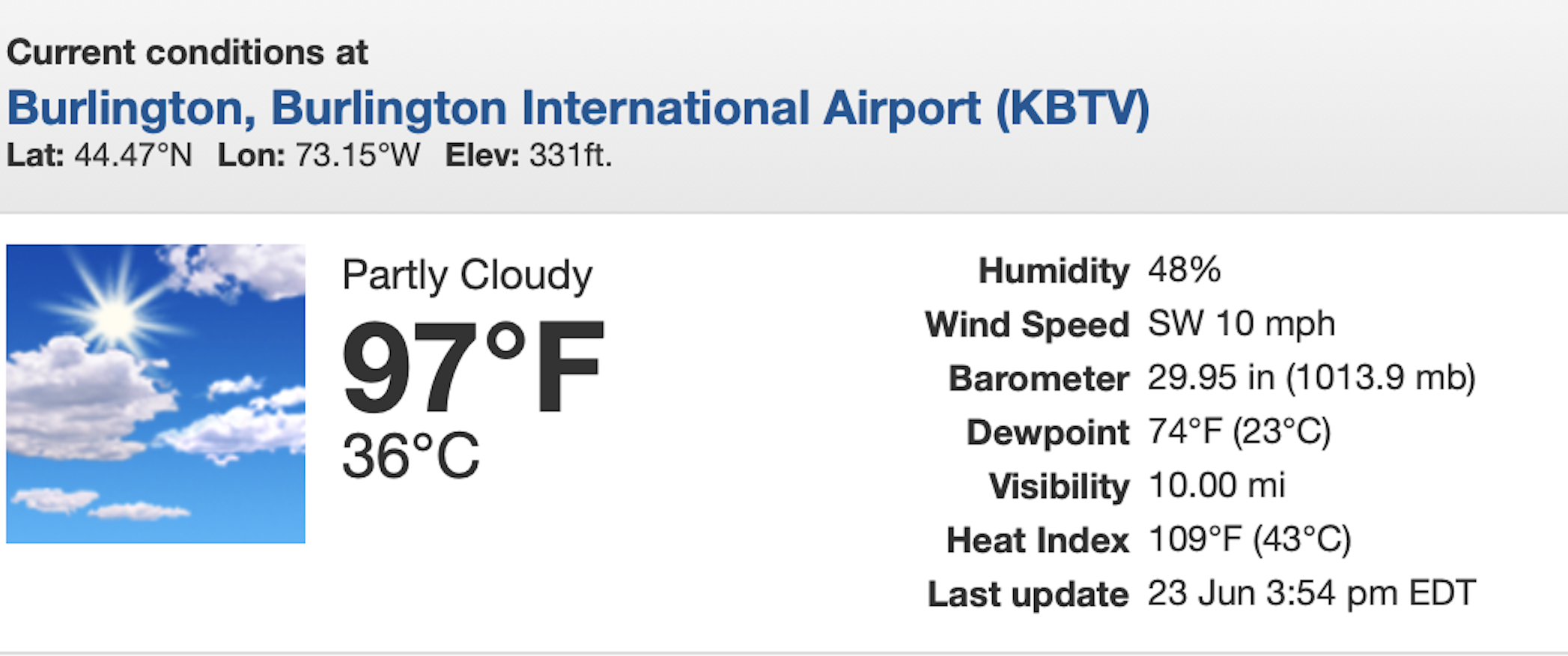
The 4 p.m. report from Burlington Monday showed
a heat index of 109. Several Vermont towns had
incredible heat index readings of 115 degrees or more, 
Humidity levels were higher than usual on Monday for a Vermont hot spell. Dew points, a measure of how humid it feels were at near record levels. 

Nobody really keeps track of record dew points, but NVU-Lyndon Atmospheric Sciences says the highest dew point seen in Burlington was 77.8 degrees at 4:10 p.m. on July 2, 2018. 

During the height of Monday's heat, the dew point in Burlington was 75 degrees. There were some reports in Vermont of a dew point at or above 80 degrees, which to me had been previously unheard of this far north in New England. '

The resulting heat indexes were brutal, especially where the humidity was especially high. Those indexes peaked at incredible - and very dangerous levels - 119 degrees at Highgate Falls, right up there near the Canadian border; 118 degrees in Colchester and Cambridge, and at or above 115 in several other Vermont communities.   

The result was a hunkered down Vermont. 

I went out and did some errands Monday. (The air conditioner in my truck was fixed just last week, phew!). Out on the streets, it sort of looked like it does during a snowstorm. Minus the snow, of course. 

Traffic was lighter than usual.   I saw very few people walking on sidewalks. Downtown St. Albans was practically a ghost town as the heat peaked in the mid and late afternoon. Outdoor construction sites were shut down and abandoned in the heat of the afternoon.  Some of the beaches were less crowded than you'd expect. It was simply too hot for the beach. 

I know this kind of weather is pretty routine in places like Houston, New Orleans and Miami. Though Miami was actually cooler and less humid than Vermont was on Monday. 

It's disconcerting to have their kind of weather here. Just as it had to be a little scary when the first-ever major snowstorm and near 0 degree cold snap that swept the Gulf Coast last  January.  

TODAY

After a terribly stuffy night, today should be almost as bad as Monday.   When I went out to water the gardens at 7 a.m. today, it was already sweltering. 

Some Vermont towns, especially north and central, might not be quite as hot as Monday because a cold front will be approaching from the north. That might throw some clouds and even a few thunderstorms into the picture this afternoon, tempering the heat just a bit.

(I'll get into those thunderstorms in just a bit)

Burlington's expected high temperature is now forecast to be 95 degrees. The record high for today is 96 set in 2003. So we might avoid a record high there today, we'll see. 

One wild card is the humidity is just a slight hint lower than yesterday.  Actual temperatures under sunshine can more easily get hotter when there's less humidity. If the clouds hold off in the north, we could shatter more record highs. 

Southern Vermont should avoid the clouds through the day, so they might actually be a little hotter than Monday. Or at least just as hot.  We'll be looking to see if anybody in Vermont's lower Connecticut Valley makes it to 100 degrees today. I wouldn't be surprised if that happens. 

THUNDERSTORMS

Usually when it's this extremely hot, the atmosphere is a powder keg, ready to explode with violent thunderstorms. It just needs a spark. 

That spark is usually a cold front. And, as mentioned, here comes a cold front. So yes, a few thunderstorms might fire up today and this evening, especially north and central, and there's a chance a couple of them could have damaging wind gusts.

But the thunderstorms probably won't be as widespread as you'd expect. There's a layer of dry air very high up in the atmosphere, which would limit how many thunderstorms can form.

Also, when a cold from is approaching, the air in the upper atmosphere usually cool first, before the less hot air arrives at the surface. That contrast between the hot surface and the colder upper atmosphere tends to fire up thunderstorms. This time, the upper atmosphere won't really be cooling much like it usually does ahead of the cold front this afternoon. This will also limit the number of storms.

BLESSED COOLNESS

You'll notice the change in the air and the temperature on  Wednesday. It'll still be warm - in the low 80s north to upper 80s south.  The humidity will be declining, especially north. The result will be a delightfully warm and dry and pleasant northern Vermont. Southern Vermont might remain a little uncomfortable, but will improve through the day.

Daytime temperatures might actually be near or slightly cooler than normal Thursday through Saturday, with highs only in the 70s.

Tonight's cold front will stall only a little to our south, so it will try to start coming back as a warm front late in the week. We'll still be on the cool side of it, but it looks like it will touch off some showers and maybe storms Friday and Saturday. 

It's beginning to looking kind of warm and somewhat humid this coming Sunday and Monday, but it shouldn't get nearly as torrid as it did yesterday and today. 

Saturday, May 17, 2025

Weather Mayhem In Midwest, South, East: More Than Two Dozen Dead In Tornadoes, Other Extreme Weather

Aerial view shows a row of damaged
homes in St. Louis after a tornado
passed through the city on Friday
Friday was a classic, tragic weather mayhem day in the nation 

Millions of people had to keep on their toes dodging tornadoes, severe thunderstorms, high winds, temperature extremes. Even dust storms in unlikely places.  

The worst of it was the tornadoes. So far 28 have been confirmed on Friday, with the count expected to go higher as damage is assessed. That's on top of the tornado tally for Thursday, which so far stands at 24. 

Worse, the death toll from the tornadoes had risen to 29 as of this morning. 

At least 23 people died in and near London, in southeastern Kentucky after a powerful tornado swept through that community. 

Video from London, Kentucky shows numerous houses completely leveled. Some were swept clean away, leaving behind a floor and nothing else, 

 Five of the storm-related deaths so far were in St. Louis, where at least one tornado swept through the city. One of those people died when a church collapsed.

As many as 5,000 homes in St. Louis were affected by the storm. Dozens of buildings in St. Louis lost roofs or walls.  Streets were littered and blocked with debris,f allen power lines and poles and wrecked cars.    

A brew pub in St. Louis collapsed with 20 people inside, but they all escaped with minor or no injuries. 

The Mid-Atlantic States didn't escape nature's wrath either. Several severe storms hit. At least one tornado touched down in New Jersey. Baltimore, Maryland  and southern Delaware were under tornado warnings at various points yesterday. 

The roof of the Merritt Athletic Club in Baltimore blew off, wrecking the building and damaging some surrounding structures. A possible tornado damaged several homes and buildings in Dundalk, Maryland, southeast of Baltimore. 

DUST STORM

Strong winds behind the storm's cold front stirred up winds gusting to 60 mph or more. These swept over newly plowed farm fields in Illinois. This created a wall of dust along a 100 mile line that eventually swept into Chicago.  

Approaching dust storm in Illinois Friday. Chicago was under
a first-ever dust storm warning on Friday.

So yes, Chicago had the first-ever experience of being under a dust storm warning Friday evening. 

 During the height of the dust storm, Chicago's Midway airport reported gusts to 59 mph and a quarter mile visibility in blowing dust. 

The poor visibility led to several traffic crashes in Illinois. Sections of Interstates 74 and 55 were shut down by the dust near Bloomington, in central Illinois.

Big dust storms have been usually common this spring in vast areas of the Plains States,

TEMPERATURE EXTREMES

The Northern Plains have certainly been on a wild temperature roller coaster. 

One example in Minot, North Dakota. On May 10-12 they had daily highs of  94, 99 and 95 degrees. On Friday, the high temperature there was just 41 degrees and there was a freeze warning in effect this morning. 

Overall, the northern tier of states will have cool conditions for the next several days at least, Summer is still not here yet! 

OUTLOOK

The bad weather isn't over yet. More tornadoes and severe storms are likely in and around Texas today. Other severe storms might be scattered over northern New York and New England, including here in Vermont.

A new tornado outbreak is possible in the central Plains Sunday and Monday and in the Southeast Tuesday, 


Thursday, February 20, 2025

Think It's Snowy In Vermont? Let's Take A Quick Trip To Montreal

Montreal is a mess after two storms within four days
dumped 30 inches of snow on the city. Snow removal
has been slow because of the volume of the snowfall
and people are getting frustrated.
 We spent a lot of time over the past several days talking about all the snow here in Vermont, but if you really want snow, we should talk about Montreal. 

And other large sections of Quebec and Ontario. 

Two storms between Thursday and Sunday dumped nearly 30 inches of snow on Montreal. 

It was the largest amount of snow on record for such a short period of time.  The city had 40 percent of its normal annual snowfall within five days. 

Montrea[ had full blizzard conditions, which are common further north in Quebec but rare in southern parts of the province. Winds around Montreal Sunday and Monday gusted from 35 to as high as 55 mph, whipping the snow into tremendous drifts. 

Sunday's storm was slightly larger than Thursdays, depositing about 16 inches of snow on Montreal and 21 inches in Mirabel. 

Sunday's storm was the fourth largest snowfall on record in Montreal. Thursday's storm was tenth largest.  (Montreal's biggest snowstorm dropped 18 inches of snow on the city on December 27, 2012.

At least one death was reported due to the storm.  A 57-year old ma was found dead inside a snow-covered car with its engine running, Global News reports.

 It's likely the snow blocked the car's exhaust, backing deadly carbon monoxide back into the car where the man was sitting.

In Chateauguay, Quebec, just south of Montreal, a 13-year old girl was in critical condition after she was found unresponsive beneath a collapsed snowbank.  A snow tunnel must have collapsed. 

Montreal has a reputation as being at least somewhat  efficient at snow removal, but this threw the city for a loop. Schools were canceled Monday and the city told anyone who was able to work from home to do so. 

Quiet weather starting Tuesday has allowed Montreal to get the cleanup going in earnest, but officials said it could take to early next week to get all the sidewalks plowed. On Tuesday, only six percent of rte snow had been cleared from Montreal streets. So yeah, this will take awhile.

As of midweek, city streets were still treacherous. Snowbanks made street parking virtually impossible.  Adding to the chaos, pedestrians were walking in the streets because sidewalks were still blocked by snow. 

If you're contemplating a quick trip up to Montreal, I'd wait more than a week before doing it. 

The huge volume of snow is making it hard to get rid of it all. Montreal has these big snow blowers that filled one large 45-foot truck every minute to be hauled to a snow dump. The city either dumps snow into sewer chutes, where it mixes with warmer wastewater, melts, and is then treated by the city's wastewater system. Or it's deposited at dumps, including an old quarry, where the snow gradually melts in the summer. 

 Far away from Montreal, and well northeast of Quebec City, an avalanche swept across a highway and trapping cars. However, everyone escape unscathed. 

Toronto was also reeling from the dual snowstorms.  Main roads there are clear, but like Montreal, Toronto has to load snow on trucks and haul it away, which is taking forever given the 21 inches of snow that fell on Toronto in the dual storms. 

The slow pace of snow clearing in Toronto is frustration residents, much like in Montreal. 

It's unclear if the weather had anything to do with the plane crash in Toronto Monday in which a plane with 80 people on board crashed and flipped over when trying to land.  Twenty-one people were hurt, but miraculously no deaths were reported. 

The plane landed amid blowing snow and strong winds, but pilots are trained to take off and land in such conditions, so it could well have been a mechanical problem. 

Much like here in Vermont, the snow machine as shut off for now in most of southern Quebec and Ontario. Only very light snows are expected in Toronto and Montreal over the next week. In both cities, high temperatures next Monday through Wednesday could rise to levels slightly above freezing. 

Videos:

 Scenes from the Montreal blizzard. Click on this link to view or if you see the image below, click on that. 


News report shows how chaotic things looked in Montreal. Again, click on the link or if you see image below click on that:


Judging from this video, it looks like Ottawa, Canada is very efficient at removing near 30 inches of snow from city streets. Click on this link to view or if you see image below, click on that. 

 
A walk through a Montreal neighborhood Wednesday morning shows how chaotic things still are in the city. Click on this link or if you see the image below click on that. 


Wednesday, February 19, 2025

Winter Storm Battering Flood Ravaged Kentucky As Nation's Intense Winter Weather Continues.

 Kentucky just can't catch a break.

Flooding with snow on the ground in
Kentucky on Sunday. A winter storm
is dumping several inches of
additional snow on the flood-
ravaged state this morning. 
The death toll from this past weekend's flooding in the state has risen to 14. An additional three people died from the flooding in adjacent West Virginia. 

The flooding hit all of Kentucky, from near the Mississippi River in the west to the Appalachians in the east.

The flooding prompted something like 1,000 water rescues, and at least 300 roads were shut down by the high water.  

The flash flooding from the weekend is over, but some rivers haven't crested quite yet. Moderate and sometimes major flooding was still going on along at least three Kentucky rivers as of early Tuesday morning. 

Now, a winter storm is about to hit Kentucky, with two to six inches of snow falling on the flood zones tonight and Wednesday. Temperatures are expected to fall into the single numbers Wednesday and Thursday nights

This weather misery comes as Kentucky has endured other outsized disasters in recent years. 

In December, 2021, a swarm of tornadoes in Kentucky killed more than 80 people and left trails of destruction behind. 

An enormous Kentucky flash flood in July 2022, left 45 people dead and left widespread destruction. 

Now this.  

It's hard enough to start digging out from a flood in warm weather. Imagine trying to do it while temperatures are well below zero and there's a few inches of snow on the ground. The mud freezes into a hard concrete, so you can't shovel it away. Wet items that need to be removed from wrecked buildings are frozen together. 

People trying to deal with all the wet, destroyed property are especially prone to hypothermia and frostbite. 

It's really a tough week in Kentucky,

The rough late season winter blast isn't just affecting Kentucky. Winter storm warnings extend to the Carolina and Virginia coastlines, where five to nine inches of snow is forecast.

Extreme cold warnings and advisories extend from Montana and North Dakota all the way down to the Gulf Coast.

Minot, North Dakota was enjoying a comparatively mild morning today as it got down to 23 below.  It was 33 below there Tuesday morning and 30 below Monday.  Those are actual temperatures, not wind chill. 

The frigid temperatures and snowstorms are forecast to at least temporarily relax over the next few days, giving some places, mostly areas west of the Mississippi River an early taste of spring next week.

VERMONT EFFECTS

For once, a storm is going to miss us completely. First time that's happened all month\

The winter storm that's been hitting from the Midwest to North Carolina and Virginia is going to eventually evolve into a pretty substantial nor'easter. But it will be far, far off the coast, passing about a couple hundred miles southeast of Cape Cod.

Instead, it'll stay very cold today and to extent tomorrow before a slow warming trend arrives. A weak disturbance could put down a dusting to two inches of snow Thursday, but nothing big for a change. 

We will still probably get into a brief warm-ish spell Sunday through to the middle of next week, where valleys should get above freezing daily, maybe even 40 degrees in the banana belt towns. 

But this does not herald spring.  The overall trend is for colder than average weather well into March, at least as it looks now. 

Tuesday, January 21, 2025

Climate Change Is Contributing To "Weather Whiplash" And Helping To Create Big Disasters

Winter, 2025. Super dry weather and extreme winds
caused mass destruction from wildfires in 
southern California. 
The California firestorms are highlighting one of many big problems climate change brings to our world: 

It's what scientists are calling hydrological variability or hydroclimate volatility.

Those are fancy words for weather whiplash involving extremes in rain and snow. With climate change. many parts of the world are increasingly whipsawing from super wet to super dry and back again. 

The current wildfire crisis in California is a classic example of this violent see-sawing related to climate.

The story really starts last winter, and the winter before that.  Winter is the wet season in southern California. Or at least it's supposed to be. The winters of 2023 and 2024 were really, really wet around Los Angeles.  

For instance, in just a single storm in early February, 2024, Los Angeles had five to seven inches of rain, nearly half their annual average total.  Climate change tends to make storms more intense, so this unusually heavy rain kinda makes sense in this age in which the world is warming. 

Then the rain stopped. Southern California went through its normal rain-free summer, and waited for the late autumn and winter rains to return. So far they haven't. The storms are still out there in the Pacific Ocean, and those storms are still very wet. 

But a stubborn weather pattern is keeping those storms away from southern California. Again, this could be, at least maybe, another climate change issue. Some scientists say weather patterns are more likely to get "stuck" so conditions on the ground don't change like they are supposed to. 

All that brush that grew thick and lush in those rainy winters dried out more and more, until, by the beginning of a rainless January, they were tinder. 

Winter, 2024: Extreme rains brought destructive
mudslides to southern California. Two photos
are an example of an increasing trend 
toward weather whiplash

All they needed was a spark, and the arid, gusty winds that sometimes blow in from the interior desert to cause the calamity. 

The rest is sad history. 

Southern California is far from the only place that has been enduring this kind of whiplash. 

We've seen this weather whiplash play out here in Vermont. We went from devastating floods in July. Those catastrophic floods extended into Connecticut and Long Island in August.

But by October and November, the whole Northeast, including Vermont and Connecticut had entered a drought.  

It can also consist of sharp variations in precipitation over relatively small geographic distances. The southern third of California has been extremely dry this winter. The northern third, at least up until recently, has been exceptionally wet.  

This whiplash is increasingly a worldwide problem. Per KQED:

"'I see the last decade as a preview of what we should expect to see more of,' said Daniel Swain, a climate scientist with UC Agriculture and Natural Resources and UCLA. Except that 'the wettest wets and the driest dries we've seen recently are not the wettest wets and the driest dried we will see in the coming decades.'"

 There's two main drivers to this flood and drought/fire cycle. A warmer atmosphere can hold more moisture, which means storm can gather more water and dump it as more torrential rains.

However, it storms are avoiding a particular area, a warmer atmosphere can pull more moisture from plants and soil, so droughts take hold more quickly, and potential fuel for fires becomes super dry. 

On paper, many areas won't see any major shifts in average precipitation. There will probably be an increase in extremes, but average those extremes out, and that average might be roughly the same as they are now, said John Abatzoglou a climatologist at UC Merced, reports KQED.

California - and presumably other places - should plan on more extremes in the future rather than just basic changes in precipitation totals.