Showing posts with label hurricane. Show all posts

Thursday, October 23, 2025

Forecasters Worred Tropical Storm Melissa Could Turn Into Catastrophic Caribbean Hurricane

Satellite view of Tropical Storm Melissa starting
to get its act together over the Caribbean today. 
When we last checked in on Tropical Storm Melissa in the central Caribbean Sea two days ago, it was a fairly weak and disorganized mess with a highly uncertain future. 

Today, Melissa is still a weak system, still in the central Caribbean, still rather disorganized and still facing an uncertain future. In fact, winds with Melissa were just 45 mph, a bit less than they were on Tuesday. 

So no news, right?

Oh, but there is news, and it's ominous. 

Here's the deal:

Strong winds aloft have been keeping Melissa in check, blowing apart the thunderstorms Melissa needs to sustain itself and grow. 

Those winds are weakening, and as of late morning, Melissa was showing signs of the monster it might well become.

Thunderstorms started erupting on the storm's west side, not just to the east. Also, some of Melissa's clouds were showing curved, banded shapes. These are signs those strong upper level winds are starting to subside.  Meteorologists believe those upper level winds will continue to die down. 

Tropical Storm Melissa is sitting over record warm Caribbean Sea waters. That makes Melissa a ticking time bomb, ready to go off.  

The question is, where will the bomb go off? 

The official forecast as Melissa slowly growing stronger later today into early Saturday, then really going off to the races to become a major hurricane. A few computer models have it going to Category 5, which would mean top sustained winds of at least 160 mph. 

For now, the National Hurricane Center isn't going that far. But they do have official forecast has Melissa with top sustained winds at 130 by Sunday.

Where Melissa will go is still super hard to figure out. Much harder than usual for a hurricane. There's a complex dance of other weather systems far to its north that will control where it goes. 

This time of year, almost every time a storm goes by to the north, it will try to "pick up" a tropical storm and fling it northward through the Atlantic.  Not every storm can "reach" a Caribbean hurricane. In those cases, the hurricane stays well to the south. 

A sort of storm, a weak thing near the Bahamas is trying to tug on Melissa, which is why it's ever so slowly crawling northward. It'll keep doing that through about Friday, the National Hurricane Center thinks, at a pace that this 63 year old writer could easily outrun -really outwalk -  it if Melissa were a person. 

The disturbance near the Bahamas will zip away, and forecasters think this will make Melissa make a sharp left turn and intensify. When it makes its left turn - if it does - will have a huge effect on how bad things get in Jamaica, Haiti, Dominican Republic,and maybe Cuba.

At this point, Jamaica looks like it might really be in jeopardy. Melissa is already coming close enough to Hispaniola and Jamaica to raise the threat of flooding and mudslides. If a powerful Hurricane Melissa hits Jamaica, that would be absolutely catastrophic. 

The forecast is really complicated, so Melissa can, and probably will pulls some surprises. It could keep heading north to blast Haiti or maybe eastern Cuba. It could turn toward the north or northeast near or just west of Jamaica, putting western Cuba and the Bahamas in the crosshairs. 

There's a chance it could hit Florida, but for now, most computer models have Melissa missing the United States. There's also a chance Melissa could keep plowing west toward Central America.

One of the few certainties about Melissa is that it will continue to move incredibly slowly. So it's going to be a problem for maybe a week or more.  

This looks like a really dangerous one for somebody. 

Tuesday, August 19, 2025

The Craziest Hurricane Conspiracy Yet As Erin Spins Off The Coast

Hurricane Erin off the East Coast in September, 2001.
Insert on upper left shows the World Trade Center
burning in the September 11, 2001 terrorist attack.
Every weather event seems to bring a storm of wacko conspiracy theories each weirder and more outlandish than the rest.  

This time it's Hurricane Erin. I think, Get a load out of the one I saw this morning: 

As we know, strong Hurricane Erin was east of the Bahamas today, and is forecast to move northward, well off the U.S. East Coast.

 It will cause problems with coastal flooding and rip currents up and down the East Coast. The Outer Banks of North Carolina are going to get blasted by storm surges and battering waves. 

But thankfully, it won't be a direct hit, 

In September, 2001, there was another Hurricane Erin, which also moved northward well off the U.S. East Coast, passing far offshore of New York City on September 11, 2001.

That, of course was 9/11, the day of the worst terrorist attack in U.S, history, claiming more than 3,000 lives.

The conspiracy theory is that 9/11 was supposedly an inside job, and part of that inside job was 2001's Hurricane Erin.

According to this conspiracy, that version of Hurricane Erin was supposedly heading straight toward New York. But it '"unexpectedly" veered away from the city because the  government steered the hurricane away to allow for the clear skies that accommodated the attack.

I'm unclear from the conspiracy theory as to why our government would want to launch such a fatal attack on itself, but whatevs.

Now, there's another Hurricane Erin and the government is somehow plotting something, Even the name Erin is one code word they're using since both the 2001 and 2025 hurricanes are named Erin. 

Uh, yeah, right. 

It's unclear what nefarious plot is supposedly coming with the latest Hurricane Erin, but I'm sure they'll come up with something creative. 

I won't link to the source of this wild story, ss I don't want to give them any clicks or revenue. 

For those who want an explanation, nobody can change the path of a hurricane.  Nothing any human has invented can overcome the power of even a weak tropical storm, never mind a full blown hurricane. All you can do is predict where a hurricane is going and get people out of the way. 

There was nothing unexpected about 2001's Hurricane Erin. The National Hurricane Center and every other meteorologist worth their salt in 2001 knew days in advance that Hurricane Erin would miss the East Coast and stay well offshore. Which is exactly what happened. 

A cold front that passed through the Northeast, one that produced picturesque thunderstorms over New York City on the evening of September 10, 2001 helped steer the hurricane away. 

Those clear blue skies weren't created by man either. Often, a hurricane will help produce sinking air west of its center. Sinking air means clear skies. That's the weather pattern we had that day. 

If I understand our conspiracy theorists correctly (admittedly hard to do)  the claim is that both Hurricane Erins stayed or will stay offshore is highly suspicious, and can't happen without human intervention,

Actually,a hurricane in the Atlantic Ocean that stays offshore isn't weird art all. It happens pretty much every year. If a storm system or cold front is timed right, which is often, a hurricane will respond by heading north, then northeast offshore instead of plowing into the East Coast. 

There's nothing on about the name "Erin" coming up again and again, It's not a code word, 

The World Meteorological Organization picks the names, and tries to use easy to remember monikers to help the public avoid confusion over which storm is which. 

All tropical storm names are recycled every six years. The only exception is when a storm is so powerful and so memorable that it is retired, to be replaced by another name with the same first letter.

There has not been a remarkable or particularly destructive Erin yet, so we had Hurricane or Tropical Storm Erin in 2001, 2007, 2013, 2019 and 2025. 

OTHER WEIRD STORIES

I've seen other conspiracy theories on 2001's Hurricane Erin.

From Facebook, meteorologist T.J. Del Santo posted an innocent and factually correct note and satellite photo of the 2001 Hurricane Erin.  Mixed in with comments containing personal remembrances of that day, we get this tin hat gem:  

"Erin was planned out with 9/11. Geoengineered to steer out to sea and bring in the North wind that kept all the harmful smoke/dust mostly offshore Had there been the traditional south-southeast wind, there would have been many more fatalities from inhalation."

If that wasn't bad enough, somebody responded, "Ridiculous - fatalities were the goal, the point of it all."

Sigh, 

I've also seen stories about how Hurricane Erin was created via AI somehow, that it's HAARP, a conspiracy theory in which the government is waging war on the public by unleashing storms on us.

I'm always amazed that people will gravitate to the most outlandish stories when scary or weird weather hits. But they ignore the one thing that humans are doing to make a lot of these storms scarier or worse or more destructive,

Which is climate change. Climate change is likely one of the reasons Hurricane Erin intensified so quickly last weekend. It's why other hurricanes lately do the same. And it's at least in part why hurricanes Helene and Milton were so awful last year,

But that's boring. Let's instead invent some far out story about the Deep State or George Soros in some evil laboratory, cooking up a storm named Erin to terrorize Americans for reasons that are never made clear. 

There's also an Instagram account who's character says HAARP -  again run by some evil government agency - was pushing Hurricane Erin toward the U.S. but some white knight group called The Collective successfully pulled its path away from the U.S. 

"The Collective" is still apparently trying to battle two more coming storms the government is hatching. 

Back in the real world, two new disturbances have come off the west African coast, as these things always do this time of year. These two disturbance might or might not naturally develop into tropical storms, and nobody is sure where they will end up if they form. 

Also in the real world, HAARP is a low-key scientific study of the ionosphere. It has no ability to control the weather, and the scientists working on HAARP have no apparent desire to alter the directions of storms or anything like that.  

The real world might be more boring than the fantasies conspiracy theorists weave.  But it's more fun being sane, to be honest. 

Monday, August 11, 2025

Tropical Storm Erin Forms, Expected To Be Big Hurricane, But Where Will It Go?

Tropical Storm Erin in the far eastern Atlantic Ocean
doesn't look like much in satellite photos just yet,
but forecasters expect it to grow into a pretty 
powerful hurricane. No word yet on whether it 
would eventually threaten the United States.
 Tropical Storm Erin formed in the far eastern Atlantic Ocean today. This one will be the first biggie of the Atlantic hurricane season.  

But what Erin does and where it goes is still a big question. 

Since it was just forming, Erin is - for now - pretty week - with top winds of 45 mph.  Meteorologists at the National Hurricane Center said they think Erin will at first struggle against dry air and ocean water temperatures only barely warm enough to maintain a tropical system.

But as Erin moves westward, it'll encounter more humid air and ocean water that is much warmer.

 The water temperature isn't at record high levels as they were in 2023 and 2024.  But that temperature is well above normal and can easily support a strong hurricane,

The early guess is by Saturday morning, a rather powerful Hurricane Erin might be somewhere north of the Leeward Islands.

But then where will it go?

Many, but not all of the computer models are kind of encouraging. They turn Erin northward while it's well north of Puerto Rico and send it off into the middle of the Atlantic Ocean, far off the U.S. East Coast. 

The current track forecast for Erin, It's depicted as a 
major hurricane well northeast of Puerto Rico on
Saturday. It might turn north after that, but 
meteorologists are still unsure. 
But not all models do that. Some bring Erin to near Florida. And remember, it'll be a week or more before Erin will have any opportunity to approach the U.S.   So many things can change in that time frame that could conceivably take Erin anywhere from the Gulf of Mexico, to anywhere along the U.S. or Canadian east coasts, or, as I mentioned harmlessly out to sea.

Obviously we're rooting for the harmlessly out to sea option. 

It's not worth panicking over Erin because any United States impacts it might have are far, far away. There's lots of time to watch this thing. 

As the National Hurricane Center notes, this is only the beginning of peak hurricane season. 

Even if Erin ultimately misses the U.S., it's a great excuse to prepare for the season, and make sure you have everything you need and plans in place in case a hurricane threatens later this summer or fall. 

Erin is brand new and it has already caused trouble. Even before it was officially a tropical storm, it set off serious flooding in the Cabo Verde islands, where six people were reportedly killed.  Homes, businesses and vehicles on the islands sustained serious damage. 

The Cabo Verde islands are roughly 400 miles west of the westernmost point in the continent of Africa.  

Wednesday, November 13, 2024

Believe It Or Not, ANOTHER Hurricane Threat Looming?

That cluster of thunderstorms you see in the lower left
of this morning's satellite image - east of Central
America and well south of Cuba, are what forecasters
believe will become tropical storm or hurricane Sara
 It's still technically hurricane season, so you can still get such storms this time of year.

But the end of Hurricane Season 2024 is likely setting records for being busy. 

I'm saying that because meteorologists are convinced another tropical storm or hurricane will form in the Caribbean Sea very soon. And it could get strong, according to some computer projections. If and when it does get going, they'll name it Sara. 

The problem now is - since the thing hasn't officially formed yet -  we don't yet know where Wannabe Sara will go and how much of a threat it's going to become. 

But yes, it's possible it could hit Florida, but were way too early to start panicking over that possibility. It's just as plausible that Wannabe Sara would entire miss Florida.

 Or hit, but be in such a weakened state by the time it gets there that it wouldn't be that big of a deal. Still, a worrying percentage of the computer model forecasts bring this thing into Florida next week. So stay tuned to this bat channel.

After three strikes by destructive hurricanes this year (Debby, Helene, Milton), Florida could certainly do without another such storm. Two other hurricanes made landfall in the U.S. this year. (Beryl in Texas, Francine in Louisiana). Five U.S. hurricane strikes in one year is very rare.

CURRENT SITUATION

As of this morning, Wannabe Sara hadn't organized into anything like a tropical storm yet. It didn't look like it had a noticeable circulation. But the mess of clouds with this thing was getting better organized. It's over water that's much warmer than usual for this time of year. And the type of strong upper level winds that could smack down a potential tropical storm just aren't there. 

Climate change has helped make ocean water in the tropics warmer than in the past and extends the warmth later into the season. So I guess we shouldn't be all that surprised that given the right conditions, a late season hurricane becomes more likely. 

Air Force Hurricane Hunter planes are scheduled to fly into this thing later today to have a look under the hood. That'll provide a lot more data on what's going on with Wannabe Sara.

Many forecasts seem to have Wannabe Sara meandering in the western Caribbean Sea for awhile later this week and weekend before heading north. If it stays over water and threads the needle on its northward path over water between Cancun and Cuba, it could enter the Gulf of Mexico as a major, threat.

If Wannabe Sara bumps into or over land in Central America and Mexico, then it would be a weaker, lesser threat later on. 

BUSY LATE SEASON

Since late October, there have already been three tropical storms or hurricanes, which is awfully busy for a time of year when hurricane activity  usually wanes. Tiny Hurricane Oscar made landfall in eastern Cuba back on October 19 with top winds of 80 mph. That storm caused damage in Cuba and parts of the Bahamas.

Tropical Storm Patty (which spent most of its life as a hybrid subtropical storm) harassed the Azores in early November. Its location was oddly far north and east in the Atlantic, especially for that late in the season.

Then, category 3 Hurricane Rafael made landfall in western Cuba with top winds of 115 mph and caused a lot of damage. It then moved into the central Gulf of Mexico and attained top winds of 120 mph, a record strength for such a late season hurricane in that location. Luckily, Rafael then dissipated without ever hitting land again. 

Friday, October 25, 2024

Florida Trees Turn Brown In Wake Of Hurricanes

Hurricane Milton caused countless trees in western 
Florida to turn brown. Arborists say most of these
trees will recover. Photo from WBBH
 Throughout America, leaves and turning color and falling as we progress through autumn.

This includes much of Florida, including the western part of the state. 

But that shouldn't happen, right? Florida is not known for its fall foliage displays. And it's not even cold down there yet, at least by the standards we northerners have. 

Leaves, though have turned brown on many trees, and they're falling in Florida. What's going on?

Blame Hurricane Milton. 

The force of so much wind for so many hours has put many trees in stress mode. Even though it was raining through much of the event, the wind pulled moisture from the leaves, turning them brown. 

So, on top of everything else they're dealing with, Floridians in the hurricane zone are dealing with trees that look dead or half dead. Most of the brown leaves are on the south and southwest sides of the trees which makes sense. 

"Basically, out;s the wind whipped the leaves around and sucked all the moisture out before the leaves could rejuvenate themselves," arborist Chris Corner told television station WBBH NBC2

 Most of the strong winds in Hurricane Milton across western Florida was from that direction. The southwest sides of the trees took the brunt of the storm. 

It didn't help that the strong hurricane winds pulled sea salt well inland, which plastered trees as well.

The good news is the vast majority of those trees will survive and make a nice recovery. The dead leaves will all fall away, and the trees will sprout fresh new leaves.  Arborists are advising homeowners to leave their trees alone and they should recover without help. 

However, those same arborists are telling homeowners to keep an eye on those trees, because in a few cases, there could be some hidden damage that won't allow some to recover.  

Saturday, October 5, 2024

BREAKING: Florida Now Under NEW Hurricane Threat

Projections released Saturday by the National Hurricane
Center bring a powerful hurricane to already battered
Florida midweek. This projected path is subject to change
 In a report I did yesterday, it appeared as if some sort of tropical system heading toward Florida might prove weak and disorganized.  

At least that was the hope. 

Now, however, many of the same parts of Florida severely whacked by Hurricane Helene are about to get it again. That "weak" storm is now expected to become a powerful hurricane. 

As of this morning, a tropical depression had formed in the western Gulf of Mexico. It is expected to strengthen slowly at first, then rapidly as it moves at an increasing forward speed toward the west coast of Florida. 

Per the National Hurricane Center:

"There is an increasing risk of life-threatening storm surge and wind impacts for portions of the west coast of the Florida Peninsula beginning late Tuesday or Wednesday. Residents in these areas should ensure they have their hurricane plans in place, follow any advice given by local officials and check back for updates in the forecast. "

The forecast path could change, but right now, the projected path takes what will probably be Hurricane Milton could end up somewhere near Tampa or Fort Myers around Wednesday. This is the precise area of Florida that suffered record high storm surges and probably more than $1 billion in damage from coastal flooding less that two weeks ago.

On top of that, current forecasts have top wind speeds at landfall somewhere near 110 mph. Given the record warm temperatures in the Gulf of Mexico feeding this storm, those winds could end up being stronger than forecast. 

People there are only just beginning to clean up that mess, and here we go again. It's so disheartening. I really feel for these people.

Also, sort of like Helene, heavy rain is likely to precede the arrival of Wannabe Milton on Monday and Tuesday in Florida. That would prime the pump for inland flooding once the hurricane hits. 

If there's any good news out of this, strong indications are wannabe Milton will move in an east to northeast direction across Florida and then out into the Atlantic Ocean off the Georgia and South Carolina coasts on Thursday. 

That means it will NOT curve up toward western North Carolina and surrounding areas, scene of the deadly and cataclysmic floods with Helene at the end of September.  No rain is forecast in western North Carolina for the next week at least. 

Further out in the Atlantic Ocean, Hurricanes Kirk and Leslie pose no threats to land. However, once Kirk ceases being a hurricane in the cold North Atlantic waters, it will become a powerful "regular" storm that could cause wind damage and flooding in much of western Europe toward Wednesday and Thursday. 

Tuesday, September 24, 2024

Soon To Be Hurricane Helene Big Threat To Florida, Gulf Coast, Southeast

This is one computer model's version of what
soon to be Hurricane Helene might look like off
the west coast of Florida Thursday morning.
This model takes the storm northward to hit
Florida's Big Bend, where the panhandle curves
to start forming the main Florida peninsula. 
UPDATE 1 PM Tuesday.

As expected, the system has been upgraded to Tropical Storm Helene as of 11 a.m today.

The forecast for it hasn't changed much since this morning. 

It should be a hurricane by sometime tomorrow morning as it begins to move northward into the Gulf of Mexico.

The only question now is how big it will get, how strong it will get and how much it maintains its strength by the time it hits land, probably in northwest Florida later Thursday.

Stay tuned!

PREVIOUS DISCUSSION 

What will become Hurricane Helene is now a big threat to the United States Gulf Coast, especially Florida this week.   

Early this morning, what will almost surely be Hurricane Helene within the next couple of days was still something of a disorganized mess in the northwestern Caribbean Sea. 

 It hadn't formed a well-defined center yet, so before dawn it was still awkwardly called Potential Tropical Cyclone Nine.

As I wrote this post early today, hurricane hunter planes were invading the developing storm, poking and prodding it for clues as to what it will do and when.

Even before those hurricane hunters went in today, forecasters have a pretty good broad brush idea on wannabe Helene's growing danger. 

This was already a large area of stormy weather. Upper level winds, which were slightly hindering development, should quit today. The stage is set for this thing to quickly turn into a monster.

Steering currents in the atmosphere should take the developing system northward and a quickening pace.

The National Hurricane Center expects the growing storm to squeeze itself between Mexico's Yucatan Peninsula and western Cuba tomorrow morning and early afternoon so that it ends up in the Gulf of Mexico.

Even if the center of the storm clips Cancun or western Cuba, that would only very briefly disrupt its growth. It'll have plenty of resources to strengthen as it approaches the eastern Gulf Coast. 

The gulf waters are extremely warm, at near record levels. There's the jet fuel for a growing hurricane.  Upper level winds at this point shouldn't hinder its growth much, if at all. The fear is what is now Wannabe Helene will become major Hurricane Helene by the time it comes ashore Thursday night. 

"The potential for life-threatening storm surge and damaging hurricane force winds along the coast of the Florida Panhandle and the Florida west coast is increasing," the National Hurricane Center said last evening. 

Dawn breaking this morning on what will be Hurricane
Helene. Looks disorganized now, but those hot white 
clouds are the thunderstorms that should fuel
it's fast development today and tomorrow.

It's looking like Helene will be large, covering a big area. That would make problems like storm surges and high winds worse and more widespread than if this was a more compact storm. 

Helene would be the fifth hurricane to hit Florida since 2022, so that state has really been battered lately. This won't help.

That a major hurricane seems likely in Florida in just over 48 hours doesn't give people a lot of time to prepare. Florida Gov. Ron DeSantis has declared a state of emergency in 41 counties and the state has activated its price gouging hotline.

They're trying to prevent retailers from upping prices on necessary supplies that people are rushing to buy ahead of the storm. 

I'm sure we'll hear news of evacuations from coastal parts of Florida later today. 

Although forecasters are confident Helene will end up being a pretty strong hurricane and it's most likely to hit land in northwestern Florida, there are picky little details that could change things. Or at least clarify things in the next couple of days before landfall.

Anyone from Biloxi, Mississippi eastward through Florida should be nervous. It could also trend further east and hit western Florida. It would be particularly bad if it comes ashore near Tampa, as the hurricane would shove an incredible amount of destructive storm surge into Tampa Bay. 

There's also questions of how strong this will be. It seems very likely that at landfall, wannabe Helene would have top winds of at least 115 mph with a storm surge of eight feet.

Worst case scenario would be if this thing ends up being like Hurricane Michael in 2018.  That one kept strengthening to a category 5 with top winds of 160 mph when it hit shore a little east of Panama City, Florida. 

INLAND THREAT

As all hurricanes do, what will be Helene's intense winds will quickly diminish right after it comes ashore.  However, Helene's fast forward speed would allow strong winds to punch pretty far inland to cause damage well away from the coast.

It kind of reminds me a little of Hurricane Hugo in 1989. It hit Charleston, South Carolina and surroundings with devastating force. It was moving so quickly forward that Hugo still managed to cause highly destructive winds around Charlotte, North Carolina, which is a good 200 miles inland.  

The remains of Hugo even managed to produce winds strong enough to produce  quite a few power outages here in Vermont. I remember an odd scene it created around midnight at Burlington's north beach. Hot air brought to Vermont made temperatures that night soar to 80 degrees. We bodysurfed in three to four foot waves generated by the winds as power flashes lit up the sky here and there as trees fell onto electrical lines.

I bring that up just to demonstrate how hurricanes can cause weird and damaging effects far from their landfall spot.

Anyway, an upper level low in the Mid-South seems likely to capture the dying hurricane and spread large areas of torrential rains over swaths of the Southeast. At this point, it looks like the southern Appalachians are most under the gun for serious flooding late this week and the weekend, though that forecast could change a bit. 

VERMONT EFFECTS

Unlike Hurricane Hugo in 1989, it's starting to look like Helene won't bother us much here in Vermont, if at all.

Strong high pressure, mostly centered over southeast Canada, has blocked any kind of real storminess from reaching the Green Mountain State since around September 8.

The high pressure will temporarily withdraw somewhat for the next couple of days, allowing some needed rain to move into the Green Mountain State tomorrow and Thursday. This rain is completely unrelated to Helene, and will not be especially heavy.

Then, that persistent high pressure will reassert itself, once again acting as roadblock preventing the remains of Helene from pestering us. 

We've already had two former hurricanes - Beryl and Debby - cause quite a bit of havoc in Vermont this year, so it's nice that - fingers crossed! - Helene will leave us completely alone. 

Wednesday, September 11, 2024

Hurricane Francine To Smack Louisiana This Evening With Intense Winds, Storm Surge, Flooding

Satellite view of Hurricane Francine late this morning.
UPDATE: 5:30 p.m. EDT

Hurricane Francine managed to strengthen a little bit late this afternoon shortly before making landfall in Louisiana. 

Top sustained winds were 100 mph as of the 5 p.m. advisory from the National Hurricane Center.

This despite increasing upper level winds which tend to weaken hurricanes.

The storm should come ashore this evening, with those 100 mph. Francine has pretty much run out of time to either strengthen or weaken. 

As of late this afternoon, winds were increasing and storm surges were moving in along the Louisiana coast. 

Expect a rough evening in Louisiana.

PREVIOUS DISCUSSION

The forecast for Hurricane Francine has so far turned out to be accurate as the storm bears down on Louisiana today. 

At last check, top sustained winds were at 90 mph.  Francine has a brief opportunity to strengthen before stronger upper level winds prevent further gains in power right before landfall. 

Still, this storm will be a big problem for much of Louisiana. Storm surges will rise to as much as ten feet right where the storm comes ashore and just east of that spot. Landfall looks like it will be somewhere near Morgan City, Louisiana late this afternoon or evening. 

Luckily, Francine is no Katrina, so main levees in the most flood prone areas like New Orleans should hold.

However, smaller levees in somewhat less populated areas, or smaller levees elsewhere might get overwhelmed, so there certainly will be some coastal flooding. 

Winds at landfall should still be around 90 mph, but those will diminish quickly once the storm moves inland. However, the risk of flooding won't disappear once Francine is inland. 

The upper level winds that are forecast to hit Francine just before landfall might change the shape of the storm from something circular to more of a comma shape. Areas within that expected "comma" with a feeder band coming in from the Gulf of Mexico, will be most at risk for flash flooding and tornadoes. 

Both New Orleans and Baton Rouge could see rainfall rates of up to four inches per hour in the worst of it.  People in both cities spent Tuesday filling sandbags to at least try and ward off the expected floodwaters. 

Once inland, Francine or its remains will sputter out in the lower to mid Mississippi Valley, spreading the risk of some flash flooding in that region later today and tomorrow. 

As I mentioned in an earlier post today, Francine won't have any effect on us up here in Vermont. 

Sunday, August 4, 2024

Debby Set To Cause Florida/Southeast Disaster; Lots of Questions Remain About Forecast Here In Vermont

Tropical Storm Debby had "that look" on satellite photos
this morning that suggested it wants to intensify
pretty fast before making landfall in northwestern
Florida sometime on Monday. 
 Yesterday's Wannabe Debby near Cuba is this morning's strengthening Tropical Storm Debby in the Gulf of Mexico about 150 miles west of Tampa. 

I decided to wait until late this morning to post, so I could get the most updated information on the tropical storm.  Debby's top sustained winds had increased to 65 mph by late this morning. It's getting close to becoming a hurricane. 

Debby is taking full advantage of extremely warm waters in the eastern Gulf of Mexico so that it is getting stronger pretty quickly and will be a hurricane when it makes landfall in what is known as Florida's Big Bend on Monday. 

That Big Bend is the area in northwest Florida where the peninsula bends and transitions to the Florida panhandle.

Anyway, the forecast looks very sure on its path to that landfall, and there's even a chance it could be a Category 2 hurricane at landfall. (That would mean sustained winds of at least 96 mph). 

After that, forecasters have serious questions as to what Debby will do next, but significant to maybe catastrophic flooding  (here we go again!) is likely somewhere in the Southeast.

Meanwhile, up here in Vermont, we have our own forecasts questions, unrelated, at least for now to Tropical Storm Debby. More on that further down.

DEBBY

This is becoming an unpleasant trend.  Climate change and other factors have led to record  or near record high water temperatures in most of the areas where hurricanes form and grow. This is jet fuel for hurricanes, and we keep seeing hurricanes become monsters as a result.

That's why Hurricane Beryl earlier this summer managed to become a Category 5 beast in the Caribbean. It's why Hurricane Michael back in 2018 was able to slam into roughly the same spot in Florida  as a Category 5 calamity that Debby will hit. The hot water is one major reason why we had so many other intense hurricanes in recent years.     

The saving grace with Debby is it won't have all that much time over water where it can strengthen. It only has about 24 hours to do so. But a lot can change in a day, so we'll really have to watch the intensity of this thing.

Debby already had those sustained winds of 65 mph late this morning, as mentioned.As you can see in the visible satellite photo of Debby this morning it has "that look" that suggests it really wants to turn powerful. The inner core of the storm still wasn't completely well organized as of early this morning. How fast that core gets its act together will determine how strong it gets. 

One rather ominous sign is that Debby was showing signs of forming a central eye late this morning, indicating that its organizational skills are pretty good. 

In any event, Florida's Big Bend can expect damaging winds, a ferocious, destructive storm surge and torrential rains.  The storm surge could be made bigger by two factors: Debby's overall size is pretty big, which means it can push more water into a storm surge. Also, that bend in the coastline along that part of Florida can compress incoming water from the left and right, causing higher surges.

That's why mandatory evacuations are ongoing today in areas near where Debby will make landfall.

That torrential rain will become the main, worrisome feature of Debby in the coming days. 

Uncertain Path, Big Rain Dump

The trough of low pressure in the upper atmosphere that is steering Debby toward Florida's Big Bend is dissipating and moving on, which will leave very little to push Debby in any particular direction after it makes landfall. 

When hurricanes make landfall, their strong winds quickly collapse into much lighter breezes. But these systems generate torrential rainfall for days after landfall. That's part of the reason we had a destructive flood here in Vermont back on July 10-11.  The remnants of Hurricane Beryl, which had made landfall in Texas days earlier, was able to contribute torrential downpours to a stalled weather front over Vermont. 

One problem is we don't know if the center of Debby will linger inland over the Southeast, or manage to  make its way just off the coast of Georgia or South Carolina. Either way, destructive flooding from inland downpours is inevitable. But if Debby goes off the coast, it'll have a chance to re-strengthen before moving back inland. 

No matter what happens, Debby is going to be a big problem in the Southeast starting today and going right through the week. 

In fact, due in part to Debby, more than enough rain to cause flooding is a decent bet at various times from now through next weekend anywhere from Florida to Maine. Which leads us to talk about Vermont. 

Spoiler: It's not dire, but we do have to watch the weather.

VERMONT FORECAST

The humidity grinds on. We are now on Day 6 in a row at Burlington in which the temperature failed to dip below 70 degrees. Saturday was the 14th day this year in Burlington which made it to 90 degrees. That's a tie for seventh most in a year. 

The Lake Champlain lake temperature was bath water this morning - 82 degrees which has to be a record high. 

We have 24 hours of oppressive humidity left in Vermont before the long awaited big change comes. Maybe a little more than 24 hours south. But it's coming. 

Until then, we have the ever-present risk of torrential showers and thunderstorms. They're always a risk in this kind of weather. 

Seems like every thunderstorm makes you worry, because we're spooked by the twin flash floods of July, and the other floods we endured last year. 

One storm popped up near Bolton and Huntington last evening that lingered for a bit. But luckily, it moved on and weakened just before it could cause major trouble.  I noticed a flood advisory for a corner of far southwestern Vermont early this morning, and locally  heavy rain was going on in spots in far southern parts of the state as of mid-morning.

More hit and miss storms are a good bet this afternoon and evening. Once again, many places won't see anything. Other places will get a quick drenching but otherwise not a big deal. But isolated places once again face the risk of microbursts, which would cause small pockets of wind damage, and isolated flash floods. 

NOAA's Storm Prediction Center has us at a marginal risk (level one of five) of severe storms today. Southern Vermont is under a marginal risk (level one of four) of flash flooding today. I think northern Vermont has a very low, but not zero chance of one or two flash floods. NOT a panic moment, for sure. 

Monday

The risk of severe storms and flash flooding will rise somewhat in Vermont as that long-awaited cold front comes in. It'll arrive early enough north of Route 2 to suggest the risk of severe storms is very, very low. We are under a marginal risk of flash flooding in all but far southern Vermont due to some downpours expected along the front.  

But in central and southern Vermont, there is the risk of severe storms. Morning sunshine will increase instability before the cold front pushes in, so we'll have time to see scattered severe storms to develop. Those areas are under level 2 risk of severe storms. 

Although rain might linger into the evening, we're still expecting the start of the longest period of coolish, low humidity days we've seen in quite some time.  Tuesday through Thursday look great, though some minor questions in the forecast mean there's a non-zero chance of light showers Tuesday, and maybe Thursday. 

Beyond that, we have HUGE question marks. During our break from the oppressive weather, that deep heat and moisture will be lurking not too far to our south.  It could surge back northwards at least briefly toward the end of the week. Plus nobody has any idea what Debby or its remnants might do. 

So stay tuned on that.  

Thursday, July 4, 2024

Quick Fourth Of July Hurricane Beryl Update: Weakening, But Still Formidable. Texas Monitors It

Hurricane Beryl still looks like it's getting disrupted
by strong upper level winds. But look closely.
It still has a pretty symmetrical core and an eye
which means the storm is still resisting
atmospheric conditions that want to weaken it faster.
 As expected, Hurricane Beryl has weakened more today, but it's still doing pretty well for itself despite strong upper level winds that want to rip it apart.  

In  satellite photos, the outer edges of it looked like a mess the afternoon, but if you looked closely, the inner core is nice and round with an eye still visible. That means some of the damage to Beryl from those winds are being deflected.

Still, Beryl is forecast to keep slowly weakening, then diminish faster as it crosses Mexico's Yucatan Peninsula tomorrow. 

Then it will re-emerge over the southwestern Gulf of Mexico as a 60 mph tropical storm, at least if forecasts are correct. Could we weaker at that point, could be stronger.

After that, Beryl is expected to slowly strengthen again as it moves over the warm Gulf of Mexico. One sort of good thing is that an earlier tropical storm. Alberto, churned up that section of the Gulf of Mexico in mid-June, which makes the surface water a little cooler.

If the water is a bit cooler, it can't fuel a hurricane as much as water that is really, really warm. 

Beryl is still forecast to become a hurricane before landfall.  That landfall looks like it will be somewhere between Tampico, Mexico and Galveston, Texas Sunday or Monday. 

Tuesday, July 2, 2024

Category 5 Hurricane Beryl Continues To Amaze Amid Windward Island Destruction

Formidable Category 5 Hurricane Beryl late
Tuesday morning over the Caribbean. 
 Despite the idea this was impossible at the very start of July, Hurricane Beryl last night grew to a Category 5 storm - the most intense possible - with top sustained winds of an incredible 165 mph. 

This, after trashing some of the Windward Islands as a high end Category 4 yesterday with sustained winds of 150 mph. 

Category 5 hurricanes are relatively rare in the Atlantic Ocean, but have been becoming a little more common in recent years. 

However, such powerhouses were considered virtually impossible until August and September, when oceans reach their peak temperatures and atmospheric conditions are most primed to pump a hurricane to its maximum potential.

With ocean temperatures in and near the Caribbean Sea at record highs and at readings more typical for around Labor Day, Beryl was able to become the most intense Atlantic hurricane on record for so early in the season.

This, after setting records for the earliest major hurricane known to have formed east of the Windward Islands. When it was just getting its act together last week, it was also the furthest east in the Atlantic a tropical storm is known to have popped up in June.  

All this is a combination of a perfect set of conditions to make Beryl a monster, and probably climate change, which is serving to warm oceans more and more. This creates better and better incubators for hurricanes. 

DAMAGE AND FUTURE

As you might expect, Beryl devastated the islands it hit on Monday.

Says the Washington Post:

"Grenada and the nation of St. Vincent and the Grenadines were reeling from a storm that probably will be the region's most intense hurricane on record.

'In half an hour, Carriacou was flattened,' Grenadian Prime Minister Dickon Mitchell said Monday. 

At least one person died on St. Vincent and the Grenadines, the prime minister said Monday evening. 'There may well be more fatalities,' Ralph Gonsalves said in an address to the nation, adding that hundreds of houses had been severely damaged or destroyed in the country, including on the main island of St. Vincent."

Latest reports as of early this afternoon suggest seven deaths have already been reported in association with the storm.

Beryl has finally reached peak strength. I can't image it possibly getting any stronger anyway. But stronger upper level winds will steadily weaken Beryl as it moves west to northwest across the Caribbean Sea toward Mexico's Yucatan Peninsula.  

The weakening trend will start this afternoon, but Beryl will still be a pretty intense hurricane as it passes over or  close by Jamaica tomorrow. By then, it will be a little less powerful than it was this morning, but still an intense, destructive hurricane. 

Beryl will eventually probably pass over the Yucatan Peninsula and menace northeastern Mexico or southern Texas. But by then it might be reduced to a tropical storm or a much less formidable hurricane than it is now. 


Saturday, June 29, 2024

Soon To Be Weird, Early Season Hurricane Beryl Menaces Caribbean

Satellite view of a healthy looking Tropical Storm
Beryl early this afternoon has "that look" that suggests
it could turn into a powerful and 
dangerous early season hurricane. 
 Tropical Storm Beryl was gathering steam pretty quickly Saturday out in the open Atlantic. It's behavior seems to hint at the widely predicted very busy Atlantic hurricane season for 2024.  

As of late Saturday morning, Beryl had top winds of 65 mph as it headed toward the Windward Islands. Barbados is already under a hurricane watch, as Beryl should be near that island late Sunday or early Monday. 

Tropical storms and hurricanes absolutely adore very warm ocean water and Beryl is no exception.  The hotter the water, the better chance a storm like this will strengthen.  That's one of the reasons why forecasters were saying this will be a busy hurricane season.

Waters in most of the areas where hurricanes form are at near record high levels.

Those super warm waters make Beryl weird and very much an early bird.  It's developing in an area where hurricanes very often get their act together. But this hurricane incubator zone pretty much never produces tropical storms until late August or September.

That Beryl is forming there is a testament to how unusually hot the water is out there.

Philip Klotzbach, a meteorologist who specializes in Atlantic hurricanes said Saturday Beryl is the strongest tropical storm on record to develop that far east in the Atlantic Ocean.

Normally, if you do manage to get a hurricane in late June or early July, it forms in the Gulf of Mexico, or even further south, near Mexico's Bay of Campeche. 

The hot water under Beryl means it will probably strengthen rapidly on its trek toward the Windward Islands. By the time it gets to near Barbados, its top sustained winds could reach or exceed 110 mph.  Such rapid intensification in this part of the Atlantic is pretty much unheard of early in the season is unheard of.

Once Beryl gets into the Caribbean next week, it's future strength and track are still open to question. Stronger upper level winds could slowly weaken it. We also don't know whether this will eventually threaten the United States or not. 

Meanwhile, there's other areas the National Hurricane Center is watching. Another disturbance in the eastern Atlantic is following roughly the same path as Beryl and could develop into a new tropical storm next week. 

A disturbance near the Gulf of Coast of northeastern Mexico could briefly develop into a tropical storm before it runs inland next week. 

Overall, this whole scenario in the tropical storm and hurricane zone in the Atlantic reminds me of how things usually look when the season usually is ramping up in mid-August.  It's usually pretty quiet in late June. 

This is an ominous sign that all those forecasts of a very busy and potentially destructive Atlantic hurricane season of 2024 might well come true. 


Thursday, August 31, 2023

Idalia Smashes Florida, Not As Bad As Feared, But Gulf Coast Hurricane Trends Worrying

In a screen grab from a video by storm chaser 
Reed Timmer, Hurricane Idalia's storm surge
smashes into condos in Cedar Key, Florida Wednesday.
Now-Tropical Storm Idalia was heading off the coast of North Carolina this morning, and is expected to take a lonely meander in the Atlantic off the Southeast Coast over the next few days. 

As rain diminishes in North Carolina today, the threat of any further trouble in the United States from Idalia is over.

Damage was extensive in Florida from Idalia, as expected. But it could have been worse, mostly because it hit a rather sparsely populated part of the state. 

Severe storm surges wrecked a number of homes and businesses on Cedar Key and in Steinhatchee, along the northwest coast of Florida. Just inland, the town of Perry, population 7,000, was raked by winds gusting to at least 90 mph, shredding roofs, punching through windows, smashing metal buildings, dismantling signs and toppling numerous trees. 

Still, things aren't as bad as they could have been. So far, two deaths have been reported. That's bad, but you could have had dozens of fatalities had things worked out differently.  Tampa only got a glancing blow. The feared storm surge in Tampa Bay did materialize, but it only caused relatively minor flooding. Though a few businesses right along the shore were badly damaged there. 

All in all, it could have been worse. 

There were some really interesting things, though regarding Idalia and some worrying trends involving hurricanes, especially those that have been striking the United States Gulf Coast

LAST MINUTE STRENGTHENING

 Idalia continued an increasing - and dangerous - trend toward hurricanes rapidly intensifying just before landfall.

Storms like that which quickly ramp up before hitting land can more easily catch people by surprise, sometimes with deadly results.

As Jeff Masters reports, since 1950, only ten hurricanes that made landfall in the United States had their winds strengthen by at least 40 mph within the 24 hours before landfall. Five of those hurricanes (Harvey, Michael, Laura, Idalia and Ida) have occurred just within the past six years. 

DID CLIMATE CHANGE CONTRIBUTE?

There have always been powerful hurricanes in the Gulf of Mexico. The water there usually gets quite warm in the late summer. 

Most of the time, you need water temperatures of at least 82 degrees to allow hurricanes to form and strengthen. Water temperatures in the Gulf routinely get hotter than that this time of year.  

The hotter the water, though, the more a hurricane will strengthen, as long as other meteorlogical factors, like upper level winds cooperate. 

Idalia was of course not the strongest hurricane ever to form in the Gulf of Mexico. But it was strong, and it developed incredibly rapidly, as you just read above. 

Jeff Masters again:

"As far back as 1987, MIT hurricane scientist Kerry Emanuel theorized that the wind speeds in hurricanes can be expected to increase about 5 percent for every 1.8 degrees Fahrenheit increase in tropical ocean temperature, assuming that the average wind speed near the surface of the tropical oceans does not change. Computer modeling has found a slightly smaller magnitude (4 percent) for the increase."

Masters acknowledges that a four to five percent increase in hurricane winds doesn't sound like a big deal. But he says damage increases exponentially with an increase in hurricane winds. 

A hurricane with 100 mph winds will do ten times the damage of a minimal hurricane with 75 mph winds, if you take into account destruction from wind, storm surges, inland flooding and tornadoes.  "Bottom line: a 4-5% increase in winds yields about a 40-50% increase in the destructive potential of a hurricane," Masters writes. 

Gulf of Mexico waters were near 90 degrees along the path of Idalia.  It probably would not have strengthened as fast as it did if water temperatures were closer to normal, say 84 or 85 degrees. Climate change is heating the Gulf of Mexico, along with ocean water all over the world.

Climate change was likely not the main driver of Idalia's strength, but it probably contributed some to  it. 

BEWARE THE "I"S OF HURRICANES

For some reason, hurricanes that start with the letter "I" have historically been especially nasty.

Usually, the same hurricane names are recycled every six years. If you get a nothing burger tropical storm named, say, Arlene, you'll see a storm with the same name pop up six years later.

However the National Hurricane Center retires names of hurricanes if they are particularly memorable and destructive. 

Hurricane expert Brian McNoldy recently tweeted (Or X'd?) that of the 13 "I" storms that have been retired in the past 70 years, seven of those names have been retired in just the past 14 years. (Ike, Igor, Irene, Ingrid, Irma, Ida, Ian).

Storms that begin with the letter "I" tend to occur during the middle of the hurricane season, when storms tend to be strongest. So you'd think that storms that begin with "H" and "J" are also frequently retired.

Not so, says McNoldy. Only six "H" storm names have been retired over the past 70 years, and only five "J" storms have been retired during that period. 

GULF COAST BATTERED IN PAST 7 YEARS

The United States along the coastline in the Gulf of Mexico has been especially battered over the past seven years. As atmospheric scientist Tomer Burg notes, ten hurricanes, all with top winds of at least 100 mph, have hit somewhere between Texas and western Florida in the past seven years. Seven of those storms had top winds of at least 125 mph. 

Burg notes that these Gulf Coast hurricane strikes seem to come in phases in recent years. In the seven years between 2009 and 2016, no hurricanes with top winds of 100 mph or higher struck the Gulf Coast. 

However, between 2004 and 2008, eighty hurricanes with top winds of 100 mph or more struck our Gulf Coast.

I don't know what the explanation is for this on and off cycle.   

OTHER HURRICANES

It's near the peak of hurricane season, so the Atlantic Ocean continues to bubble with tropical activity. Big Hurricane Franklin is still out there, lumbering east-northeastward heading away from Bermuda.   It will gradually weaken over the next several days without affecting land. 

Weak little Tropical Storm Jose formed in the central Atlantic Ocean overnight. It has top winds of only 40 mph, and soon will be sucked into the circulation of Hurricane Franklin. Tropical Storm Jose is destined to have a short and lame life. It won't hurt anybody. 

Another disturbance has come off the west coast of Africa.  It's just a collection of thunderstorms now, but there's a high chance it could become a tropical storm within the next couple of days. Nobody is really sure of its future path, but early indications are it might head northwest, instead of west, which would limit how many places it could eventually hit. 


Tuesday, August 29, 2023

Florida Bracing For Hurricane Idalia, Evacuations Ongoing Ahead Of Destructive Storm Surge

Satellite photo of Hurricane Idalia this morning shows
it beginning to take on "that look" of a potentially
very powerful storm.
Thousands of people are fleeing western and northern Florida today, and for good reason. 

What was Tropical Storm Idalia has strengthened into a hurricane, with top winds of 80 mph as of 7 a.m. this morning. Now, the meteorological ingredients have come together that could further strengthen this thing into a monster. 

Thunderstorms have consolidated around the center of Idalia. There's a lot of lightning in those storms. Upper level winds above the hurricane have relaxed. The water beneath the storm is at near record warmth. The combination sets the stage for rapid intensification today from a middling hurricane to a powerful, dangerous one. 

Forecasters expect Idalia to become a major Category 3 storm with top winds of 120 mph by the time it hits land tomorrow. It could even get stronger than that.   That's unquestionably bad, of course, but the worst part of any big hurricane is the storm surge. 

The low air pressure of a hurricane lifts the water, and the intense winds shove the water onshore like a massive bulldozer, taking down anything in its path. Huge waves with the surge just make everything that much worse. 

The National Hurricane Center warnings concerning the storm surge are worrying to say the least: They warn of "widespread deep inundation, with storm surge flooding greatly accentuated by powerful battering waves. Structural damage to buildings, with many washing away. Damage greatly compounded from considerable floating debris. Locations may be uninhabitable for an extended period."

I found it a bit disconcerting that already there was minor coastal flooding in communities like St. Petersburg, Florida on Monday, well in advance of the storm. The storm center was a full 175 miles west of Key West this morning and there was quite a bit of coastal flooding going on there. 

Officials are urging people to high tail it out of danger zones now if not sooner, before escape routes are cut off by rising water. 

All this while the sun is still shining on the Hurricane Idalia danger zone.  But the sun won't shine for long. Outer rain bands and squalls from Idalia should start moving over the area by this afternoon and evening. 

The area under a storm surge warning is huge, running from south of Sarasota in southwestern Florida, all the way northward along the rest of the west coast of Florida and on into the state's panhandle to a little east of Panama City. Evacuation orders are in effect for 21 Florida counties. 

The center of the hurricane, and its worst destruction is still expected to hit land where the coast of Florida starts curving westward into the panhandle. But there's still questions about whether it will shift east or west, so Idalia could strike closer to Tampa or closer to Panama City. 

It's always important to note that even if Hurricane Idalia tracks exactly where forecasts now think it will go. The storm surge will hit a broad area of coastal Florida. As I mentioned yesterday, the geography of the coast line and the path of Idalia will ensure that a storm surge is shoved into Tampa Bay, and the water will have nowhere to go with all that pressure from the southerly gales as Idalia blows past.

In the hardest hit zones, the storm surge could go up to 12 feet. Tampa Bay is expecting a four to seven foot storm surge. 

Torrential rains will also add to the mix, causing inland flooding. Water trying to drain from the land into Tampa Bay will have nowhere to go because of the storm surge blocking the way. 

President Biden has already approved an emergency declaration for Florida. Everyone is battening down. Tampa International Airport closed at midnight last night, and won't reopen until after the storm and damage is assessed. 

The hurricane warning affects 13 million people. Forty-six of Florida's 67 counties are in a state of emergency.  Schools are unsurprisingly closed throughout the western  half of Florida.  You can tell people there are expecting a biggie.   

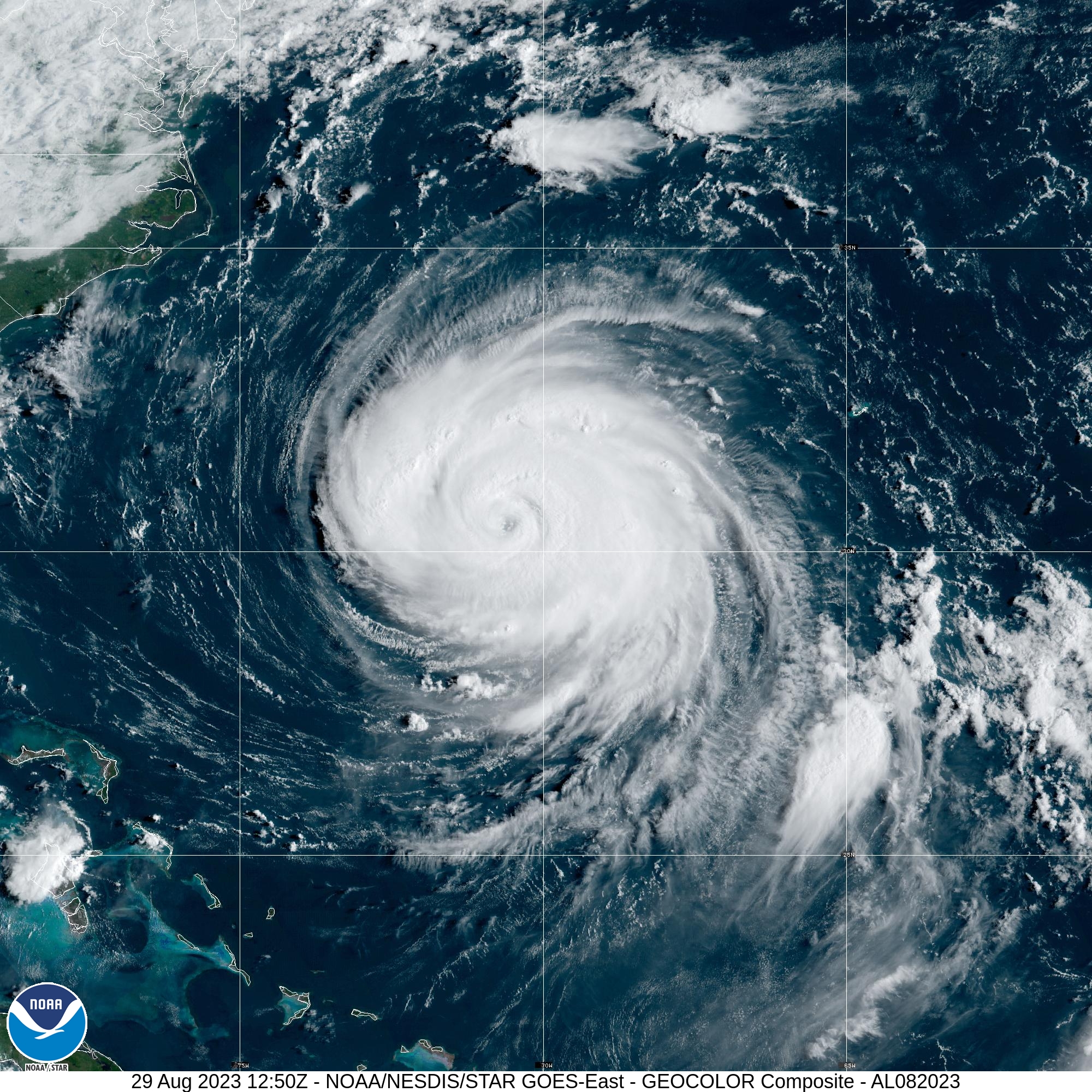
Meanwhile, Hurricane Franklin swirls off the southeast
U.S coast, and west of Bermuda.

After striking Florida, Idalia will cruise through Georgia and South Carolina as a tropical storm, then head out to sea off the southeastern North Carolina coast by Thursday. From there, its future is uncertain.

HURRICANE FRANKLIN

We have to mention Hurricane Franklin, which as of this morning was very roughly half way between Bermuda and the southeastern coast of the United States.

 It's a monster that I think peaked yesterday, thankfully without hitting land.  Its top winds reached to nearly 150 mph and in satellite imagery took on the look of a classic powerful hurricane.

Its center will miss land and Franklin will eventually die in the cold waters of the North Atlantic. But being such  powerful storm, it's causing and will cause dangerous rip currents from Miami, Florida all the way north along the U.S. and Canadian east coasts to Newfoundland. 


Monday, August 28, 2023

Hurricane Idalia Forecast For Florida Turns Grim

Satellite phot from Sunday shows Tropical Storm Idalia
organizing in the southern Gulf of Mexico and 
Hurricane Franklin northeast of the Bahamas.
 Tropical Storm Idalia continues to get its act together in the southeastern Gulf of Mexico, and now Florida is under a terrible threat from this strengthening storm. 

As of early this morning, Idalia had top winds of 65 mph. It was starting to take its expected path north and will probably brush the western tip of Cuba tonight. 

At first, Idalia should only slowly strengthen into a hurricane as upper level winds are still somewhat interfering with how it's organizing itself.

But starting tomorrow, it's turning into a potential worst-case scenario for several reasons. For one, the water in the Gulf of Mexico in the path of the storm is super warm and toasty to quite a depth.  If the warm water layer was just near the surface, the storm might churn up cooler water from below to blunt its development. 

But all that warm water means Idalia will have plenty of fuel to strengthen quite a lot, as long as upper level winds aren't too strong. 

Unfortunately, those upper level winds look like they'll give Idalia a break, and possibly allow it to get a lot stronger a lot faster. Right now, expected top winds are forecast to go to 115 mph at landfall, which is expected on Wednesday. Forecasts like this are uncertain, as the warm water could maybe make the storm even stronger than that. 

Yet another worry in a long list of problems with this storm is it will likely be strengthening right up until it hits land. So, wherever Idalia lands, people might be taken by surprise by the intensity of the winds and the storm surge. After all, they might hear the storm has winds of say, 110 mph offshore, and that's what they'll expect. Then something even worse hits. 

Speaking of landfall, here's another issue: We don't know exactly where it's going to hit. It will be moving pretty much parallel to the Florida west coast. Any deviation from Idalia's predicted path could bring it onshore anywhere from Sarasota north to Panama City.   

Right now, the current project is for Idalia to hit land in Florida's big bend, where the Florida coastline curves toward the panhandle.  

On one hand, that would be kind of good since that area is lightly populated.  But not that good. That's because Idalia's storm surge will be widespread, and so will its torrential rains. A wide area of northern Florida is under the gun because of that. 

And, as I already noted, that project path could well be wrong. Especially if it goes further to the east and slams in to the Tampa Bay region.

Even if Idalia behaves like forecasters think it might and it goes by to the west of Tampa, that metro area would still be in trouble. 

The way Tampa Bay is oriented, combined with the direction of the wind and water flow with Idalia, a storm surge would keep shoving water up into Tampa Bay, causing widespread flooding.  Many thousands of people live in houses only a few feet above normal sea level.

I'm seeing some comparisons to Category 5 Hurricane Michael in 2018, which also strengthened rapidly until it slammed ashore around Mexico Beach, Florida. I don't think, or at least hope, Idalia won't be as intense as Michael, but you never know. 

Oh, and here's another doozy that might make things worse, at least for some people.  Evacuations are inevitable, and probably have already started. It turns out, more than two dozen Florida Citgo gas stations received shipment of gasoline that were contaminated by diesel fuel.

If a motorist unwittingly filled their tank with that bad gas, they'll end up stranded one the side of the road. Just as Idalia is bearing down.  

Of course, there will be updates as Idalia gets closer to an eventual landfall Wednesday. Florida is in for another very rough ride. 

Sunday, August 27, 2023

Hurricane Worries In Florida, Meanwhile Franklin Shows Its Muscle

Satellite photo from this morning showing what
will become tropical storm and likely eventually
Hurricane Idalia organizing off the coast
of Cancun Mexico. 
Florida is beginning to brace for a potential new hurricane disaster. Meanwhile, another hurricane is flirting with Bermuda, but will otherwise sort of behave itself. Let's get into it:  

WANNABE IDALIA

It's not set in stone yet, but a storm that's now now far from Cancun, Mexico definitely has Florida nervous. 

That storm is soon to become Tropical Storm Idalia, that is if it isn't already a tropical storm by the time you read this.

Wannabe Idalia was just sort of meandering aimlessly early this morning, but is forecast to soon start heading north is expected to head north and probably hit western Florida or the state's panhandle sometimes around Wednesday.  

How strong Wannabe Idalia will be by the time it gets to Florida is anybody's guess.  Forecasts have generally been trending stronger over the past couple of days with this thing. 

One thing going for this storm is the Gulf of Mexico waters are at near record warmth, and that warmth extends deep into the water.  That's incredibly high octane fuel for tropical storms and hurricanes.  It provides the potential for the storm to strengthen explosively, which would make it a powerful, catastrophic hurricane by the time it reaches Florida.

But that won't necessarily happen. To become a monster category 5 hurricane like Michael in 2018 that leveled parts of the Florida Panhandle, you need relatively light winds aloft to avoid disrupting the storm's circulation. 

This, however is an El Nino year. It tends to make higher level winds stronger, which could interfere with Wannabe Idalia's strength. It all depends on how strong those upper winds are.  It's a trade off. The hot Gulf waters want to blow up the storm into a monster, the upper level winds want the storm to chill out. 

Forecasters aren't so sure which factor will be the more dominant of the two. 

In the latest advisory from the National Hurricane Center, they note predictions for upper level winds over Wannabe Idalia are weaker than in previous forecasts. That would favor more strengthening. But again, that's highly uncertain.

So, we know Florida is at risk, but we don't know precisely where in Florida that hit will strike, and we don't yet know how hard the strike will be. 

If you live in Florida, especially the panhandle and the west coast from Fort Myers north, I'd start making early hurricane preparations just in case. Although it will be hot and busy, today's a great day to make a Costco and Home Depot run for supplies, protections for your home, that sort of thing. 

Even if Wannabe Idalia ends up missing you, or becomes a nothing burger, at least you have all that stuff for the inevitable next hurricane, whenever that will be.

It doesn't look like Wannabe Idalia will affect us here in Vermont. I'll get into that in a separate post this morning on Vermont weather, which is currently weird but safe.

HURRICANE FRANKLIN

Meanwhile this morning, Hurricane Franklin was east of the Bahamas, with top winds of 90 mph. It's really getting its act together, and is now expected to rapidly strengthen as it heads north to a point west of Bermuda by Wednesday. Top winds near its center by then could be an impressive 130 mph by then. 

Franklin will probably cause some rough weather in Bermuda as it passes by, but so far, it looks like that island will miss out on the full effects of the storm. 

Most forecasts had a dip in the jet stream moving off the coast in the Northeast U.S. shoving Franklin away from the United States and then zip out into the North Atlantic where it would die. The only effects it would have on, say, New England would be rough surf and dangerous rip current. 

Some predictions now have that weather disturbance missing Franklin, but the U.S. will still not be in trouble. If that happens, Franklin will probably meander eastward in the middle of the Atlantic, and linger longer than first thought. But it would just be trouble for ships and all the fishies out there.